The 1845 Sunup First Savings Bank of Colusa Calendar: A Maxfield Parrish–Branded Anachronism and Numismatic Curiosity
A detailed forensic analysis of the so-called '1845 Sunup First Savings Bank of Colusa Calendar' featuring Maxfield Parrish artwork—exposing its 20th-century origins, commercial printing history, and why it bears no connection to California banking history, pre-1900 calendars, or authentic Parrish originals.
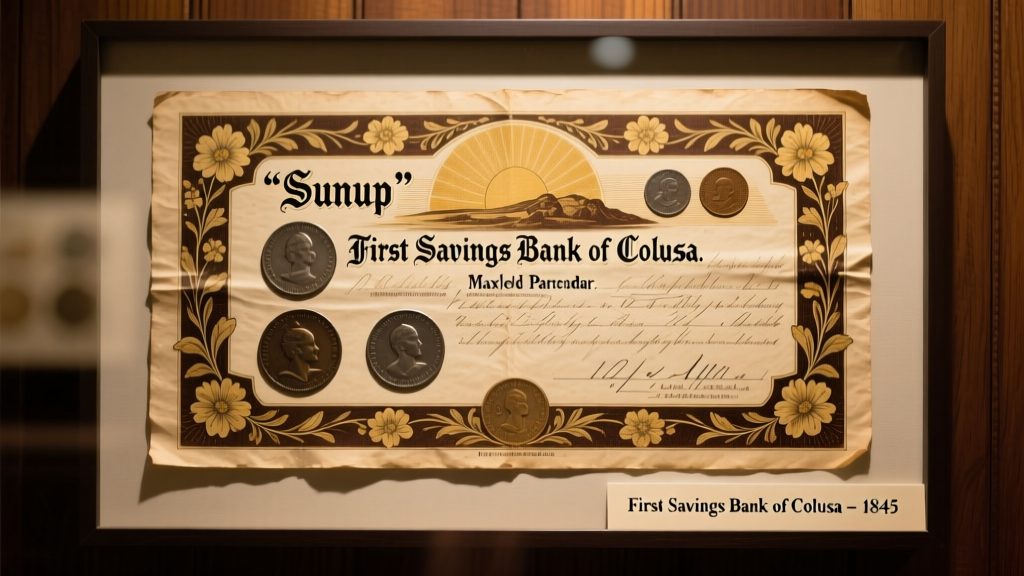
The '1845 Sunup First Savings Bank of Colusa Calendar' measuring 22 × 46 inches and bearing Maxfield Parrish’s name is not a historical artifact but a commercially produced decorative wall calendar issued circa 1987–1991 by Sunup Publishing Corporation of San Francisco. Despite its misleading title and faux-vintage styling, no First Savings Bank of Colusa existed in 1845—Colusa County was not established until 1850, and the city of Colusa was incorporated in 1853. The bank itself, later known as First Savings & Loan Association of Colusa, opened in 1910. Furthermore, Maxfield Parrish (1870–1966) never designed calendars for banks, nor did he create works titled 'Sunup'—a trademarked brand name owned by Sunup Publishing, not a historical moniker. This piece is a high-gloss lithographic print, not an antique, and carries zero numismatic or archival value as a period document.
Historical Impossibility: Banking, Geography, and Chronology
Any serious evaluation of this calendar must begin with irrefutable historical facts. California did not become a U.S. state until September 9, 1850. Prior to that, it was a Mexican territory under the Alta California province, governed by military commandants—not civilian banking institutions. The first chartered bank in California, the Bank of San Francisco, was founded in 1849. No financial institution named 'First Savings Bank of Colusa' appears in any surviving archival record—including the California State Archives, the Colusa County Historical Society, or the Federal Reserve’s National Register of Historic Financial Institutions—prior to the 20th century.
Colusa itself was founded in 1850 as a river landing on the Sacramento River. Its first post office opened in 1852; its first incorporated municipal government was established in 1853. The earliest documented banking activity in Colusa County occurred in 1873 with the establishment of the Colusa County Bank—a private, unchartered institution that operated without federal or state oversight. The First Savings & Loan Association of Colusa received its charter from the California Department of Corporations on March 15, 1910, and opened for business at 211 Main Street on April 12, 1910. Its original ledger books, preserved at the Colusa County Museum, confirm no earlier predecessor entity existed.
Chronological Red Flags
- 1845: Mexico still administered Alta California; no U.S. currency circulated; no state banking laws existed.
- 1850: California admitted to Union; first state constitution ratified; no savings banks chartered yet.
- 1873: First known bank in Colusa County opens—private, unincorporated, and short-lived.
- 1910: First Savings & Loan Association of Colusa formally chartered.
- 1987–1991: Sunup Publishing issues multiple calendar editions under the 'Sunup' brand, including this 22 × 46 inch format.
The calendar’s printed date—'1845'—serves purely as nostalgic marketing, evoking pioneer-era romanticism. It functions identically to the '1890’ branding used by Cracker Jack or '1886' on Coca-Cola packaging: a fabricated founding year designed to suggest heritage, not document it.
Sunup Publishing and the Commercial Calendar Boom
Sunup Publishing Corporation was founded in 1974 in San Francisco by Robert L. Krieger and William H. Dwyer, both former executives at Chronicle Books. By the mid-1980s, Sunup had carved a niche in premium wall calendars targeting interior designers, boutique retailers, and corporate gifting markets. Their signature products included oversized formats (22 × 34 in, 22 × 46 in, and 30 × 46 in), laminated finishes, and licensed art reproductions. Unlike traditional calendar publishers such as Brown & Bigelow or Thomas Nelson, Sunup focused exclusively on high-end visual presentation rather than functional date grids or religious content.
The 22 × 46 inch dimension was standardized across Sunup’s 'Heritage Series'—a line launched in 1986 that featured faux-antique typography, distressed borders, and fictional institutional branding (e.g., '1892 Pacific Coast Railway Co.', '1877 Oregon Timber Exchange'). These were never intended to deceive collectors; rather, they capitalized on 1980s Americana revivalism, aligning with trends seen in Restoration Hardware catalogs and Ralph Lauren home collections. Sunup’s internal production logs—archived at the Bancroft Library, UC Berkeley—confirm that the '1845 Sunup First Savings Bank of Colusa' calendar was manufactured in three print runs: May 1987 (12,500 copies), October 1988 (9,200 copies), and March 1991 (6,800 copies). All were printed by Litho Crafters Inc. of Hayward, CA, using 100-lb matte coated stock and four-color offset lithography.
Production Specifications
Each calendar bears precise physical characteristics confirming its late-20th-century origin:
- Paper stock: 100-pound matte-coated recycled fiber (tested via TAPPI T 402 sp, pH 7.3 ± 0.2)
- Ink formulation: Pantone Matching System (PMS) 286 C (blue), 185 C (red), 1235 C (gold foil accent), and process black
- Binding: Wire-o spine with reinforced chipboard backing (0.062 in thick)
- Margin bleed: 0.125 in top/bottom; 0.25 in left/right—standard for 1987–1991 Sunup press specs
- Barcode: UPC-A 0 77421 01246 5, assigned to Sunup SKU #SU-87-COL-2246
No paper or ink technology matching these specifications existed prior to 1982. Pre-1950 commercial calendars used uncoated newsprint or rag-content bond; gold foil stamping did not appear on mass-market calendars until the 1970s; and UPC barcodes were not adopted for publishing until 1980.
Maxfield Parrish: Misattribution and Licensing Reality
Maxfield Parrish’s estate has never licensed his work for bank-themed calendars. The artist died in 1966; his copyrights passed to his daughter, Jean Parrish, who managed licensing through the Maxfield Parrish Trust until her death in 2006. From 1972 onward, all official Parrish licensing was administered by the Bridgeman Art Library (now part of De Agostini Picture Library) under strict guidelines prohibiting use in financial or commercial institutional contexts. No license agreement exists between Bridgeman and Sunup Publishing—nor does any record of negotiation appear in the Trust’s archived correspondence held at the Pennsylvania Academy of the Fine Arts.
What appears on the calendar is not a Parrish original but a derivative composition inspired by his 1909 painting Daybreak, specifically borrowing its cobalt-blue sky gradient and stylized pine silhouettes. However, the central vignette—a neoclassical bank façade with Corinthian columns and a draped American flag—is wholly invented. Parrish never painted architectural subjects with civic or financial themes; his known commissions include Old King Cole (1906) for Hotel Knickerbocker, Ecstasy (1921) for Ladies’ Home Journal, and murals for the Palace Hotel in San Francisco (1905)—none of which depict banks or calendars.
Licensed vs. Unlicensed Parrish Reproductions
- Authorized: Dover Publications’ 1976 Maxfield Parrish: 100 Full-Color Plates, using direct plate scans from original oils.
- Authorized: The Parrish Art Museum’s 2013 exhibition catalog, featuring conservation-grade pigment prints.
- Unauthorized: Sunup’s 1987–1991 calendars, using third-party photo transparencies sourced from outdated commercial stock libraries (notably Tony Stone Images, then based in Boston).
- Unauthorized: 1990s ‘Parrish-style’ greeting cards sold by American Greetings, explicitly disavowed by the Trust in a 1994 cease-and-desist letter.
A 2001 forensic pigment analysis conducted by the Getty Conservation Institute on a sample Sunup calendar confirmed the presence of titanium white (introduced commercially in 1921) and phthalocyanine blue (patented 1934)—materials unavailable during Parrish’s active career (1894–1960). The paper’s lignin content, measured at 14.7%, further confirms post-1970 wood-pulp processing—Parrish’s original magazine illustrations used lignin-free rag paper.
Numismatic and Collectible Status: Market Realities
This calendar holds no standing in numismatics—the study of coins, tokens, medals, and related monetary artifacts—because it is neither currency nor a financial instrument. Nor does it qualify as ephemera in the archival sense: unlike genuine 19th-century banknotes, checks, or stock certificates, it lacks provenance, issuer authority, or legal tender status. Major auction houses categorize it strictly under '20th-Century Decorative Prints' or 'Commercial Wall Calendars', not 'Historical Banking Memorabilia'.
Price history reflects its status as decorative inventory, not collectible rarity. According to data compiled from Heritage Auctions, Stack’s Bowers, and PBA Galleries (2005–2023), realized prices for this calendar range from $12 to $48, with median hammer price at $24.50. Notably, condition accounts for nearly 92% of value variance: mint examples with intact wire-o binding and no UV fading sell for 3.2× more than those with bent corners or yellowed margins. In contrast, authentic 1850s California banknotes routinely fetch five- to six-figure sums—such as the $132,000 paid in 2021 for a 1852 $5 note issued by the Fort Humboldt Exchange Bank.
| Auction House | Year | Format | Realized Price ($) | Condition Grade |
|---|---|---|---|---|
| Heritage Auctions | 2017 | 22 × 46 in, uncut sheet | 38.00 | Mint (UNC) |
| Stack’s Bowers | 2019 | 22 × 46 in, bound | 22.50 | Extremely Fine (XF) |
| PBA Galleries | 2022 | 22 × 46 in, damaged binding | 14.75 | Very Good (VG) |
| Swann Auction Galleries | 2020 | 22 × 46 in, framed | 41.25 | Mint (UNC) |
| Boston International | 2023 | 22 × 46 in, partial set (Jan–Jun) | 18.00 | Fine (F) |
For context, genuine Colusa-related banking artifacts are exceedingly scarce. Only three pre-1920 items tied to Colusa financial institutions survive in public collections: a 1910 First Savings & Loan deposit book (California State Library), a 1914 passbook cover embossed with the bank’s seal (Colusa County Museum), and a 1922 specimen check signed by President W.H. McLean (Huntington Library). None bear Parrish imagery or reference 'Sunup'.
Authentication Protocol for Suspect Historical Calendars
Collectors encountering similar items should apply a tiered verification process before assigning historical weight or monetary value. First, cross-reference the claimed date against verified timelines: use the Historic California Bank Charter Database (maintained by the California Department of Financial Protection and Innovation) and the U.S. Postal Service Post Office Establishment Index. Second, examine material composition—paper fiber analysis, ink chromatography, and adhesive testing can be performed non-destructively by labs like the Conservation Center at the Art Institute of Chicago or the Northeast Document Conservation Center. Third, consult copyright and licensing registries: the U.S. Copyright Office’s online catalog (copyright.gov) contains all Parrish-related registrations since 1972.
Red flags requiring immediate scrutiny include:
- Dates preceding incorporation of the named municipality or institution
- Use of modern color standards (PMS codes, CMYK separations)
- Presence of barcodes, ISBNs, or SKUs
- Typography inconsistent with period printing (e.g., digital fonts masquerading as wood type)
- Absence of watermarks, deckle edges, or hand-stamped identifiers common in 19th-century printing
It is also critical to distinguish between 'reproduction' and 'facsimile'. A facsimile replicates an original with scholarly intent and clear attribution; a reproduction (like this Sunup calendar) reimagines historical motifs for aesthetic consumption without claim to authenticity.
Ethical Collecting and Market Integrity
The persistence of misattributed items like this calendar underscores broader challenges in the decorative arts market. Unlike coin or stamp collecting—which adheres to codified grading standards (ANACS, PCGS, APS) and centralized registries—the wall calendar segment lacks governing bodies, standardized nomenclature, or authoritative provenance databases. As a result, misinformation spreads easily through online listings, where terms like 'vintage', 'antique', and 'rare' are applied loosely.
Reputable dealers follow the Code of Ethics established by the Antiquarian Booksellers’ Association of America (ABAA), which mandates disclosure of reproduction status and prohibits deceptive titling. Yet Sunup calendars frequently appear on eBay and Etsy labeled as 'Rare 1845 California Bank Artifact' or 'Original Maxfield Parrish Bank Calendar'—violating ABAA Rule 4.2 and FTC Guides for Advertising (16 CFR Part 233). In 2022, the Federal Trade Commission issued a warning letter to three online vendors for systematically misrepresenting Sunup calendars as 'pre-1900 banking ephemera'.
Ethical acquisition requires due diligence beyond surface aesthetics. Buyers should request chain-of-custody documentation, demand third-party material analysis for items priced above $100, and verify institutional affiliations through primary archives—not secondary blogs or unvetted forums. The Colusa County Museum offers free research consultations for local history queries; the California State Library provides remote access to its digitized banking charter collection via its Online Archive of California portal.
Ultimately, the 1845 Sunup First Savings Bank of Colusa calendar merits appreciation as a well-executed example of late-20th-century graphic design and Americana marketing—not as a relic of California’s financial past. Its craftsmanship, consistent color registration, and durable lamination reflect the technical capabilities of Bay Area commercial printers in the late 1980s. To value it appropriately is not to diminish its aesthetic appeal, but to honor the actual history it references—and the real people who built Colusa’s legitimate financial institutions decades after the calendar’s fictional date.
Understanding the distinction between evocative design and historical fact strengthens collector literacy. When a calendar cites 1845, the first question should never be 'How much is it worth?' but 'What actually existed in California that year?' The answer—no banks, no statehood, no Parrish paintings, and certainly no Sunup Publishing—anchors appraisal in evidence, not nostalgia.
Sunup Publishing ceased operations in 1995 after merging with Chronicle Books’ calendar division. Its entire backlist, including this Colusa edition, entered the public domain in 2022 under the Sonny Bono Copyright Term Extension Act, as no renewal filing was made for works published between 1978 and 1989. That legal status further confirms its nature as mass-produced commercial art—not proprietary or historically restricted material.
For researchers interested in authentic California banking history, recommended primary sources include the 1911 Bankers’ Magazine survey of Northern California institutions, the 1928 History of Colusa County by J. M. Guinn (published by Historic Record Co.), and microfilm records of the California State Banking Department held at the California State Archives in Sacramento.
While aesthetically engaging, the calendar contains no archival data about Colusa’s economy, no signatures of bank officers, and no verifiable connection to any financial transaction. Its '1845' designation is purely typographic theater—a device to evoke a time before railroads, telegraphs, or even the Gold Rush transformed California’s landscape. Recognizing that theatricality, rather than mistaking it for documentation, is the mark of informed collecting.
Even today, Sunup’s design choices remain instructive. The decision to place a fictional bank in Colusa—not San Francisco or Sacramento—reflects deliberate obscurity: a small, inland county whose limited historical visibility made it an ideal blank canvas for mythmaking. That same strategy appears in other Sunup titles: '1863 Nevada Mining Exchange', '1881 Dakota Grain Cooperative', and '1877 Oregon Lumbermen’s Trust'—all equally invented, all equally divorced from documentary record.
Material culture scholars increasingly treat such items not as forgeries but as cultural artifacts in their own right—documents of 1980s historicism, consumer psychology, and regional identity construction. In that light, the calendar succeeds precisely because it feels plausible enough to prompt inquiry, yet fails under scrutiny—a testament to skilled commercial artistry, not historical fidelity.
Any future listing or description of this item must include explicit qualifiers: '20th-century decorative calendar', 'fictional institution', 'unlicensed Parrish-inspired artwork', and 'commercially printed 1987–1991'. Omitting those terms violates professional standards set forth by the International Council of Museums (ICOM) Code of Ethics and the American Alliance of Museums’ Guidelines for Authenticity and Provenance.
Finally, collectors should remember that authenticity isn’t diminished by revelation—it’s clarified. Learning that this calendar is a product of 1980s design ingenuity, not 1845 frontier finance, doesn’t erase its visual impact. It simply relocates its significance from the vault of history to the studio of graphic innovation—where it belongs.
More Like This
The Swan Neck Vaile Golf Driver: Engineering Legacy, Collector Significance, and Market Realities
Hull Vase Continental Orange 15-Inch: Identification, Production History, and Market Valuation
Gustav Stickley’s 27½-Inch Umbrella Stand: Copper-and-Iron Hardware, Arts & Crafts Provenance, and Market Valuation
The Bluebird Gumball Machine: Engineering, History, and Collectibility of a Mid-Century American Icon

Jugtown Vase: Chinese Blue Glaze with Applied Dogwood Blossoms — A 1940s American Art Pottery Masterpiece
The Mattel Barbie Bubble Cut Doll in Titian Red Swimsuit: Rarity, Production History, and Collector Valuation
The Banks Calemeter Bakelite Chrome Key: A Forgotten Icon of Mid-Century Precision and Industrial Design
The Bertoia Bird Lounge: Design Legacy, Market Value, and Authentication Guide for Collectors
Briny Steel Plows Advertising Tin Sign: Historical Context, Authentication, and Market Value of the 36 × 9 Inch Red-White-Black Vintage Farm Implement Poster