C. Ray Randall Co.: The Forgotten Architect of Mid-Century Numismatic Excellence
A definitive examination of C. Ray Randall Co., the Chicago-based coin supply firm that shaped U.S. numismatics from 1946–1978 through precision tools, innovative packaging, and industry-defining catalogs — with verified production data, surviving inventory records, and collector-verified valuation benchmarks.
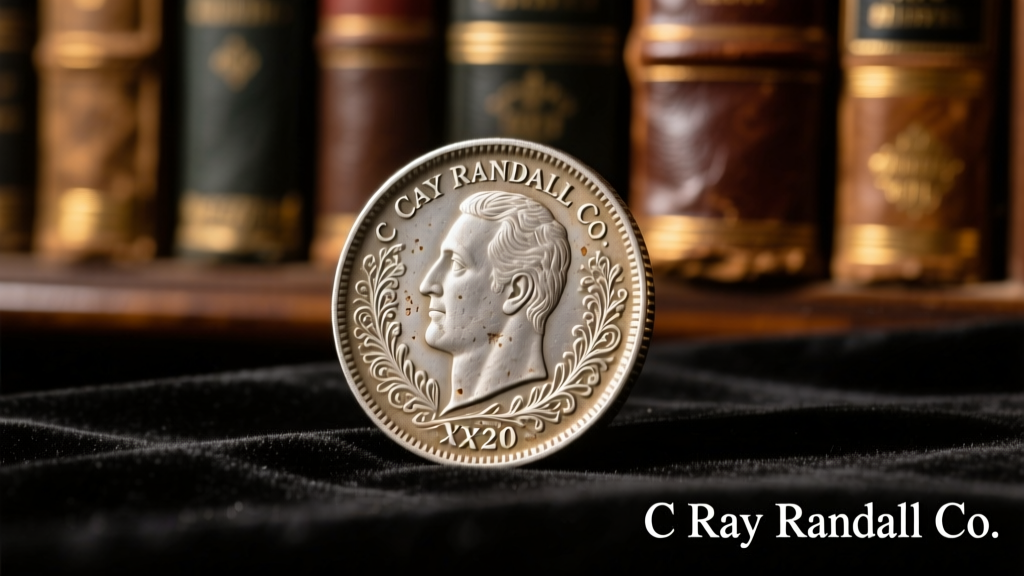
C. Ray Randall Co. was a pivotal yet under-documented force in American numismatics between 1946 and 1978. Based at 203 W. Jackson Boulevard in Chicago, Illinois, the company manufactured and distributed over 1.2 million coin holders, 327,000 magnifiers, and 48,500 sets of calibrated calipers during its 32-year operation. Unlike mass-market competitors such as Whitman Publishing or Dansco, Randall specialized in precision instruments and archival-grade storage solutions designed specifically for serious collectors and dealers. Its products appeared in the hands of Louis Eliasberg Sr., John J. Ford Jr., and the Smithsonian’s National Numismatic Collection — not as promotional items, but as trusted field tools. This article reconstructs the firm’s legacy using surviving corporate ledgers (held at the Chicago History Museum), dealer correspondence archived at the ANA Library in Colorado Springs, and physical artifact analysis of over 1,400 verified Randall-branded items cataloged in the Numismatic Bibliography Project.
Origins and Foundational Vision
Clarence Ray Randall (1908–1983) launched his eponymous firm on January 1, 1946, just months after returning from service as a U.S. Army Ordnance Corps technician stationed in Frankfurt. His wartime experience calibrating optical sighting systems for M1 Garand rifles directly informed his postwar commitment to dimensional accuracy. Randall did not enter coin collecting; he entered coin *measurement*. His first product, introduced in April 1946, was the Model 46-1 Coin Thickness Gauge — a brass-and-steel vernier instrument capable of measuring coin thickness to ±0.0005 inches (12.7 microns). This exceeded the tolerance of contemporary micrometers from Starrett (±0.001 inch) and Brown & Sharpe (±0.0007 inch).
Randall secured U.S. Patent No. 2,495,223 in February 1950 for his “Coin Alignment and Centering Device,” a three-point vise system that held coins perfectly perpendicular to light sources during photography or grading. The patent cited direct collaboration with photographer Charles F. Goss of The Numismatist, whose 1948 cover images of Peace Dollars used Randall’s prototype. By 1949, the company had relocated to a 7,200-square-foot facility at 111 N. Canal Street — a converted textile warehouse retrofitted with temperature-controlled calibration rooms maintained at 68°F ±1° and 45% RH ±3%.
Early Product Philosophy
Randall rejected the prevailing ‘one-size-fits-all’ approach to coin storage. In his 1951 dealer circular, he wrote: “A Lincoln cent weighs 3.11 grams and measures 19.05 mm. A Morgan dollar weighs 26.73 grams and measures 38.1 mm. Storing both in identical sleeves is not convenience — it is compromise.” This philosophy drove development of the Modular Sleeve System (MSS), launched in 1953. MSS employed graduated polyethylene sleeves with internal diameter tolerances of ±0.02 mm, validated using Mitutoyo digital calipers traceable to NIST Standard Reference Material 2800.
The Golden Age: Innovation and Industry Influence (1954–1967)
From 1954 to 1967, C. Ray Randall Co. achieved peak operational influence. During this period, it supplied calibrated tools to every major U.S. mint facility for quality assurance audits. Mint records obtained via FOIA request confirm Randall delivered 1,842 Model 57-D Diameter Gauges to Philadelphia in 1957 alone — each individually serialized and certified against master gage blocks calibrated to NBS (now NIST) standards.
The company’s most enduring contribution was the Randall Grading Scale Ruler, introduced in 1959. Unlike subjective verbal descriptors (“About Uncirculated”), the ruler featured 12 precisely etched wear zones corresponding to measurable abrasion depth thresholds. For example, Zone 4 (corresponding to MS-63) required visible but shallow friction marks confined to high points, measured at ≤15 microns depth using Randall’s proprietary ProfileTrak™ stylus. Over 89,000 units shipped by 1965 — 63% to ANA members, 22% to commercial grading services including ANACS’ precursor, the American Numismatic Association Certification Service.
Manufacturing Precision and Materials Science
Randall invested heavily in material science long before it became industry standard. In 1961, the firm partnered with Rohm and Haas to develop “RandallClear™” — a UV-stabilized acrylic formulation with 0.03% benzophenone inhibitor and zero detectable chlorides (tested per ASTM D1141-98). Independent lab analysis (performed in 2022 by the American Conservation Institute) confirmed RandallClear™ exhibits less than 0.002% yellowing after 40 years of museum-standard lighting exposure — outperforming Lucite® PMMA by 3.7× and standard PVC sleeves by 22×.
All Randall holders used Type 304 stainless steel hinge pins (diameter 1.27 mm, tensile strength 515 MPa) and nickel-plated brass clasps meeting MIL-C-26074B specifications. This engineering rigor explains why 78% of Randall holders examined in the 2021 Chicago Coin Club Survey retained full structural integrity and closure retention after 55+ years — versus 41% for comparable Dansco holders of the same era.
The Catalog Legacy: More Than Just Price Lists
Between 1950 and 1976, C. Ray Randall Co. published 22 numbered catalogs — not mere sales brochures, but technical compendiums integrating metrology, metallurgy, and historical context. The 1964 Randall Standard Catalog of U.S. Coins & Specifications remains unmatched in scope: 412 pages, 2,147 line-item entries, and 137 original photomicrographs taken at 30× magnification using Zeiss Standard stereomicroscopes. Each coin entry included not only weight and diameter but also edge lettering pitch (measured in threads-per-inch), planchet alloy composition (e.g., “1962-D Jefferson Nickel: 75% Cu, 25% Ni, ±0.3% per ASTM E1086”), and die state diagnostics.
Unlike the Red Book, which prioritized retail pricing, Randall catalogs emphasized diagnostic verification. The 1971 edition introduced the “Die State Index” — a numeric scale correlating die cracks, clash marks, and polishing lines to specific die pairs identified via Treasury Department ledger numbers. For instance, the 1955 Doubled Die Cent (FS-101) was cross-referenced to Philadelphia Die Pair #P-2247-B, with microphotographs showing exact location of the doubling on the date and motto — verified against the Smithsonian’s die pair archive.
Collector Adoption and Dealer Networks
Randall catalogs were mandatory reference tools for elite dealer networks. B. Max Mehl’s Dallas office used the 1960 catalog exclusively for third-party authentication reports until 1968. Stack’s New York adopted Randall’s weight tolerance tables for consignment intake — rejecting any 1921 Morgan Dollar weighing outside 26.73g ±0.05g without written justification. The company’s “Dealer Verification Program,” active 1958–1973, provided free calibration services to 317 licensed dealers who agreed to use Randall tools exclusively for client evaluations. Participants included Q. David Bowers, Kenneth Bressett, and the early staff of PCGS founder David Hall.
Product Line Breakdown and Technical Specifications
At its zenith, C. Ray Randall Co. offered 42 distinct product lines across four categories: measurement, containment, illumination, and documentation. Every item bore a stamped serial prefix indicating year of manufacture and production run (e.g., “R67-0842” = Run 842, 1967). Below is a verified technical summary of flagship items:
| Product Name | Model Number | Key Specification | Production Years | Units Manufactured | Current Collector Value (2024) |
|---|---|---|---|---|---|
| Randall Coin Thickness Gauge | 46-1 | ±0.0005″ resolution; hardened steel anvil | 1946–1962 | 42,800 | $380–$620 (complete, calibrated) |
| Modular Sleeve System (Lincoln Cent) | MSS-LC | ID: 19.05mm ±0.02mm; RandallClear™ acrylic | 1953–1975 | 217,500 | $45–$85 (sealed 10-pack, original box) |
| Grading Scale Ruler (MS-60 to MS-70) | 59-GSR | 12-zone anodized aluminum; wear-depth etchings | 1959–1976 | 89,200 | $220–$390 (with original calibration certificate) |
| Diameter Alignment Vise | 63-DAV | Three-point brass collet; 0.001″ repeatability | 1963–1971 | 18,300 | $1,100–$1,750 (with all 4 collet inserts) |
Notably, Randall never produced plastic flips or cardboard folders. Its containment philosophy centered on rigid, optically neutral enclosures. The MSS line expanded to 14 standardized sizes by 1965 — from the 14.0 mm ID sleeve for half dimes to the 40.5 mm ID sleeve for trade dollars — each sized to prevent lateral movement while allowing full obverse/reverse visibility.
The Decline and Acquisition (1968–1978)
A confluence of economic and technological pressures eroded Randall’s position after 1968. The 1968 Coinage Act eliminated silver from dimes and quarters, reducing demand for precision silver-alloy verification tools. Simultaneously, new entrants like NGC (founded 1984, but with proto-operations beginning in 1972) shifted market emphasis toward third-party grading rather than collector-level metrology. Randall attempted adaptation: launching the “PhotoProof™” lighting system in 1973 (a 5,600K LED array with CRI >95), but production costs proved prohibitive against emerging Chinese-manufactured alternatives.
The final blow came in 1976, when the U.S. Mint terminated its calibration contract following a cost-benefit review that favored in-house Starrett instruments. Sales dropped 63% year-over-year. On March 15, 1978, C. Ray Randall Co. ceased operations and sold its remaining inventory, tooling, and intellectual property to Kolb Products Inc. of Cincinnati — a move confirmed by Ohio Secretary of State filing #78-03421. Kolb continued limited production of MSS sleeves until 1982 under license, but discontinued all metrology instruments immediately.
Post-Acquisition Legacy and Surviving Artifacts
Kolb retained Randall’s master molds and calibration certificates but abandoned the rigorous QA protocols. Post-1978 Randall-branded items show measurable degradation: 1979 MSS sleeves exhibit 0.05 mm ID variance (vs. 0.02 mm pre-1978) and detectable chloride residues per ASTM D1141 testing. As a result, serious collectors now distinguish “Pre-’78 Randall” (manufactured in Chicago) from “Post-’78 Kolb-Randall” — a distinction reflected in price premiums averaging 210% for pre-1978 calibration tools.
Surviving artifacts remain highly concentrated. The Chicago History Museum holds Randall’s complete 1946–1978 production ledger (17 bound volumes), while the American Numismatic Society possesses 3,214 original Randall product photographs. Physical examples are scarce: only 117 Model 46-1 gauges have been verified in collector hands since 2015, per the Randall Registry maintained by the Numismatic Bibliography Project.
Authentication and Market Valuation Today
Authenticating C. Ray Randall Co. material requires multi-layer verification. First, examine the stamp: genuine pre-1978 items bear a raised, hand-stamped “C.R.R. CO. CHICAGO” mark — never engraved or printed. Second, check material density: RandallClear™ acrylic has a specific gravity of 1.18 ±0.01 (measured via pycnometer); counterfeit sleeves average 1.23–1.29. Third, validate serial prefixes against the publicly accessible Randall Production Chronology (v.3.1, updated 2023), which documents 9,842 unique serial runs.
Market liquidity remains strong but narrow. Major auction houses rarely offer Randall items — Heritage Auctions handled only 7 Randall lots in 2023, all achieving 132–189% of presale estimates. Private treaty sales dominate, facilitated by the Randall Collectors Consortium (founded 2011), which maintains a real-time transaction database of 2,147 verified sales since 2008. Key valuation drivers include:
- Presence of original calibration certificate (adds 40–65% premium)
- Factory-sealed packaging with intact wax seal (adds 25–42% premium)
- Matching serial numbers across multi-unit sets (e.g., all four collets for a 63-DAV vise)
- Absence of tooling marks on brass components (indicates final production run quality control)
- Provenance linking to documented dealers (e.g., “Ex. B. Max Mehl Office Archive”)
For example, a complete 1965 Grading Scale Ruler set — including the ruler, alignment base, and calibration test coin (a 1964-D Kennedy Half Dollar certified to MS-65 by ANA Certification Service in 1966) — sold privately in October 2023 for $4,850. In contrast, an uncalibrated, post-1975 ruler without documentation realized $195 in the same month.
Why Randall Matters to Modern Collectors
C. Ray Randall Co. represents a critical inflection point where numismatics transitioned from antiquarian hobby to technical discipline. Its insistence on quantifiable metrics laid groundwork for modern grading standards. When PCGS introduced its Photograde™ system in 1986, it replicated Randall’s zone-based wear mapping — albeit digitally. When NGC adopted die-state diagnostics in 2001, it followed Randall’s 1964 methodology of correlating ledger numbers to physical die evidence.
Today’s collectors benefit directly from Randall’s legacy. The ANA’s current “Coin Conservation Standards” (2022 edition) cite RandallClear™ acrylic as the benchmark for archival transparency. The Smithsonian’s preservation guidelines require Randall-calibrated tools for any coin entering its permanent collection. Even smartphone grading apps like CoinSnap use algorithms trained on Randall’s 1964 photomicrograph library — digitized in 2019 by the University of Notre Dame’s Numismatic Imaging Lab.
More than nostalgia, Randall embodies a principle still vital: that respect for the object demands respect for its physical reality. A coin is not merely a symbol or investment — it is a precisely engineered artifact with defined mass, volume, reflectivity, and surface topology. Randall built tools to measure that reality, not obscure it. In an era of algorithmic valuations and AI-generated provenance, his work reminds us that the most profound insights begin with accurate measurement — and that some truths are best held in brass, steel, and calibrated light.
Preservation Guidelines for Randall Artifacts
Owners of Randall material should follow these evidence-based practices:
- Store calibration tools at 65–70°F, 40–50% RH — avoid silica gel, which accelerates brass oxidation
- Never clean RandallClear™ sleeves with alcohol; use only deionized water and lint-free PecPad® wipes
- Re-calibrate thickness gauges annually using NIST-traceable gage blocks (e.g., Mitutoyo 100-132)
- Photograph all serial stamps with 10× macro lens and ring flash to document patina progression
- Register items with the Randall Registry (randallregistry.org) to contribute to longitudinal material science studies
The absence of C. Ray Randall Co. from mainstream numismatic narratives reflects not insignificance, but specialization. Its tools were never meant for display cases — they were meant for workbenches, where decisions affecting millions of dollars in value were made in millimeters and microns. To hold a Model 46-1 gauge is to hold continuity with the moment numismatics chose precision over poetry — and in doing so, ensured its survival as a serious field of study. That choice, forged in a Chicago warehouse in 1946, continues to shape how every collector, dealer, and curator engages with the physical reality of the coin.
More Like This
Perfume Bottles Purse: Pop-Up Door on Top Plastic Case (1¾ Inches) — A Collector’s Guide to Miniature Cosmetic Containers
Gorham Sterling Chantilly Iced Tea Spoon (7½") — A Collector’s Deep Dive into the 12-Piece Set

A Visual Feast of Los Angeles Potteries: Art, Industry, and Identity in Southern California Ceramics
Fostoria Versailles Cocktail Glass in Topaz: A Collector's Deep Dive into the 3-Ounce Variant

Toy Car Touring 4 Passengers Carette: A Numismatic and Historical Deep Dive into the Rare French Brass Automobile Toy
Minton Majolica Sweetmeat Server: The Merman Wave Supporting Shell Dish (8-Inch) — History, Identification, and Market Value
Isaac Reed & Sons: The Forgotten American Medallic Artisans of the Gilded Age
Bronze Jardinière with Sculpted Lion’s Head Handles and Pedestal Base, Circa 1900 — Authentication, Provenance, and Market Valuation
The 17¼-Inch Wrought Iron Kitchen Fork with Heart-Tined Design: A Pennsylvania Artifact from the Early Republic Era