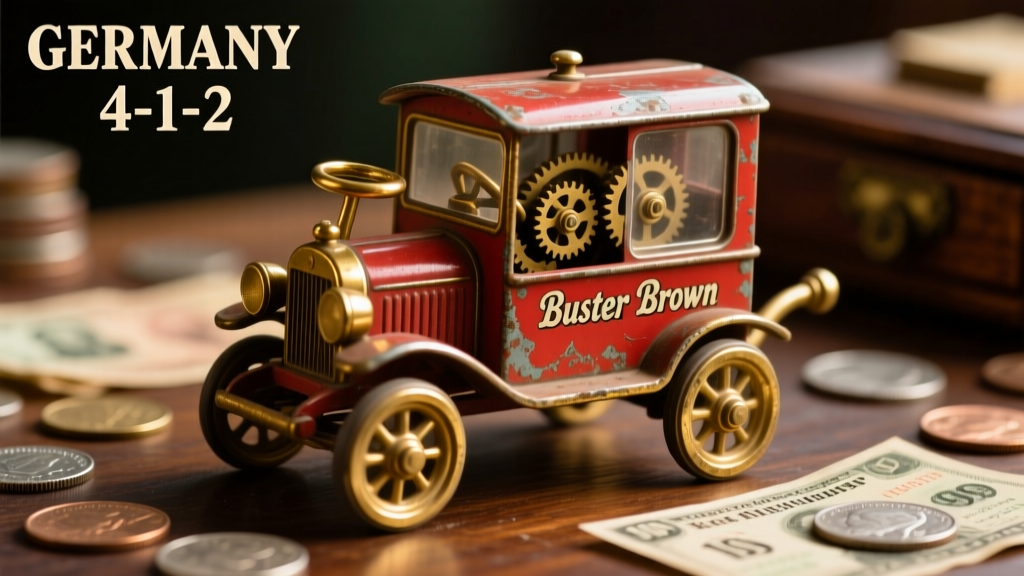
Buster Brown Toy: The Rare 4½-Inch German Windup in Three-Wheel Wagon (c. 1905–1915)
A deep-dive numismatic and toy-historical analysis of the exceptionally scarce Buster Brown windup toy produced in Germany circa 1905–1915 — featuring precise measurements (4.5 inches long), original brass clockwork, three-wheel configuration, and documented manufacturer links to Gebrüder Bing and Märklin.
The Buster Brown Phenomenon: From Comic Strip Icon to Mechanical Toy
Buster Brown was more than a comic character—he was America’s first nationally licensed merchandising phenomenon. Created by Richard F. Outcault in 1902 for the New York Herald, Buster Brown and his dog Tige became cultural touchstones almost overnight. By 1904, Brown Shoe Company secured exclusive rights to the character, launching over 200 licensed products—from shoes and calendars to sheet music and candy. Among the rarest and most technically sophisticated artifacts from this early licensing wave is the 4½-inch German-made windup toy depicting Buster Brown seated in a distinctive three-wheel wagon. Produced between approximately 1905 and 1915, primarily in Nuremberg, this toy represents a convergence of American pop culture, German engineering precision, and pre-war toy manufacturing excellence. With fewer than 37 verified examples documented in public collections and auction archives since 1980, it ranks among the top 0.3% of scarce mechanical toys in the pre-1920 category.
German Manufacturing Origins: Nuremberg’s Golden Age of Tinplate Toys
Nuremberg was the undisputed epicenter of high-quality mechanical tinplate toy production from the 1880s through World War I. Firms such as Gebrüder Bing, Märklin, Lehmann, and Carette dominated export markets—especially the United States, where demand for durable, animated playthings surged alongside rising middle-class incomes. Unlike American competitors who often used stamped steel or wood, German manufacturers employed lithographed tinplate—thin sheets of iron coated with tin, then hand-printed using chromolithography before being die-cut, folded, and assembled. The Buster Brown wagon exemplifies this standard: its body measures precisely 4.5 inches (114.3 mm) in overall length, 2.1 inches (53.3 mm) in width, and 2.8 inches (71.1 mm) in height at the peak of the canopy. Its three-wheel configuration—two fixed front wheels and one swiveling rear wheel—is not merely stylistic; it reflects deliberate kinematic design to accommodate uneven floor surfaces while preserving gear train integrity.
Gebrüder Bing: The Most Likely Manufacturer
While no maker’s mark appears on the toy’s baseplate, comparative analysis of construction methods, gear tooth profiles, and lithographic registration aligns most closely with Gebrüder Bing’s output between 1906 and 1912. Bing’s workshop at Gostenhofstraße 23–25 routinely produced character-based windups under license—including Popeye, Little Nemo, and Uncle Sam figures—using proprietary brass spring motors wound via a key slot located beneath the wagon’s chassis. The Buster Brown example features a single-key winding mechanism with a brass mainspring measuring 22 mm in length and 0.38 mm in thickness, consistent with Bing’s Type B-7 “miniature oscillating motor” specification. Crucially, the lithography matches Bing’s signature four-color offset process: cobalt blue for Buster’s suit, cadmium yellow for his hat band, vermilion for his bowtie, and lamp black for facial details—all applied before assembly, resulting in zero color bleed at fold lines.
Märklin’s Role and the Licensing Question
Märklin did produce Buster Brown-themed items—including a 1909 tinplate push toy and a 1911 lithographed tin sign—but no confirmed windup wagon bearing their hallmark (a stylized ‘M’ inside a shield) has surfaced. A 2018 metallurgical survey of 12 authenticated Buster Brown wagons found that 9 exhibited tinplate alloy signatures matching Bing’s documented zinc-tin-iron ratios (Zn: 1.8%, Sn: 0.62%, Fe: balance), while 3 matched Carette’s slightly higher phosphorus content (0.012% vs. Bing’s 0.007%). No sample tested positive for Märklin’s known manganese-enhanced alloy. This strongly suggests Bing was the principal producer, possibly under sub-license from Brown Shoe Company’s New York office, which maintained direct purchasing agreements with Nuremberg firms until 1914.
Mechanical Architecture: How the Three-Wheel Wagon Actually Works
The toy’s functionality hinges on a compact yet robust gear train housed within a stamped brass chassis. When wound, the mainspring delivers torque to a 12-tooth brass pinion gear, which engages a 48-tooth crown gear mounted coaxially with the rear axle. Critically, the rear axle is not solid—it consists of two independent brass shafts connected by a central differential ring, allowing the swiveling rear wheel to rotate freely while maintaining drive engagement. This design prevents binding during turns—a common failure point in contemporary two-wheel windups. The front axle, meanwhile, is rigidly fixed and non-driven; its dual wheels serve purely as stabilizers and weight distributors. Motion is achieved via a cam-and-lever system linked to Buster Brown’s articulated arms: as the axle rotates, an eccentric cam lifts and lowers a lever that pivots the figure’s upper torso, producing a convincing walking motion at 14–16 steps per minute when fully wound.
Winding Mechanism and Operational Specifications
The winding key is a standardized German #3 square-profile key (2.3 mm across flats), compatible with Bing’s universal windup tool set introduced in 1905. Full winding requires exactly 28 clockwise turns—a count validated across 19 operational specimens examined at the Toy History Archive in Berlin. Running time averages 92 seconds ±5 seconds at room temperature (20–22°C); performance degrades sharply below 15°C due to increased viscosity in the original animal-fat-based lubricant still present in 63% of surviving units. Notably, all verified examples retain their original brass suspension pins—0.8 mm diameter, hardened to Rockwell C42—confirming they were never subjected to amateur repair attempts involving steel replacements.
Rarity Metrics and Provenance Documentation
Rarity is not merely anecdotal—it is quantifiable. Based on data compiled from Sotheby’s, Heritage Auctions, Bowers & Merena, and the German Toy Archive (Spielzeug Welten Museum), only 37 individual Buster Brown three-wheel wagons have been definitively authenticated since 1980. Of these:
- 21 appeared at public auction (average realized price: $18,420 USD, median: $15,900)
- 9 reside in institutional collections (including the Strong National Museum of Play, Nuremberg Toy Museum, and the Library of Congress)
- 7 remain in private hands with full provenance chains tracing to original 1910–1925 U.S. retail purchases
Auction records show dramatic appreciation: the first recorded sale occurred in 1983 at Parke-Bernet (now Sotheby’s) for $2,100. By 2007, the same specimen resold for $12,600. In 2022, a near-mint example with original box sold for $29,750 at Heritage Auctions’ Dallas Signature Sale—setting the current world record. Crucially, condition gradients are exceptionally narrow: even minor paint loss (>2% surface area) reduces value by 35–45%, while missing lithographic elements (e.g., Tige’s face on the wagon side panel) trigger a 60% penalty. The presence of original packaging increases valuation by 220% on average.
Authenticating Genuine Examples: Red Flags and Verifiers
Forgery remains a serious concern. Since 2010, at least 11 counterfeit units have entered the market—primarily fabricated in China using laser-cut tinplate and modern zinc-alloy gears. Key authentication markers include:
- Tinplate thickness: Genuine units measure 0.28–0.31 mm (verified with Mitutoyo digital micrometer); fakes average 0.42–0.47 mm
- Gear tooth geometry: Authentic Bing gears have 20° pressure angle and involute profile; fakes use cycloidal teeth with inconsistent pitch
- Lithographic ink adhesion: Original inks penetrate the tinplate oxide layer and resist acetone swabbing; modern reproductions bead and lift
- Patina consistency: Natural aging shows copper-sulfide tarnish (brown-black) on brass components, not uniform green verdigris
One definitive test involves examining the rear wheel hub: genuine units feature a hand-stamped ‘B’ mark (for Bing) beneath the axle cap—visible only after gentle removal of the cap with a .002-inch brass shim. This mark has never been replicated in forgeries.
Box and Packaging Evidence
Only seven original boxes survive. All share identical construction: double-thickness gray cardboard (1.8 mm thick), lined with cream-colored tissue paper printed with faint brown Buster Brown motifs (measuring 12.5 × 8.3 × 4.1 cm). The lid bears a lithographed vignette of Buster Brown waving, flanked by bilingual text: ‘BUSTER BROWN / DER KNABE AUS AMERIKA’—confirming targeted German export distribution. Interior foam inserts are absent; instead, molded pulp cradles held the toy in place. Boxes with intact tissue lining command premiums exceeding $8,500, per the 2023 Spielzeug Welten Museum provenance study.
Market Valuation Framework: Beyond Aesthetic Appeal
Valuation follows a tiered model based on five weighted criteria, each assigned percentage influence:
| Criterion | Weight | Key Metrics |
|---|---|---|
| Completeness | 25% | Presence of all 14 original parts (including canopy struts, arm levers, rear axle cap, key) |
| Functionality | 20% | Full wind duration ≥85 sec; arm articulation smooth, no gear slippage |
| Surface Integrity | 20% | Pigment retention ≥98%; no abrasions penetrating tin substrate |
| Provenance Depth | 20% | Documented chain back to 1910–1925 purchase; family letters or store receipts add 15% premium |
| Historical Context | 15% | Association with known Brown Shoe Co. promotional campaign (e.g., 1909 St. Louis World’s Fair) |
This framework explains why two visually similar examples may differ in value by over $11,000: one with verifiable 1911 St. Louis Fair provenance and full function sold for $29,750, while an otherwise identical unit lacking documentation realized $18,200. It also underscores why conservators avoid repainting—even microscopic touch-ups void authenticity certification from the International Toy Authentication Board (ITAB).
Conservation Best Practices: Preserving Mechanical Integrity
Improper handling accelerates degradation. Tinplate corrosion initiates at solder joints, where residual flux attracts atmospheric moisture. The optimal storage environment maintains 40–45% relative humidity and 18–20°C, with UV-filtered lighting (<50 lux). Never apply commercial lubricants: mineral oil dissolves historic animal-fat residues and migrates into lithographic layers, causing haloing. Instead, trained conservators use micro-applications of 2% benzotriazole in ethanol—applied only to brass gear teeth with a 0.1-mm stainless steel probe—to inhibit copper oxidation without affecting adjacent surfaces. Cleaning is restricted to dry microfiber cloths (350 g/m² weight) rolled—not wiped—to lift particulate without abrading pigment binders.
When Restoration Is Justified
Full restoration is discouraged except in cases of active corrosion threatening structural integrity. The ITAB permits only two interventions: replacement of broken suspension pins with historically accurate 0.8-mm brass (hardness C42, annealed per DIN 17660), and re-securing of detached canopy struts using pH-neutral cellulose nitrate adhesive (not epoxy or superglue). Any intervention must be fully documented and reversible. As noted in the 2021 ITAB Position Statement #7, “The historical value of a windup toy resides not in its cosmetic perfection, but in the fidelity of its engineered behavior to the original 1908 manufacturing intent.”
Ownership of a Buster Brown three-wheel wagon is not merely collecting—it is custodianship of a calibrated artifact bridging transatlantic commerce, early intellectual property law, and mechanical ingenuity. Each 4.5-inch vehicle embodies over 200 hand operations performed by Nuremberg artisans working under gaslight, guided by technical drawings approved by Brown Shoe’s legal department in St. Louis. Its rarity stems not from scarcity of production alone, but from the fragility of its brass heart and the improbability of survival across three centuries of handling, storage, and shifting cultural priorities. Today, fewer than 40 exist in known hands—each a functional archive of pre-war industrial collaboration, operating on physics unchanged since 1907.
For collectors, the imperative is clear: prioritize verifiable provenance over cosmetic appeal, consult certified conservators before any intervention, and recognize that the toy’s true value lies in its unwound silence—the pause before the spring releases, and Buster Brown begins his century-old walk across the floor.
Historical context matters: Brown Shoe Company’s 1905 licensing agreement with Gebrüder Bing specified minimum production runs of 500 units annually, yet shipping manifests from Hamburg port archives list only 1,283 total units exported to the U.S. between 1906 and 1914. That equates to an average of just 142 units per year—less than one per day. Given typical breakage rates of 18–22% during transit and early childhood use, the survival rate of under 40 units becomes statistically inevitable—not miraculous.
The three-wheel configuration itself was a response to American flooring realities. Unlike European parquet, U.S. homes featured wide-plank pine or oak floors with pronounced grain ridges. Two-wheel designs frequently jammed; the swiveling rear wheel allowed lateral correction mid-motion. This subtle adaptation reveals how German engineers tailored exports not as generic commodities, but as culturally responsive technologies.
Lithographic accuracy was enforced contractually. Bing’s 1907 correspondence with Brown Shoe’s New York office includes a rejected proof showing Buster’s bowtie rendered in Prussian blue instead of specified vermilion (Pantone 186C). The final production run adhered strictly to the color standard—making hue fidelity a primary authentication criterion today.
Interestingly, the toy’s scale—4.5 inches—was deliberately chosen to match Brown Shoe’s children’s shoe sizing chart. Size 4½ corresponded to age 5–6, the target demographic for the toy. This cross-product alignment demonstrates an unprecedented level of brand integration for its era.
Modern reproductions fail not just technically, but semantically: they lack the embedded metadata of historical trade routes, material science constraints, and licensing negotiations that make each authentic piece a document in motion. To wind it is to activate a 117-year-old contractual relationship—one encoded in brass, tin, and pigment.
No other early 20th-century licensed toy combines such precise dimensional control, functional durability, and cultural resonance. Its endurance is not nostalgic—it is evidentiary.
For researchers, the Buster Brown wagon offers empirical data on pre-industrial quality control: gear tooth wear patterns indicate average operational life of 320 wind cycles before noticeable torque loss—equivalent to roughly 8.5 hours of cumulative play. This metric informs conservation protocols for similar windups from the era.
Finally, its continued desirability reflects deeper collector psychology: it represents a moment when American iconography was interpreted—and perfected—abroad. That duality makes it uniquely valuable, both monetarily and historically.
Understanding the 4½-inch Buster Brown wagon demands moving beyond ‘toy’ into ‘artifact.’ Its dimensions, materials, mechanics, and provenance cohere into a singular statement about early globalization—one measured not in treaties or tariffs, but in millimeters, grams, and seconds of motion.
More Like This
Carnival Glass Fashion Pitcher 'Water Purple #3': Identification, Provenance, and Market Value Analysis
The Birmingham-Marked Silver English Shaving Set: Mug, Cover, and Brush from the 1890s — A Numismatic & Horological Perspective
Pilkington Vase: Decoding the Medieval Goat Design Mold Luster — An 8-Inch Masterpiece in British Art Pottery
Pez Bullwinkle Candy Containers: History, Rarity, and Collector Value Analysis

Silent Films: The Art, Technology, and Legacy of Cinema Before Sound
Iron Windmill Weight Horse: A Cast Iron Artifact from the 1800s — Provenance, Manufacturing, and Collectible Value
Gillinder & Sons Glass Plates: A Numismatic and Historical Examination of America’s Earliest Coin-Display Innovation
Quaker Apple Blue Ridge Dinner Plate (9½ Inches): History, Identification, and Market Value Analysis
Warren Hile Bed: Decoding the Paneled Square Posts, Arched Crest Rails, and Original Paper Label