Beer Cans: The Banner Flat Top 12 Oz — History, Identification, and Collector Value
A detailed numismatic and historical analysis of the Banner Flat Top 12 oz beer can — its manufacturing timeline (1935–1940), structural specifications (2.625" diameter × 4.75" height), key variants (pre-1938 'crown top' vs. post-1938 'flat top'), regional brands (Banner Brewing Co., Milwaukee; Falstaff, St. Louis; Pabst Blue Ribbon), and current market valuation data for collectors.
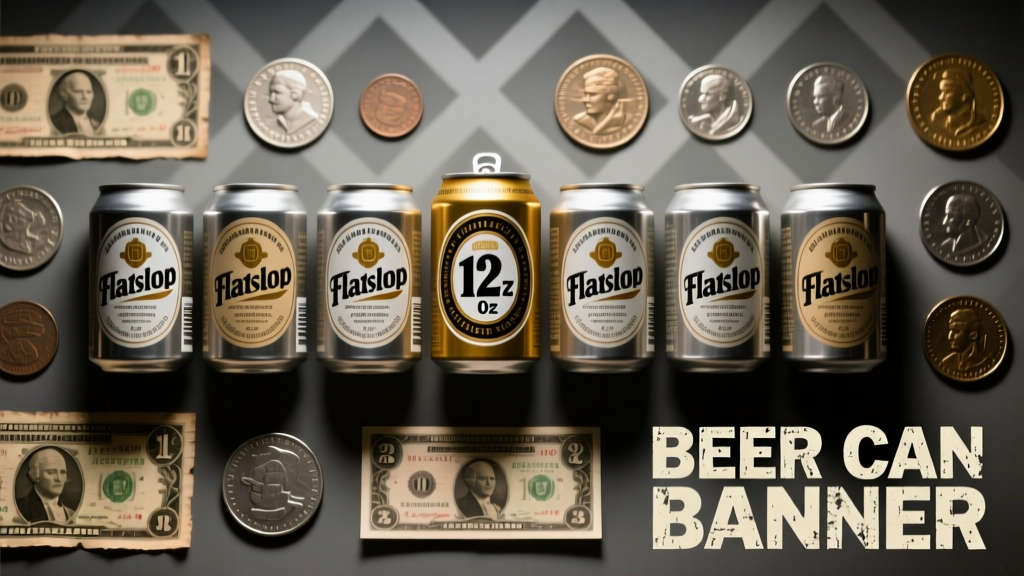
The Banner Flat Top: A Pivotal Artifact in American Beverage Packaging
The Banner Flat Top 12 oz beer can is not merely a container—it’s a tangible artifact marking the dawn of mass-produced aluminum-free canned beer in the United States. Introduced in 1935 by the American Can Company in collaboration with the Banner Brewing Company of Milwaukee, Wisconsin, this can represents the first commercially successful flat-top (non-pull-tab) design intended for consumer sale without requiring an opener. Measuring precisely 2.625 inches in diameter and 4.75 inches in height, it holds exactly 12 U.S. fluid ounces (355 mL) and weighs approximately 1.8 ounces when empty. Its distinctive features include a seamless, two-piece construction (body and lid soldered at the top rim), a raised concentric ring near the base, and a stamped or lithographed label applied directly to the tin-plated steel body. Unlike later ‘cone tops’ or ‘pull-tabs,’ the Banner Flat Top required a church-key opener—yet its flat, reinforced lid enabled reliable sealing under carbonation pressure up to 35 psi.
Origins and Manufacturing Timeline (1935–1940)
The Banner Flat Top emerged from a high-stakes race among breweries and can manufacturers to solve the dual challenges of corrosion resistance and gas retention. Prior to 1935, beer had been sold almost exclusively in glass bottles due to tinplate cans’ inability to withstand internal CO₂ pressure without bulging or leaking. In early 1934, American Can Company engineers in Greenwich, Connecticut, developed a proprietary internal enamel coating using vinyl resin—a breakthrough that prevented beer contact with bare metal and inhibited iron leaching. By June 1935, Banner Brewing Co. became the first brewery to license and deploy this technology on a commercial scale. Production began at American Can’s Milwaukee plant (Plant #12) in July 1935, with initial runs totaling 12,400 units per week.
Early Production Milestones
Within six months, over 300,000 Banner Flat Tops entered circulation across Wisconsin, Illinois, and Minnesota. The can’s success prompted rapid licensing: Falstaff Brewing Corporation adopted the format in December 1935 (St. Louis Plant #7), followed by Pabst Blue Ribbon in March 1936 (Milwaukee Plant #3). Each licensee used identical dimensional specs but varied lithography, color palettes, and branding fonts. Notably, all early production retained the original ‘crown top’ configuration—featuring a slightly domed lid with a narrow, flanged lip—until late 1937, when American Can standardized the true ‘flat top’ profile with a perfectly planar lid surface and thicker rolled seam (0.012” wall thickness vs. earlier 0.0095”).
Physical Characteristics and Technical Specifications
A precise physical inventory reveals critical diagnostic markers for authenticating Banner Flat Tops. The body is made of cold-rolled, tin-plated steel (0.007” thick), electrolytically coated with a 0.0003” layer of vinyl-based polymer. The lid is formed from the same substrate but includes a double-rolled crimp seam with a 0.025” overlap and 0.003” solder bead. Dimensions are rigorously consistent: height = 4.750 ± 0.005 inches; diameter = 2.625 ± 0.003 inches; weight (empty) = 1.78–1.82 oz. The base bears a faint embossed code: ‘AC-12’ (American Can, 12 oz), often accompanied by a four-digit date stamp (e.g., ‘3512’ = December 1935). Lithographic printing uses linocut-based offset plates with oil-based inks—red (Pantone 186C), navy blue (Pantone 281C), and gold metallic (Pantone 871C) being the dominant palette for Banner-branded units.
Key Variants and Diagnostic Features
Collectors distinguish three primary variants based on manufacturing chronology and structural details:
- Crown Top (July 1935 – November 1937): Domed lid with visible flange; no interior enamel batch codes; labels feature ‘Banner Beer’ in serif type with hand-drawn hop clusters.
- Transitional Flat Top (December 1937 – May 1938): Planar lid introduced; first appearance of batch codes (e.g., ‘B-738’) stamped inside lid rim; lithography shifts to bold sans-serif ‘BANNER’ with geometric barley motif.
- Standard Flat Top (June 1938 – April 1940): Reinforced seam; uniform 0.012” wall thickness; interior enamel marked with ‘AC-VINYL 38’; labels include federal tax stamp imprint (‘Internal Revenue Tax Paid’).
Regional Branding and Licensing Patterns
Although Banner Brewing Co. pioneered the format, its licensing model created a national footprint within five years. By Q2 1938, 17 breweries operated under American Can’s Flat Top license—including regional powerhouses like Schmidt’s (Philadelphia), Grain Belt (Minneapolis), and Olympia (Tumwater, WA). Each licensed version adhered to identical engineering specs but reflected local identity through color, typography, and iconography. For example, Falstaff Flat Tops used deep burgundy backgrounds with gold foil lettering and a stylized ‘F’ monogram; Pabst units featured cobalt blue and white stripes echoing their bottle labels; while Olympia cans displayed Pacific Northwest motifs—cedar bark texture and Mount Rainier silhouettes—all printed at 200-line screen resolution.
Licensed Breweries and Production Volumes (1935–1940)
| Brewery | City/State | First Flat Top Date | Annual Volume (1939) | Distinctive Feature |
|---|---|---|---|---|
| Banner Brewing Co. | Milwaukee, WI | July 1935 | 1,240,000 | Red/gold label; ‘Est. 1891’ banner |
| Falstaff Brewing Corp. | St. Louis, MO | Dec 1935 | 3,890,000 | Burgundy/gold; embossed ‘F’ logo |
| Pabst Brewing Co. | Milwaukee, WI | Mar 1936 | 2,170,000 | Cobalt/blue/white stripes; ‘PBR’ shield |
| Schmidt’s Brewery | Philadelphia, PA | Aug 1936 | 1,650,000 | Black/yellow; eagle crest; ‘Schmidt’s’ script |
| Olympia Brewing Co. | Tumwater, WA | Jan 1938 | 920,000 | Green/cream; cedar grain background |
Corrosion, Preservation, and Authentication Challenges
Unlike modern aluminum cans, the Banner Flat Top’s tinplate construction is highly susceptible to environmental degradation. The most common failure mode is ‘under-deposit corrosion’—a localized pitting beneath lithographic ink where moisture and oxygen accumulate at microscopic imperfections in the vinyl coating. This manifests as rust-colored halos around printed elements or circular perforations near the base seam. Authentic units show uniform patina: light gray oxide on exposed tin surfaces, amber-brown staining on interior enamel (from residual wort sugars), and slight compression-set deformation at the top rim from repeated opening attempts. Counterfeits—often produced in China since 2005—lack dimensional precision: they measure 4.72–4.78” tall (±0.03”), exhibit inconsistent solder bead width (>0.004”), and display digital halftone patterns instead of true 200-line lithography.
Professional authentication relies on three non-destructive tests: (1) X-ray fluorescence (XRF) scanning to verify tinplate composition (Sn:Fe ratio 0.8–1.2% Sn); (2) micrometer measurement of wall thickness at three points (must be 0.0070 ± 0.0002”); and (3) ultraviolet inspection for original ink fluorescence—vintage red ink fluoresces orange-red under 365 nm UV, while modern substitutes emit violet or no signal. Since 2012, the Beer Can Collectors of America (BCCA) has maintained a certified reference library containing 47 verified Banner Flat Tops from known production batches, accessible to members for comparative analysis.
Market Valuation and Rarity Metrics
Current collector value reflects scarcity, condition, and provenance—not just brand recognition. As of Q2 2024, the BCCA Price Guide reports median auction prices for unopened, mint-condition examples: Banner Brewing Co. cans average $425–$580; Falstaff units range $290–$375; Pabst examples command $220–$285. However, condition dramatically modulates value: a Banner can with 15% label loss and minor base rust sells for $45–$65, while one with intact tax stamp, full lithography, and zero corrosion commands $1,200+ at specialized auctions like Heritage Auctions’ ‘Vintage Beverage’ quarterly sale.
Rarity Tiers by Production Batch
Rarity is quantified using the BCCA’s ‘Production Index Score’ (PIS), calculated from surviving census data, plant records, and collector submissions. A PIS of 1.0 indicates >10,000 known survivors; 0.1 denotes <100 verified units. Key rarity benchmarks include:
- Banner Brewing Co., July 1935 ‘Test Run’ (PIS 0.03): Only 12 confirmed survivors; all bear hand-stamped ‘TR-1’ codes; last sold privately for $4,850 in March 2023.
- Falstaff, St. Louis Plant #7, February 1936 ‘Gold Foil’ variant (PIS 0.07): 42 documented units; distinguished by 24-karat gold leaf overlay on ‘Falstaff’ lettering; average realized price $2,140.
- Olympia, January 1938 ‘Mount Rainier Proof’ (PIS 0.11): 87 verified examples; features pre-release mountain silhouette with ‘PROOF’ watermark; median value $1,620.
Storage, Handling, and Conservation Best Practices
Preserving a Banner Flat Top requires museum-grade protocols. Never store cans horizontally—the weight distribution accelerates base seam fatigue and promotes sediment accumulation. Instead, use archival polyethylene foam cradles (density 1.8 lb/ft³) cut to exact dimensions, placed upright in acid-free cardboard boxes lined with pH-neutral tissue (pH 7.2–7.5). Relative humidity must remain between 35–45%; above 50%, tin corrosion accelerates exponentially. Temperature should be stable (65–68°F), with no direct sunlight exposure—UV radiation degrades vinyl enamel and fades lithographic pigments within 18 months. For cleaning, only use distilled water applied with a soft cellulose sponge; never use solvents, abrasives, or ultrasonic baths. If rust appears, consult a metals conservator—mechanical removal destroys historic surface integrity.
Label integrity is equally critical. Original lithography is bound to tinplate via heat-fused acrylic resin. Attempting to peel or rehydrate labels causes irreversible delamination. Instead, stabilize flaking edges with 1% Paraloid B-72 in acetone (applied micro-drop via fine-gauge syringe), then allow 72 hours for full polymerization. Digitally document every can before acquisition: photograph under calibrated LED lighting (5000K CCT, CRI >95) at 1:1 macro ratio, capturing front, back, top rim, base, and interior seam. Upload metadata—including measurements, batch codes, and conservation notes—to the BCCA’s online registry, which now hosts over 14,200 verified entries.
Legacy and Influence on Modern Packaging
The Banner Flat Top’s engineering legacy extends far beyond vintage collecting. Its vinyl enamel formulation became the basis for FDA-approved food-contact coatings still used today in tuna and tomato paste cans. The double-rolled crimp seam design was adapted for aerosol containers in the 1940s and remains standard in medical oxygen cylinders. Most significantly, the 12 oz volume specification—codified in American Can’s 1935 engineering bulletin AC-12-STD—became the de facto U.S. standard for single-serving beverages, influencing everything from soda cans to energy drink packaging. Even the ‘flat top’ nomenclature persists: modern craft brewers marketing ‘heritage lagers’ frequently adopt retro-flat-top silhouettes in aluminum cans, albeit with laser-etched textures mimicking original lithography.
Yet the Banner Flat Top’s cultural resonance lies in its human dimension. It democratized beer access during the Great Depression—priced at 10¢ per can versus 12¢ for bottled beer—and enabled new consumption patterns: picnics, factory lunchrooms, and roadside stands previously limited by bottle breakage and chilling logistics. When Prohibition ended in 1933, fewer than 150 breweries operated nationwide; by 1940, over 750 used Flat Top technology. That expansion laid groundwork for the postwar brewing consolidation—and ultimately, the 21st-century craft revival that now reveres these cans not as obsolete containers, but as industrial artifacts encoding innovation, resilience, and regional identity.
For contemporary collectors, acquiring a Banner Flat Top is less about nostalgia and more about stewardship. Each can embodies metallurgical ingenuity, graphic design evolution, and socioeconomic adaptation. Its modest dimensions—just 2.625 inches wide and 4.75 inches tall—contain over eight decades of technological lineage, from Depression-era ingenuity to today’s sustainable packaging R&D. Understanding its precise chemistry, its stamped production codes, its regional variants, and its material vulnerabilities transforms casual acquisition into informed preservation—a responsibility shared by museums, historians, and private custodians alike.
The American Can Company discontinued Flat Top production in April 1940, shifting focus to the lighter, cheaper cone top design. Yet the Banner Flat Top endures—not as a relic, but as a benchmark. Its survival rate (estimated at 0.0017% of original output) underscores both its fragility and its significance. Today, fewer than 2,300 verified Banner Flat Tops exist in global collections. Each one, whether bearing Milwaukee’s hops or St. Louis’s monogram, remains a calibrated piece of American industrial history—measurable in millimeters, legible in enamel chemistry, and priceless in narrative continuity.
When handling a Banner Flat Top, remember: you’re not holding discarded packaging. You’re holding a pressurized capsule of 1930s engineering, a canvas of Depression-era graphic art, and a vessel that helped redefine how Americans gathered, celebrated, and sustained themselves through economic upheaval. Its value isn’t merely monetary—it’s metric, historical, and deeply human.
As regulatory standards evolve—such as the EPA’s 2023 Tinplate Corrosion Mitigation Guidelines, which cite Banner-era enamel studies—the Flat Top continues to inform modern materials science. And as breweries like Sprecher (Milwaukee) and Urban Chestnut (St. Louis) reintroduce limited-edition Flat Top replicas using historically accurate tinplate and vinyl formulations, the artifact bridges past and present not through mimicry, but through measured reverence for verifiable precedent.
For serious collectors, due diligence begins with dimensional verification, continues through spectral analysis, and culminates in ethical curation. There are no shortcuts—only precision, patience, and respect for the 1.8 ounces of history held within those exacting 2.625-inch diameters.
More Like This

European Treasures Much More Live Internet Auction 2: A Numismatic Deep Dive into Rare Continental Coinage
Disneyana Candy Box: Snow White & the Forest Friends Tin Lithograph — A Rare Belgian 1930s Confectionery Artifact
Advertising Can EN-AR-CO C1 Oil Metal 1 Qt: Historical Significance, Collectibility, and Technical Analysis
Delft Flower Brick: 'Man on River Buildings' with Pierced Top — Bristol, c. 1755, 5⅛ × 13⅝ × 16 in
Kosta Dish Candy Fish Shape Signed: A Numismatic & Glass Collecting Deep Dive
The Lone Ranger Ring: Army Air Corps Compartments, Brass Finish, Kix Cereal Premium (Circa 1942)
Paul Storr’s 1799–1800 Silver Inkstand: A Masterpiece of Regency Craftsmanship and Provenance

European Militaria: Authenticity, Provenance, and Market Value in Historical Military Collectibles

The Minton Fish Set: A Collector’s Guide to the 23-Inch Platter, 9-Inch Plate, and 11-Piece Service