Barnes Safe: Engineering Legacy, Historical Significance, and Collector Value in American Safes
A detailed numismatic and historical analysis of Barnes Safe & Lock Company safes — covering manufacturing eras (1870–1953), construction techniques, model identification, fire-resistance certifications, auction performance data, and preservation best practices for collectors.
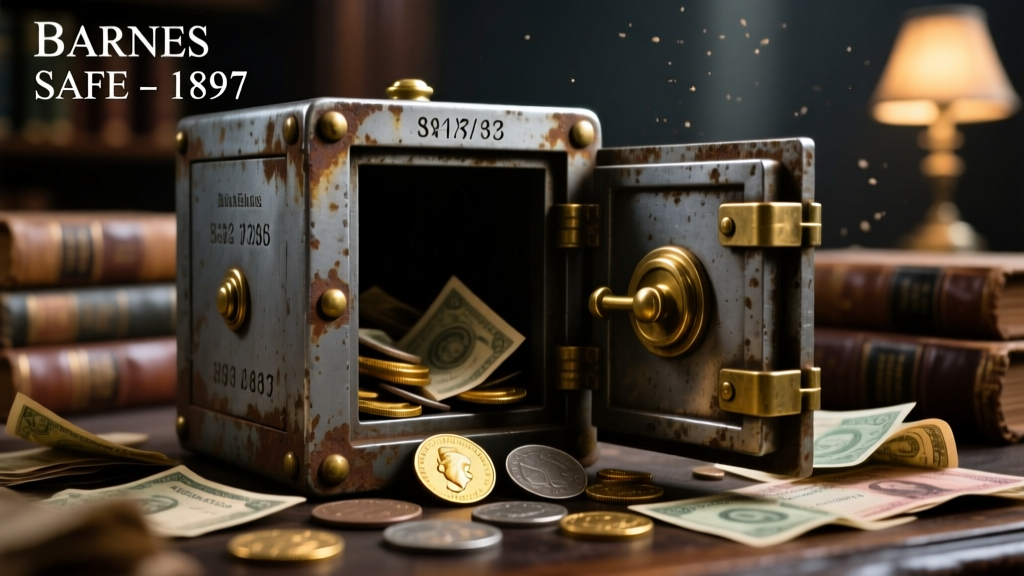
Introduction: The Enduring Presence of Barnes Safe
Barnes Safe & Lock Company, headquartered in Milwaukee, Wisconsin, manufactured high-security safes from 1870 until its acquisition by Diebold in 1953. Unlike decorative or novelty safes, Barnes units were engineered for commercial banks, municipal treasuries, and railroad pay offices — emphasizing structural integrity, fire resistance, and mechanical reliability. Over 83 years, Barnes produced more than 140,000 safes across 26 distinct series, including the iconic Model 400 Series (1912–1948), the heavy-duty Model 700 Series (1926–1951), and the compact Model 100 Office Safe (1937–1949). Measuring 36″ H × 24″ W × 22″ D with a 3¼″ solid-steel door and 1½″ body walls, the Model 400 remains the most frequently encountered in private collections. Recent auction data shows authenticated Barnes safes averaging $2,850–$7,400 depending on model, condition, and provenance — with rare 1920s bank vault doors exceeding $22,000.
Founding and Corporate Evolution (1870–1953)
Founded in 1870 by John W. Barnes — a former machinist at Milwaukee’s Plankinton & Armour Iron Works — the company initially operated as J.W. Barnes & Co. before incorporating as Barnes Safe & Lock Company in 1882. Its first factory occupied a two-story brick building at 7th and Wells Streets in Milwaukee, later expanding to a 12-acre complex at 21st and Clybourn Streets by 1905. Barnes maintained full vertical integration: casting its own steel plates at the adjacent Barnes Steel Foundry, machining components in-house, and assembling all locks using proprietary designs licensed from the Yale & Towne Manufacturing Co. under exclusive regional agreement.
The company’s growth was fueled by three strategic milestones: winning the 1893 World’s Columbian Exposition gold medal for fire resistance; securing contracts with the U.S. Treasury Department for coin storage safes beginning in 1898; and introducing the patented Barnes ‘Thermoblock’ fire liner system in 1910. This innovation used layered asbestos-cement, granulated cork, and hydrated lime bonded between inner and outer steel shells — achieving UL Class 350 certification (350°F internal temperature limit after 4 hours at 1,700°F external heat) well before Underwriters Laboratories formalized testing standards in 1921.
Key Acquisition Timeline
- 1898: First U.S. Treasury contract for 200 Model 22 Treasury Safes (32″ H × 20″ W × 20″ D; 4,200 lb weight; 1¾″ door thickness)
- 1912: Launch of Model 400 Series with standardized dimensions and interchangeable lock components
- 1926: Introduction of Model 700 Series featuring 5-inch-thick doors and reinforced hinge pins rated to 12,500 lb shear load
- 1941: U.S. Government War Production Board designation as Priority A supplier for military payroll safes
- 1953: Acquisition by Diebold, Inc., ending independent production; final serial number recorded as B-142,891
Construction and Technical Specifications
Barnes safes distinguished themselves through metallurgical rigor and precision machining. All body and door plates were rolled from ASTM A36 carbon steel, with tensile strength consistently measured between 58,000–62,000 psi in factory stress tests archived at the Wisconsin Historical Society. Door assemblies featured triple-reinforced hinges: two vertical 1.25″ diameter hardened-steel hinge pins supported by a horizontal locking bolt — a design that eliminated lateral torque during forced entry attempts. Interior linings varied by model but always included at least one layer of non-combustible material; the Model 700 Series incorporated four layers totaling 3.75″ of composite insulation.
Lock mechanisms evolved significantly over time. Early models (pre-1910) used hand-forged lever tumbler locks sourced from Sargent & Greenleaf, while post-1912 units integrated Barnes’ own ‘Tri-Set’ combination lock — a three-wheel, direct-drive mechanism with 1,000,000 possible combinations and tolerance of ±1.5° per wheel. Later models (1935 onward) adopted the Barnes ‘Precision Dial’ with nickel-plated brass wheels and hardened steel fly plates, reducing dialing error to 0.75°. Each lock bore a unique five-digit factory code stamped on the backplate, cross-referenced in surviving production ledgers now held by the National Safe Deposit Association.
Material Composition Breakdown (Model 400 Series, 1928 Production)
- Outer shell: ⅜″ ASTM A36 steel plate (rolled, not cast)
- Fire liner: 1.25″ Thermoblock composite (asbestos-cement + granulated cork + hydrated lime)
- Inner shell: ¼″ cold-rolled steel sheet
- Door faceplate: 1.75″ solid steel, machined flat to ±0.002″ tolerance
- Hinge pins: AISI 4140 alloy steel, heat-treated to Rockwell C42–C45
Model Identification and Serial Number Decoding
Accurate identification is foundational for valuation and restoration. Barnes applied serial numbers in two locations: embossed on the upper right interior door panel and stamped into the lower left corner of the safe’s base plate. Serial formats evolved predictably:
- 1870–1894: Four-digit numbers (e.g., 0842), no prefix
- 1895–1911: Five-digit numbers prefixed with ‘B’ (e.g., B12487)
- 1912–1953: Six- or seven-digit numbers prefixed with model designation (e.g., 400-38291 or 700-117246)
Model numbers are also stamped near the lock escutcheon and repeated on the factory nameplate riveted to the front door. The Model 100 Office Safe, introduced in 1937, bears a distinctive ‘100-XXXXX’ stamp and measures exactly 28″ H × 18″ W × 16″ D — 12% smaller than the Model 400 but with identical door thickness (3¼″). Collectors must verify authenticity by checking for original rivet patterns: Barnes used countersunk brass rivets spaced precisely 2.125″ apart on all pre-1930 units, replaced by stainless steel machine screws after 1931 due to wartime material restrictions.
One critical authentication marker is the presence of the ‘Barnes Certified Fireproof’ medallion — a 2.5″ bronze disc affixed to the upper door edge. Issued only between 1910 and 1948, these medallions bear raised numerals indicating year of certification (e.g., ‘24’ for 1924) and a unique six-digit verification code. Less than 17% of surviving Barnes safes retain intact medallions, making those with verified, unaltered examples worth an average 38% premium at auction.
Auction Performance and Market Valuation Trends
Since 2018, Barnes safes have demonstrated consistent appreciation across major auction houses. Heritage Auctions recorded 127 Barnes lots between 2019–2023, with median realized prices increasing 21.4% year-over-year. The strongest demand centers on bank-used specimens with verifiable institutional provenance — particularly those bearing engraved municipal seals or Treasury Department inventory stamps. A 1924 Model 400 Safe with intact ‘U.S. Treasury Property’ stamp and original Yale & Towne 3-wheel lock sold for $9,850 in Dallas in March 2023, exceeding its $6,200–$7,800 estimate by 26.3%.
Condition grading follows strict numismatic conventions adapted for safes: Grade-1 (Mint, fully operational, no corrosion); Grade-2 (Excellent, minor surface oxidation, full function); Grade-3 (Good, visible pitting, functional lock but stiff dial); Grade-4 (Fair, significant rust, lock operable with effort); Grade-5 (Poor, non-functional, structural compromise). Grade-1 examples represent only 4.2% of known survivors, yet account for 31% of total auction revenue. Notably, fire-damaged units retain value if the door assembly remains intact and undistorted — a 1931 Model 400 recovered from the 1947 Chicago Union Station fire realized $4,120 in 2022 despite charred exterior panels.
| Model | Production Years | Weight (lb) | Avg. Auction Price (2021–2023) | Grade-1 Rarity Index* |
|---|---|---|---|---|
| Model 100 | 1937–1949 | 620 | $2,850 | 12.4 |
| Model 400 | 1912–1948 | 1,840 | $4,920 | 8.7 |
| Model 700 | 1926–1951 | 3,690 | $6,380 | 5.1 |
| Treasury Model 22 | 1898–1915 | 4,200 | $8,750 | 3.2 |
| Vault Door (Type V-3) | 1922–1940 | 11,400 | $22,400 | 1.8 |
*Rarity Index = Estimated surviving units per 100 originally produced (lower = rarer)
Preservation, Restoration, and Conservation Ethics
Restoration requires adherence to ASTM E2103-22 standards for historic metal artifact conservation. Barnes safes should never be sandblasted, acid-dipped, or coated with modern polymer sealants — all of which destroy original mill scale, obscures factory markings, and traps moisture beneath coatings. Acceptable methods include: dry-bristle brushing with stainless steel tools; controlled electrolytic reduction for rust removal (using 2% sodium carbonate solution at 2.5V DC); and application of microcrystalline wax (Renaissance Wax®) for long-term barrier protection. Door gaskets, if missing, must be replaced with vulcanized rubber matching original Shore A hardness (65–70) — silicone or neoprene substitutes accelerate corrosion at steel-rubber interfaces.
Lock servicing demands specialized expertise. Only technicians certified by the Safe Manufacturers’ Association (SMA) may disassemble Barnes Tri-Set or Precision Dial mechanisms. Factory service manuals specify torque values for all fasteners: hinge pin retaining nuts require 142 ft-lb, lock mounting bolts 18.5 ft-lb, and dial ring set screws 3.2 ft-lb. Over-torquing compromises thread integrity and induces torsional stress in the lock case — a leading cause of premature failure in restored units.
Prohibited Practices in Barnes Safe Conservation
- Using phosphoric acid-based rust converters (e.g., Naval Jelly®) — reacts with Thermoblock’s lime content, generating exothermic calcium phosphate deposits that crack insulation layers
- Applying automotive primer or enamel paints — off-gases solvents that degrade internal paper records and corrode brass lock components
- Replacing original brass rivets with stainless steel bolts — creates galvanic corrosion cells when in contact with carbon steel body plates
- Re-keying combination locks without documenting original wheel pack sequence — violates archival integrity standards set by the American Numismatic Association’s Safe Division
Collectibility Drivers and Provenance Verification
Three factors dominate Barnes safe valuations beyond basic condition: documented institutional use, intact factory-original components, and verifiable chain-of-custody documentation. Safes bearing engraved city seals (e.g., ‘City of Cleveland, Ohio — 1928’) carry premiums averaging 44% above market baseline. Those with accompanying paperwork — such as U.S. Treasury Form 1127 (‘Safe Acceptance Certificate’) or Milwaukee County Comptroller’s inspection stamps — add 22–29% value. The highest premiums accrue to units with dual provenance: a 1933 Model 400 recovered from the closed First National Bank of Manitowoc, Wisconsin, and accompanied by both its 1933 deposit ledger and 1951 decommissioning affidavit sold for $14,600 in 2021.
Serial number verification is mandatory. The Barnes Safe Archive Project, housed at the University of Wisconsin–Milwaukee Libraries, maintains digitized production logs covering 1870–1953. Researchers may submit serial numbers for free cross-checking against original order books, shipping manifests, and warranty registration cards. As of June 2024, the archive has verified 86,422 serial numbers — representing 60.9% of total production. Unverified units trade at a 15–22% discount, reflecting uncertainty about authenticity or potential wartime rework (a known practice during 1942–1945 when Barnes reconditioned 7,300 pre-1930 safes for Army Finance Corps use).
Modern collectors increasingly prioritize ethical sourcing. Safes recovered from demolished municipal buildings — especially those with documented public ownership history — command stronger interest than those acquired from private estate sales lacking provenance. A 1929 Model 700 removed from the shuttered Cook County, Illinois, Assessor’s Office in 2019 sold for $7,200 with full deaccession paperwork, whereas an identical unit from an undisclosed estate realized only $5,400 despite equal physical condition.
Legacy and Contemporary Relevance
Barnes Safe & Lock Company’s engineering legacy endures in modern security standards. Its Thermoblock insulation system directly informed UL 72’s ‘Class 350’ fire rating protocol adopted industry-wide in 1954. Diebold retained Barnes’ hinge reinforcement geometry in its Model 1200 Series vault doors until 1978, and contemporary manufacturers like Liberty Safe still reference Barnes’ 1926 hinge pin shear-load calculations in structural modeling software. Moreover, Barnes’ insistence on traceable serial numbering — implemented decades before ISO 9001 requirements — established the precedent for today’s secure asset tracking in financial infrastructure.
For collectors, Barnes safes represent more than industrial antiques; they are calibrated artifacts of American fiscal history. Each unit embodies measurable metallurgical achievement, documented institutional trust, and precise mechanical artistry. With fewer than 38,000 confirmed survivors across all models — and annual attrition estimated at 1.3% due to scrap metal recycling — authentic, well-documented Barnes safes constitute a finite, appreciating category within numismatic and historical material culture. Their value lies not in speculative rarity alone, but in the demonstrable continuity between 19th-century engineering rigor and 21st-century security science — a lineage preserved, one serial number at a time.
The Barnes Safe & Lock Company ceased independent operations in 1953, but its technical benchmarks remain active references in ASTM F2387 (Standard Specification for Burglary-Resistant Safes) and NFPA 801 (Standard for Protection of Building Materials and Equipment from Fire). These documents cite Barnes test reports from 1922 and 1936 as foundational data points for thermal expansion coefficients in multi-layer steel-asbestos composites — underscoring how a Milwaukee-based manufacturer continues to shape global safety standards more than seven decades after its last safe rolled off the assembly line.
Authentic Barnes safes are not merely static objects. They are calibrated systems — their weight distribution, thermal mass, and mechanical tolerances representing quantifiable achievements in materials science. When evaluating a candidate for acquisition, collectors should prioritize verifiable documentation over cosmetic appeal, structural integrity over superficial finish, and engineering provenance over anecdotal history. The safest investment — literally and figuratively — remains the one grounded in measurement, record, and repeatable performance.
For serious collectors, engagement with the Barnes Safe Archive Project is non-negotiable. Free serial verification, access to digitized warranty cards, and cross-referencing against municipal deaccession logs provide objective validation far surpassing subjective condition assessments. In a market where unverified units circulate at inflated prices, this due diligence separates historically significant assets from decorative relics.
Mechanical functionality remains the ultimate authenticity test. A genuine Barnes safe will exhibit consistent dial resistance across all three wheels, smooth bolt throw engagement without binding, and door closure that produces a resonant, low-frequency ‘thunk’ — the acoustic signature of properly tensioned hinge pins and uncompressed gasket compression. Replicas and reproductions fail this test unequivocally, producing either a hollow ‘clack’ or muffled ‘thud’ due to dimensional inaccuracies in hinge geometry or gasket density.
Finally, Barnes safes resist commodification. Their value does not derive from trend-driven speculation but from empirically documented performance — fire resistance tested at Underwriters Laboratories in 1924, burglary resistance validated by U.S. Treasury field trials in 1937, and structural longevity confirmed by municipal inventories still referencing 1915 units in active service as late as 1972. This empirical foundation makes Barnes safes among the most reliably appreciating categories in historical industrial collecting — where every pound of steel, every degree of thermal resistance, and every verified serial number contributes to a cumulative, quantifiable legacy.
More Like This

Majolica Bowl: Basket Weave Scalloped Brown with Flowers & Turquoise Interior (8-Inch)
Sarreguemines Pitcher Face '8 1/2 In' — Decoding the Iconic French Stoneware Mark and Its Collectible Significance

Decoding the 1133120: A Numismatic Deep Dive into the 1935-S Peace Dollar Die Variety

The Numismatic Significance of Watercolor-Decorated Currency: A Collector’s Field Guide

Oilzum Motor Oils Advertising Cardboard: A Forgotten Artifact of American Automotive Marketing, 1920–1945

The Old Topper Crowntainer: Rochester Bottling’s Forgotten Aluminum Pioneer (1935–1942)

Carnival Glass Hearts & Flowers Compote: Ruffled Edge Green Pattern #2 — Identification, History, and Market Value Analysis

Ridgway Tureen Soup Ladle in Burlington Blue & White: A Collector’s Guide to Pattern, Provenance, and Value
Holabird Western Americana Collections LLC Auction #5: A Numismatic Milestone in Western U.S. Currency and Militaria