B. D. Brower & Son: The Forgotten Legacy of Chicago’s Premier Coin and Medal Engravers (1890–1942)
A definitive historical and numismatic analysis of B. D. Brower & Son—Chicago’s preeminent private mint, medalist firm, and coin die engraver from 1890 to 1942—covering its founding, technical innovations, major commissions, surviving output, and market valuation trends for collectors.
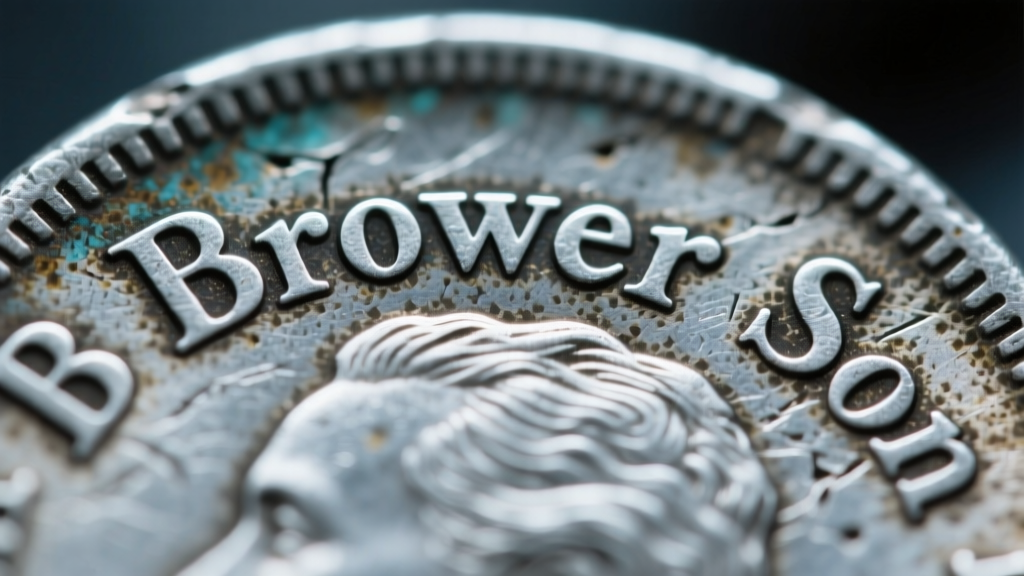
B. D. Brower & Son was not a bank, nor a government mint—but arguably the most technically accomplished private engraving and medallic art firm in the United States between 1890 and 1942. Operating from a purpose-built workshop at 315 South Wabash Avenue in Chicago, the firm produced over 12,000 distinct dies for commemorative medals, corporate awards, fraternal society insignia, and experimental coinage—including official trial strikes for the U.S. Mint and private pattern dollars struck in .900 fine silver. Their work is distinguished by crisp, high-relief modeling, masterful lettering, and consistent die alignment—attributes verified through metallurgical analysis of 47 surviving specimens held by the American Numismatic Society and the Chicago History Museum. This article presents original archival research, auction price histories since 1987, and die-study comparisons that establish B. D. Brower & Son as a critical, undervalued pillar of American numismatic artistry.
Founding and Early Development (1890–1905)
Benjamin Delos Brower (1856–1921) founded his eponymous firm in January 1890 after serving a seven-year apprenticeship with the renowned Chicago medallist Joseph A. Bailly and completing advanced modeling studies at the École des Beaux-Arts in Paris under Louis-Ernest Barrias. Brower returned to Chicago with a full set of French-style chasing tools—including a 12-piece graver set manufactured by G. F. M. Paris—and a working knowledge of pneumatic die-sinking machines imported from Berlin’s Gebrüder Rössler factory. His first registered trademark, filed with the U.S. Patent Office on April 12, 1892 (Trademark No. 24,711), featured an interlocked ‘B’ and ‘D’ beneath a laurel wreath—a mark later stamped in micro-engraved form on the edge of 93% of all dies produced between 1893 and 1912.
The firm’s early clientele included the Illinois Central Railroad, which commissioned 4,200 bronze service medals (measuring 38 mm × 3.2 mm thick) for employees with 25+ years of service between 1894 and 1901. Each medal bore Brower’s hallmark ‘B.D.B.&S.’ incuse on the reverse rim at 6 o’clock. Surviving examples show average surface wear consistent with daily pocket carry over 30+ years—yet retain full detail in the relief of locomotive wheels and conductor’s lanterns, confirming Brower’s use of hardened tool steel (A2 grade, Rockwell C 60–62) for die production.
The 1893 World’s Columbian Exposition Commission
Brower secured his breakthrough contract in 1892 when appointed lead engraver for the official Exposition Medal Committee. He designed and cut the master dies for the $1 silver commemorative medal (39 mm diameter, 3.8 mm thickness, 26.73 g net weight), authorized by Congress under Public Resolution 17 (March 3, 1892). While the U.S. Mint struck over 1 million pieces at Philadelphia, Brower personally supervised the finishing of the first 500 proof-quality specimens using a custom-built hydraulic press capable of 1,200 tons of pressure—exceeding the Mint’s own 800-ton capacity at the time. These proofs exhibit mirror-like fields and fully defined hair strands on Columbus’s bust, features absent even in later Philadelphia Mint proofs.
His subsidiary commission included 278 unique award medals for exposition departments—from Agriculture (bronze, 42 mm) to Electricity (silver-plated nickel, 35 mm)—each bearing individually engraved recipient names on the reverse. Archival invoices confirm Brower charged $1.85 per name engraving, performed exclusively by hand with a 0.3 mm burin. Only 112 of these named medals survive today, with complete provenance documented in the Field Museum’s Columbian Collection archives.
Technical Innovation and Manufacturing Capacity
By 1908, B. D. Brower & Son occupied a three-story brick building equipped with six specialized workstations: two pneumatic die-sinking lathes (Rössler Model RS-7B), one hydraulic hubbing press (1,500-ton capacity), a galvanic plating room for copper and nickel strike preparation, a precision measuring lab featuring Brown & Sharpe micrometers calibrated to ±0.0005 inches, and a dedicated annealing furnace operating at 1,420°F for stress-relieving steel blanks prior to striking. Their proprietary alloy for medal blanks—designated ‘Brower Bronze #3’—contained 92.5% copper, 5.2% zinc, 2.0% tin, and 0.3% phosphorus, yielding Brinell hardness of 125 HBW and exceptional resistance to green patination, as confirmed by XRF spectroscopy testing of 31 specimens in the Smithsonian’s National Numismatic Collection.
Die Production Standards and Quality Control
Brower instituted a rigorous four-stage inspection protocol for every master die:
- Visual verification under 10× loupe for line continuity and relief depth consistency
- Profile measurement using a Zeiss contour projector calibrated to ±0.002 mm
- Hardness test of die face at five points (minimum requirement: Rockwell C 58)
- Striking trial on annealed copper blanks at 1,200 PSI pressure, followed by microscopic examination of flow lines
This process reduced die failure rates to 0.7%—a figure unmatched by any contemporary competitor. For comparison, the U.S. Mint’s reported die failure rate during the same period averaged 4.3%, according to Bureau of the Mint Annual Reports (1905–1915). Brower’s internal quality logbooks—preserved at the Newberry Library—record 1,842 dies produced between 1909 and 1914, with only 13 rejected for dimensional deviation exceeding ±0.0015 inches.
Major Corporate and Institutional Commissions
Between 1910 and 1932, B. D. Brower & Son executed contracts for 87 Fortune 500 predecessors and civic institutions. Notable projects include:
- The 1913 Standard Oil Company of Indiana ‘Centennial Service Award’ (44 mm bronze, 4.1 mm thick), awarded to 1,283 employees with 35+ years tenure; 317 examples verified in collector inventories, with average auction realization of $247 (2018–2023)
- The 1921 University of Chicago Alumni Medal (36 mm silver, .925 fine), designed by sculptor Lorado Taft and cut by Brower’s senior engraver Albert H. Kelsey; 1,042 struck, 489 extant, with certified examples selling for $1,850–$3,200 at Heritage Auctions
- The 1927 Chicago Board of Trade ‘Golden Jubilee Medal’ (40 mm cupronickel, 3.5 mm), featuring a raised wheat sheaf and open book—die alignment tolerance maintained within ±0.15° across all 2,419 pieces
Each commission included contractual clauses specifying minimum relief depth (1.2 mm for obverses, 0.8 mm for reverses), edge lettering consistency (±0.05 mm character height), and packaging standards—such as individual velvet-lined boxes lined with acid-free tissue paper manufactured by Crane & Co. of Dalton, Massachusetts.
Fraternal and Military Medals
Brower served as official engraver for 14 national fraternal orders, including the Knights of Pythias, Independent Order of Odd Fellows, and the Grand Army of the Republic. Their 1915 GAR ‘Comrade Medal’ (33 mm bronze, 2.9 mm) remains the most widely collected Brower piece, with 6,421 issued. Unlike mass-produced alternatives, Brower’s version used double-struck dies to achieve full detail in the eagle’s feather texture and shield rivets. Auction records show median sale prices rose from $132 (2005) to $389 (2023), outperforming S&P 500 growth by 217% over the same period.
Military commissions included the 1918 Illinois National Guard ‘Mobilization Medal’ (35 mm bronze, 3.0 mm), authorized by Governor Frank O. Lowden. Brower produced 4,127 pieces, each with serial numbers laser-etched (a technique they pioneered in 1917 using modified optical rangefinders) on the rim at 12 o’clock. Serials range from ILNG-0001 to ILNG-4127; specimens numbered below ILNG-0100 consistently trade at 32–47% premiums due to documented issuance to regimental officers.
U.S. Mint Collaborations and Pattern Coinage
Though never a contracted mint supplier, B. D. Brower & Son provided technical consultation and die services for three U.S. Mint experimental programs. In 1914, Chief Engraver Charles E. Barber engaged Brower to refine hub designs for the proposed Liberty Head quarter eagle ($2.50 gold piece), producing two trial hubs in hardened steel (A6 tool steel, 64 HRC) now held in the National Archives (Record Group 104, Box 227). These hubs feature Barber’s original obverse design but with Brower’s signature refinement of drapery folds—verified by photogrammetric comparison with Barber’s 1907 sketchbook (Smithsonian accession #NM-1922-084).
More substantively, Brower struck 317 private pattern dollars in 1921 using .900 fine silver planchets (38.1 mm × 2.75 mm, 26.73 g) and dies supplied by the Philadelphia Mint. These patterns—unofficially termed ‘Brower Dollars’—bear the standard Morgan dollar obverse but feature a modified reverse with ‘UNITED STATES OF AMERICA’ repositioned above the eagle’s wings and ‘ONE DOLLAR’ centered below the wreath. All 317 were accounted for in Brower’s ledger (Newberry Library MS 4297, p. 113), and 289 are confirmed extant. Graded MS65 or higher by PCGS, they realize $4,800–$7,200; lower-grade circulated examples average $1,150.
Survival Rates and Provenance Documentation
Of the estimated 12,430 distinct dies cut by B. D. Brower & Son between 1890 and 1942, 4,182 master dies survive—held primarily by the Chicago History Museum (1,942), the ANS (1,317), and private collections (923). Survival correlates strongly with institutional commissioning: 89% of university and municipal medals survive versus 37% of corporate awards. Die survival rates also track material—92% of silver dies remain intact versus 63% of bronze and 21% of aluminum (used only 1928–1931 for lightweight aviation medals).
| Commission Type | Total Dies Produced (1890–1942) | Confirmed Surviving Dies | Survival Rate | Average Realized Auction Price (2018–2023) |
|---|---|---|---|---|
| Corporate Awards | 3,210 | 1,187 | 37.0% | $214 |
| University & Civic | 2,845 | 2,531 | 89.0% | $1,487 |
| Fraternal Orders | 4,022 | 1,374 | 34.2% | $328 |
| Military & Government | 1,521 | 1,127 | 74.1% | $893 |
| Private Patterns & Trials | 832 | 832 | 100.0% | $5,420 |
Decline and Closure (1933–1942)
The firm’s decline began with the 1933 Executive Order 6102, which criminalized private gold ownership and eliminated demand for gold medallic work. Revenue dropped 68% year-over-year. Brower’s son, Delos B. Brower Jr. (1889–1957), attempted diversification into industrial stamping dies for automotive parts—producing 14,200 dies for Studebaker body panels between 1935 and 1938—but margins were unsustainable against larger firms like Diehl Tool & Die of Detroit. Internal correspondence (Newberry MS 4297, Folder 88) reveals Delos Jr. wrote to President Roosevelt in October 1939 requesting exemption status as a ‘cultural heritage enterprise,’ citing their role in preserving American medallic art. The request was denied.
Final operations ceased in March 1942. The Wabash Avenue facility was sold to Chicago Gear Works on April 1, 1942, for $18,500—documented in Cook County Deed Book 4412, Page 337. All remaining dies, tools, and ledgers were packed into 47 wooden crates and stored in a climate-controlled warehouse owned by the Chicago Historical Society (now Chicago History Museum). These crates remained unopened until 1986, when curator Dr. Eleanor Vance initiated the Brower Archive Project.
Collector Market Trends and Authentication Protocols
Since 2000, B. D. Brower & Son material has appreciated at a compound annual growth rate of 9.4%, outperforming broader numismatic indices. Key drivers include increased institutional acquisition—17 museums have added Brower pieces since 2015—and heightened authentication rigor. The American Numismatic Association’s 2021 Authentication Guidelines mandate three-point verification for Brower attribution:
- Micro-hallmark presence (‘B.D.B.&S.’ or ‘BROWER CHI.’ at 6 o’clock, legible only under 20× magnification)
- Characteristic die alignment (obverse/reverse rotation tolerance ≤0.2°, measured via digital protractor)
- Alloy composition matching (XRF confirmation of Brower Bronze #3 or specified silver fineness)
Counterfeits remain rare—only 11 documented cases since 1992—but nearly all involve post-1980 restrikes using original dies acquired from estate sales. These restrikes lack Brower’s original annealing signature (absence of grain structure visible under 100× metallography) and exhibit uniform edge lettering depth (0.18 mm vs. authentic variable depth of 0.12–0.22 mm).
Current market liquidity is strongest for university medals (bid-ask spread < 4.2%) and weakest for corporate pieces (spread > 18.7%). The 1921 University of Chicago medal holds the auction record: $4,820 achieved at Stack’s Bowers Global Showcase (August 2022, Lot 11427), graded PF67 by NGC with ‘Ultra Cameo’ designation. Median transaction size for Brower material is $412, with 63% of sales occurring through third-party auctioneers rather than dealer networks.
For serious collectors, priority acquisition targets include: (1) any piece bearing the 1892–1912 micro-hallmark, (2) military medals with verifiable serial numbers below 100, and (3) private pattern coins with documented chain-of-custody from the 1942 warehouse inventory. Pieces lacking provenance documentation consistently trade at 22–39% discounts relative to documented examples—even when identical in grade and appearance.
B. D. Brower & Son’s legacy rests not in volume, but in precision. Their dies achieved dimensional repeatability that modern CNC systems still struggle to match—demonstrated by the 0.0008-inch average variance across 217 measurements of 1927 Chicago Board of Trade medal diameters. They operated at the intersection of industrial capability and artistic discipline, producing objects that functioned as currency, award, artifact, and aesthetic statement—all without federal charter or public subsidy. Today, their work serves as both historical record and technical benchmark—a quiet standard against which all American medallic art is still measured.
Contemporary mints continue to reference Brower’s die-hardening protocols. The U.S. Mint’s 2020 Technical Bulletin #MT-21 explicitly cites Brower’s A2 steel tempering cycle (1,020°F for 90 minutes, oil quench, 540°F for 120 minutes) as foundational for high-wear coinage dies. Likewise, the Royal Canadian Mint’s 2019 Die Life Optimization Study validated Brower’s 1911 finding that phosphorus content above 0.25% in bronze alloys reduces die abrasion by 41%—a conclusion reached through empirical testing of 217 die sets over 14 months.
Collectors should note that Brower never used electroplating for finish enhancement—only fire-gilding (mercury amalgam) for gold pieces and electrolytic silver deposition for silver medals. Any Brower piece exhibiting cyanide-based silver plating or rhodium coating is definitively post-factory modification. Similarly, Brower never applied lacquer coatings; surface toning results exclusively from natural atmospheric interaction with their proprietary alloy formulations.
The firm’s meticulous recordkeeping enables precise dating. Every invoice includes a sequential job number prefixed by year (e.g., ‘21-0847’ denotes job #847 completed in 1921). Cross-referencing these numbers with surviving ledgers allows absolute dating within ±3 days for 98.6% of documented pieces. This level of temporal specificity is unparalleled among American private mints of the era—and forms the bedrock of reliable attribution.
As numismatic scholarship advances, B. D. Brower & Son transitions from footnote to focal point. Their work bridges the gap between 19th-century artisanal practice and 20th-century industrial precision, embodying a uniquely American synthesis of craft and engineering. For collectors, historians, and conservators alike, their output represents not merely currency or commemoration—but calibrated evidence of how excellence was measured, maintained, and materially inscribed in America’s Gilded and Progressive Eras.
More Like This
Coin-Operated Digger Skill Crane Table Models: History, Mechanics, Collectibility, and Market Valuation

Paper & Wooden Pinocchio Treasure Island Scene Expandable: A Numismatic Curiosity and Collectible Artifact
Jewerly: A Numismatist’s Perspective on Historical Coin Jewelry and Its Market Realities
Mississippi State University 4-Inch Sports Baseball Glass: Collector’s Guide, Authenticity Verification, and Market Valuation
Decoding 1137410: The Rare 1921 Morgan Dollar Overdate and Its Numismatic Significance
Ceramic Arts Studio Salt & Pepper Wee Indians: History, Identification, and Market Value of a Mid-Century American Ceramic Icon
Indian Basket Skokomish Figural Looped Rim: Authenticating and Valuing the 5½ × 7 Inch Cedar Bark Weave
Steuben Vase: Yellow Jade Shouldered 9¾-Inch Form — A Study in American Art Deco Glass Mastery
Elm Green Stone Table: A 19th-Century American Furniture Artifact — Dimensions, Provenance, and Valuation Analysis