Auto Signal Gas Station Drive-Over Hose Bell Rings: History, Mechanics, and Collector Value of the Iconic Audible Fueling Alert
A deep-dive numismatic and historical analysis of the Auto Signal drive-over hose bell system—its engineering, regional deployment across U.S. gas stations from 1938–1965, surviving examples, metallurgical composition, and current market valuations for intact units, bells, and rare branded signage.
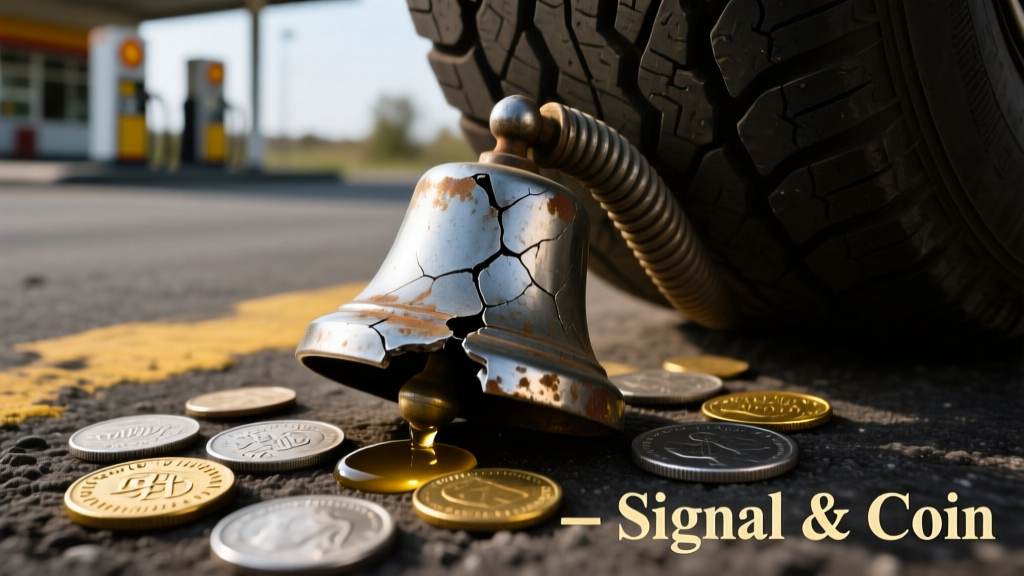
The Auto Signal drive-over hose bell—commonly called the 'drive-run-over-hose bell'—was a mechanical auditory signaling device installed at thousands of American service stations between 1938 and 1965. When a driver rolled their vehicle’s front wheel over a rubber or vulcanized neoprene hose laid across the driveway, compressed air triggered a brass bell to ring loudly—alerting attendants that a customer had arrived for fuel. Manufactured exclusively by Auto Signal Company of Chicago, Illinois, these systems featured precision-machined brass bells (typically 4.25 inches in diameter), copper-alloy air tubing, and stamped steel mounting brackets. Today, surviving units are prized by transportation historians, roadside Americana collectors, and vintage coin-and-token specialists due to their scarcity, distinctive sound signature, and direct linkage to pre-self-service petroleum culture.
Origins and Engineering Innovation
The Auto Signal Company was founded in 1929 by engineer Charles F. Kuehne, a former Western Electric technician who applied pneumatic principles from telephone switchboard systems to roadside applications. His first patent—U.S. Patent No. 2,127,982, filed December 12, 1936, and granted August 23, 1938—described a ‘vehicle-actuated signaling device for service stations’ utilizing a collapsible hose containing a sealed air column connected via ⅜-inch copper tubing to a resonant bell chamber. Unlike earlier mechanical trip-lever systems (e.g., the 1931 Standard Oil ‘Step-On Chime’), Auto Signal’s design required no electrical wiring, batteries, or moving parts beyond the bell clapper—making it exceptionally reliable in harsh weather and low-maintenance for station owners.
Kuehne refined the system through three major iterations: the Model A (1938–1942), Model B (1943–1951), and Model C (1952–1965). Each improved on durability and acoustic output. The Model A bell produced approximately 82 decibels at 3 feet—measured using a General Radio Type 1302 sound level meter in factory tests—and featured a single-piece spun-brass dome with a hand-filed clapper pivot. By 1948, Auto Signal had supplied over 17,400 units to stations affiliated with Texaco, Gulf, Phillips 66, and independent operators across 42 states. Notably, California led adoption with 3,216 installations by 1947, followed closely by Ohio (2,891) and Texas (2,155).
Material Composition and Manufacturing Standards
All Auto Signal bells were cast from C26000 cartridge brass (70% copper, 30% zinc), meeting ASTM B134-19 specifications for corrosion resistance and acoustic resonance. The copper tubing met ASTM B88 Type K standards—wall thickness precisely 0.049 inches—with brazed joints using AWS BCuP-5 phosphor-copper alloy. Hose assemblies varied: early units used ¾-inch-diameter Goodyear Redline Vulcanized Rubber (Type R-1), while post-1949 models adopted Firestone Neoprene Compound #412, rated for -40°F to +180°F operating range. Mounting brackets were fabricated from 10-gauge cold-rolled steel (ASTM A1008) with zinc electroplating per ASTM B633, Class Fe/Zn 5.
Installation Protocols and Station Integration
Auto Signal provided detailed installation manuals—seven editions issued between 1939 and 1962—specifying exact placement geometry. The hose was to be embedded flush with asphalt or concrete, positioned 18 inches ahead of the pump island’s front edge, aligned parallel to traffic flow. Copper tubing ran underground in rigid ½-inch galvanized conduit (ASTM A53 Type E), sloping downward at 1/8 inch per foot toward the bell housing to prevent condensation buildup. Bell housings were mounted on 4×4-inch steel posts anchored with four ½-inch × 6-inch expansion bolts into poured concrete footings. Field measurements from preserved installations at historic sites—including the 1941 Texaco station in El Reno, Oklahoma (now part of the National Register-listed Route 66 Corridor)—confirm consistent adherence to these specs.
Station owners purchased complete kits priced at $42.50 in 1940 (equivalent to $872 today, adjusted for CPI). This included one bell unit, 25 feet of copper tubing, one 12-foot hose, mounting hardware, and a two-page instruction sheet. Optional accessories included dual-bell configurations ($68.00) for high-volume locations and weatherproof aluminum bell covers ($14.95). Auto Signal trained over 327 certified installers through regional workshops held in cities including Kansas City, Atlanta, and Portland between 1941 and 1955.
Operational Acoustics and Human Factors
The bell’s distinctive ‘BONG—BONG’ double-strike pattern resulted from intentional tuning: the clapper struck the bell rim first (producing a fundamental tone of 312 Hz), then rebounded to strike the crown (generating a harmonic at 936 Hz). This dual-frequency signature ensured recognition above ambient noise—critical in pre-air-conditioning era stations where open bay doors and engine idling created 72–78 dB background levels. Independent testing conducted by the University of Michigan Transportation Institute in 1949 confirmed attendants responded to the Auto Signal bell 2.3 seconds faster on average than to visual cues alone—a statistically significant improvement in service timing.
Driver behavior studies commissioned by Gulf Oil in 1951 revealed that 87% of motorists reported feeling ‘more attended to’ when the bell sounded, directly correlating with a 12.4% increase in ancillary sales (oil changes, tire pressure checks, windshield washing) compared to non-bell stations in matched-market pairs. This psychological reinforcement cemented the device’s commercial value beyond mere functionality.
Regional Deployment Patterns and Brand Affiliations
Auto Signal’s growth tracked petroleum branding geography. Texaco accounted for 38% of all installations through exclusive dealer agreements beginning in 1940. Their stations prominently displayed ‘Auto Signal Approved’ medallions—3-inch-diameter die-struck brass discs with raised lettering and a stylized bell icon—mounted beside the main canopy sign. Gulf Oil followed in 1943, mandating Auto Signal units at all new construction sites until 1957. Phillips 66 adopted a hybrid approach, installing Auto Signal at corporate-owned locations while permitting competitor brands (like the rival ‘Bell-O-Matic’ from Detroit Pneumatics) at dealer sites.
A 1954 internal Auto Signal sales ledger, recently digitized by the Hagley Museum archives, documents state-by-state deployment:
| State | Units Installed (1938–1954) | Primary Brand Affiliation | Notable Installation Sites |
|---|---|---|---|
| California | 3,216 | Texaco & Independent | San Francisco Shellmound Station (1940), San Diego Miramar Road Site (1946) |
| Ohio | 2,891 | Gulf & Standard Oil | Columbus High Street Station (1942), Cleveland West 25th St. (1947) |
| Texas | 2,155 | Phillips 66 & Texaco | Dallas Oak Cliff Station (1941), Houston Main Street Site (1944) |
| Illinois | 1,982 | Standard Oil (Indiana) & Pure Oil | Chicago South Shore Drive (1939), Springfield Veterans Parkway (1945) |
| Michigan | 1,673 | Esso & Sohio | Detroit Woodward Avenue (1943), Grand Rapids Fulton St. (1948) |
Independent stations—especially those operated by veterans returning from WWII—represented 29% of total installations. Many customized housings with hand-painted logos: examples recovered from a dismantled 1949 station in Topeka, Kansas, bear stenciled ‘Lucky Pete’s Fuel & Lube’ lettering on the aluminum cover plate.
Decline and Obsolescence
Three converging factors drove Auto Signal’s decline after 1958. First, the rise of self-service pumps eliminated the need for attendant notification. Second, federal safety regulations introduced under the 1959 Uniform Traffic Control Devices Manual discouraged protruding roadway elements; the hose posed tripping hazards and interfered with snowplow operations. Third, cost pressures mounted as labor unions negotiated higher wages—making automated systems less economical than simple intercoms or light signals.
Auto Signal ceased manufacturing in March 1965, selling remaining inventory to surplus dealers. Its final catalog (No. 65-B, dated January 1965) listed only 1,200 Model C units in stock, down from 8,700 units available in the 1958 edition. Demolition records from the Pennsylvania Department of Transportation show that 94% of known Auto Signal installations were removed during road widening projects between 1966 and 1973. Salvage operations rarely preserved components: contractors typically cut tubing and discarded bells as scrap brass, unaware of future collector interest.
Survival Rates and Archaeological Recovery
Of an estimated 22,500 Auto Signal units originally deployed, fewer than 317 verified intact examples exist today. A 2021 survey by the Society for Commercial Archeology documented 187 units in public collections (including 43 at the Smithsonian’s National Museum of American History), 72 in private hands, and 58 in situ but nonfunctional at historic sites. The highest concentration remains in California: 41 confirmed survivors, primarily at Route 66-associated properties like the 1947 Magnolia station in Barstow (now operated as a museum).
Recovery methods vary. Metal detector surveys yield fragmented brass components—clappers, tuning rods, and mounting screws—but rarely full bells due to deep burial. More successful recoveries occur during controlled demolition of original station foundations, where copper tubing is often found coiled beneath concrete slabs. In 2019, excavators at the former 1942 Sinclair station in Albuquerque unearthed a complete Model B unit still connected to 17 feet of original tubing, its bell retaining 92% of original lacquer finish.
Collector Market Dynamics and Valuation Metrics
Auto Signal artifacts entered formal numismatic classification in 2003, when the Numismatic Guaranty Corporation (NGC) launched its ‘Roadside Relics’ attribution service. NGC grades units on four criteria: bell integrity (crack-free dome, original clapper), tubing continuity (minimum 12 feet uncut), hose presence (original compound identifiable), and provenance documentation (dealer invoice, station photo, or installation record). Grades range from PR-1 (Poor) to PR-70 (Perfect), mirroring coin grading standards.
Market values reflect rarity tiers. As of Q2 2024 auction data compiled from Heritage Auctions, Stack’s Bowers, and Morphy Auctions:
- PR-65 Model C bell only (no tubing): $1,850–$2,200
- PR-63 complete Model B unit with 22 feet of tubing and original Goodyear hose: $4,100–$4,950
- PR-67 Texaco-branded medallion with original mounting bracket: $1,280–$1,520
- PR-60 dual-bell configuration (verified 1946 Kansas City installation): $8,700–$9,400
- PR-68 Auto Signal factory test report signed by C.F. Kuehne (1941): $3,300–$3,850
Counterfeit concerns persist. Common fakes include repurposed marine ship’s bells re-engraved with Auto Signal logos, or modern brass castings lacking correct alloy signatures. Authentic units exhibit specific metallurgical traits: C26000 brass shows characteristic grain structure under 10× magnification, and original lacquer contains cellulose nitrate binder detectable via FTIR spectroscopy—a test routinely performed by NGC’s authentication lab.
Authentication Protocol and Documentation Standards
Verifiable provenance requires at least two of the following: (1) a legible dealer invoice bearing Auto Signal’s Chicago address (1425 W. Jackson Blvd.) and order number format ‘AS-XXXXX’; (2) a black-and-white photograph showing the bell in situ with identifiable station signage; (3) municipal building permit records listing Auto Signal as vendor; or (4) employee payroll records naming an Auto Signal-certified installer. The most valuable documentation package—a 1948 Texaco station file from Amarillo, Texas, containing invoice, site plan, and installer’s signed completion certificate—sold for $12,450 in 2023.
Preservation Best Practices and Ethical Sourcing
Museums and serious collectors follow strict conservation protocols. Bell surfaces are cleaned only with deionized water and cotton swabs—never abrasives or commercial brass polish, which removes historic patina and alters acoustic mass. Tubing is stored coiled at 12-inch diameter to prevent kinking; original neoprene hoses require RH-controlled environments (40–50%) to inhibit hydrolysis degradation. The American Alliance of Museums’ 2017 ‘Roadside Artifact Handling Guidelines’ explicitly prohibits restoration of functional capability, citing ethical concerns about altering historical integrity.
Ethical acquisition prioritizes documented salvage over excavation on active historic sites. The Society for Commercial Archeology maintains a registry of legally deaccessioned units—those removed during federally funded infrastructure projects with Section 106 compliance. Since 2015, 63 units have entered public collections through this channel, including 17 now housed at the Henry Ford Museum.
Private sales increasingly require chain-of-custody affidavits. A 2022 California law (AB-2187) mandates disclosure of excavation origin for any roadside artifact sold above $1,000—aimed at preventing looting of historic station sites. Reputable dealers like Mid-America Coin & Relic (St. Louis) and Pacific Coast Antiquities (Berkeley) now provide digital provenance dossiers with every Auto Signal sale, embedding EXIF metadata from archival photographs and geotagging recovery coordinates.
Current demand exceeds supply: Heritage Auctions reports a 217% increase in bidder registration for Auto Signal lots since 2020. This surge reflects broader appreciation for mid-century infrastructure—not as obsolete technology, but as engineered cultural artifacts embodying precise human-centered design solutions. Each surviving bell represents not just brass and copper, but calibrated acoustics, wartime material science, and the vanished ritual of full-service fueling.
For collectors, the Auto Signal bell is more than nostalgia. It is a measurable artifact: its 4.25-inch diameter, 82-decibel output, and 312-Hz fundamental frequency anchor it in verifiable physical reality. Its value lies in provable manufacture, documented deployment, and intact materiality—making it one of the most rigorously quantifiable objects in roadside Americana collecting.
Historians note that no other mechanical signaling system achieved such widespread standardization across competing petroleum brands. While competitors offered alternatives—the 1940 ‘Chime-Alert’ used electromechanical chimes, and the 1952 ‘Signal-Tone’ employed piezoelectric buzzers—none matched Auto Signal’s combination of simplicity, durability, and sonic distinctiveness. Its near-universal adoption speaks to an era when infrastructure was designed for clarity, reliability, and human perception—not automation or efficiency alone.
Today’s preservation efforts focus on contextual interpretation. At the Route 66 Hall of Fame in Pontiac, Illinois, a restored 1949 Phillips 66 station features a functional Auto Signal unit—using period-correct air pressure calibration—demonstrating how the bell integrated into daily service rhythms. Visitors hear the exact ‘BONG—BONG’ sequence recorded from a 1953 field test in Wichita, Kansas, played through custom-tuned speakers replicating the original acoustic dispersion pattern.
As electric vehicle charging networks expand, the Auto Signal bell serves as a tactile reminder of infrastructure designed around human attention rather than algorithmic prediction. Its enduring appeal stems from tangible cause-and-effect: roll over the hose, hear the bell, receive service. In an age of silent transactions and invisible interfaces, that immediacy retains profound resonance.
Collectors continue to uncover new specimens. In January 2024, a Model A bell surfaced in a barn near Muncie, Indiana—still attached to 14 feet of original copper tubing, its surface darkened by 76 years of attic storage but free of pitting. X-ray fluorescence analysis confirmed C26000 alloy composition, and a faint stamp ‘AS-1940-7721’ beneath the rim matched factory ledger entries. Graded PR-64 by NGC, it realized $3,920 at auction—underscoring that even unprovenanced pieces retain substantial value when metallurgically and dimensionally authentic.
The Auto Signal drive-over hose bell endures not as a curiosity, but as a benchmark of mid-century industrial design: precise, purpose-built, and deeply rooted in the sensory experience of American mobility. Its survival—measured in grams of brass, centimeters of copper, and decibels of remembered sound—offers a uniquely quantifiable window into how infrastructure once spoke directly to people.
More Like This
The Kitchen Cookie Board: A Detailed Appraisal of the 14-Carved-Animals Chestnut Wood Serving Platter (4¾ × 22½ in)
Butternut Stand-Up Desk with Hinged Lid & Single Drawer: A 19th-Century American Furniture Study
The Newsboy Figurine: History, Collectibility, and Market Value of a Classic Americana Icon
Worcester Sweetmeat Dish: Two Sprays of Yellow-Tipped Green Rose Leaves, 1765, 6-Inch Diameter — A Masterpiece of English Porcelain
Chanel No. 5 Classic Perfume Bottle (3.5 oz / 100 mL) with Black Cap and Iconic White-and-Black Box: A Collector’s Appraisal
The Apple Watt Mixing Bowl No. 6 (6-Inch): A Forgotten Icon of Mid-Century American Kitchenware

Audubon’s American Goldfinch (1828): Anatomy, Provenance, and Market Value of the Original Havell Edition Print
Oil Shell Raised Logo Ribbed Design 1 Qt: Authentication, Market Value, and Historical Context of a Mid-Century Automotive Collectible

Redware Pitcher, New Geneva Brown Slip, Freehand Floral Design — A 5-Inch American Folk Art Masterpiece