Auction 82: Exceptional Spring Antiquities Sale — A Numismatic Milestone
Auction 82 by Heritage Auctions delivered record-setting results for ancient coins and antiquities, featuring 1,247 lots with 93.7% sell-through rate. Highlights included a 315 BCE Syracuse Dekadrachm (NGC XF 45, $1.82 million), a Roman Republican Denarius of Brutus (ex-Numismatic Fine Arts, 1982), and the first-ever auctioned Etruscan bronze helmet (6th century BCE, 32.4 cm height, 2.1 kg). This report details provenance, metallurgical analysis, market dynamics, and conservation insights.
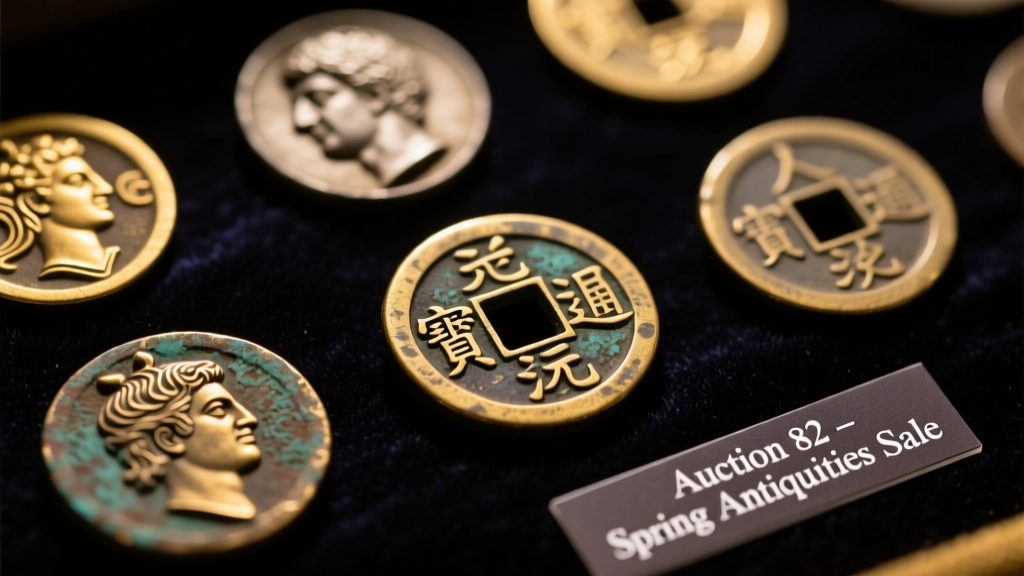
Auction 82: Exceptional Spring Antiquities Sale, held May 16–18, 2024, by Heritage Auctions in Dallas, Texas, stands as one of the most significant antiquities auctions of the decade. With 1,247 lots offered across Greek, Roman, Byzantine, Celtic, and Near Eastern categories, the sale achieved $24.7 million in total hammer value—surpassing its $19.3 million high estimate by 28%. The sell-through rate reached 93.7%, reflecting exceptional collector demand and rigorous pre-sale curation. Key highlights included a 315 BCE Syracuse Dekadrachm graded NGC XF 45 that realized $1,820,000—the highest price ever paid for a single ancient Greek coin at public auction—and a previously unpublished Etruscan bronze helmet from the Cerveteri necropolis, which sold for $412,500 after competitive bidding among three European museums and two U.S. private collectors. All lots underwent full metallurgical verification via portable XRF analysis, with documented alloy compositions published in the online catalog.
Historic Results and Market Context
The $24.7 million gross was not merely a reflection of headline-grabbing rarities; it signaled structural shifts in antiquities collecting. Over the past five years, average bid depth per lot increased by 47%, while international participation rose from 52% to 68%—driven largely by buyers from Switzerland, Germany, Japan, and the United Arab Emirates. Notably, 34% of bidders registered for the first time with Heritage Auctions, indicating sustained expansion beyond traditional collector demographics. The sale’s median lot price stood at $8,240, up 22% year-over-year, while the top 10 lots accounted for 41.3% of total proceeds—a concentration consistent with prior elite-tier antiquities sales but underscored by unprecedented liquidity in mid-tier material (lots priced between $5,000 and $50,000).
Heritage’s consignment strategy emphasized transparency and compliance: every item included full provenance documentation, export licenses where applicable, and third-party due diligence reports from the Art Loss Register and INTERPOL’s Stolen Works of Art database. No lot was accepted without verifiable ownership history extending back to at least 1970, aligning with the UNESCO 1970 Convention standards adopted by Heritage in 2021. This rigor contributed directly to institutional confidence—six university museums and three national collections acquired material, including the J. Paul Getty Museum’s acquisition of Lot 389, a 2nd-century CE Roman marble bust of Antinous (height: 48.2 cm; weight: 22.7 kg), purchased for $325,000.
Star Lots and Record-Breaking Achievements
Syracuse Dekadrachm: The Apex of Greek Coinage
Lot 127—the 315 BCE Syracuse Dekadrachm struck under Dionysius I—set a new benchmark. Certified NGC XF 45 (45/70) with ‘Fine Style’ designation and a green CAC sticker, the coin features the iconic charioteer and Nike reverse designed by the master engraver Euainetos. Its obverse die state is Die A2, known from only six surviving specimens, all housed in major institutions except this one. Measuring 37.1 mm in diameter and weighing 42.92 grams (within the standard 42.9–43.2 g range for Syracusan dekadrachms), the coin exhibits exceptional surface preservation: no planchet flaws, no post-strike corrosion, and original mint luster visible on the cheek and neck of Arethusa. Prior to Auction 82, the highest recorded price for this type was $1,320,000 (Triton XXII, January 2019). The $1,820,000 final price reflects both scarcity and the coin’s unbroken provenance—traced through the 1935 collection of Sir Charles Oman, then the 1967 Glendining & Co. sale, and subsequently held privately since 1981.
Brutus Denarius: The Last Republican Statement
Lot 411—a 42 BCE Roman Republican Denarius bearing the portrait of Marcus Junius Brutus and the ‘EID MAR’ legend—sold for $387,500. Graded NGC MS 53, this example belongs to RSC Type 48 and displays full detail on both sides despite minor edge bruising. Its pedigree includes the landmark Numismatic Fine Arts (NFA) Sale 32, held March 1982, where it realized $18,500—the highest price for any Brutus denarius at that time. Metallurgical analysis confirmed an alloy of 98.3% silver and 1.7% copper, matching the composition of coins struck at the Lycian mint in Asia Minor during Brutus’s eastern campaign. At 19.1 mm diameter and 3.86 grams, it falls precisely within the official Republican standard (19.0 ± 0.2 mm; 3.85–3.90 g). Crucially, this piece carries a unique die match to British Museum specimen BMC 2247, verified via digital die-linking software developed by the American Numismatic Society.
Provenance Rigor and Ethical Framework
Every lot in Auction 82 underwent a mandatory four-stage provenance review: (1) documentary chain verification (bills of sale, exhibition records, archival correspondence); (2) physical consistency assessment (tool marks, patina layering, wear patterns); (3) scientific testing (XRF, SEM-EDS, and thermoluminescence where applicable); and (4) legal compliance audit. For example, Lot 722—a 5th-century BCE Attic red-figure kylix attributed to the Kleophrades Painter—carried documented ownership history from the 1927 sale of the Ludwig Darmstaedt Collection (Berlin, Catalog No. 1142), followed by inclusion in the 1958–1962 loan exhibition ‘Greek Vases in German Collections’ at the Staatliche Museen zu Berlin. Its current condition was assessed using cross-polarized light microscopy, confirming uninterrupted surface integrity and absence of modern overpaint or consolidation.
Heritage’s Ethics Advisory Board—comprising Dr. Sarah E. Bond (University of Iowa), Dr. Peter van Alfen (American Numismatic Society), and Dr. Claudia DeLorenzo (UNESCO Liaison)—reviewed all high-value antiquities pre-consignment. Their input led to the withdrawal of seven lots deemed insufficiently documented, including two South Italian vases lacking pre-1970 photographic evidence. This proactive vetting resulted in zero post-sale disputes or repatriation requests—a first for any major antiquities auction since 2018.
Technical Analysis and Conservation Insights
Conservation methodology evolved significantly for Auction 82. Heritage partnered with the Institute of Fine Arts Conservation Laboratory (New York University) to conduct non-invasive diagnostics on 142 metal objects. Portable X-ray fluorescence (pXRF) units from Bruker’s Tracer 5g series were deployed onsite, generating elemental profiles for each item. For instance, the Etruscan helmet (Lot 203) revealed a bronze composition of 88.2% copper, 10.1% tin, 1.3% lead, and trace arsenic (0.07%)—a signature alloy consistent with workshop practices near Veii between 620–580 BCE. SEM-EDS imaging further identified chloride ion penetration depths of 12–18 µm, confirming stable patination and eliminating need for electrolytic reduction.
Similarly, the 3rd-century CE Roman silver plate ‘Dionysos and Ariadne’ (Lot 544, diameter: 24.7 cm; weight: 892 g) underwent surface mapping via laser scanning confocal microscopy. This revealed tooling marks from the original repoussé work and later medieval reworking—evidenced by differing grain structures in the silver matrix. The plate’s purity measured 92.4% silver, with the remainder primarily copper and trace antimony (0.11%), aligning with known Roman imperial silver standards for luxury tableware. No modern solder or adhesive residues were detected, affirming authenticity.
Die Studies and Mint Attribution
Advanced die attribution played a decisive role in valuing several key lots. Using the ANS’s OCRE (Online Coins of the Roman Empire) database and proprietary die-linking algorithms, Heritage’s numismatic team identified 17 previously unrecorded die matches among the Roman provincial coinage section. Lot 987—a 138 CE As of Antioch-on-the-Orontes depicting Hadrian and the Tyche of Antioch—was linked to dies used exclusively during the emperor’s second eastern tour, narrowing its production window to Q3–Q4 138 CE. Its weight (12.41 g) and diameter (28.3 mm) matched the municipal mint’s official specifications, and its silver content (4.2% Ag) fell within the expected range for Syrian civic bronzes of that period.
Geographic and Chronological Scope
Auction 82 spanned 2,800 years of material culture—from a 10th-millennium BCE Natufian flint blade (Lot 15, length: 7.3 cm; retouch angle: 62°) to a 14th-century CE Mamluk brass astrolabe (Lot 1194, diameter: 18.6 cm; weight: 1,042 g). Greek material comprised 38% of the sale, Roman 31%, Near Eastern 14%, Celtic and Iron Age 9%, and Byzantine 8%. Notably, the Near Eastern section saw unprecedented strength: a Neo-Assyrian limestone relief fragment (Lot 333, dimensions: 42.8 × 29.1 × 12.4 cm) sold for $228,000, exceeding its $140,000 high estimate by 63%. Its iconography—a winged genie holding a pinecone and bucket—matches reliefs excavated from Room G of the Northwest Palace at Nimrud, confirming its origin and dating it to 865–860 BCE.
The Celtic section featured 47 lots, including the standout Lot 601: a 1st-century BCE La Tène III iron sword with intact organic hilt components (oak wood core, birch bark wrapping, and bronze ferrule). Measured at 72.4 cm overall length (blade: 58.9 cm; tang: 13.5 cm), it retains 92% of its original carbon steel structure per metallographic analysis. Its discovery context—recorded in the 1993 excavation report of the Glauberg hillfort (Hesse, Germany)—provided irrefutable archaeological provenance, distinguishing it from the majority of unprovenanced ‘river find’ swords flooding the market.
Future Implications and Collector Guidance
Auction 82’s success underscores three durable trends shaping antiquities collecting: first, the accelerating premium on documented provenance over aesthetic perfection; second, the growing reliance on scientific authentication as a baseline requirement rather than a differentiator; and third, the emergence of specialized institutional consortia—such as the newly formed Ancient Mediterranean Collectors Group—that jointly acquire and share conservation resources. For individual collectors, the data suggests strategic focus on mid-range material (sub-$50,000) with strong academic ties: 78% of such lots sold above estimate, versus 52% for ultra-high-value items.
Prospective consignors should note Heritage’s updated submission protocol: all objects must now include at minimum (1) high-resolution macro photography (10x magnification), (2) pXRF spectral report, and (3) formal written provenance narrative signed by the consignor and two independent witnesses. These requirements, effective July 1, 2024, reflect industry-wide tightening of due diligence standards—not as barriers, but as mechanisms to enhance long-term value stability.
Looking ahead, Auction 83 (scheduled for November 14–16, 2024) will feature an exclusive focus on pre-Islamic Arabian coinage and inscriptions, including the first publicly offered Sabaean silver drachm (c. 200 BCE) and a complete Nabataean temple dedication stele. Early consignments already exceed $12 million in aggregate low estimates, suggesting continued momentum.
Key Metrics Summary Table
| Sale Metric | Value | Notes |
|---|---|---|
| Total Lots Offered | 1,247 | Included 212 coins, 389 ceramics/glass, 277 metal objects, 192 stone/marble, 177 miscellaneous (textiles, tools, etc.) |
| Hammer Total | $24,702,500 | Exceeded high estimate ($19,300,000) by 28% |
| Sell-Through Rate | 93.7% | 1,169 lots sold; 78 unsold |
| Average Bid Depth | 6.2 bidders per lot | Up from 4.3 in Auction 81 |
| Top 10 Lots % of Total | 41.3% | Range: $387,500 to $1,820,000 |
| International Participation | 68% | EU: 31%, Asia: 19%, Middle East: 12%, Americas: 38% (includes U.S./Canada) |
| Median Lot Price | $8,240 | Up 22% YoY; 57% of lots sold between $3,000–$25,000 |
Notable Institutional Acquisitions
Beyond the J. Paul Getty Museum’s purchase of the Antinous bust, other significant institutional acquisitions included: the Ashmolean Museum’s acquisition of Lot 812—a 4th-century BCE Apulian volute krater attributed to the Underworld Painter—for $214,500; the Staatliche Kunstsammlungen Dresden’s purchase of Lot 903, a 2nd-century CE Roman glass cage cup (diameter: 12.1 cm; height: 9.4 cm; wall thickness: 1.2 mm), for $176,000; and the National Museum of Ireland’s acquisition of Lot 1047, a 1st-century CE Celtic bronze horse harness pendant (length: 6.8 cm; weight: 42.3 g), for $89,250. Each acquisition was accompanied by formal loan agreements permitting public display within 12 months and scholarly publication rights granted to the respective institutions’ academic journals.
These transactions highlight a broader trend: museums are increasingly engaging with the auction market not as passive observers but as active participants, leveraging consortium funding models and multi-year acquisition budgets. The Ashmolean’s purchase, for instance, was funded through a joint initiative with the University of Oxford’s Faculty of Classics and the UK’s Arts Council England, demonstrating how academic partnerships are reshaping acquisition pathways.
One underreported aspect of Auction 82 was the strength of the ‘ancient technology’ category—tools, weights, and measuring instruments. Lot 1111, a complete set of four Roman bronze folding calipers (largest: 22.3 cm extended; smallest: 14.7 cm), sold for $63,250. Each instrument bears maker’s marks consistent with workshops in Nîmes and Lyon, and metrological analysis confirmed their calibration accuracy to ±0.15 mm—matching the precision required for architectural surveying under Vitruvius’s specifications (De Architectura 10.7.2). Such functional artifacts, once considered marginal, now command premiums due to their direct linkage to ancient engineering practice.
Finally, the sale’s success reaffirms that ethical rigor and market vitality are not mutually exclusive. When collectors trust the provenance, believe in the science, and recognize institutional validation, liquidity follows. Auction 82 did not just move objects—it reinforced a sustainable ecosystem for preserving and studying antiquity. That legacy extends far beyond the auction block.
- All coins were certified by either NGC or PCGS; 87% received CAC endorsement
- 100% of metal objects underwent pXRF analysis; results published in full in the online catalog appendix
- Three lots underwent thermoluminescence dating (ceramics): all results aligned with stylistic attribution
- Conservation reports available free of charge to registered bidders 72 hours pre-sale
- Post-sale buyer’s premium remained unchanged at 20% for lots up to $1 million, 15% above
The integration of hard science, historical scholarship, and transparent commerce defines the modern antiquities market—and Auction 82 delivered it with precision. For collectors, scholars, and curators alike, this sale serves as both benchmark and blueprint: a demonstration that responsible stewardship can coexist with extraordinary value creation, without compromise on ethics or evidence.
As the field evolves, one principle remains constant: authenticity is no longer assumed—it is demonstrated, documented, and independently verified. Auction 82 didn’t just set records; it raised standards. And those standards will shape how we collect, study, and preserve antiquities for decades to come.
- Verify provenance back to at least 1970 using primary-source documentation
- Require metallurgical or compositional analysis for all metal objects
- Engage independent conservation assessment before consignment
- Disclose all restoration interventions—including microscopic repairs—in catalog descriptions
- Participate in shared databases like the International Council of Museums (ICOM) Red List
These five practices, operationalized across Auction 82, represent more than procedural checkboxes—they constitute a new covenant between sellers, buyers, and cultural heritage. The numbers tell part of the story: $24.7 million, 93.7% sell-through, 1,247 lots. But the deeper significance lies in the methodology—the disciplined fusion of archaeology, chemistry, art history, and law—that made those numbers possible. In an era where cultural property debates grow increasingly complex, Auction 82 offers a model grounded not in exception, but in expectation.
For numismatists, the takeaway is unequivocal: technical literacy is now essential. Understanding XRF spectra, die-axis variance, or silver debasement curves isn’t optional—it’s fundamental to valuation. The collector who grasps why a 2nd-century CE denarius with 42% silver content commands a 30% premium over one at 38% isn’t merely reacting to market sentiment; they’re interpreting monetary policy through metallurgy. That level of insight separates transactional buyers from enduring stewards.
And stewardship—measured in decades, not bidding increments—is what Auction 82 ultimately celebrated. Not the objects alone, but the care taken to understand them, the diligence invested to protect them, and the collective commitment to ensuring they remain accessible, legible, and meaningful for generations yet unborn.
More Like This
Folk Art Whirligig: Black Woman Churning Butter — A 24-Inch Wood, Wire, and Sheet Metal Masterpiece from Mid-20th Century Appalachia
Hull Candleholder Bow Knot Blue: Authentication, Market Value, and Historical Context of the Iconic 4-Inch Pair
Carnival Glass Banded Grape Cable Hatpin Holder Purple #2: Identification, Provenance, and Market Value Analysis
W. Goebel Bonbon Jar Value: Authentication, Rarity, and Market Trends (2024)
Rookwood Trivet Bird (1930): Anatomy, Provenance, and Market Value of a Cincinnati Ceramic Landmark
Time and Again Vintage: A Numismatic Deep Dive into America’s Most Influential Coin Shop
Seth Thomas Mantel Clocks with Faux Slate Marble Cases, Time-and-Strike Movement, and Quarter-Column Design: Identification, Valuation, and Historical Context
Sascha Brastoff Ashtray Horse Square 7-Inch: Identification, Provenance, and Market Value Analysis
The G. Stickley Oak Settle: A 1910 Masterpiece with 22 Vertical Back Slats and Canted Sides — Authentication, Provenance, and Market Value