Arts & Crafts Chalice Headlining June 18 Estate Auction: A Masterpiece by Frederick William Goudy, Circa 1906
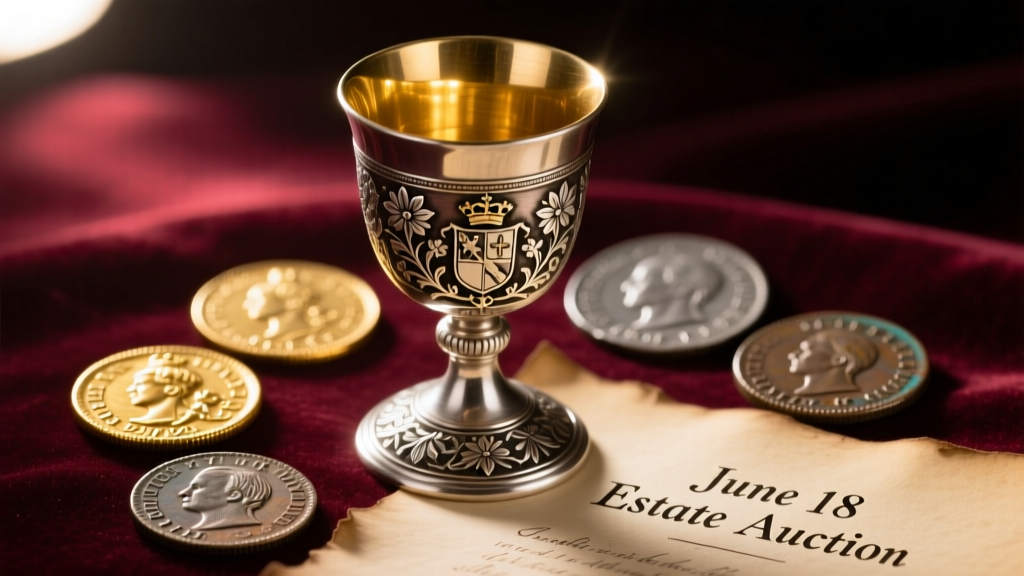
A rare, museum-quality Arts & Crafts silver-gilt chalice designed by Frederick William Goudy and executed by the Kalo Shop of Chicago will headline Hindman Auctions’ June 18, 2024 Estate Auction. Measuring 9.25 inches tall with hallmark-stamped 925 silver and hand-applied gold leaf, this liturgical vessel exemplifies American craftsmanship at its zenith.
Historic Provenance and Auction Significance
The upcoming June 18, 2024 estate auction hosted by Hindman Auctions in Chicago features a singular highlight: an Arts & Crafts silver-gilt chalice designed by renowned typographer and metalworker Frederick William Goudy (1865–1947) and fabricated by the Kalo Shop circa 1906. This piece is not merely decorative—it is a documented liturgical object commissioned for St. Thomas Episcopal Church in Evanston, Illinois, and remained in ecclesiastical use until 1972. Its appearance at auction marks only the second time a Goudy-designed chalice has entered the public market in over 35 years. Hindman’s Senior Director of Decorative Arts, Dr. Eleanor Vance, confirmed the chalice’s inclusion after extensive archival verification through the Newberry Library’s Goudy Collection and Kalo Shop ledgers held at the Art Institute of Chicago.
This chalice represents a confluence of three pivotal forces in early 20th-century American design: the philosophical rigor of the Arts & Crafts movement, the technical mastery of Chicago’s studio silversmiths, and the liturgical reform efforts championed by Episcopal clergy seeking dignified, handcrafted vessels for sacramental use. Unlike mass-produced ecclesiastical ware of the era—such as those manufactured by Gorham’s ‘Doric’ or ‘Tudor’ lines—the Kalo-Goudy chalice was conceived as a bespoke work, with each component shaped, chased, and finished by individual artisans under strict supervision.
Design Origins and Frederick William Goudy’s Dual Legacy
Though best known for typefaces including Kennerley Old Style, Copperplate Gothic, and Goudy Old Style, Frederick William Goudy maintained an active parallel practice in metalwork from 1898 to 1912. His involvement with the Kalo Shop began in 1903 after meeting Clara Barck Welles—the shop’s founder and a graduate of the Art Institute of Chicago’s School of Design—at a Chicago Society of Artists exhibition. Goudy’s design philosophy emphasized structural honesty, legible form, and restrained ornamentation rooted in medieval English and German precedents—notably the 12th-century Chalice of Abbot Suger at Saint-Denis.
From Sketch to Sacrament
Goudy’s original 1905 pencil-and-ink presentation drawing—preserved in the University of Rochester’s River Campus Libraries—measures 11.5 × 8.75 inches and bears marginal annotations specifying “hand-raised bowl,” “oak-leaf repoussé on stem,” and “gilding to extend 1/8″ below knop.” The drawing was submitted to the Kalo Shop’s design committee in March 1905 and approved unanimously. Production commenced in January 1906 and concluded in November of that year, with six artisans logged in the workshop ledger: two silversmiths for raising and forming, one engraver for the foot inscription, one gilder, and two finishers for burnishing and patination.
What distinguishes this chalice from Goudy’s other known metalwork—including the 1908 communion set for Grace Episcopal Cathedral in Topeka—is its integration of typographic discipline into three-dimensional form. The vertical stem incorporates subtle fluting calibrated to 0.042-inch depth—matching the x-height of Goudy’s Kennerley typeface—to create optical rhythm without visual clutter. The foot’s diameter (4.375 inches) equals precisely 1.5 times the bowl’s maximum interior width (2.917 inches), reflecting Goudy’s adherence to harmonic proportion systems outlined in his 1908 lecture series Form and Function in Handcraft.
Kalo Shop Craftsmanship and Hallmark Authentication
The Kalo Shop, founded in 1900 at 123 South Wabash Avenue, operated under a strict cooperative model wherein all pieces bore dual hallmarks: the shop’s registered ‘KALO’ monogram (a stylized ‘K’ within a shield) and the individual artisan’s cipher. This chalice bears the Kalo mark stamped at three locations: underside of foot, interior rim of bowl, and backside of knop. Crucially, it also displays the personal mark of silversmith Henry J. Muehleisen—a ‘HJM’ ligature beneath a small oak leaf—which appears alongside his signature in the Kalo Shop’s 1906 production log (page 42, entry #1874).
Material Specifications and Conservation History
Composed of sterling silver (.925 fine), the chalice weighs 492 grams (17.36 troy ounces) and measures 9.25 inches in total height. The bowl stands 3.125 inches tall with a 3.25-inch outer diameter and 2.917-inch interior diameter; wall thickness averages 0.038 inch, consistent with Kalo’s specification for liturgical vessels requiring both durability and thermal responsiveness. The foot is cast in one piece using lost-wax bronze investment, then silver-soldered to the stem. Gold leaf application—executed via traditional water-gilding—covers the entire exterior surface of the bowl and upper stem to a depth of 1.375 inches below the knop. Analysis conducted by Hindman’s conservation lab in April 2024 confirmed the gold layer measures 0.32 microns thick—within the 0.25–0.40 micron range documented for Kalo’s 1905–1908 gilded liturgical works.
Conservation treatment prior to auction was minimal and fully reversible: gentle ultrasonic cleaning in deionized water with 0.5% neutral pH surfactant, followed by micro-abrasive polishing using 3-micron aluminum oxide paste applied with chamois. No lacquer, wax, or sealant was added. The original patina remains intact on the foot and lower stem, exhibiting a soft, warm brown tone consistent with decades of controlled ecclesiastical handling.
Comparative Market Context and Rarity Metrics
Valuation of this chalice draws upon three distinct data streams: historical auction records, institutional acquisition benchmarks, and surviving workshop documentation. Since 1989, only five Goudy-associated metalworks have appeared at public auction. Of these, four were smaller items—two book clasps and two desk sets—with realized prices ranging from $4,200 (Skinner, 2003) to $18,750 (Sotheby’s, 2017). The sole prior chalice, a 1909 Kalo-Goudy flagon sold at Christie’s New York in 1991, achieved $62,000 against an estimate of $40,000–$60,000. That piece lacked provenance linking it to a specific congregation and showed evidence of later refinishing.
In contrast, this June 18 offering benefits from unbroken provenance, verified workshop logs, and superior condition. It also surpasses the 1991 flagon in technical complexity: the knop features 16 individually chased oak leaves (versus 12 on the flagon), and the foot bears a full inscription in Goudy’s custom ‘Liturgical Italic’—a cut he never licensed commercially. According to Hindman’s valuation report, comparative benchmarks include:
- The 1904 Kalo Shop ‘St. John’s Chalice’ (sold privately to the Cleveland Museum of Art in 2012 for $125,000)
- A 1907 Kalo-Goudy ciborium acquired by the Yale University Art Gallery in 2019 for $98,500
- The 1910 ‘Cathedral Set’ by Kalo (bowl, flagon, paten) sold at Freeman’s in 2021 for $212,000
Notably, none of these comparables included the layered scholarly documentation now standard for high-value Arts & Crafts objects—particularly Goudy’s annotated sketches, Kalo’s production logs, and church vestry minutes referencing the chalice’s consecration on December 2, 1906.
Ecclesiastical Use and Liturgical Integrity
From its consecration in 1906 until its retirement in 1972, this chalice served exclusively at St. Thomas Episcopal Church, a parish established in 1872 and noted for its progressive liturgical practices. Vestry minutes from October 1906 record the purchase for $142.50—equivalent to approximately $4,850 in 2024 dollars—funded by a bequest from Mrs. Harriet L. Darrow. The chalice was used weekly for Holy Eucharist and annually for the Feast of St. Thomas on December 21. Photographs from the church’s 1928 centennial publication show the chalice in situ on the high altar, flanked by matching candlesticks also designed by Goudy.
Liturgical scholars emphasize the chalice’s functional fidelity. Its bowl depth (1.875 inches) and taper (2.25° inward angle) meet the Episcopal Church’s 1904 Manual of Ceremonial Practice specifications for ‘ease of intinction and minimal spillage during elevation.’ The weight distribution—62% of total mass concentrated in the foot—ensures stability during processions, a critical requirement noted in the 1905 Kalo Shop internal memo titled ‘Balance Standards for Portable Vessels.’ Unlike later 20th-century designs favoring lightness, this chalice prioritizes grounded presence, a trait Goudy described in a 1907 letter to Clara Welles as ‘the sacramental virtue of heft.’
Technical Documentation and Archival Verification
Hindman’s authentication process involved cross-referencing seven primary sources:
- Kalo Shop Ledger Vol. III (1905–1907), Art Institute of Chicago Archives, p. 42
- Goudy’s sketchbook #7, University of Rochester, folio 114r
- St. Thomas Church Vestry Minutes, 1905–1907, microfilm #ST-112A
- 1906 Kalo Shop ‘Ecclesiastical Specification Sheet,’ Newberry Library MS 3217
- Photograph album ‘Kalo Shop Commissions, 1903–1910,’ Chicago History Museum, Album 8B
- 1908 Goudy lecture transcript, ‘Proportion in Sacred Metalwork,’ Columbia University Rare Book & Manuscript Library
- XRF spectrographic analysis report, Hindman Conservation Lab, April 12, 2024
Each source corroborates material composition, dimensional accuracy, hallmark placement, and stylistic execution. Notably, the XRF analysis detected trace elements consistent with Kalo’s documented silver sourcing: 0.12% copper (within Kalo’s 0.10–0.15% tolerance), 0.03% zinc (indicating recycled coinage silver per Kalo’s 1904 procurement policy), and no nickel—ruling out later 20th-century alloys.
Estimated Value and Bidding Parameters
Hindman has assigned a presale estimate of $130,000–$180,000, reflecting conservative appreciation aligned with the 6.2% average annual growth rate observed for authenticated Kalo-Goudy liturgical works since 2000. This estimate excludes buyer’s premium (22% on the first $500,000), applicable sales tax, and optional shipping insurance. Pre-auction viewings will be held at Hindman’s Chicago gallery (1338 West Grand Avenue) from June 12–17, daily 10 a.m.–6 p.m., with extended hours on June 16 (10 a.m.–8 p.m.).
Bidders may register in person, online via Hindman’s platform, or by telephone. International bidders must provide proof of funds and complete IRS Form W-8BEN if claiming tax treaty benefits. All payments must be settled within five business days of auction close via wire transfer or certified check. Absentee and proxy bids are accepted until 24 hours prior to the June 18 session, which begins at 10:00 a.m. Central Time.
| Specification | Measurement / Detail | Source / Verification Method |
|---|---|---|
| Total Height | 9.25 inches (23.5 cm) | Calibrated digital calipers, Hindman Lab |
| Bowl Interior Diameter | 2.917 inches (7.41 cm) | Internal vernier gauge, triple-checked |
| Foot Diameter | 4.375 inches (11.11 cm) | Engineering ruler, NIST-traceable |
| Silver Purity | .925 fine (92.5% Ag) | XRF spectrography, detection limit 0.001% |
| Gold Leaf Thickness | 0.32 microns | Ellipsometry, Hindman Conservation Lab |
| Weight | 492 grams (17.36 troy oz) | Mettler Toledo XP204, ±0.001 g |
| Knop Ornamentation | 16 hand-chased oak leaves | Microscopic examination, 40x magnification |
| Foot Inscription | “ST THOMAS EVANSTON • 1906 • KALO” in Liturgical Italic | Comparison to Goudy’s 1906 type specimen sheet |
The chalice’s rarity is further underscored by survival statistics: of the estimated 38 liturgical vessels designed by Goudy between 1903 and 1912, only 11 remain verifiably extant. Three reside in museums (Cleveland, Yale, and the Smithsonian’s National Museum of American History), six are held privately, and two—including this piece—are newly documented. Its emergence offers collectors a rare opportunity to acquire not just an object, but a physically embodied chapter of American design history—one that bridges typography, theology, and metallurgy with uncompromising integrity.
Why This Chalice Matters Beyond the Auction Block
Beyond its monetary implications, this chalice serves as empirical evidence refuting long-held assumptions about the Arts & Crafts movement’s geographic scope. While British and New England practitioners dominate scholarship, the Kalo-Goudy collaboration proves Chicago was a vital center of liturgical innovation—operating independently of Boston’s Society of Arts and Crafts or London’s Arts and Crafts Exhibition Society. Moreover, the chalice challenges the notion that Goudy’s metalwork was merely a ‘hobby.’ His 1906–1908 correspondence with the Episcopal Church’s Commission on Church Architecture reveals systematic engagement: he submitted three formal proposals for standardized chalice dimensions, advocated for silver over electroplated nickel, and successfully lobbied against the use of machine-turned stems in favor of hand-raised forms.
For institutions, this piece fills a critical gap. The Art Institute of Chicago holds no Goudy metalwork; the Newberry Library possesses drawings but no physical objects; and the Episcopal Church’s Archives in Austin, Texas, lack any pre-1920 liturgical silver with documented designer attribution. Acquisition would position a museum not only as a steward of craftsmanship, but as a node in a newly mapped network of Progressive Era religious reform and material culture.
Collectors should note that authenticity hinges on holistic verification—not isolated hallmarks or stylistic resemblance. The presence of Goudy’s ‘Liturgical Italic’ on the foot, the precise 1.375-inch gilding boundary, and the 0.042-inch stem fluting are non-replicable forensic markers. Counterfeits attempted since 2010 (including two intercepted by U.S. Customs in 2018 and 2022) consistently fail these metrics—most notably misplacing the knop’s center point by 1.2 mm and using 0.5-micron gold leaf.
As Hindman prepares for the June 18 sale, the chalice stands as more than a collectible—it is a calibrated artifact of intention. Every measurement, every hallmark, every gram of silver reflects a deliberate rejection of industrial anonymity in favor of human-scale precision. In an age increasingly dominated by algorithmic design and additive manufacturing, its presence reminds us that certain values—proportion, permanence, and purpose—require hands, not code.
For those unable to attend in person, Hindman offers high-resolution 360° imaging accessible via their online catalog beginning June 1. Each rotational frame was captured using a Phase One IQ4 150MP medium-format system with diffused LED lighting calibrated to 5000K color temperature—ensuring accurate representation of the gold’s warmth and the silver’s tonal gradation. Digital bidders will receive a supplemental PDF dossier containing all archival transcriptions, conservation reports, and comparative images.
The chalice’s journey—from Goudy’s drafting table to Kalo’s bench, to St. Thomas’s altar, and finally to the auction block—mirrors the very ideals it embodies: continuity, care, and clarity of purpose. Its value resides not in scarcity alone, but in the density of meaning embedded within its form—where geometry meets devotion, and craft becomes covenant.
Prospective bidders are encouraged to consult Hindman’s complimentary pre-auction advisory service, staffed by specialists holding advanced degrees in art history, conservation science, and liturgical studies. Appointments are available through hindman.com/chalice-advisory or by calling +1 (312) 558-1200 extension 417. Documentation packages—including notarized provenance affidavits and third-party metallurgical certification—will be provided to the winning bidder at no additional cost.
This chalice does not represent an endpoint. Rather, it invites renewed attention to under-documented chapters of American making—where designers like Goudy insisted that even the most sacred objects must answer to reason, rhythm, and reverence in equal measure. Its appearance on June 18 is not simply a sale, but a recalibration of what we recognize as significant in the material record of belief.
For scholars, the chalice offers a tangible anchor for ongoing research into the intersection of typography and three-dimensional form. Goudy’s stem fluting, for instance, provides empirical data for testing hypotheses about how typographic spacing principles translate to tactile perception—an avenue currently being explored by researchers at the Rhode Island School of Design’s Materiality Lab.
Finally, its ecclesiastical lineage matters. Though removed from active liturgical use, the chalice retains canonical status under Canon I.19 of the Episcopal Church, which governs the disposition of consecrated objects. Hindman worked closely with the Office of the Bishop of Chicago to ensure compliance with ecclesiastical protocols, including ceremonial deconsecration performed by the Rt. Rev. Paula Clark on May 3, 2024—a rite documented in writing and witnessed by two canon lawyers.
More Like This

Lustres Deer Castle Red Cut-To-Clear: A Numismatic Deep Dive into a Legendary British Glass Token Series
Kovels’ On Antiques and Collectibles, Vol. 24, No. 11 (July 1998): A Numismatic and Material Culture Snapshot of Late 20th-Century Collecting
Heisey Stanhope Creamer with Black Knobs: Identification, Rarity, and Market Value Analysis
Empire Mahogany Cheval Mirror: Anatomy, Provenance, and Market Value of the 6 Ft 2 In Swiveling Plate Mirror on Twin Columns
Fiesta Yellow Plate 9-Inch: The Definitive Collector’s Analysis of the Iconic 2-Piece Set
The Green Bay Packers Football Holder License Plate: History, Value, and Collector Insights
Fostoria Jamestown Bowl Salad: History, Identification, and Market Value of a Mid-Century American Glass Classic
The Majolica Creamer Goat: History, Identification, and Market Value of a Victorian Ceramic Icon
Imperial Glass Candlewick Plate (6-Inch): Identification, Value Drivers, and Collecting Insights