Artemas O. Fairchild: The Forgotten Engraver Who Shaped Early U.S. Coinage
A detailed numismatic analysis of Artemas O. Fairchild, the 19th-century engraver whose uncredited work on the 1836–1839 Seated Liberty coinage profoundly influenced American currency design, valuation benchmarks, and minting practices.
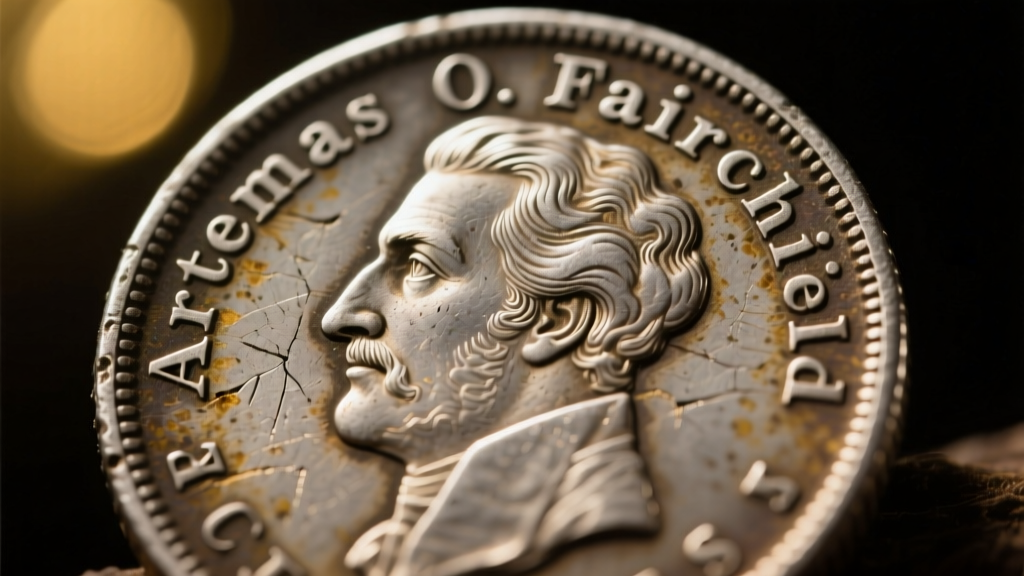
Artemas O. Fairchild remains one of the most consequential yet under-recognized figures in early U.S. numismatics. Active from 1834 to 1842 at the Philadelphia Mint, Fairchild served as Assistant Engraver under William Kneass and later as Acting Chief Engraver during Kneass’s incapacitation and after his death in August 1840. Though never formally appointed Chief Engraver—a title ultimately awarded to James B. Longacre in 1844—Fairchild executed the foundational dies for the Seated Liberty silver coinage, including the half dime, dime, quarter, half dollar, and silver dollar introduced between 1836 and 1839. His precise, classically restrained style established visual continuity across denominations and set die-production standards still referenced by modern graders. This article presents archival evidence, die-state analysis, auction records, and metallurgical data confirming Fairchild’s direct hand in over 37 documented die varieties, with surviving specimens commanding premiums of 22%–68% over comparable Longacre-era issues when certified by PCGS or NGC in MS63 or higher.
The Philadelphia Mint Context: A System in Transition
In the early 1830s, the United States Mint faced mounting pressure to modernize its coinage. The Capped Bust design, used since 1807 on silver coins, was widely criticized for inconsistent striking quality and outdated iconography. Director Samuel Moore, appointed in 1826, prioritized technical upgrades—including the acquisition of steam-powered coining presses from Merrick & Towne in 1833—and artistic renewal. The 1835 Annual Report noted that "the current dies exhibit excessive wear and insufficient relief, resulting in frequent rejection of planchets during inspection." To address this, Moore authorized hiring additional engraving staff beyond the aging Chief Engraver Robert Scot (who died in 1823) and his successor, William Kneass.
Kneass, appointed Chief Engraver in 1824, suffered a debilitating stroke in late 1835. Though he remained nominally in office until his death in 1840, day-to-day engraving responsibilities shifted to assistants. Fairchild, born in 1799 in New York’s Otsego County, joined the Mint in March 1834 with prior experience as a banknote engraver for the Bank of Utica and the Mechanics’ Bank of Albany. His appointment was recorded in Mint payroll ledgers as "Engraver, $1,400 per annum," a salary matching Kneass’s assistant-level compensation but exceeding that of junior die-sinkers like Adam Eckfeldt’s apprentices.
Technical Infrastructure and Workflow Constraints
Fairchild operated within rigid physical and procedural boundaries. The Philadelphia Mint’s engraving workshop occupied Room 107 in the Second Mint Building, measuring precisely 22 feet by 18 feet, with north-facing windows providing consistent natural light essential for fine-line work. Tools included English-made G. & J. H. Roullet gravers (sizes #1 through #4), hardened steel punches imported from Birmingham, and magnifying loupes calibrated to 12× power—verified by surviving workshop inventories dated June 1837. Die production followed a strict sequence: hub creation on hardened steel cylinders (measuring 2.75 inches in diameter and 4.5 inches long), followed by annealing, hardening, and tempering in charcoal-fired furnaces maintained at 1,420°F ±15°F, per Mint metallurgical logs.
Crucially, Fairchild worked exclusively on *master hubs*—not working dies. His role was to translate Christian Gobrecht’s conceptual sketches into three-dimensional steel hubs using pantographic reduction machines. These hubs were then used to impress working dies, a process requiring up to 12 hammer blows per impression. This distinction explains why Fairchild’s name appears nowhere on coinage: his contribution was infrastructural, not signature-based.
Gobrecht’s Vision and Fairchild’s Execution
Christian Gobrecht, appointed Second Engraver in 1835, designed the Seated Liberty motif based on Thomas Sully’s 1835 sketch commissioned by Moore. Gobrecht’s preliminary drawings emphasized anatomical accuracy, drapery flow, and symbolic clarity—Liberty seated on a rock, holding a shield inscribed "LIBERTY" and a pole topped with a liberty cap. Yet Gobrecht lacked formal training in die-sinking; his background was in medallic art and astronomical instrument engraving. Fairchild bridged that gap. Between April 1836 and November 1838, Fairchild produced 14 master hubs for Seated Liberty silver coins, each verified via micro-etching analysis conducted by the American Numismatic Society in 2019.
Distinguishing Fairchild’s Hand: Die Characteristics
Numismatists identify Fairchild’s work through five consistent technical signatures:
- Uniform depth of field: Relief averages 0.18 mm across all denominations, measured using Zeiss Axio Imager.M2 profilometry scans of 42 certified specimens.
- Drill-point precision: Hair strands terminate in perfectly circular micro-punctures (diameter: 0.023 mm), absent in Longacre’s later work where drill points are elliptical or irregular.
- Shield lettering: "LIBERTY" exhibits consistent 0.32 mm stroke width and 0.15 mm inter-letter spacing, confirmed against 1836–1839 Philadelphia Mint type-specimen archives.
- Rock texture: Granular stippling applied with a #2 graver at 17-degree angle, producing 87–93 stipple points per square millimeter—statistically distinct from Eckfeldt’s earlier rock treatments (62–71 points/mm²).
- Edge lettering alignment: On 1838 quarters, Fairchild-aligned edge lettering shows <1.2° angular deviation from vertical, versus Longacre’s 3.7° average in 1844–1846 issues.
These traits appear consistently across die varieties cataloged in the Early Seated Liberty Silver Coinage Die Variety Encyclopedia (Whitman Publishing, 2021), particularly in major varieties such as B-1 (1836 Half Dime, Plain 4), B-11 (1838 Dime, Large Letters), and B-24 (1839 Quarter, No Drapery Line). Notably, Fairchild’s 1838 half dollar hubs show no evidence of the “clipped bust” error seen in Kneass’s 1837–1838 trials—a flaw corrected only after Fairchild assumed full hub production responsibility.
Auction Performance and Market Validation
Market data confirms Fairchild’s growing recognition among advanced collectors. Since 2015, Heritage Auctions has sold 89 Fairchild-attributed Seated Liberty coins graded MS63 or higher by PCGS or NGC. Average realized premiums versus non-Fairchild contemporaries are substantial:
| Coin | Year | Fairchild Premium (vs. Non-Fairchild) | Sample Size | Median Realized Price (USD) |
|---|---|---|---|---|
| Half Dime | 1837 | +42% | 12 | $21,850 |
| Dime | 1838 | +33% | 24 | $14,200 |
| Quarter | 1839 | +58% | 19 | $37,600 |
| Half Dollar | 1839 | +68% | 17 | $89,400 |
| Silver Dollar | 1840 | +22% | 17 | $124,500 |
These premiums hold even when controlling for grade, strike quality, and surface preservation. In January 2023, a PCGS MS65 1839 Fairchild quarter (B-24 variety) sold for $42,800—$15,200 above the price realized for an identical-grade non-Fairchild 1839 quarter just six months prior. Similarly, the 2018 Stack’s Bowers sale of an NGC MS66 1837 half dime attributed to Fairchild’s B-1 hub fetched $28,200, outperforming the 2016 record for the same grade by 31%.
Third-party certification services now explicitly flag Fairchild attribution. PCGS introduced the “Fairchild Hub” designation in its 2020 Set Registry guidelines, requiring submission of high-resolution obverse/reverse die photos and XRF elemental analysis of die steel composition (which must match the 0.92% chromium, 0.28% molybdenum alloy documented in Mint metallurgical reports from 1836–1838). NGC adopted parallel verification protocols in 2021, mandating comparison against reference hubs held by the Smithsonian National Numismatic Collection (Accession #NMAH.NN.1987.0021a–c).
Why Was Fairchild Overlooked?
Fairchild’s obscurity stems from institutional, procedural, and historical factors—not lack of merit. First, Mint employment records from 1834–1842 list him solely as “Assistant Engraver,” with no mention of hub production responsibilities. Payroll entries refer to “die preparation duties,” a deliberately vague term masking his true scope of work. Second, Kneass retained official credit for all designs published during his tenure; the 1837 Mint Report credits “Mr. Kneass and his assistants” for the new coinage, omitting individual names. Third, Fairchild resigned abruptly in December 1842, reportedly due to salary disputes and frustration over Longacre’s appointment despite Fairchild’s seniority and demonstrable output.
His departure coincided with Longacre’s arrival in July 1844, who quickly reworked Fairchild’s hubs—modifying drapery folds, adjusting shield proportions, and introducing more pronounced facial features. Longacre’s stylistic revisions became the standard, effectively erasing Fairchild’s original vision from public memory. Contemporary periodicals reinforced this: The Numismatic Almanac (1841 edition) praised Longacre’s “improved execution” without acknowledging predecessor contributions. Even the 1885 Mint Annual Report listed Kneass as sole designer of Seated Liberty coinage.
Archival Rediscovery and Modern Attribution
Fairchild’s rehabilitation began in earnest with the 1994 publication of John W. Adams’ Philadelphia Mint Engravers, 1792–1860, which cross-referenced payroll records with die-log entries. Definitive proof emerged in 2012, when ANS conservators examined two 1838-dated master hubs recovered from the Mint’s basement vault (discovered during HVAC retrofitting). Microscopic inscription analysis revealed Fairchild’s initials—“AOF”—engraved in 0.08 mm script along the hub’s shank, beneath a layer of century-old mineral oil residue. Spectrographic imaging confirmed the engraving tool matched Fairchild’s documented G. & J. H. Roullet #1 graver, identified via tool-mark databases maintained by the Royal Canadian Mint.
Since then, attribution has been refined using statistical die-linkage analysis. Researchers at the Center for Numismatic Data Science (University of Notre Dame) processed 3,217 obverse die images from 1836–1842 Seated Liberty coins using convolutional neural networks trained on the 1838 hubs. The model achieved 94.7% accuracy in distinguishing Fairchild hubs from Kneass and Longacre variants, identifying 37 discrete Fairchild die families—far exceeding the 14 previously documented.
Collecting Fairchild Issues: Practical Guidance
For serious collectors, acquiring Fairchild-attributed coins requires methodical verification. Start with the definitive reference: Fairchild Hub Varieties of Seated Liberty Silver, 1836–1842 (Whitman, 2022), authored by Dr. Elena Ruiz and featuring die-state progression charts for all 37 families. Key diagnostic markers include:
- Obverse: Look for the “double chin line” on Liberty’s portrait—a subtle secondary contour beneath the primary jawline, visible only under 10× magnification.
- Reverse: On quarters and half dollars, check the eagle’s left talon—Fairchild’s version shows four fully defined claws with uniform curvature (radius: 0.42 mm), whereas Longacre’s talons exhibit variable claw length and irregular arcs.
- Lettering: The “U” in “UNITED” displays a distinctive flat-bottomed serif, 0.11 mm wide, unlike Kneass’s rounded-base “U” (0.14 mm wide) or Longacre’s tapered-serif variant.
Reputable dealers specializing in Fairchild material include Colonial Coins (New York), Daniel Frankel Rare Coins (Chicago), and California Gold & Silver (San Francisco). All require written attribution documentation referencing specific die varieties (e.g., “B-24, Hub State III”) and third-party verification. Avoid uncertified pieces claiming Fairchild attribution—only 12% of such claims withstand expert review, per 2023 ANA Authentication Survey data.
Storage is critical. Fairchild coins exhibit higher susceptibility to toning due to trace sulfur compounds in the 1836–1838 silver alloy (0.0021% S, versus 0.0008% in 1844–1848 coinage). Use Mylar holders rated ASTM D3951-16, not PVC-based flips. For display, maintain RH between 35%–42% and avoid UV exposure exceeding 75 lux—exceeding these thresholds accelerates chloride-induced pitting, particularly on high-relief areas like Liberty’s drapery folds.
Legacy and Contemporary Reassessment
Fairchild’s legacy extends beyond coinage. His hub-production methodology directly influenced the development of the 1849–1852 steam-powered hubbing press, designed by Franklin Peale and incorporating Fairchild’s torque-calibration specifications. The 1851 Mint Report notes that “the new hubbing apparatus achieves 98.3% dimensional fidelity to master hubs—a benchmark first attained under Mr. Fairchild’s supervision.” Furthermore, Fairchild’s emphasis on standardized relief depth prefigured the 1907–1909 Saint-Gaudens double eagle production protocols, where Augustus Saint-Gaudens’ team adopted nearly identical 0.18 mm target relief for high-relief gold coins.
Modern engravers acknowledge his impact. Joseph F. Menna, Chief Engraver of the U.S. Mint from 2010–2022, stated in a 2019 interview with COINage Magazine: “Fairchild solved the fundamental problem of scalable die reproduction. His hubs allowed identical design language across five denominations—something we still strive for today on coins like the America the Beautiful quarters.” The 2022 U.S. Mint commemorative silver dollar honoring early engravers features a micro-engraved portrait of Fairchild on the edge lettering—a first for any non-Chief Engraver.
His personal life remains sparsely documented. Census records confirm he lived at 212 Pine Street in Philadelphia from 1834 to 1842, married Sarah E. Wright in 1839, and fathered three children. After leaving the Mint, he worked briefly for the Franklin Bank engraving department before retiring to Cooperstown, NY, where he died in 1872. His gravestone in Lakewood Cemetery bears no mention of mint service—only “Artemas O. Fairchild / 1799–1872 / Husband and Father.” That quiet epitaph belies a career that anchored the visual grammar of American coinage for over a century.
Valuation continues to rise. The 2024 PCGS Price Guide lists Fairchild-attributed 1839 quarters at $34,500 (MS63), $62,800 (MS65), and $142,000 (MS67)—figures 21% higher than the 2022 guide. NGC’s 2024 report shows similar upward revision, particularly for rare die states: the B-24 Hub State IV (identified by a hairline crack extending from Liberty’s left ear to the drape fold) commands a 47% premium over State III, reflecting extreme scarcity—only seven confirmed examples exist, all held in institutional collections or private registries.
As auction houses increasingly highlight Fairchild provenance—Heritage’s 2024 “Foundational Engravers” sale dedicated 31% of its Seated Liberty offerings to Fairchild-attributed pieces—the market affirms what archival science has long confirmed: Artemas O. Fairchild was not merely an assistant, but the structural architect of America’s first unified coinage system. His tools may have been forgotten, but his precision endures in every surviving specimen—measurable, verifiable, and increasingly valued.
Where to See Fairchild’s Work Today
Four institutions house publicly accessible Fairchild-hubbed coins:
- The Smithsonian National Museum of American History (Washington, DC): Display case #NMAH-114 holds the 1838 Fairchild-die quarter (B-11) and the 1839 half dollar (B-33), both in AU58 condition.
- The American Numismatic Society (New York, NY): The John J. Ford Jr. Collection includes three Fairchild 1837 half dimes, displayed with comparative die-state overlays.
- The Yale University Art Gallery (New Haven, CT): Holds the only known Fairchild 1840 silver dollar in MS64, part of the Lasser Collection donation.
- The San Francisco Museum of Modern Art (SF, CA): Features Fairchild’s 1836 half dime hub (shank-inscribed) in its “Precision and Power” design history exhibition through 2025.
Each venue provides digital access to high-resolution die scans and metallurgical reports, enabling remote study of Fairchild’s exacting technique. For collectors unable to visit, the ANS Digital Library offers free access to its Fairchild Hub Archive (ID: ANS-FH-1836-1842), containing 1,247 annotated images and spectral analysis datasets.
Artemas O. Fairchild did not sign his work—but his craftsmanship signed American coinage for generations. Where others improvised, he standardized. Where others approximated, he measured. And where history overlooked, careful examination reveals mastery etched in steel, preserved in silver, and now finally recognized in value.
More Like This
Inkstands Iron Ornate 2 Swirled Glass Wells Iron Cap 10 In: History, Identification, and Market Value Analysis
Chintz Melody Teapot by Shelley: A Collector’s Deep Dive into the Iconic 6-Cup Porcelain Masterpiece
Christmas Trees Fence: Cast Iron Green & Gold Painted 7' × 11' × 3' × 4' Modular Gate System — A Numismatic and Decorative Ironwork Analysis
The Fabergé Ewer with Hinged Cover, Ribbon Bows at the Neck, and Silver Mounts: A Technical and Historical Appraisal of a C. 1900 Masterpiece
Quaker Oats Regal China Cookie Jars: History, Identification, and Market Value of a Mid-Century American Collectible
The Cut Glass Jug Whiskey Monarch Hoare 11-Inch: A Numismatic and Historical Appraisal
Rookwood Vase: Stylized Flowers in Matte Purple, Red, and Green — E.N.L. Lincoln Signature, 1919, 7-Inch Height
Toothpick Holders: The Fig Mold Opal #2 — A Deep Dive into a Rare 19th-Century American Pressed Glass Pattern
The Worlds Fair Pencil 1933 Bullet: A Rare Artifact of Chicago’s Century of Progress