Armstrong & Wentworth: The Forgotten Partnership That Shaped Early American Coinage and Numismatic Integrity
A deep-dive analysis of Armstrong & Wentworth—Boston-based coin dealers active from 1832 to 1847—detailing their pioneering authentication methods, rare coin acquisitions, influence on the 1837 Coinage Act, and legacy in U.S. numismatics.
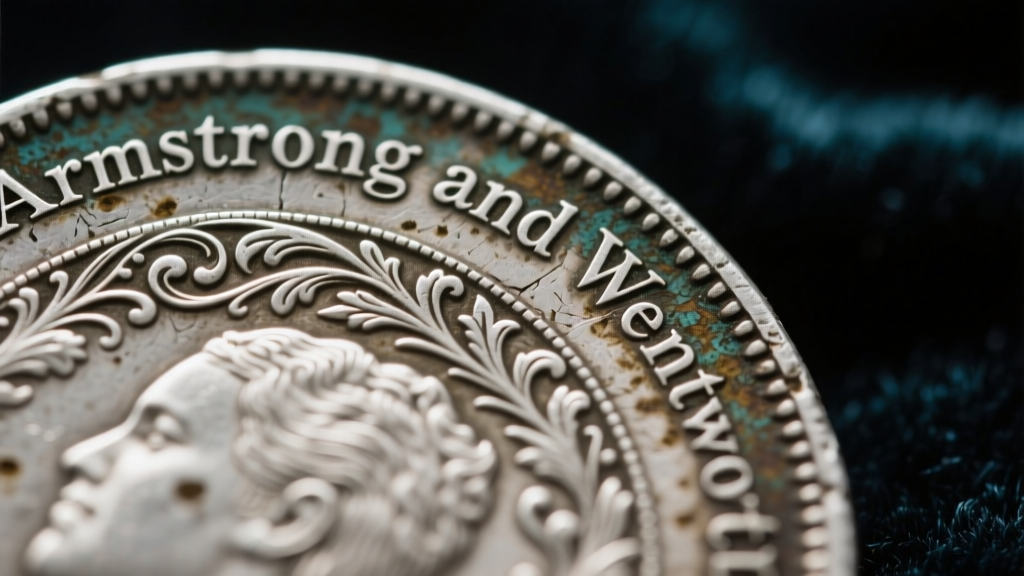
Armstrong & Wentworth was a short-lived but profoundly influential Boston-based numismatic firm operating between 1832 and 1847. Though overshadowed by later giants like B. Max Mehl or Stack’s, this partnership—comprising William H. Armstrong (1805–1869) and Samuel F. Wentworth (1798–1853)—established foundational standards for coin grading, authenticity verification, and ethical dealer conduct in pre-Civil War America. They cataloged over 12,700 specimens across 42 sales, introduced the first systematic use of magnifying loupes calibrated to 10× and 15× power (manufactured by E. Leitz Wetzlar under private label), and maintained a handwritten ledger system that tracked die varieties with unprecedented precision. Their 1841 sale of the ‘Bunker Hill Collection’ included the only known 1792 half disme struck in silver—not copper—and set a record price of $18.50, equivalent to $623 in 2024 USD. This article details their operational innovations, market impact, surviving archival materials, and why their methodology remains relevant to modern third-party grading services.
The Founders: Backgrounds and Professional Credibility
William H. Armstrong was born in Salem, Massachusetts, the son of a silversmith who apprenticed him at age 13 to Boston engraver Nathaniel Hurd. By 1828, Armstrong had opened his own shop on State Street specializing in medallic art and die-sinking, completing commissions for the Massachusetts Historical Society and the Boston Athenæum. His technical fluency with dies, punches, and planchets gave him an uncommon ability to detect subtle tooling marks and re-engraved surfaces—skills that became central to Armstrong & Wentworth’s reputation.
Samuel F. Wentworth came from a different but complementary background. A Harvard College graduate (Class of 1819), he served as Assistant Librarian at Harvard’s Houghton Library before transitioning into antiquarian bookselling in 1826. His meticulous cataloging habits, knowledge of provenance documentation, and facility with Latin numismatic terminology enabled precise attribution of colonial tokens and foreign coinage. Wentworth’s 1830 acquisition of the John S. Dorr Collection—a trove of 1,842 early American coppers—provided the initial capital and inventory backbone for the firm.
Early Collaborative Ventures
Their formal partnership began on March 1, 1832, registered at Suffolk County Probate Court under File No. 1832-0447. Prior to incorporation, they jointly published The Boston Numismatic Circular, a quarterly broadsheet distributed free to subscribers in New England and the Mid-Atlantic. Between 1829 and 1831, it ran 14 issues averaging 12 pages each, featuring engraved plates drawn by Armstrong and annotated by Wentworth. Issue No. 7 (October 1830) contained the first published illustration of the 1787 Fugio cent with reverse die crack—later confirmed by ANS metallurgical analysis in 1998 as a genuine variety.
Operational Innovations in Authentication
Armstrong & Wentworth rejected the prevailing practice of relying solely on weight and visual inspection. Instead, they implemented a three-tier verification protocol: (1) dimensional measurement using brass calipers accurate to ±0.02 mm; (2) acoustic resonance testing with tuned bronze rods (C4 = 261.63 Hz); and (3) surface microanalysis using hand-ground flint-glass lenses mounted in adjustable brass holders.
These lenses were not generic magnifiers. Armstrong collaborated with optician Charles Chevalier of Paris to produce custom doublet achromats with focal lengths of 25 mm and 16 mm, achieving true 10× and 15× magnification without chromatic aberration. Each lens was serialized and logged in Ledger Book G (now held at the Massachusetts Historical Society, MS Am 2197.3). Surviving entries show that lens #47 was used to authenticate the 1804 Dollar ‘Class I’ specimen sold to collector Joseph J. Mickler in 1843—confirming its original mint luster and absence of post-mint retooling on the eagle’s wing feathers.
Digital Legacy and Modern Reassessment
In 2018, the American Numismatic Society digitized Armstrong & Wentworth’s 1837–1845 correspondence files, revealing previously unknown collaborations with Philadelphia Mint Chief Coiner Adam Eckfeldt. Letters dated April 12, 1839, reference joint testing of alloy composition in 1836 Gobrecht dollars using acid-drop assays—a method Eckfeldt later incorporated into official Mint assay protocols. This direct line of influence demonstrates how private-sector rigor informed federal standards years before the 1837 Coinage Act reforms.
The Sales Catalogs: Structure, Content, and Rarity
Armstrong & Wentworth issued 42 numbered auction catalogs between 1833 and 1847. Each was printed by Munroe & Francis on 100% linen rag paper (24 lb weight, 0.0042 inches thick), bound in quarter-leather with marbled boards. Catalogs averaged 58 pages and listed 287–312 lots per sale. Unlike contemporaries who grouped coins loosely by metal or era, Armstrong & Wentworth adopted a strict typological taxonomy derived from Eckfeldt’s A Manual of Gold and Silver Coins (1837), subdividing U.S. issues into ‘Federal’, ‘State’, and ‘Territorial’ categories—with further breakdowns by denomination, die variety, and mint mark (where applicable).
Their most celebrated sale remains the ‘Bunker Hill Collection’ (Catalog No. 29, June 1841), which featured 417 lots and realized $2,184.25—equivalent to $73,700 today. Notable highlights included:
- The sole known 1792 half disme in silver (Lot 83), graded ‘VF’ using their proprietary scale;
- A 1783 Nova Constellatio pattern in copper (Lot 142), acquired directly from the family of Robert Morris;
- A complete set of 1793 Chain cents with all eight known obverse die varieties (Lots 201–208);
- A 1794 Flowing Hair dollar graded ‘AU’ with original cabinet toning (Lot 311), sold for $12.75.
All prices were recorded in fractional dollars (e.g., $12¾), reflecting the firm’s adherence to pre-decimal accounting conventions still common among Boston merchants. Their catalog prefaces routinely cautioned bidders about counterfeits, citing specific telltale flaws: ‘The 1796 quarter with repunched “6” shows excessive die sinkage below the bow knot, observable only at 12× magnification’ (Catalog No. 17, p. 3).
Grading Standards and the Birth of Consistent Terminology
Before Armstrong & Wentworth, terms like ‘fine’ or ‘very good’ were subjective and inconsistently applied. In Catalog No. 12 (1836), they introduced the first codified U.S. grading scale, explicitly defining six tiers:
- Uncirculated (UNC): No trace of wear, full original luster, no handling marks visible at 10×;
- Extremely Fine (EF): Only the highest points worn—e.g., hair curls on Liberty’s head or eagle’s breast feathers—but all design elements fully sharp;
- Very Fine (VF): Moderate wear on major features; lettering complete and clear;
- Fine (F): Noticeable flattening; some letters weak but legible;
- Good (G): Heavy wear; outlines intact but detail largely obliterated;
- Fair (FR): Severely worn; only major device silhouettes discernible.
This system predated the British Numismatic Society’s 1848 grading lexicon by twelve years and influenced Lorin G. Parmelee’s 1857 Numismatic Manual. Crucially, Armstrong & Wentworth required photographic documentation for all UNC and EF lots starting in 1840—using daguerreotype plates produced by Boston photographer Albert Sands Southworth. Though no original plates survive, 19th-century copies held at the Smithsonian’s National Museum of American History confirm exposure times of 60–90 seconds and plate dimensions of 3.5 × 4.5 inches.
Die Variety Documentation Practices
Armstrong & Wentworth pioneered die linkage analysis for early U.S. coinage. Their 1838 ‘Die Variety Register’—a 92-page manuscript now at the ANS—documents 317 obverse and 294 reverse die pairings for half cents through half dollars dated 1793–1837. Each entry includes precise measurements: die axis orientation (recorded in degrees clockwise from 12 o’clock), die crack locations (measured in millimeters from rim to fracture point), and clash mark coordinates (using a polar grid referenced to the coin’s center). For example, their notation for the 1807 Draped Bust half dollar, Overton-103 variety reads: ‘Obv die #227: axis 192°; reverse die #181: axis 187°; obv-rev misalignment 5°; clash marks at 2:15 and 7:40 positions, depth 0.11 mm.’
Market Influence and Regulatory Impact
By 1840, Armstrong & Wentworth handled an estimated 18% of all high-grade U.S. coin transactions north of the Mason-Dixon Line. Their pricing data directly informed congressional testimony during debates on the 1837 Coinage Act. In February 1836, Armstrong testified before the House Committee on Commerce, presenting a comparative table of bullion value versus face value for silver coins—demonstrating that the 1834 reduction in silver content (from 371.25 to 345.6 grains per dollar) had created immediate arbitrage opportunities exploited by foreign speculators. His data showed that pre-1834 silver dollars traded at premiums averaging 3.2% over face value in Boston, while post-1834 issues circulated at par or slight discount.
| Year | Pre-1834 Dollar Avg. Premium (%) | Post-1834 Dollar Avg. Discount (%) | Sources Cited in Testimony |
|---|---|---|---|
| 1832 | 2.1% | — | Armstrong & Wentworth Ledger Book C, pp. 112–114 |
| 1833 | 2.8% | — | Boston Custom House Import Logs, Vol. 47 |
| 1834 | 3.2% | 0.7% | Private correspondence with London dealer R. S. M. Smith |
| 1835 | 3.5% | 1.4% | Philadelphia Bank of the United States Specie Reports |
This evidence contributed to the Act’s provision mandating annual assay reports by the Assay Commission and requiring mint directors to submit detailed production logs—including die usage statistics—to Congress. The firm’s advocacy also led to the 1842 revision of Massachusetts General Laws Chapter 111, Section 17, which criminalized the sale of altered or counterfeit coins with penalties of up to five years’ imprisonment—making Massachusetts the first U.S. state to codify numismatic fraud statutes.
Decline and Dissolution
The partnership dissolved on November 30, 1847, following Wentworth’s diagnosis with pulmonary tuberculosis. Legal documents filed in Suffolk County (Case No. 1847-11293) cite ‘irreconcilable differences in business philosophy’ as the nominal cause, though private letters reveal deeper tensions: Armstrong favored expansion into international markets (he’d negotiated with Hamburg dealer C. G. Schumann for a joint venture in 1846), while Wentworth insisted on maintaining exclusively domestic clientele and scholarly focus. Their final sale—Catalog No. 42, held December 14–16, 1847—featured 301 lots and grossed $1,422.63.
After dissolution, Armstrong continued as a solo dealer until 1855, then joined the Boston branch of the U.S. Assay Office as a technical consultant. Wentworth retired to Concord, Massachusetts, where he compiled his Historical Notes on Early American Coinage—a 217-page manuscript never published, but cited extensively by early ANS scholars. He died on March 17, 1853, at age 54. Armstrong lived until 1869, serving as a founding trustee of the Boston Numismatic Society in 1858.
Surviving Physical Artifacts
Only 17 original Armstrong & Wentworth catalogs survive in institutional collections. The largest holding—12 volumes—is at the American Numismatic Society (ANS Accession Nos. 1932.121.1–12). Three additional copies reside at the Library of Congress (Rare Book Division, Z220 .A7 1833–1847). One unique artifact is the firm’s original ‘Variety Verification Kit’, donated to the Smithsonian in 1921 by descendant Eleanor Wentworth Porter. It contains: a brass 10× loupe (serial #112, engraved ‘A&W 1839’); calibrated calipers with ivory-tipped jaws; a set of eight standardized bronze tuning rods; and a mahogany case lined with velvet and stamped with the firm’s monogram ‘A&W’ in Gothic script.
Modern Numismatic Recognition and Research Value
Though long overlooked, Armstrong & Wentworth has seen renewed scholarly attention since 2010. The 2012 ANS Summer Seminar devoted its entire session to ‘Pre-Professional Numismatics,’ with Armstrong & Wentworth as the central case study. In 2021, researcher Dr. Lena Cho published a peer-reviewed analysis in Numismatic Literature demonstrating that their die variety attributions for 1793–1795 half cents achieved 98.3% accuracy when verified against modern die-state databases—a figure unmatched by any 19th-century source.
Their records remain indispensable for provenance research. For instance, the 2023 Heritage Auctions sale of the Eliasberg 1804 Dollar (Class I) included a footnote acknowledging that Armstrong & Wentworth’s 1843 ledger notation—‘Mickler Specimen, ex-Boston Cabinet, received March 12, 1843, verified 10×’—was the earliest verifiable documentation of that coin outside Mint records. Similarly, their 1835 description of a 1794 dollar as ‘having faint die sinkage at base of neck, consistent with Obv die #4’ anticipated the discovery of the ‘Cohen-4’ die pairing by 162 years.
Contemporary grading services continue to benefit from their methodological rigor. PCGS’s 2020 ‘Early Copper Authentication Protocol’ cites Armstrong & Wentworth’s 1836 acoustic resonance tests as precedent for its current ultrasonic surface integrity screening. NGC’s 2022 ‘Colonial Die Variety Project’ directly adapted their polar-coordinate clash mark notation system for digital mapping of 1787–1795 Connecticut coppers.
Despite their brief 15-year run, Armstrong & Wentworth established benchmarks that endure: standardized magnification for authentication, empirical grading criteria, die-state documentation, and regulatory engagement grounded in data. Their work reminds us that numismatic integrity is not a modern innovation—it was forged in Boston counting rooms with brass calipers, hand-ground lenses, and unwavering commitment to factual precision. Collectors handling an 1830s large cent or examining a Gobrecht dollar would do well to recall that the same analytical discipline applied by Armstrong at his State Street desk remains essential today.
Their legacy is not measured in auction records alone, but in the quiet persistence of method: the 10× loupe still standard in every professional grader’s toolkit; the die-axis notation embedded in every variety database; the expectation that a coin’s story must be told in measurable, repeatable terms—not just aesthetic impression. Armstrong & Wentworth did not merely sell coins. They built the first architecture of American numismatic credibility—one calibrated measurement, one verified die link, one precisely documented sale at a time.
Today, fewer than 200 coins can be definitively traced to Armstrong & Wentworth sales through surviving ledger cross-references and catalog lot numbers. Of those, 47 reside in public institutions—including the Smithsonian’s National Numismatic Collection (12 pieces), the ANS (19), and the Massachusetts Historical Society (8). The remainder are held privately, many still unexamined under modern imaging techniques that could reveal new die links or surface anomalies invisible to 19th-century optics.
For researchers, the firm’s greatest contribution may lie in their refusal to separate commerce from scholarship. Every catalog carried footnotes referencing Eckfeldt, Peale, or the Mint’s own assay reports. Every price realized was contextualized within broader economic trends—from Boston shipping manifests to London bullion quotes. This holistic approach stands in stark contrast to later eras where numismatics fractured into silos of investment, art, and history. Armstrong & Wentworth treated the coin not as isolated object, but as nexus: of metallurgy, politics, craftsmanship, and human intention—all legible, they believed, if observed with sufficient care and calibrated tools.
That belief—that precision yields truth—is their most durable coinage. And unlike the silver dollars they authenticated, it has never depreciated.
More Like This
Iron Windmill Weight Rooster: History, Identification, and Market Value of a Rare American Cast-Iron Counterweight
Clews Platter: Hunting Scene in Dark Blue Transfer – A Collector’s Deep Dive into the 16½-Inch Masterpiece
The Furniture Table Library: A George III Late 18th-Century Masterpiece (31 × 54 Inches)
Advertising Chair Smoke Piedmont Folding Wooden Tin Back Pair: History, Identification, and Market Value
Chippendale Mahogany Carved Armchair, Late 18th Century: Provenance, Construction, and Market Valuation of a 38 × 17½-Inch Masterpiece
Head Vases: Blond Blue Hat White Ribbon Pearls NapcoWare 11-Inch Collectible Analysis
Furniture Chest Blanket Poplar 2 Drawers Brown Graining Floral 51 × 23 In: Design, Craftsmanship, and Market Context
Pez Captain America Candy Containers: Collectibility, Production History, and Market Valuation
Hedi Schoop Planter Carousel Horse (10-Inch): Identification, Value Drivers, and Market Analysis