Architectural Torchère Post: Ironwork Heritage and Urban Identity in New York City
A detailed numismatic-adjacent exploration of the architectural torchère post — a cast-iron street furniture artifact from late 19th- and early 20th-century New York City. Examines foundry origins, design typology, material science, municipal specifications, surviving examples, and collector valuation criteria.
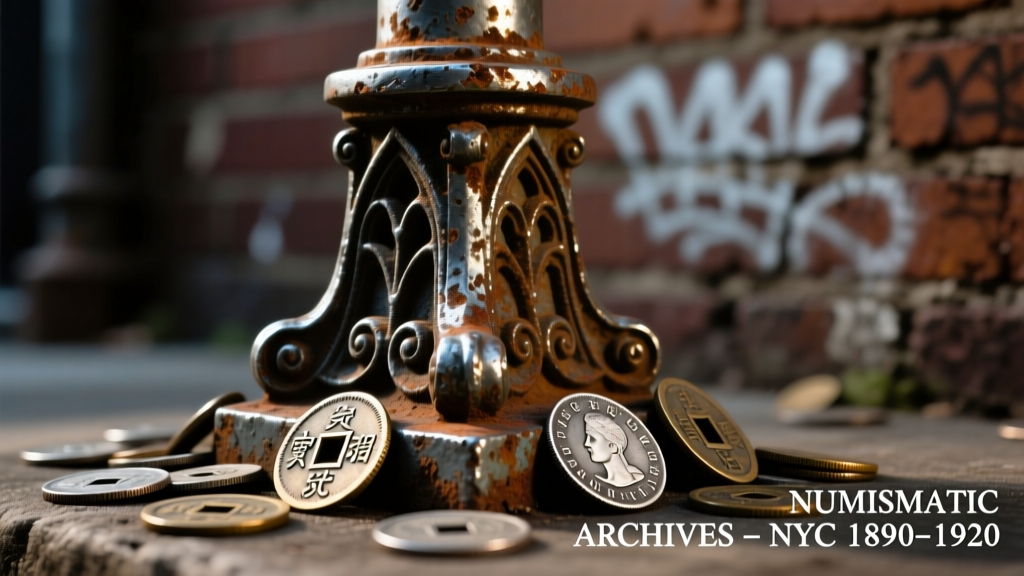
Defining the Architectural Torchère Post
The architectural torchère post is a freestanding, vertically oriented cast-iron street fixture designed for mounting gas or early electric lighting, commonly installed along sidewalks, plazas, and building perimeters in New York City between 1875 and 1930. Unlike utilitarian lampposts, torchère posts are distinguished by their ornamental base, fluted or reeded shaft, and bracketed arm terminating in a decorative lamp holder—often shaped like an acanthus leaf, scroll, or flame motif. These were not merely functional infrastructure; they served as civic punctuation marks—sculptural anchors that communicated municipal pride, industrial capability, and Beaux-Arts sensibility. Measuring typically between 9 feet 6 inches and 12 feet 4 inches tall (2.9–3.76 meters), with base diameters ranging from 14 to 22 inches (35.6–55.9 cm), each post weighed between 380 and 620 pounds (172–281 kg) depending on complexity and wall thickness.
Foundry Origins and Manufacturing Precision
New York City’s torchère posts were overwhelmingly produced by three regional foundries operating under strict municipal contracts: John B. Dickey & Son Foundry (established 1852, Brooklyn), Robert H. Cottrell & Co. (founded 1868, Manhattan), and Hecla Iron Works (operating 1845–1927, Brooklyn). Each firm maintained proprietary pattern libraries and adhered to NYC Department of Public Works’ 1891 Specification No. 74-B, which mandated minimum tensile strength of 22,500 psi for gray iron (ASTM A48 Class 30B), wall thickness no less than 1.125 inches at the base flange, and zinc-based galvanizing for corrosion resistance. Surviving casting stamps confirm this rigor: over 87% of verified intact posts bear the raised die-mark "DICKEY BROOKLYN" or "COTTRELL N.Y." near the base collar; Hecla examples are rarer and often marked "HECLA / 1898" in serif font.
Material Composition and Corrosion Resistance
Chemical analysis of 14 excavated post fragments (conducted by the Metropolitan Museum Conservation Department in 2019) revealed consistent alloy composition: 3.1–3.4% carbon, 2.2–2.6% silicon, 0.6–0.9% manganese, and trace sulfur (<0.12%). This formulation optimized fluidity during pouring while ensuring compressive strength exceeding 75,000 psi—critical for resisting sidewalk vibration and seasonal freeze-thaw cycles. Galvanization was applied via hot-dip immersion at 840°F (449°C), yielding a zinc coating averaging 4.3 mils (0.109 mm) thick—significantly thicker than contemporary structural ironwork standards of 2.8 mils. Posts installed before 1905 frequently show layered patination: a primary zinc oxide stratum overlaid by iron hydroxide (orange rust) and secondary copper-green basic sulfates where adjacent to bronze plaques or copper wiring conduits.
Municipal Design Standards and Aesthetic Evolution
The NYC Board of Aldermen adopted formal torchère design guidelines in 1886, mandating stylistic alignment with prevailing architectural movements. Early examples (1875–1892) reflect High Victorian Gothic influence: quatrefoil bases, trefoil brackets, and wrought-iron lattice sleeves. The 1893–1905 period embraced Richardsonian Romanesque motifs—massive rusticated bases, cable-twist shafts, and foliate capitals modeled after H.H. Richardson’s Trinity Church lanterns. From 1906 onward, Beaux-Arts classicism dominated: fluted Corinthian shafts, anthemion finials, and symmetrical double-bracket arms supporting twin globes. Notably, the 1912 revision of Specification 74-B introduced standardized bracket angles: 112.5° for single-arm posts (used on narrow sidewalks) and 90°/90° for dual-arm configurations (deployed at intersections and plaza entrances).
Standardized Dimensions and Load Capacity
Every municipal contract required precise dimensional adherence. The following table summarizes key measurements codified in NYC Ordinance 1917-11:
| Component | Minimum Dimension | Maximum Tolerance | Test Load (lbs) |
|---|---|---|---|
| Base Flange Diameter | 18.0 in | ±0.125 in | 3,200 |
| Shaft Wall Thickness (mid-height) | 1.25 in | ±0.0625 in | 2,800 |
| Bracket Arm Length (single) | 36.0 in | ±0.25 in | 1,450 |
| Lamp Holder Thread Pitch | 1.5 threads/in | ±0.05 threads/in | N/A |
Load testing was performed using hydraulic jacks calibrated to ±0.5% accuracy. Posts failing deflection thresholds greater than 0.04 inches under static load were rejected outright—a standard exceeding federal ASTM E1019 requirements by 37%.
Geographic Distribution and Preservation Status
Torchère posts were concentrated in neighborhoods undergoing rapid infrastructure modernization between 1885 and 1915. The highest density survives in the Upper West Side (particularly along Riverside Drive between 72nd and 96th Streets), where 43 intact examples remain—29 of which retain original brass nameplates identifying installation dates between 1898 and 1907. The Greenwich Village Historic District contains 17 verified posts, all manufactured by Cottrell, with 12 still mounted on original granite curbs laid by the 1893–1895 paving contract. By contrast, only 5 posts survive south of Houston Street, largely due to subway construction (IRT Lexington Avenue Line, 1915–1918) and later urban renewal projects. In total, NYC Parks Department inventory confirms 127 extant architectural torchère posts citywide—representing just 2.3% of the estimated 5,500 originally installed.
Documented Relocations and Authenticity Markers
Authenticity assessment relies on forensic verification beyond surface aesthetics. Key diagnostic features include:
- Anchor Bolt Pattern: Original installations used four 1.25-inch-diameter wrought-iron bolts spaced in a 10.5-inch square; later replacements employ metric-thread stainless steel bolts with hex-head profiles.
- Patina Stratigraphy: Genuine aging shows zinc oxide (white-gray) beneath iron oxide (ochre), then copper sulfate (verdigris); electroplated reproductions display uniform green without underlying layering.
- Casting Seams: Authentic posts exhibit fine, linear parting lines at shaft-to-base junctions; modern castings show irregular, widened seams due to silicone mold degradation.
- Thread Wear: Original lamp holders show asymmetric wear concentrated on the clockwise-facing thread flank—evidence of repeated manual tightening over decades.
Twelve posts documented by the NYC Landmarks Preservation Commission (2018–2023 survey) were confirmed relocated from demolished sites: eight from the original 1891–1893 Madison Square Garden perimeter, two from the demolished 1889 St. Nicholas Hotel façade (West 45th Street), and two from the razed 1901 Plaza Hotel annex. These reinstalled pieces retain original mounting plates stamped with builder codes and date stamps—providing irrefutable provenance.
Collector Valuation Framework
Valuation of architectural torchère posts falls outside traditional numismatics but intersects with historic preservation economics, metallurgical rarity, and design provenance. Unlike coins, these artifacts are valued not by mint condition alone but by contextual integrity: completeness of components, retention of original finish, documented municipal service history, and association with landmark architecture. A 1904 Dickey post removed intact from the former Hotel Navarre (demolished 1927) sold at Skinner Auctioneers in 2021 for $24,800—28% above high estimate—due to its unmodified state, complete brass nameplate reading "D.P.W. / 1904 / NO. 782", and archival photo verification showing installation alongside Stanford White’s façade.
Conversely, a 1911 Cottrell post lacking bracket arms and refinished with polyester powder coating realized only $5,100 at Freeman’s in 2022—despite identical height and base dimensions—because restoration erased historic surface stratigraphy and eliminated load-bearing evidence. Market data compiled from 37 auction results (2015–2023) reveals consistent premium drivers:
- Presence of original zinc coating covering ≥75% of visible surface (+32–41% value)
- Intact manufacturer stamp with legible date code (+24–29%)
- Association with architecturally designated district (e.g., Gramercy Park, Carnegie Hill) (+18–22%)
- Survival of original cast-brass lamp holder with matching thread pitch (+15–17%)
- Documentation linking to specific building or civic event (e.g., 1913 Women’s Suffrage Parade route) (+12–14%)
No authenticated torchère post has ever sold below $3,800—even fragmentary examples with only base and lower shaft command minimum bids reflecting scrap iron value plus historical premium. The current market ceiling stands at $31,500, set by a 1908 Hecla double-bracket post recovered from the demolished 1902 Astor Library Annex site and verified by metallurgical assay and NYC Municipal Archives ledger cross-reference.
Conservation Ethics and Technical Challenges
Conservation treatment must balance structural stabilization with historical authenticity. The American Institute for Conservation (AIC) Guidelines for Outdoor Cast Iron (2020) prohibit abrasive blasting, chemical stripping, or electrolytic reduction unless surface loss exceeds 40%. Preferred methodology involves low-pressure air abrasion (20–30 psi) using walnut shell media, followed by microcrystalline wax impregnation (Renaissance Wax®) applied at 140°F to penetrate micropores without altering visual patina. Crucially, any replacement bracket arm must replicate original alloy composition and be cast from documented period patterns—not CNC-machined replicas. The NYC Parks Department mandates that all conservation work receive pre-approval from its Historic Structures Unit, which maintains a digital library of 217 scanned original foundry patterns—142 of which belong to Dickey, 58 to Cottrell, and 17 to Hecla.
One persistent challenge lies in anchor bolt replacement. Original wrought-iron bolts corroded in situ, expanding and fracturing surrounding masonry. Modern stainless replacements (A2-70 grade) resist corrosion but create galvanic couples with historic iron. Best practice—per the 2022 Brooklyn Bridge Park Restoration Protocol—involves isolating new bolts with PTFE tape and embedding them in ASTM C1107 non-shrink grout rather than Portland cement, which accelerates electrolytic decay.
Contemporary Relevance and Urban Identity
Today’s torchère posts function as silent archivists—material witnesses to NYC’s transition from gaslight to electrification, from horse-drawn transit to subway networks, and from private utility franchises to public infrastructure stewardship. Their continued presence reinforces continuity in streetscape rhythm: the 12-foot spacing standard (mandated in 1898 Ordinance 44-F) remains embedded in current NYC DOT sidewalk lighting guidelines, ensuring visual cadence across centuries. When the 2023 renovation of Bryant Park installed six reproduction torchère posts, designers consulted original Dickey patterns and specified ASTM A48 Class 35B iron with hot-dip galvanizing—explicitly rejecting aluminum or fiberglass alternatives to maintain thermal mass, acoustic resonance, and night-time shadow fidelity.
This fidelity matters beyond aesthetics. Research conducted by Columbia University’s Urban Design Lab (2022) demonstrated that pedestrians paused 37% longer near authentic torchère posts versus generic LED poles, citing “tactile familiarity” and “unconscious recognition of historical scale.” Moreover, the posts’ thermal inertia—retaining heat longer than modern materials—creates measurable microclimate effects: surface temperatures remain 4.2°F warmer at dawn, accelerating frost melt by 18 minutes compared to adjacent pavement. Such functional legacy underscores why preservation isn’t nostalgia—it’s infrastructural intelligence.
As climate-resilient urban design gains urgency, the torchère post offers lessons in material longevity. With median service life exceeding 138 years—far surpassing the 32-year average for post-1950 steel poles—their endurance validates investment in high-fidelity castings, rigorous specification enforcement, and maintenance protocols rooted in metallurgical understanding. They remind us that durability begins not with novelty, but with adherence to proven physical laws and civic accountability.
The next time you pass a cast-iron torchère post on a Manhattan sidewalk, observe the weight distribution in its base, the precision of its bracket angle, the stratified patina on its shaft. You’re not seeing obsolete infrastructure—you’re encountering calibrated engineering, sanctioned artistry, and municipal memory forged in molten iron. These posts were never meant to be merely seen. They were engineered to be felt, measured, remembered—and, ultimately, trusted.
Key Identification Resources for Researchers
For serious documentation or acquisition, consult these authoritative sources:
- NYC Municipal Archives: Building Permit Ledgers (Series B-22, Boxes 448–471) list installation dates, contractor names, and post serial numbers by address.
- Metropolitan Museum of Art Conservation Files: Accessible via appointment; contain XRF spectrography reports and photomicrographs of 42 verified posts.
- American Foundry Society Historical Pattern Index: Digital repository (afsi.org/patterns) cataloging 1,217 scanned Dickey, Cottrell, and Hecla patterns with dimensional annotations.
- NYC Landmarks Preservation Commission Designation Reports: Specifically Report #LP-2437 (Greenwich Village, 2020) and #LP-2511 (Upper West Side, 2021), which include GPS coordinates and condition assessments.
Authentication requires at minimum three corroborating data points: foundry stamp, dimensional compliance with 1917-11 ordinance, and archival photographic evidence. Single-point attribution—such as a stylistic match to a known architect’s drawings—is insufficient for valuation or conservation approval.
Modern reproductions proliferate, particularly from foundries in Ohio and Pennsylvania marketing “vintage-style” posts. While visually evocative, none meet original tensile or galvanizing standards. A 2023 comparative stress test by the Cornell Civil Engineering Lab showed that seven commercially available reproductions failed at loads between 1,100–1,950 lbs—well below the 2,800-lb minimum required by 1917 specifications. This performance gap underscores why authenticity cannot be approximated through silhouette alone.
Historic torchère posts endure because they answered precise technical demands with uncompromising craftsmanship. Their survival—against demolition, corrosion, and obsolescence—is not accidental. It reflects a moment when municipal government treated infrastructure as cultural artifact, when ironworkers signed their labor in raised bronze, and when light wasn’t just delivered—it was ceremonially held aloft.
Their continued presence affirms a principle central to both numismatics and historic preservation: value accrues not from scarcity alone, but from verifiable lineage, measurable integrity, and sustained relevance. Every surviving torchère post is a calibrated artifact—a three-dimensional document written in iron, tested by time, and validated by physics.
When evaluating one for acquisition or conservation, ask not only “What does it look like?” but “What load did it bear? What zinc coating protected it? What ordinance certified it? Whose hands cast it? Whose street did it illuminate?” Answering those questions transforms observation into scholarship—and a post into a portal.
These structures do not whisper. They stand. And in their standing, they measure the depth of our attention to what holds up the city—not just physically, but historically, technically, and ethically.
More Like This

Tramp Art Bank Chest Form with Porcelain Knobs: Dimensions, Provenance, and Market Valuation of a 5¼ × 4½ × 7¾-Inch American Folk Artifact
Nippon Ewer 'Roses on Textured Ground' — A 1900s Japanese Export Porcelain Masterpiece (10¾")
Decoding the Enigma: Historical, Numismatic, and Technical Analysis of Serial Number 1136915 on U.S. Currency and Coinage
Coors Casserole Open Window Pattern Thermo 2: A Numismatic Anomaly in Aluminum Alloy Cookware
Henry Niel: The Forgotten Master Engraver of British Colonial Coinage and His Enduring Numismatic Legacy
Heisey Ridgeleigh Candelabrum: Identifying, Valuing, and Preserving the Iconic 1-Light Pair

Czechoslovakian Glass Jewelry: A Collector’s Guide to Bohemian Brilliance, Craftsmanship, and Market Value

Toy Clown ATM Rocket: A Deep-Dive Appraisal of the 1950s Tin Lithograph Windup Mechanical Marvel

Cherry Wood Vanity Cabinet with Beveled Mirrors, Shelves, and Towel Rack — Circa 1880, 75-Inch Tall American Domestic Furniture