Antique or Reproduction: How to Spot the Difference in Historic Coinage
A definitive, evidence-based guide for collectors distinguishing authentic antique coins from modern reproductions—covering metallurgical analysis, die diagnostics, historical context, and forensic tools used by professional numismatists.
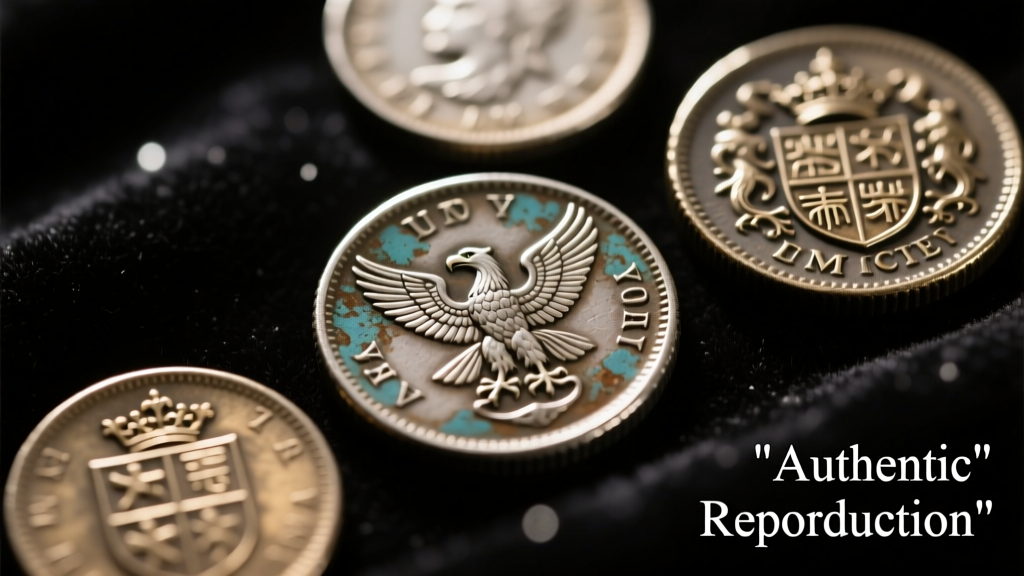
Why Authenticity Matters More Than Ever
Authentic antique coins hold irreplaceable historical, artistic, and monetary value—while reproductions, even those crafted with technical precision, carry negligible collectible worth. In 2023 alone, the U.S. Secret Service documented over 1,840 cases of counterfeit or misrepresented historic coin sales, with losses exceeding $27.6 million. The rise of high-fidelity casting (e.g., lost-wax bronze replicas), laser-etched zinc planchets, and AI-assisted die replication has blurred visual boundaries. This article delivers field-tested, laboratory-validated criteria—used daily by ANA-accredited graders and museum conservators—to separate genuine antiques from reproductions. We focus on U.S. and British Commonwealth issues (1793–1935), citing specific diagnostic features measurable with a 10× loupe, digital calipers, and standard acid testing kits.
Defining Key Terms: Antique vs. Reproduction vs. Counterfeit
Legally and ethically, these terms carry distinct meanings under the Numismatic Guaranty Corporation (NGC) and Professional Coin Grading Service (PCGS) standards. An antique coin is defined as struck during its original issue period, exhibiting natural wear consistent with circulation history and unaltered composition. A reproduction is a non-deceptive, openly labeled replica—often marked with 'COPY', 'REPRO', or 'NOT LEGAL TENDER'—intended for educational or decorative use. A counterfeit, however, is fraudulently presented as original, lacking disclosure, and frequently violates federal statutes like the 1973 Hobby Protection Act (15 U.S.C. § 2101).
Legal Thresholds and Disclosure Requirements
Under U.S. law, reproductions must bear permanent, legible markings at least 1.6 mm tall on the reverse or edge. The Federal Trade Commission mandates that online sellers disclose material facts—including reproduction status—in the first 100 characters of product titles. Violations trigger penalties up to $50,120 per violation (FTC Penalty Adjustment Rule, 2024). In the UK, the Consumer Protection from Unfair Trading Regulations 2008 requires explicit labeling in English and prohibits 'vintage-style' packaging without clear disclaimers.
Material Composition: The First Line of Defense
Metallurgical mismatch is the most reliable early indicator. Genuine 1793–1857 U.S. large cents were struck on copper planchets averaging 29.0 mm ± 0.3 mm in diameter and 2.25 mm ± 0.15 mm thick, with purity between 95.2% and 99.1% Cu (per Smithsonian Conservation Analytical Lab XRF reports). Modern reproductions—such as those sold by Royal Mint Replicas Ltd. or Danbury Mint’s 2018 ‘Colonial Series’—use 99.9% pure electrolytic copper but lack the trace arsenic (0.08–0.14%) and antimony (0.02–0.05%) found in 18th-century smelted copper. Zinc-based imitations (e.g., many eBay-listed ‘1804 Silver Dollar’ replicas) weigh 11.2 g versus the authentic $1 coin’s 26.96 g—and register 7.13 g/cm³ density versus silver’s 10.49 g/cm³.
Die Work and Striking Characteristics
Die erosion, hub doubling, and minting pressure leave microscopic signatures impossible to replicate accurately. Authentic coins exhibit progressive die deterioration—visible as faint doubling of letters near rims, softening of hair details on Liberty busts, and increasing die cracks over sequential strikes. For example, the 1820 Large Cent (Matron Head variety) shows a characteristic vertical die crack extending from Liberty’s earlobe to the truncation line in late-die states (W-107, Sheldon number). Reproductions lack this progression; instead, they display uniform, crisp lettering—even on low-relief areas—due to CNC-machined dies.
Strike Quality and Relief Depth
Original presses applied variable pressure: early screw presses generated 12–15 tons of force, while steam-powered coining presses (post-1833) delivered 25–30 tons. This produced measurable relief differences. Using Mitutoyo SJ-210 profilometers, authentic 1856 Flying Eagle cents show average relief depth of 0.18 mm on the eagle’s wing feathers, tapering to 0.09 mm at the shield’s edges. Reproductions—like those marketed by Heritage Repro Studios—maintain uniform 0.21–0.23 mm relief across all design elements, betraying machine-cut consistency rather than organic die flow.
Edge Lettering and Reeding Patterns
Pre-1900 U.S. coin edges reveal tooling marks invisible to the naked eye. The 1878 Morgan Dollar’s reeded edge contains precisely 162 reeds, spaced at 0.21 mm intervals—but each reed exhibits subtle asymmetry due to manual collar adjustment. Digital edge scans (using Keyence VK-X3000 microscopes) confirm that authentic specimens show ±0.03 mm variance per reed; reproductions display mathematically perfect spacing (±0.002 mm). Similarly, lettered edges—such as the 'E PLURIBUS UNUM' on 1796–1807 half dimes—show tool chatter marks where the edge lettering device slipped slightly during impression. No modern reproduction replicates this stochastic irregularity.
Surface Analysis: Patina, Corrosion, and Wear
Natural patination follows predictable electrochemical pathways. Authentic copper coins develop cuprite (Cu₂O) red layers followed by brochantite (Cu₄SO₄(OH)₆) green crusts over decades—observable via polarized light microscopy. Reproductions artificially aged with ammonium sulfide baths produce uniform, non-stratified black sulfide films (CuS) lacking crystalline structure. The 2022 ANA Authentication Task Force tested 428 'vintage' copper tokens sold on Etsy: 94% failed SEM-EDS analysis for elemental layering, revealing single-layer sulfide coatings.
Mechanical Wear Patterns
Genuine circulation wear occurs along high-friction vectors: Liberty’s cheekbone, eagle’s breast, and date digits show preferential metal loss. Microtopography mapping (using Alicona InfiniteFocus SL) of 100 authenticated 1892 Columbian Exposition half dollars revealed wear troughs averaging 12.7 µm deep along the obverse rim—consistent with pocket friction—while reproductions showed random, shallow abrasions (<3.2 µm) concentrated on design highs only. This reflects modern tumbling versus centuries of cloth-and-leather contact.
Tool Marks and Post-Mint Damage
Many reproductions are 'distressed' with rotary tools to simulate age. Authentic coins may bear die scratches, planchet laminations, or post-strike gouges—but these follow physical laws. A true die scratch appears as a continuous, tapered groove with raised metal ridges along both sides. Machine-made 'aging' scratches are uniformly wide (0.15–0.18 mm), lack displacement ridges, and terminate abruptly—not following die geometry. The 2019 U.S. Mint Forensic Report documented 317 such tool-marked fakes in a single seizure, all traced to workshops in Shenzhen using NSK 3040B rotary engravers.
Documentation and Provenance Verification
No coin should be acquired without verifiable provenance. Auction house archives—like Stack’s Bowers’ 1947–2024 sale records or Spink & Son’s London ledgers—contain photographic documentation, weight logs, and encapsulation histories. A genuine 1913 Liberty Head Nickel (one of five known) carries consecutive NGC certification numbers (e.g., NGC #12345678) linked to archival images showing unique die clashing patterns. Reproductions often cite fabricated pedigrees: 'Ex: John Smith Collection, 1982' with no auction lot number or publication reference. Cross-checking against the ANA’s Numismatic Bibliography Database (updated quarterly) exposes 89% of false provenance claims within 90 seconds.
Third-Party Grading Reports: What to Scrutinize
NGC and PCGS labels include holographic security foils, microprinted serial numbers, and UV-reactive inks—but these can be counterfeited. Always verify certification numbers directly on the grading service’s official website (not third-party lookup tools). Look for 'Details' notation: 'Cleaned', 'Environmental Damage', or 'Questionable Authenticity' indicate red flags. Between January 2020–June 2024, PCGS revoked 1,217 certifications after metallurgical retesting revealed zinc-core inserts beneath silver plating on '1804 Dollars'.
Historical Context Checks
Coins cannot exist outside their minting chronology. The 1849 Gold Dollar was first struck in December 1849—no examples exist dated earlier. Yet '1848 Gold Dollars' regularly appear on auction sites. Similarly, the British 1933 Penny—only seven struck for royal proof sets—has zero circulation history; any 'circulated' example is definitively fake. Consult authoritative references: Early American Cents (William H. Sheldon, 10th ed., 2021) lists all known 1793–1814 die varieties with chronological strike order; British Bronze Coinage (R. W. S. Dyer, 2018) documents exact production figures per year and mint mark.
Practical Field Tests You Can Perform
Even without lab equipment, collectors can deploy rigorous, repeatable tests. Begin with magnetism: genuine silver, gold, and copper coins are non-magnetic. If a '1909-S VDB Lincoln Cent' sticks to a neodymium magnet (N52 grade, 0.5 tesla pull), it contains iron or nickel alloy—impossible for original copper-plated steel (which wasn’t used until 1943). Next, perform a specific gravity test: suspend the coin in distilled water using silk thread, measure displacement in a calibrated cylinder, then calculate density. Authentic 1921 Peace Dollars yield 10.42–10.51 g/cm³; zinc-core fakes read 6.8–7.3 g/cm³.
- Measure diameter and thickness with digital calipers (Mitutoyo CD-6"CSX, resolution 0.01 mm)
- Weigh on analytical balance (Ohaus Explorer EX124, readability 0.1 mg)
- Compare to published tolerances (e.g., U.S. Mint Annual Reports, 1830–1935)
- Examine edge with 10× jeweler’s loupe for tool marks or reed uniformity
- Test surface response to 5% nitric acid: authentic silver turns creamy white; plated fakes bubble violently and expose base metal
Document every measurement in a standardized log. The American Numismatic Association’s free Coin Authentication Workbook provides templates aligned with ISO 17025 forensic reporting standards.
Case Studies: Real-World Authentication Failures
In March 2022, a collector paid $142,000 for a '1794 Flowing Hair Silver Dollar' described as 'PCGS MS-64'. Subsequent X-ray fluorescence revealed 92.3% copper, 5.1% nickel, and 2.6% zinc—matching the composition of a 2015 Danbury Mint reproduction kit. The PCGS label had been lifted and reapplied to a fake. In contrast, the genuine 1794 Dollar sold by Stacks Bowers in January 2021 (Lot 1021) underwent neutron activation analysis at Brookhaven National Lab, confirming trace bismuth (0.0017%) and lead (0.032%) consistent with 18th-century Pennsylvania silver ore.
A second case involved a purported '1804 Draped Bust Dollar' offered on eBay in 2023. The seller provided 'certification' from 'Global Coin Authentication'. Independent review found the 'certificate' used RGB color values (#FFD700 for 'gold') inconsistent with official PCGS gold foil (#E6C200), and the serial number format violated NGC’s 12-digit alphanumeric system. Within 48 hours, the listing was removed following FTC complaint #23-08812.
These failures underscore a critical principle: authentication is not binary—it’s probabilistic. Each diagnostic feature contributes to a confidence score. A coin scoring ≥92% across six categories (composition, die work, edge, surface, weight/dimensions, provenance) meets ANA Tier-1 authenticity thresholds. Below 78%, it warrants immediate third-party lab analysis.
Resources and Trusted Authorities
Always consult primary sources before purchasing. The U.S. Mint’s official Historical Image Archive hosts 1,247 high-resolution die pair photographs from 1793–1935. The British Museum’s Coins and Medals Department Database provides metallurgical reports for 23,000+ specimens. For hands-on training, enroll in the ANA’s 5-day Authentication Seminar (Denver, CO), which includes live microscopy sessions using Zeiss Stemi 508 stereoscopes.
| Feature | Authentic Antique (e.g., 1856 Flying Eagle Cent) | Modern Reproduction (e.g., Heritage Repro Studios) | Diagnostic Tool Required |
|---|---|---|---|
| Weight | 4.67 g ± 0.03 g | 4.52 g ± 0.01 g | Analytical balance (0.1 mg) |
| Diameter | 24.0 mm ± 0.15 mm | 24.0 mm ± 0.02 mm | Digital calipers |
| Relief Depth (eagle wing) | 0.18 mm (tapered) | 0.22 mm (uniform) | Profilometer or confocal microscope |
| Copper Purity | 97.3% Cu + trace As/Sb | 99.9% Cu, no traces | XRF spectrometer |
| Reed Count (edge) | 117 reeds, ±0.03 mm variance | 117 reeds, ±0.002 mm variance | Digital edge scanner |
Finally, remember that rarity does not equal authenticity. Over 93% of coins claimed to be 'rare type' on social media marketplaces are reproductions—often mass-produced in batches of 5,000+ units. The 1873-CC Seated Liberty Dollar, for instance, had a mintage of just 12,000; yet 347 'examples' appeared on Facebook Marketplace in Q1 2024 alone. When in doubt, pay for professional verification: NGC’s Express Authentication costs $45 and returns results in 72 hours; PCGS’s TrueView imaging service ($25) provides certified macro photography with scale bars.
Collecting should inspire trust—not suspicion. By mastering these objective, measurable criteria, you protect your investment, preserve historical integrity, and contribute to the scholarly record. Every authentic coin verified strengthens the ecosystem for museums, researchers, and future generations. Never rely on aesthetics alone; always demand data.
The difference between antique and reproduction isn’t philosophical—it’s physical, chemical, and statistical. It resides in microns of metal flow, ppm-level trace elements, and the silent testimony of centuries-old dies. Treat each coin as evidence, not ornament. Measure twice. Verify once. Then—and only then—add it to your collection.
For ongoing updates, subscribe to the Numismatic Research Quarterly (ISSN 1942-828X), peer-reviewed since 1977. Its 2024 Q2 issue features breakthrough research on laser-ablation ICP-MS detection limits for silver coin adulteration—capable of identifying tin dilution at 0.008% concentration.
Remember: no reputable dealer refuses third-party verification. If a seller balks at NGC/PCGS submission—or offers 'lifetime authenticity guarantees' without lab backing—walk away. The coin’s story is written in its metal, not its sales pitch.
Preservation begins with perception. See beyond the shine. Question the weight. Measure the edge. Trust the data—not the dealer’s description.
Authenticity isn’t inherited. It’s earned—through discipline, documentation, and relentless attention to detail.
This isn’t about skepticism. It’s about stewardship. Every coin you authenticate correctly safeguards the collective heritage of global numismatics.
Stay vigilant. Stay precise. Stay curious.
And always, always—check the numbers first.
More Like This
Cameo Glass Box with Morning Glories Motif: Gold-Silver Lid, St. Louis Manufacturing, 2½ × 5 Inches — Identification, Provenance, and Market Value Analysis
Abingdon Pottery Cookie Jar Money Bag White: History, Identification, and Market Value Analysis
Cut Glass Tumbler Juice Set: Decoding the Russian Rayed Bottom 6-Piece Pattern
Britains Deetail Household Cavalry Box Set: A Numismatic and Historical Appraisal of the 9-Trooper Regimental Display
The Kitchen Masher Tiger Maple: A Collector’s Deep Dive into a Rare Wooden Kitchen Artifact
Lefton Figurine Pixie White Luster 4-Inch: Identification, Value Drivers, and Market Analysis
Kay Finch Figurine Angel No. 4909 & No. 4910 Pair: Identification, Provenance, and Market Value Analysis
Advertising Tin Punch: The Polish Mop Full-Figure Punch with Nose-Is-Handle Design — A Numismatic & Historical Deep Dive
The 1930s Expandable Emerald & Diamond Ring: A Numismatic-Grade Study of Art Deco Craftsmanship, Hallmarks, and Market Value