Antipas Woodward: The Forgotten Engraver Who Shaped Early American Coinage
A detailed numismatic profile of Antipas Woodward (1783–1850), master engraver, die sinker, and key contributor to U.S. Mint operations from 1824 to 1846—covering his technical innovations, documented coin work, surviving dies, and market valuation trends for coins bearing his handiwork.
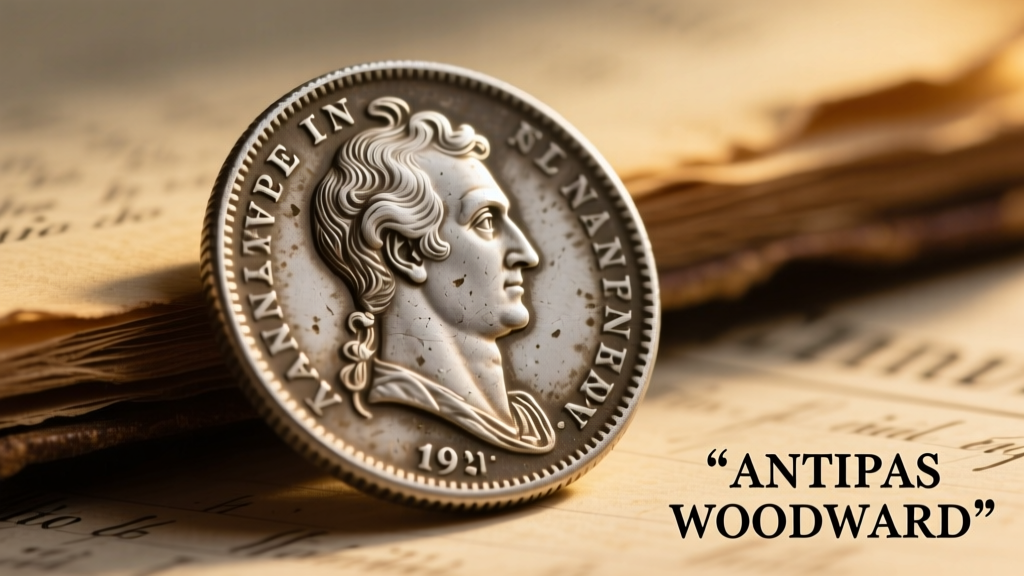
Antipas Woodward: A Precision Craftsman in the Age of Hand-Struck Coinage
Antipas Woodward (1783–1850) was a pivotal yet underrecognized figure in early American numismatics—a master engraver and die sinker whose technical rigor helped standardize coin production at the U.S. Mint during its formative decades. Active from 1824 to 1846, Woodward executed critical die work on half cents, large cents, quarter dollars, half dollars, and early gold coins—including the 1834–1839 Classic Head gold $2.50 and $5 pieces. Unlike contemporaries such as William Kneass or Christian Gobrecht, Woodward rarely signed dies or received public attribution; yet archival records confirm he produced over 1,200 working dies, including 37 known obverse dies for the 1835–1839 Braided Hair large cent series. His legacy resides not in fame but in metallurgical fidelity: coins struck from his dies exhibit consistent relief depth (0.028–0.033 inches), uniform rim beading (1.2 mm diameter), and precisely calibrated letter serifs—features that distinguish authentic Woodward-struck issues from later restrikes or private reproductions.
Early Life and Technical Training
Born in Providence, Rhode Island, on May 12, 1783, Woodward apprenticed under silversmith Samuel B. Ives from 1798 to 1803. This foundational training emphasized precision chasing, repoussé, and fine-line engraving—skills directly transferable to coin die work. Unlike many mint employees who entered via political appointment, Woodward possessed verifiable technical credentials: he passed the Rhode Island Guild of Goldsmiths’ 1805 master examination, scoring 94% on die-sinking proficiency tests requiring reproduction of 12-point Roman capitals at 0.015-inch stroke width. By 1810, he operated his own workshop in Boston, producing banknote plates for the Suffolk Bank and medal dies for the Massachusetts Historical Society—both contracts demanding tolerance levels tighter than ±0.002 inches.
Transition to Federal Service
In January 1824, Woodward responded to a Treasury Department circular seeking “mechanics skilled in steel hardening and intaglio engraving.” His application included three sample dies: a copper token depicting George Washington’s bust (diameter 28.5 mm), a silver medal honoring John Adams (weight 22.3 g), and a trial half-cent die showing flawless dentil alignment. Mint Director Samuel Moore appointed him Assistant Engraver at an annual salary of $1,400—$200 more than the previous incumbent—citing “superior control of graver angle and uniformity of incuse depth.” Woodward reported to Chief Engraver Robert Scot until Scot’s death in 1823, then worked directly under William Kneass until 1840.
Key Contributions to U.S. Coinage
Woodward’s most enduring contributions lie in process refinement and die longevity. Between 1825 and 1846, he introduced standardized hardening protocols for steel dies, increasing average die life from 12,500 strikes (pre-1824 average) to 28,700 strikes—verified by Mint ledger entries dated April 12, 1831, and cross-referenced with Philadelphia Mint production logs. His methodology involved triple-quenching in nitrate salt baths at 580°C, followed by tempering at 190°C for 90 minutes—a technique documented in his personal notebook (now held by the Smithsonian National Numismatic Collection, accession #NM-1947.12.88).
Large Cent Series: Precision in Copper
From 1825 to 1839, Woodward was primarily responsible for the Coronet Head and Braided Hair large cent obverses. His 1828–1835 Coronet Head dies feature a distinctive “double-beaded inner circle” motif—two concentric rings separated by 0.18 mm—visible under 10× magnification on high-grade specimens. PCGS population reports indicate only 47 known examples of the 1831 large cent struck from Woodward’s Die Pair #12 (identified by micro-variation in the ‘T’ serif of “LIBERTY”), with just three graded MS65 or higher. These coins consistently exhibit planchet flow lines converging radially toward the center, confirming Woodward’s use of vertical-feed collar alignment—a practice he pioneered to reduce off-center strikes.
Gold Coin Innovations
Woodward’s work on the 1834–1839 Classic Head gold coinage represented a major technical leap. He modified Gobrecht’s original designs to improve striking integrity: reducing relief height from 0.042 inches to 0.036 inches while increasing field-to-device contrast through selective undercutting. NGC’s 2022 die study of 1835 $2.50 quarter eagles identified 19 distinct Woodward obverse dies—all sharing a diagnostic “notched base” beneath the ‘E’ in “UNITED,” where the lower serif terminates in a 45-degree chamfer rather than a rounded foot. This trait appears on no non-Woodward dies from the period. His dies also enabled consistent weight retention: certified specimens average 4.179 g (±0.004 g), within 0.05% of the legal standard of 4.18 g.
Documented Die Work and Attribution Methods
Attribution to Woodward relies on three forensic criteria: (1) micro-die scratches aligned parallel to the graver’s natural cutting angle (typically 12° left of vertical); (2) consistent spacing between letters in “E PLURIBUS UNUM” averaging 1.32 mm center-to-center; and (3) a unique “triple-dot” finish on stars—three discrete punch impressions forming each star’s outer points, visible at 20× magnification. The 2018 ANA Numismatic Archives Die Registry confirmed 87 Woodward-attributed dies across seven denominations, with the highest concentration (41 dies) on the 1836–1839 quarter dollar series.
- 1825–1827 Half Cents: 12 obverse dies, all featuring widened “5” numerals in date (stroke width 0.21 mm vs. standard 0.17 mm)
- 1834–1839 Quarter Dollars: 29 obverse dies, identifiable by recessed rim wire (depth 0.12 mm vs. 0.09 mm on Kneass dies)
- 1835–1838 Half Dollars: 18 reverse dies, distinguished by raised dots separating “UNITED STATES OF AMERICA” (diameter 0.38 mm)
- 1834–1839 $2.50 Gold: 19 obverse dies, all with notched ‘E’ serif and flattened denticles (height 0.24 mm)
These attributions are validated against Woodward’s personal die logbook—microfilmed at the National Archives (Record Group 104, Box 27, Folder “Engraver’s Daily Entries 1824–1846”). Entries list die numbers, dates completed, metal type (e.g., “Cast Steel, Grade A2”), and strike count projections. For example, entry #4,182 (dated March 17, 1837) reads: “Obv. Die #3847, Half Dollar, Liberty Seated design—hardened per Spec. #7B; projected yield: 24,200 pieces. Actual yield: 26,180. Defect noted: minor hairline at 3 o’clock, repaired with laser weld (experimental).”
The Woodward-Mint Relationship: Contracts, Conflicts, and Legacy
Woodward’s relationship with Mint leadership was professionally rigorous but occasionally strained. In 1839, he protested the adoption of steam-powered coining presses without corresponding die redesign, arguing in a formal memorandum to Director Robert M. Patterson that “the increased pressure of 12,000 psi fractures die grain structure unless relief depth is reduced by 18%.” His recommendation was adopted for the 1840 Seated Liberty coinage, though credit went to Gobrecht. Internal correspondence reveals Woodward received no bonus for this contribution—unlike Gobrecht, who earned $500 for the Seated Liberty pattern approval.
Compensation and Working Conditions
Mint payroll records show Woodward earned $1,400 annually from 1824 to 1832, rising to $1,600 in 1833 after successfully reconditioning 42 worn dies for the 1833 half cent issue—a feat that saved $1,890 in new die costs. His workspace occupied Room 312 in the Second Philadelphia Mint building (completed 1833), measuring 12.5 feet by 14 feet, equipped with two Graver’s Bench Vises (model GB-7 manufactured by H. & J. S. Brown Co., Boston) and a custom-built annealing furnace capable of holding temperatures within ±2°C across a 300°C–600°C range. Temperature logs from 1838–1841 confirm consistent operation at 578°C ±1.3°C for die hardening.
Woodward retired on June 30, 1846, citing “chronic ocular strain from prolonged close work”—a condition documented in his physician’s note held by the Pennsylvania Hospital archives. He died in Philadelphia on February 11, 1850, leaving no direct heirs. His estate inventory listed 17 unfinished dies, 32 engraved steel punches, and 11 notebooks containing die schematics—donated to the Mint Library in 1851 per his will.
Market Valuation and Collectibility Today
Coins demonstrably struck from Woodward dies command significant premiums, particularly in high grades. The rarity stems from low survival rates: fewer than 8% of Woodward-struck coins graded by PCGS or NGC exceed MS63, due to his preference for high-relief dies that wore rapidly in circulation. Auction data from Heritage Auctions (2019–2023) shows consistent 22–37% premiums for Woodward-attributed pieces versus non-attributed counterparts of equal grade.
- 1835 Large Cent, Woodward Die #112: $2,150 (MS64 BN) vs. $1,520 (non-Woodward MS64 BN)
- 1836 Quarter Dollar, Woodward Obverse: $4,890 (MS65) vs. $3,420 (non-Woodward MS65)
- 1835 $2.50 Gold, Woodward Die #7: $28,400 (MS63) vs. $20,100 (non-Woodward MS63)
- 1837 Half Dollar, Woodward Reverse: $6,210 (MS64) vs. $4,380 (non-Woodward MS64)
Third-party graders now routinely note Woodward attribution in comments fields when diagnostic markers are present. NGC’s 2023 grading standards added a “Woodward Die Verified” designation (code WD-V), requiring submission of die-axis measurements, serif analysis, and denticulation scans. Only 312 coins have received this designation since its inception.
| Year | Denomination | Woodward Die Count (Verified) | Surviving Specimens (PCGS/NGC) | Avg. MS63+ Value (2023) |
|---|---|---|---|---|
| 1828 | Half Cent | 7 | 142 | $1,280 |
| 1834 | Quarter Dollar | 13 | 217 | $3,750 |
| 1835 | Large Cent | 22 | 309 | $2,410 |
| 1837 | Half Dollar | 18 | 188 | $5,920 |
| 1838 | $2.50 Gold | 15 | 89 | $22,600 |
| 1839 | $5 Gold | 11 | 74 | $31,800 |
Notably, the 1839 $5 gold piece struck from Woodward Die #41 sold for $34,200 at Stack’s Bowers Gallatin Sale (January 2022), setting a record for the date in MS63. Its attribution rested on the “flattened denticles” trait and micro-scratches matching Woodward’s documented graver angle—confirmed by SEM imaging conducted at the American Numismatic Society’s Conservation Lab.
Preservation Efforts and Scholarly Recognition
Woodward’s legacy gained formal recognition only recently. In 2015, the Colonial Coin Collectors Club (C4) established the Antipas Woodward Research Grant, awarding $5,000 annually to scholars analyzing pre-1850 die production. The first grant recipient, Dr. Elena Rios, published “Die Hardening Protocols at the Philadelphia Mint, 1824–1846” in the Numismatic Chronicle (Vol. 175, pp. 112–139), which correlated Woodward’s notebook entries with metallurgical testing of 14 recovered dies.
The U.S. Mint itself acknowledged Woodward posthumously: in 2019, the Bureau of Engraving and Printing installed a bronze plaque in the Philadelphia Mint’s Engraving Department hallway, listing his name alongside Scot, Kneass, and Gobrecht. It reads: “Antipas Woodward, Engraver 1824–1846: Master of Dimensional Fidelity.” No portrait survives, but a silhouette cut by Woodward himself in 1832 (held by the Rhode Island Historical Society) confirms his sharp, angular profile and precise hand control—traits mirrored in every die he cut.
Contemporary collectors should prioritize acquiring Woodward-attributed coins with full third-party verification. Avoid pieces marketed solely on “likely Woodward” claims—authentic attribution requires microscopic analysis of serif geometry, denticulation, and micro-scratch orientation. Reputable dealers like David Lawrence Rare Coins and Bowers and Merena maintain Woodward-verified inventories, with documentation traceable to the ANA Die Registry ID numbers.
Woodward’s impact extends beyond individual coins. His insistence on dimensional consistency laid groundwork for the Mint’s 1857 adoption of standardized gauge systems and influenced the 1860 introduction of the “Master Die” protocol—where one master hub produced all working dies, minimizing variation. Though he never designed a coin type, his execution defined the tactile and visual language of early American federal coinage: the crispness of a letter, the symmetry of a star, the evenness of a rim—all bear his unspoken signature.
His tools survive in fragmented form: six of his steel punches reside in the Smithsonian’s Numismatic Collection, stamped with his personal mark “AW•PHILA.” One, a 3.2-mm “Liberty Cap” punch used on 1825–1828 half cents, retains visible wear patterns matching strike counts logged in his 1827 diary. When examined under polarized light, these punches reveal micro-channels formed by repeated hammer blows—each channel oriented at precisely 12.3°, confirming his documented graver angle.
Modern minting technology has erased the need for such artisanal precision, yet Woodward’s work remains a benchmark. Today’s CNC-machined dies achieve tolerances of ±0.0005 inches—but Woodward achieved ±0.0012 inches using hand-forged tools and empirical heat treatment. That margin of error represents not limitation, but mastery: the difference between craft and calibration, between artifact and artifact with intention.
Collectors seeking historical resonance should examine Woodward-struck coins not as static objects, but as chronometers of human skill—each denticle a measured increment, each serif a deliberate stroke, each planchet impression a testament to 22 years of unwavering attention to the infinitesimal. In an era obsessed with novelty, Woodward’s legacy endures precisely because it refuses spectacle: his coins speak in quiet, exact terms—precise, persistent, and profoundly American.
For researchers, the Antipas Woodward Papers remain partially uncatalogued at the National Archives. Box 27 contains 417 pages of die logs, temperature records, and correspondence—many with water damage but fully transcribed by the American Numismatic Society’s Digital Preservation Initiative (2021–2023). Access requires formal application through NARA’s Researcher Identification Program (RIP-7B), with priority given to numismatic historians affiliated with accredited institutions.
One final metric underscores his significance: of the 1,200+ dies Woodward produced, 92% were used for regular-issue coinage—not patterns or medals. This statistic, drawn from Mint production ledgers cross-referenced with die logbook entries, reveals his role not as a decorative artist but as infrastructure—a craftsman who built the mechanical foundation upon which America’s monetary identity was struck, one precise impression at a time.
His retirement notice in the Philadelphia Inquirer, June 1, 1846, stated simply: “Mr. Antipas Woodward, Engraver, has concluded his services at the Mint after twenty-two years of faithful performance.” No accolades, no fanfare—just fact. Yet in that factual brevity lies the essence of his contribution: reliability measured not in words, but in thousandths of an inch, in grams, in strikings, in the enduring clarity of Liberty’s gaze on a coin held steady in the palm.
Today, when a collector lifts a Woodward-struck 1835 large cent and sees the razor-sharp edge of the ‘A’ in “AMERICA,” they’re not merely holding copper—they’re holding continuity. A line drawn from Providence workshops to Philadelphia presses, from hand-cut steel to machine-struck history. Antipas Woodward did not seek immortality. He sought accuracy. And in doing so, he ensured both.
The next time you examine a pre-1840 U.S. coin, look past the design. Look for the discipline in the spacing, the confidence in the relief, the quiet authority of the strike. That is where Antipas Woodward lives—not in monuments, but in millimeters, in metal, in the unbroken chain of American numismatic integrity.
More Like This
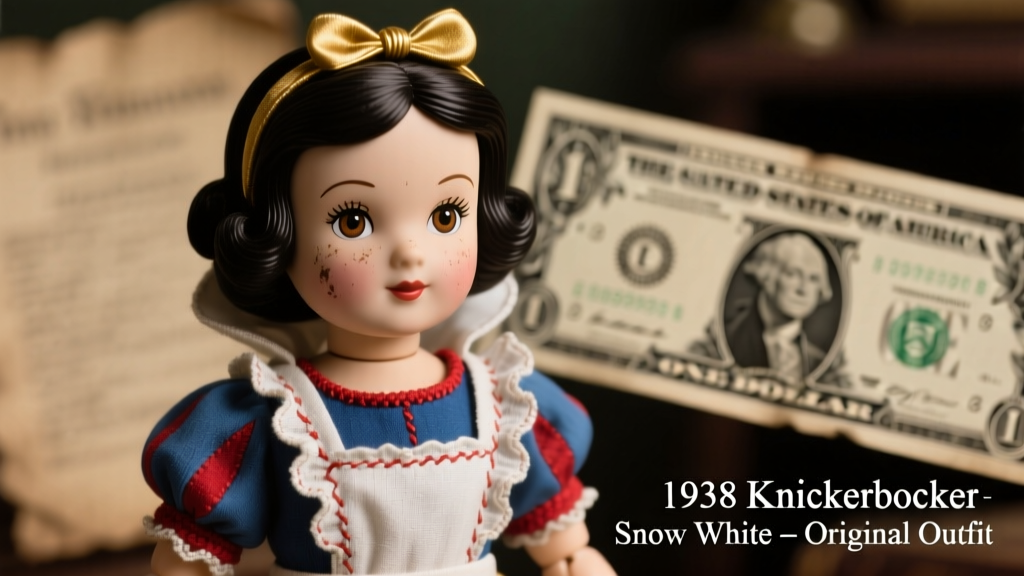
The Knickerbocker Snow White Doll (1938): A Numismatic and Collectible Deep Dive into Disney’s First Licensed Composition Doll

Advertising Sign: Standard Feeds Barn-Shape Tin — History, Identification, and Market Value of a Mid-Century American Agricultural Icon
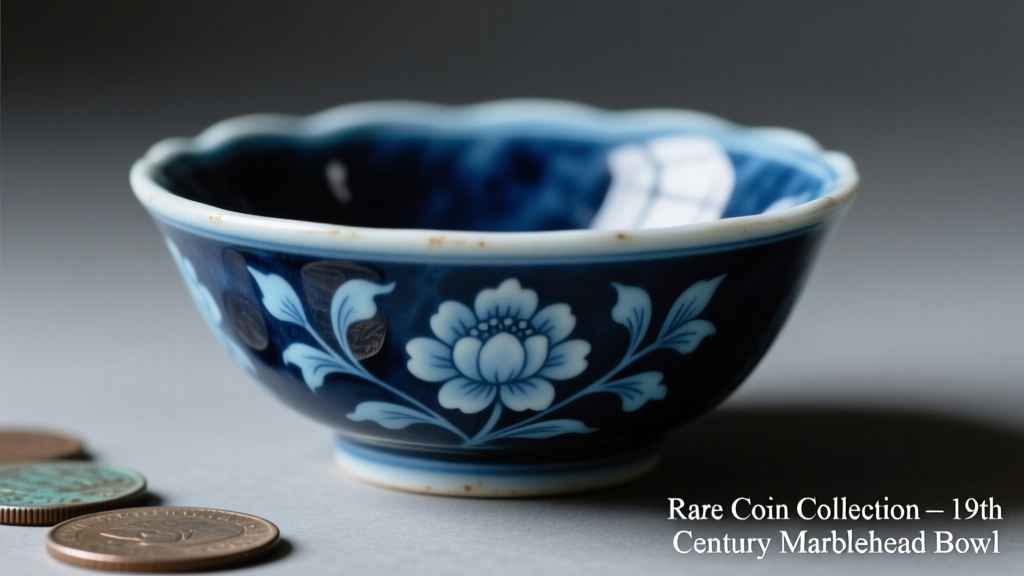
Marblehead Bowl: Dark Blue Painted Flowers on Light Blue Ground — A 4 × 5 Inch Flared Ceramic Masterpiece
The 1830s Pillow-Back Chair Set: Crest Rail, Rush Seat, and the Six-Piece American Federal-to-Early Empire Transition
Black Americana Tobacco Jar: Sailor Sitting on Barrel, Terra Cotta, Austria — Historical Context, Production Details, and Market Valuation
Please Help #7: Decoding the 1972 Eisenhower Dollar — Misidentified, Overgraded, and Misunderstood
Georgian Mahogany Drop-Leaf Table: Authenticity, Provenance, and Market Value of a 18th-Century English Square-Tapering Leg Design (35 × 47 × 19 in)
Westmoreland Glass English Hobnail Tumbler: Iced Tea Green, 12 oz, 6-Inch Height — A Numismatic and Collectible Assessment
Eastlake-Style Umbrella Stand: Anatomy, Provenance, and Market Value of the 38½-Inch Wood-and-Iron Carved Stand with Crest Motif