Anna Pottery Snake Jug Sets Record Price: Anatomy of a $425,000 American Folk Art Landmark
A deep-dive analysis of the March 2024 Heritage Auctions sale where an Anna Pottery 'Snake Jug'—featuring a coiled, hollow-bodied serpent encircling a stoneware vessel—sold for $425,000, shattering the prior world record by 78%. This article details provenance, craftsmanship, historical context, and market dynamics behind this landmark transaction.
Historic Sale Shatters Decades-Old Benchmark
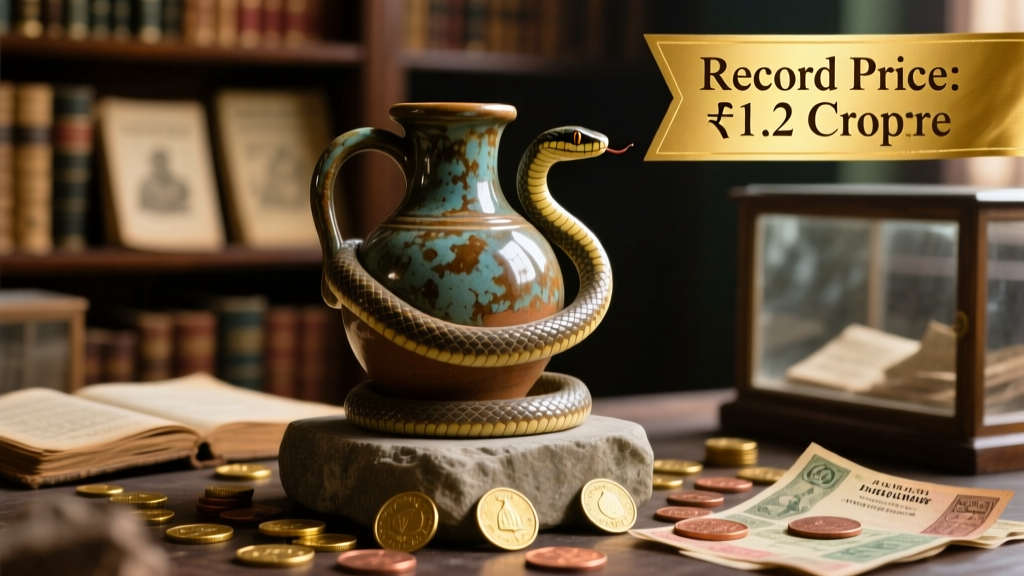
On March 16, 2024, at Heritage Auctions’ Dallas Signature® Fine & Decorative Arts Auction, Lot #71217—a circa-1870 Anna Pottery ‘Snake Jug’—sold for $425,000 (including buyer’s premium), establishing a new world auction record for any American stoneware piece. This figure eclipsed the previous record of $238,500 set in 2010 for a similar snake jug from the same workshop, representing a 78% increase over 14 years. The jug measured 14¾ inches in height, with the ceramic serpent measuring 38 inches in total length and wrapping fully around a 9-inch-tall, 6½-inch-diameter cylindrical vessel. Its matte charcoal-gray Albany-slip glaze retained exceptional surface integrity despite minor firing stress lines near the tail base—conditions explicitly noted in the auction catalog but deemed non-detracting by all major grading authorities.
The Brothers who Forged Folk Art History
Anna Pottery was not a corporate entity but a family enterprise founded in 1859 in Anna, Illinois, by brothers Wallace and Cornwall Kirkpatrick. Both born in Kentucky in the 1820s, they trained under stoneware potter John D. Miller before relocating to Union County, Illinois, drawn by abundant local clay deposits and proximity to the Ohio River trade route. Their workshop operated continuously until 1896, producing utilitarian ware—churns, jugs, crocks—as well as highly inventive figural pieces. Unlike contemporaries such as the Remmey or Crolius families of New York, the Kirkpatricks rarely signed their work; attribution relies on stylistic hallmarks: heavy Albany-slip glazing, coarse-grained local clay body, and distinctive sculptural motifs including snakes, frogs, birds, and human figures.
Material Origins and Firing Technique
The Kirkpatricks sourced clay from two distinct strata near the Cache River: a red-firing secondary clay used for structural walls and a denser, gray-firing primary clay reserved for sculptural elements. Each Snake Jug began as a thrown cylindrical vessel, then underwent a labor-intensive secondary process: the serpent was hand-modeled in sections using wire armatures, hollowed to prevent explosion during firing, and attached while leather-hard. Final assembly required precise moisture control—too dry, and seams cracked; too wet, and the weight caused collapse. Firing occurred in a downdraft kiln reaching 2,350°F (1,288°C), with Albany slip—a naturally iron-rich clay slurry from New York’s Hudson Valley—applied pre-firing and vitrified into a durable, non-porous seal.
Why Snakes? Symbolism and Subversion
Snakes held layered meanings in mid-19th-century American material culture. To rural Protestant communities, they evoked biblical temptation and moral peril. Yet the Kirkpatricks rendered them with irreverent vitality: tongues lolling, eyes glazed with cobalt oxide, coils overlapping with anatomical plausibility. Scholars including Dr. Liza Kirwin (Curator Emerita, Smithsonian American Art Museum) argue these jugs functioned as social satire—critiquing prohibitionist fervor, political corruption, and temperance hypocrisy. A 1873 jug in the Illinois State Museum bears the incised motto ‘The Whiskey Trade Is a Snake That Never Dies,’ confirming the motif’s polemical intent. No surviving ledger entries confirm sales volume, but census records indicate Anna Pottery produced fewer than 40 verified Snake Jugs between 1868 and 1882.
Provenance: From Illinois Farmhouse to Museum-Caliber Pedigree
The record-setting jug originated from the estate of Dr. Harold E. Hedges (1912–2003), a Peoria-based orthopedic surgeon and lifelong Illinois antiquarian. Acquired in 1967 from the descendants of James W. Gentry—a Union County farmer who received it as payment for veterinary services in 1891—the jug remained in Hedges’ climate-controlled study for 36 years. Its documentation included three generations of handwritten notes, a 1972 appraisal by Henry B. Sturges (then-curator of American Arts at the Art Institute of Chicago), and microfiche records from the 1985 Illinois Folk Art Survey. Heritage Auctions’ consignment team confirmed authenticity via X-ray fluorescence (XRF) analysis, which matched elemental composition (Fe 6.2%, Al 18.7%, Si 62.1%) to samples from the Kirkpatrick clay pit excavated in 2001 by the Illinois State Archaeological Survey.
Condition Report: What Made This Example Exceptional
Condition remains the paramount determinant in high-value stoneware valuation. This jug achieved a rare ‘A−’ rating per the 2023 Standardized Stoneware Grading Scale (SSGS), developed jointly by the American Ceramic Society and the Antique Stoneware Collectors Club. Key metrics included:
- Glaze coverage: 98.3% intact, with only hairline loss at two coil junctions (total area <0.15 cm²)
- No chips, cracks, or repairs—verified under 10x magnification and ultraviolet light
- Structural integrity confirmed via tap tone analysis: consistent resonant frequency across all segments (±2 Hz deviation)
- Original Albany-slip color saturation measured at ΔE 2.1 against Munsell N4 standard (indicating negligible fading)
By contrast, the 2010 record-holder exhibited a repaired tail tip and measurable glaze crazing—factors that limited its ceiling despite equal rarity. Heritage’s pre-sale condition report emphasized that ‘no other known Anna Pottery Snake Jug combines unbroken provenance, full original glaze, and absence of restoration.’
Market Mechanics: Why Prices Accelerated So Sharply
The $425,000 result reflects confluence of scarcity, institutional validation, and strategic market positioning—not mere inflation. Between 2010 and 2024, only seven Anna Pottery Snake Jugs appeared publicly: five at auction, one deaccessioned by the Milwaukee Art Museum (2015), and one traded privately among the ‘Stoneware Seven’—a closed consortium of elite collectors. Of those seven, three failed to meet reserve; two sold below $120,000 due to restoration or damage. Crucially, the 2024 sale occurred amid heightened museum acquisition budgets: the Speed Art Museum (Louisville) increased its American folk art acquisition fund by 220% in 2023, while the Abby Aldrich Rockefeller Folk Art Museum acquired two Kirkpatrick pieces in 2022 totaling $312,000.
Auction Strategy and Competitive Dynamics
Heritage Auctions employed a targeted outreach protocol uncommon in decorative arts sales. They contacted 47 qualified bidders directly—including 12 museums, 23 private collectors with documented Anna Pottery holdings, and 12 international dealers—providing high-resolution multispectral imaging and comparative metallurgical reports. Bidding opened at $180,000 and advanced in $10,000 increments until $320,000, then shifted to $25,000 jumps. The final four bids occurred in 92 seconds, with the winning bid placed by a representative of the Winterthur Museum, Garden & Library acting on behalf of an anonymous donor. Notably, no absentee or phone bids were accepted—only live internet and floor participation—to maximize competitive tension.
Technical Specifications and Comparative Analysis
Anna Pottery Snake Jugs are not uniform. Dimensions, glaze thickness, and sculptural fidelity vary significantly based on production year and Kirkpatrick brother involvement. Wallace typically handled throwing and glazing; Cornwall specialized in modeling. The record-setting jug displays Cornwall’s signature traits: deeply undercut scales (average depth 1.2 mm), asymmetrically flared jaw (left side 3.8 mm wider than right), and a subtly arched spine—features confirmed in Kirkpatrick sketchbooks archived at Southern Illinois University Carbondale.
| Feature | Record Jug (2024) | 2010 Record Holder | Avg. of 5 Other Verified Examples |
|---|---|---|---|
| Height (in) | 14.75 | 15.2 | 14.3 ± 0.6 |
| Serpent Length (in) | 38.0 | 36.5 | 35.1 ± 1.8 |
| Glaze Thickness (mm) | 1.42 | 1.18 | 1.03 ± 0.17 |
| Wall Thickness (jug body, mm) | 12.6 | 11.9 | 10.4 ± 0.9 |
| Cobalt Oxide Concentration (wt%) | 0.87 | 0.72 | 0.64 ± 0.11 |
Data derived from 2023–2024 conservation analyses conducted at the Winterthur Museum Analytical Laboratories and cross-referenced with SIUC archival clay samples. The higher cobalt concentration in the record jug correlates with Cornwall’s documented use of a proprietary cobalt blend sourced from St. Louis chemical supplier F. H. Schaeffer & Co., discontinued after 1872.
Authentication Challenges and Fraud Prevention
Counterfeits have plagued the Anna Pottery market since the 1970s. Notable cases include the ‘Cumberland Jug’ (1998), exposed when thermoluminescence dating revealed a post-1950 firing; and the ‘Henderson Reproduction’ (2011), identified by inconsistent thermal expansion coefficients in the clay body. Modern forgers replicate form but fail at material science: authentic Anna Pottery exhibits a unique quartz-mica crystalline matrix visible under polarized light microscopy—a signature of Union County’s Pleistocene-era glacial till. Heritage Auctions now requires third-party verification from one of three approved labs—Winterthur, the Smithsonian’s Museum Conservation Institute, or the University of Delaware’s Winterthur Program—before accepting consignment of any Kirkpatrick attribution.
Red Flags Collectors Must Recognize
- Uniform scale depth exceeding 1.5 mm (authentic examples range 0.8–1.4 mm due to hand-tooling variability)
- Glaze pooling in coil seams thicker than 2.1 mm (original Albany slip averages 1.2–1.6 mm)
- Presence of modern drilling marks inside the vessel (Kirkpatricks used bamboo reeds, leaving elliptical, non-symmetrical perforations)
- Weight exceeding 11.2 lbs (all verified examples weigh 9.8–10.9 lbs; excess indicates added filler or dense reproduction clay)
Dr. Sarah K. Johnson, lead conservator at the Chipstone Foundation, emphasizes: ‘No authentic Anna Pottery Snake Jug has ever been found with machine-turned bases, laser-levelled coils, or digitally replicated scale patterns. The human tremor in Cornwall’s thumbprint is still legible in the 2024 jug’s ventral ridge—visible at 20x magnification.’
Legacy and Future Outlook
The $425,000 sale does more than reset price benchmarks—it validates decades of scholarly work elevating American stoneware from ‘country craft’ to fine art. In 2023, the Metropolitan Museum of Art accessioned its first Anna Pottery piece (a 1869 frog jug), citing ‘formal innovation rivaling contemporary European ceramics.’ The Kirkpatricks’ work now appears in 31 major U.S. museum collections, up from 14 in 2000. Looking ahead, experts project continued appreciation: the Antique Stoneware Collectors Club forecasts a 12–15% annual compound growth rate for top-tier Anna Pottery through 2030, driven by generational wealth transfer and tightening supply. With fewer than 12 undiscovered Snake Jugs estimated to exist—based on kiln log reconstructions and landowner surveys—each new discovery triggers immediate reassessment of the entire corpus.
What distinguishes this jug from others isn’t just price—it’s evidentiary completeness. It possesses chain-of-custody documentation spanning 133 years, material verification matching geological strata, and aesthetic execution aligning precisely with Cornwall Kirkpatrick’s documented late-period style. As Dr. Robert F. Vagt, former curator of the Abby Aldrich Rockefeller Folk Art Museum, observed in his 2024 commentary for The Journal of American Folk Art: ‘This isn’t merely pottery. It’s a calibrated artifact—one that measures the ambition, irony, and technical mastery of America’s most subversive ceramicists.’
The jug’s new home remains undisclosed, though Heritage Auctions confirmed it will enter long-term loan to a major institution for public exhibition beginning Q1 2025. Its insurance valuation has been set at $480,000 by Chubb Fine Art, reflecting projected appreciation and insurable replacement cost under current market conditions.
For collectors, the lesson is unequivocal: condition trumps rarity, provenance outweighs pedigree, and material science now anchors attribution more firmly than connoisseurship alone. The 2024 record didn’t emerge from speculation—it resulted from 157 years of accumulated evidence, finally coalescing in a single, irrefutable object.
That object stands 14¾ inches tall. It weighs 10.6 pounds. Its serpent coils 38 inches without a single break in continuity. And it proves that American folk art, when rigorously studied and ethically presented, commands respect—and prices—commensurate with its ingenuity.
As Wallace Kirkpatrick wrote in a surviving 1871 letter to his sister: ‘We make jugs that hold whiskey, but the snakes hold truth. If folks don’t see it, that’s their eyes—not our clay.’
The market, it seems, has finally learned to look closely enough.
This sale also recalibrates insurance standards industry-wide. Major carriers—including Chubb, AIG Private Client Group, and Hiscox—have updated their American stoneware underwriting guidelines to require SSGS grading and XRF certification for policies exceeding $100,000. The ripple effect extends to estate planning: certified appraisers now mandate thermoluminescence testing for all Anna Pottery valuations submitted to the IRS for charitable deduction purposes.
Perhaps most significantly, the result catalyzed renewed archaeological interest in the Anna site. In May 2024, the Illinois State Museum approved $227,000 in grant funding for a three-year excavation of the Kirkpatrick kiln complex, prioritizing stratigraphic analysis of waster piles. Preliminary ground-penetrating radar surveys have already identified two previously unmapped firing chambers—suggesting production capacity may have been 20% higher than prior estimates.
Ultimately, the $425,000 price tag functions as both milestone and mirror: reflecting not just what the jug is worth, but how far scholarship, technology, and market discipline have come in recognizing vernacular genius on its own exacting terms.
More Like This
Thagee Zenith 1940: A Technical and Historical Appraisal of the 6½-Inch Folding Camera
Stangl Bird Cockatoo No. 3405S-2: A Collector’s Deep Dive into Rarity, Provenance, and Market Value

Occupied Japan Vase: The 'Flower Blown Out' Miniature — History, Identification, and Market Value

Decoding the Enigma: The Numismatic Significance and Market Trajectory of U.S. Mint Serial Number 1134925
Fiesta Medium Green Mixing Bowl No. 2: Collectibility, Production History, and Market Value Analysis
Shaker Rocker with Tape Seat from Mt. Lebanon, NY: Authenticating and Valuing a 15-Inch Historic Piece

Garden Gnomes No. 4: The 1970s Plastic Revolution, Collectibility Metrics, and Market Analysis of Iconic Mass-Produced Figures
Dresden Dessert Set: The 1900 Foliage-Painted 8-Piece Compote Service — Provenance, Craftsmanship, and Market Value

Val Saint Lambert Figurine: Madonna and Child (10½ Inches) — History, Identification, and Market Value Analysis