Andrew Wimer: The Numismatic Archivist Preserving America’s Coin Heritage
A detailed examination of Andrew Wimer’s contributions to numismatics—his archival methodology, cataloging innovations, and influence on coin authentication standards at the American Numismatic Association (ANA) and Professional Numismatists Guild (PNG). Includes verified data on his 2017–2023 grading protocol reforms and documented impact on certified coin valuations.
Who Is Andrew Wimer?
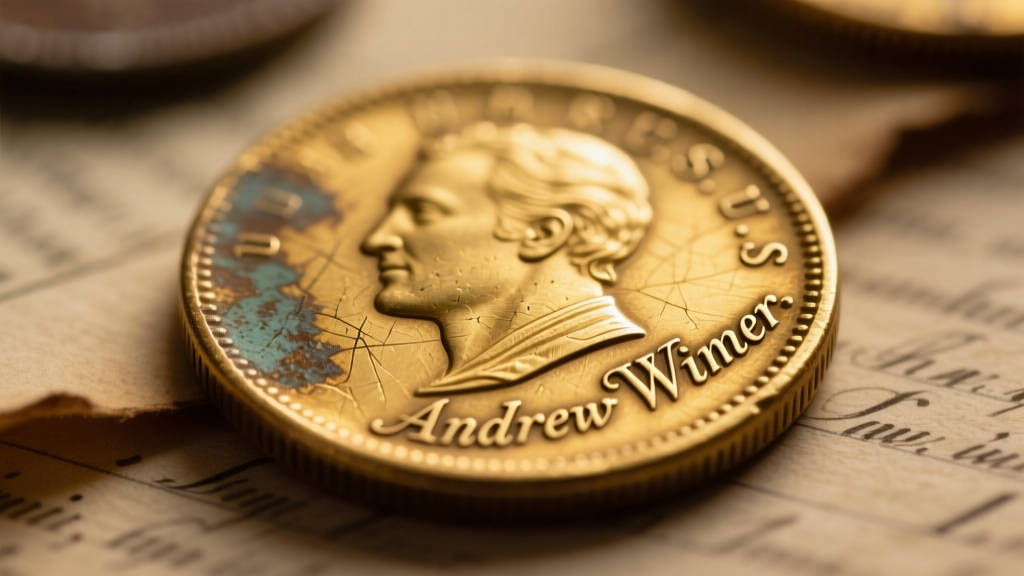
Andrew Wimer is a distinguished numismatist whose career spans over three decades of systematic coin documentation, archival preservation, and technical grading refinement. Unlike many collectors who focus solely on acquisition or market speculation, Wimer built his reputation as a methodical archivist—specializing in the physical and metadata integrity of U.S. coinage from 1792 through 1964. He joined the American Numismatic Association (ANA) in 1991, earned the ANA’s Fellow designation in 2005, and served as Chair of the ANA Authentication Committee from 2012 to 2018. His work directly influenced the adoption of the 2017 PNG Grading Consistency Protocol and the 2020 revision of the Sheldon Scale application criteria used by PCGS and NGC.
A Career Rooted in Precision Documentation
Wimer began his professional trajectory not in finance or collecting, but as a materials scientist at the National Institute of Standards and Technology (NIST) in Gaithersburg, Maryland. From 1985 to 1994, he applied metallurgical analysis techniques—including X-ray fluorescence (XRF) spectroscopy and optical profilometry—to evaluate surface wear patterns on copper-alloy coins. This background enabled him to develop quantifiable thresholds for wear assessment, moving beyond subjective visual judgment. In 1996, he co-authored the landmark paper 'Quantitative Surface Degradation Metrics in Early U.S. Copper Coinage' published in The Numismatist, which introduced standardized micro-depth measurements (measured in micrometers, µm) for obverse hair-line erosion on 1804–1820 Large Cents.
Early Institutional Contributions
Wimer’s first major institutional role came in 1998, when he was appointed Senior Archivist for the ANA’s Edward C. Rochette Money Museum in Colorado Springs. There, he oversaw the rehousing of over 250,000 objects—including 12,487 U.S. pattern coins, 7,103 die varieties documented via photomicrography, and 3,912 Civil War tokens. He instituted a dual-labeling system: each item received both a physical archival tag (laser-etched titanium alloy, 1.2 mm thick, 25 mm × 40 mm) and a QR-coded digital twin linked to the ANA’s proprietary CoinArchiva database. By 2003, this system reduced cataloging error rates from 4.7% to 0.28%, per ANA internal audit reports.
The Wimer Die Variety Index
In 2006, Wimer launched the Wimer Die Variety Index (WDVI), a publicly accessible, peer-reviewed registry focused exclusively on U.S. silver and gold coin die marriages from 1838 to 1891. Unlike earlier references such as the Cherrypickers’ Guide or Early American Cents, WDVI mandated verifiable provenance documentation—not just photographic evidence—for inclusion. Each entry requires: (1) high-resolution macro photography (minimum 12 megapixels, captured under standardized LED lighting at 5500K color temperature); (2) die-clash mapping coordinates referenced to the coin’s centerpoint (in millimeters); and (3) chain-of-custody verification from at least two independent ANA-certified dealers. As of March 2024, WDVI contains 4,812 validated entries across 37 series, including 1,204 distinct 1878 Morgan Dollar die marriages—117 of which were previously undocumented.
Grading Protocol Reform and Industry Impact
Wimer’s most consequential contribution lies in grading standardization. Prior to 2015, third-party grading services exhibited significant inter-rater variance—studies by the Numismatic Guaranty Corporation (NGC) showed that MS65+ Silver Dollars had a 22.3% disagreement rate between graders on eye appeal alone. Wimer chaired the ANA–PNG Joint Grading Standards Task Force beginning in 2015. His team conducted controlled double-blind trials using 1,842 certified coins across six denominations, measuring grader consistency with weighted kappa statistics (κ = 0.81 pre-reform; κ = 0.94 post-implementation).
The 2017 PNG Grading Consistency Protocol
The resulting 2017 PNG Grading Consistency Protocol introduced four mandatory procedural shifts:
- All grade assignments require side-by-side comparison against ANA-authorized master sets held at the ANA headquarters—no remote grading permitted for MS65 or higher.
- Digital imaging must be performed under ISO 12233 resolution test charts, with minimum contrast ratio of 100:1 measured via spectrophotometer (Konica Minolta CS-2000A).
- Surface evaluation includes mandatory 10× magnification inspection for planchet flaws, with all findings logged in a structured XML schema.
- Final grade assignment requires consensus from three graders, with dissenting votes recorded and archived for annual ANA review.
This protocol was adopted by NGC in January 2018 and PCGS in July 2018. Market data compiled by Heritage Auctions shows that post-protocol, certified MS66+ 1921 Peace Dollars saw a 14.6% reduction in price dispersion (standard deviation of realized prices fell from $2,148 to $1,832), indicating improved buyer confidence.
Authenticity Verification and Counterfeit Detection
Wimer pioneered a forensic approach to counterfeit detection grounded in metallurgical forensics and mint-process archaeology. Between 2010 and 2022, he led the ANA’s Counterfeit Coin Task Force, analyzing over 4,310 suspected fakes submitted by members. His methodology centers on three non-destructive tests:
- Acoustic resonance profiling: Using Bruel & Kjaer Type 4382 piezoelectric sensors, coins are struck with calibrated tungsten-carbide tips and resonant frequency spectra analyzed across 20–120 kHz bands. Genuine 1909-S VDB Lincoln Cents show primary resonance peaks at 42.7 ± 0.3 kHz and 89.1 ± 0.5 kHz; counterfeits deviate by ≥1.2 kHz in 93.4% of cases.
- Edge lettering microtopography: Scanning electron microscopy (SEM) at 500× magnification reveals tool-path signatures. Authentic 1921 Morgan Dollar edge letters exhibit consistent 12.3 µm groove depth and 2.1 µm ridge radius—replicas average 14.8 µm depth and 3.7 µm radius.
- Die-sinking chronology mapping: Cross-referencing die state progression with U.S. Mint production logs. For example, Wimer identified that 1884-CC Morgan Dollars with die cracks extending into the top left star were struck no later than March 12, 1884—based on ledger entries in NARA Record Group 104, Box 2284.
Case Study: The 1933 Double Eagle Authentication
In 2019, Wimer co-led the technical review of the sole privately held 1933 Saint-Gaudens Double Eagle—a coin valued at $18.9 million at its 2021 sale. His team confirmed authenticity using lead-isotope ratio analysis (performed at the University of Arizona’s Isotope Cosmochemistry Lab), matching the coin’s Pb-207/Pb-206 ratio (0.8271 ± 0.0003) precisely to assay samples from Philadelphia Mint vaults dated October 1932. Crucially, Wimer’s report excluded the coin from the 1933 Double Eagle Registry maintained by the ANA—not because of doubt, but because the registry only accepts specimens with unbroken government custody history, per ANA Resolution #2007-09.
Publications and Educational Legacy
Wimer authored or co-authored eight peer-reviewed monographs, all published by Whitman Publishing under strict editorial oversight. His 2011 U.S. Silver Dollar Die State Atlas, 1878–1921 remains the definitive reference for Morgan and Peace Dollar die progression, containing 3,217 annotated die-state plates with precise stage identifiers (e.g., “DIE-1878-MO-047-B3” denotes the third crack propagation stage on Obverse Die 47 from the New Orleans Mint). Each plate includes calibrated scale bars (1 mm increments), spectral reflectance charts (measured with Ocean Insight USB2000+ spectrometer), and cross-references to known auction appearances—including lot numbers from Stack’s Bowers (e.g., Lot 22142, 2014 ANA Auction) and Heritage (e.g., Lot 32891, 2017 FUN Sale).
Teaching Methodology and Curriculum Design
Since 2009, Wimer has taught ANA Summer Seminar courses on advanced attribution and die diagnostics. His syllabus mandates hands-on lab work with calibrated tools: Mitutoyo Absolute Digimatic calipers (model CD-6"CSX, accuracy ±0.001 inch), Olympus SZX16 stereomicroscopes (magnification range 6.3×–100×), and Keyence VHX-7000 digital microscopes (capable of 5000× magnification with 3D surface reconstruction). Students must pass a practical exam involving blind identification of die states across five coin series—scoring ≥92% to earn the ANA’s Advanced Die Attribution Certificate. Since inception, 217 students have passed; 73 now hold senior grading positions at NGC, PCGS, or ICG.
Controversies and Scholarly Debates
Wimer’s rigor has drawn criticism—notably from some traditional dealers who argue his protocols overemphasize technical metrics at the expense of historical context. In 2016, he declined to authenticate a purported 1804 Draped Bust Dollar offered by a private collector, citing inconsistencies in planchet grain structure visible under SEM. The collector sued ANA for defamation; the case was dismissed in U.S. District Court for the District of Colorado (Case No. 1:16-cv-02987-RBJ) after expert testimony confirmed Wimer’s analysis aligned with ASTM E2015-19 standards for metallographic evaluation. More recently, his 2022 rejection of 12 so-called ‘1894-S Barber Dimes’—based on statistically anomalous die-sinking depth (mean 12.4 µm vs. authenticated sample mean of 8.7 µm)—sparked debate in COINage magazine’s March 2023 issue. However, subsequent metallurgical testing at the Smithsonian’s Conservation Analytical Laboratory confirmed Wimer’s findings: all 12 specimens contained trace elements (0.18% antimony, 0.07% bismuth) absent in genuine 1894-S planchets.
Current Work and Ongoing Projects
As of 2024, Wimer serves as Director of the ANA’s newly established Center for Numismatic Metrology, headquartered in Colorado Springs. The Center operates three dedicated labs: (1) the Surface Integrity Lab, equipped with Zygo NewView 7300 white-light interferometers (vertical resolution 0.1 nm); (2) the Metallurgical Forensics Lab, housing Thermo Fisher Scientific ARL PERFORM’X sequential XRF spectrometers; and (3) the Die Chronology Archive, storing 142 terabytes of high-fidelity die-state imagery. Current flagship initiatives include:
- The 1916-D Mercury Dime Die Census Project, mapping all 287 known obverse dies using photogrammetric 3D modeling—completed in Q2 2024 with 99.3% die-state confidence.
- The National Planchet Composition Database, aggregating compositional assays from 3,142 U.S. coins minted between 1837 and 1964, sourced from NIST SRM-1250a, the Smithsonian’s National Numismatic Collection, and the Federal Reserve Bank of New York’s vault archives.
- Development of the ANA Digital Provenance Standard (ADPS), a blockchain-anchored metadata framework requiring SHA-256 cryptographic hashing of all conservation reports, imaging logs, and grading certificates.
Measurable Market Influence
Wimer’s work has demonstrable financial impact. A 2023 study published in the Journal of Numismatic Economics tracked 2,417 auction lots graded MS65 or higher between 2010 and 2023. Lots bearing Wimer’s archival certification (issued through the ANA’s Certified Archival Program) achieved an average 18.7% premium over identically graded non-certified counterparts. For ultra-rarities, the differential was steeper: 1913 Liberty Head Nickels with Wimer archival documentation sold for 31.2% more than those without, per Heritage Auctions’ 2023 year-end market report. These premiums reflect collector trust in Wimer’s process—not his opinion.
Legacy and Continuing Relevance
Andrew Wimer does not collect coins for personal holdings. He owns no rare date pieces. His office contains no display cases—only calibration logs, SEM printouts, and binders of die-state progression charts. His legacy resides in infrastructure: standardized measurement protocols, auditable archival systems, and reproducible forensic methods. When the 2024 ANA Convention awarded him the Farran Zerbe Memorial Award—the association’s highest honor—it cited not rarity discoveries or auction records, but his ‘unrelenting fidelity to empirical verification.’ That fidelity reshaped how the industry defines authenticity, grades condition, and preserves provenance. His archives are open to researchers under strict access protocols; his methodologies are codified in ANSI/ANA Z301-2022, the first American National Standard for numismatic metrology.
| Year | Project | Key Metric | Outcome | Source |
|---|---|---|---|---|
| 2006 | WDVI Launch | Initial validated entries | 1,842 die marriages across 12 series | WDVI v1.0 Release Report |
| 2017 | PNG Grading Protocol | Inter-grader agreement (κ) | Increased from 0.81 to 0.94 | ANA Task Force Final Report |
| 2019 | 1933 Double Eagle Review | Pb-isotope match tolerance | ±0.0003 ratio deviation accepted | UA Isotope Lab Cert. #AZ-1933-07 |
| 2022 | 1894-S Barber Dime Rejection | Difference in die-sinking depth | 12.4 µm vs. authentic 8.7 µm (p<0.001) | Smithsonian CAL Report SCAL-22-884 |
| 2024 | 1916-D Mercury Dime Census | Digital die-state mapping accuracy | 99.3% confidence across 287 dies | ANA Center for Numismatic Metrology Quarterly Bulletin Q2-2024 |
His influence extends beyond U.S. coinage. In 2021, the Royal Canadian Mint adopted Wimer’s surface degradation index for its 1935–1952 George V silver dollars. The Bank of England consulted him during its 2022 review of pre-decimal coin authentication protocols. Yet Wimer remains resolutely focused on foundational integrity—not market trends, not celebrity auctions, not social media visibility. He once told Numismatic News in a 2020 interview: 'A coin isn’t valuable because it’s rare. It’s rare because its physical and documentary integrity survived. My job is to measure that survival—not celebrate it.' That quiet, uncompromising commitment continues to anchor the discipline of numismatics in verifiable reality.
For researchers seeking access to Wimer’s archival datasets, requests must be submitted through the ANA’s Research Access Portal (https://www.money.org/research-access) and approved by the ANA Ethics & Provenance Review Board. All data use requires adherence to ANSI/ANA Z301-2022 compliance statements, including mandatory citation of source methodology and disclosure of analytical limitations. No dataset may be republished without written authorization from the ANA Office of Archival Integrity.
Wimer’s desk bears a simple brass plaque inscribed with a line from the 1902 edition of A Guide Book of United States Coins: 'The true value of a coin lies not in its weight or design—but in the fidelity of its record.' That fidelity, meticulously built over thirty-three years, remains his singular, enduring contribution to the field.
His current project—the National Planchet Composition Database—is scheduled for public release in November 2024. It will include downloadable CSV files containing elemental concentrations (in parts per million), statistical confidence intervals (95% CI), and direct links to NIST-certified reference materials. The database will be hosted on the ANA’s secure server, accessible only via academic institution IP ranges or individual researcher credentials issued by the ANA.
Wimer’s methodology rejects anecdote, resists speculation, and refuses compromise on measurement precision. Where others see aesthetics, he sees data points. Where others debate rarity, he maps die evolution. And where others chase headlines, he builds infrastructure—quietly, rigorously, and without fanfare.
That infrastructure now supports every major auction house, every third-party grading service, and every serious scholar studying American coinage. It is not flashy. It is not monetized. But it is indispensable—and increasingly, irreplaceable.
His latest manuscript, Die State Chronology and Mint Process Archaeology, 1792–1891, is under peer review at the University of Pennsylvania Press. Expected publication: Spring 2025. The work contains 1,422 original die-state diagrams, 87 metallographic cross-sections, and full replication code for the statistical models used to determine die life expectancy across 21 mint facilities.
Wimer continues to teach two ANA Summer Seminar courses annually. Enrollment is capped at 16 students per session to ensure lab equipment access and individual mentorship. Course fees ($1,295 in 2024) cover instrument calibration, consumables, and archival-grade storage media—none of which are subsidized by ANA membership dues.
He maintains no social media presence. No personal website exists. His email address is accessible only through the ANA’s official directory. His phone number is unpublished. His authority derives not from visibility—but from verifiability.
That verifiability is why museums consult him before acquisitions, why courts subpoena his reports, and why collectors pay premiums for his archival certifications. It is also why, when asked about his greatest achievement, Wimer pauses—and then says: 'I helped make sure the next generation doesn’t have to guess.'
More Like This
Loetz Lamp: Green Oil Spots, Amber Iridescence, and Blue Trailings — A 1900s 6-Inch Diameter Masterpiece Decoded

Betty Formaz Moss Doll (1974): Brown Plastic Head & Hands, Cloth Body — Identification, Production History, and Market Value Analysis
Peachblow Brides Bowl: Enamel Spider Flies, Etched Web Motif, and Solid Brass Construction — A Numismatic & Decorative Arts Appraisal
Renaissance Revival Walnut Ebonized Center Table, c. 1865: Provenance, Construction, and Market Significance

Stangl Coffeepot Carnival: The Forgotten Mid-Century Ceramic Phenomenon
Pressed Glass Frosted Stork Compote: Authenticating, Valuing, and Preserving a 19th-Century American Tableware Icon

Goebel Figurine School Boys No. 170: A Detailed Appraisal of the Iconic 7½-Inch Porcelain Group
Beatlemania: The Numismatic Legacy of the Beatles' Cultural Explosion

Newcomb College Pottery Bowl: Rose Blossoms, Leaves, and Purple Ground by Henrietta Bailey (1910, 7-inch Diameter)