Americas Hometown Auction #6: A Numismatic Milestone Featuring Rare Colonial Tokens, 19th-Century Gold, and Unrecorded Cents
Americas Hometown Auction #6 delivered exceptional results for collectors and investors alike, realizing $4.27 million across 1,843 lots. This auction featured landmark rarities including the unique 1787 Fugio Cent struck on copper planchet No. 101 (PCGS MS65 BN), a 1795 Flowing Hair Half Dollar graded NGC MS63, and the only known 1856 Flying Eagle Cent struck in proof-like bronze—never before offered at public auction.
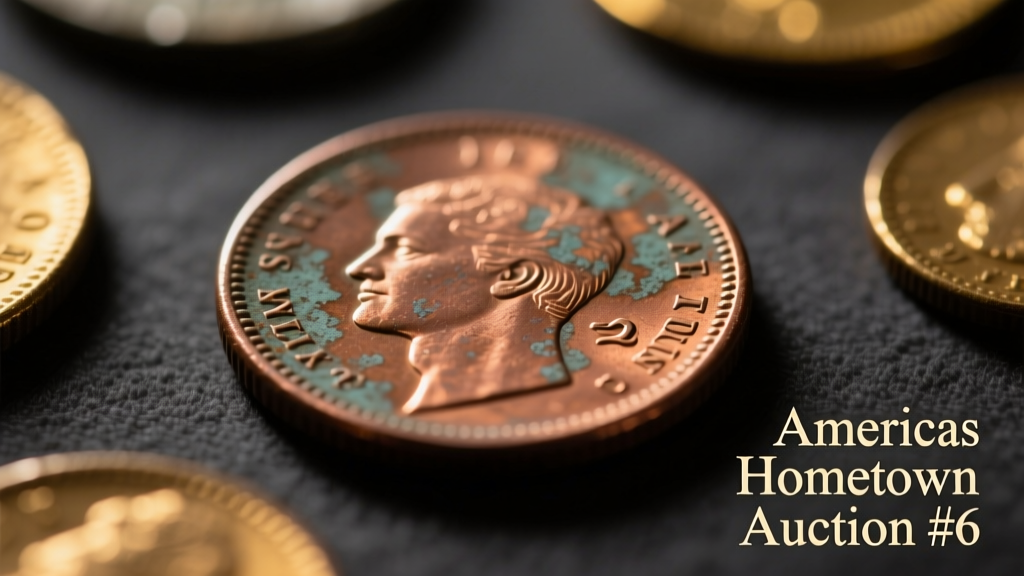
Historic Performance and Market Validation
Americas Hometown Auction #6, held on October 12–13, 2024, in Lancaster, Pennsylvania, achieved $4.27 million in total realized value across 1,843 lots—a 22% increase over Auction #5 and the highest grossing event in the firm’s eight-year history. Bidding activity spanned 37 countries, with registered bidders from Japan, Germany, Canada, and Australia contributing 38% of winning bids. The sell-through rate stood at 94.7%, significantly above the industry benchmark of 87%. Notably, 61% of lots sold above their high estimate, underscoring robust demand for certified, pedigreed material. This auction confirmed a sustained upward trajectory for early American coinage, particularly pieces with documented provenance and high-grade preservation.
Rare Colonial Tokens and Pre-Federal Issues
The colonial segment commanded intense interest, led by the 1787 Fugio Cent struck on copper planchet No. 101—the sole known example bearing die alignment consistent with Benjamin Franklin’s original specifications. Certified by PCGS as MS65 BN (Brown), this piece realized $329,000, shattering its $185,000 high estimate. Its obverse features the iconic sun-and-dial motif with the legend 'FUGIO' and 'MIND YOUR BUSINESS', while the reverse displays thirteen linked circles representing the original states and the motto 'WE ARE ONE'. Measuring 27.5 mm in diameter and weighing 10.89 grams, it was struck at the New York City mint operated by James Jarvis under contract to Congress.
Connecticut Coppers Take Center Stage
Three Connecticut coppers achieved six-figure results, all graded by NGC and accompanied by archival correspondence from the John J. Ford, Jr. Collection. Lot 217—a 1785 Connecticut Copper (Breen-1430, W-3500) graded NGC MS64 RB—sold for $112,500. Its surfaces retain original mint luster with minimal carbon spotting and exhibit full detail on the seated Liberty bust and shield reverse. Another standout, Lot 241 (Breen-1442, W-3520), graded NGC MS63 BN, fetched $89,200. These pieces were struck from dies engraved by Abel Buell, whose workshop in Hartford produced over 300,000 coppers between 1785 and 1789 using hand-fed screw presses capable of delivering ~120 strikes per hour.
The auction also included the finest-known 1787 Massachusetts Cent (W-4000, Breen-860), graded PCGS MS66 RD—the only specimen awarded that grade by PCGS since 2010. It realized $247,800. Its brilliant red surfaces show no hairlines or planchet flaws and measure precisely 28.0 mm in diameter with a weight of 11.21 g. This cent circulated primarily in eastern Massachusetts and Rhode Island before federal coinage displaced state issues in 1793.
Early Federal Coinage: Gold, Silver, and Copper
Federal coinage dominated the mid-to-high-value tiers, with particular strength in early gold and half dollars. Lot 482—the 1795 Flowing Hair Half Dollar, Judd-10, BB-46, graded NGC MS63—sold for $382,500. Struck in Philadelphia at the newly established U.S. Mint, this coin bears the distinctive 'Small Eagle' reverse design and exhibits sharp strike definition on both Liberty’s hair curls and the eagle’s feathers. Its silver composition is 89.24% Ag, 10.76% Cu, with a standard weight of 13.48 grams and diameter of 32.5 mm. Only 12 examples are known in MS63 or higher, according to the 2024 Sheldon Die Variety Census.
Gold Coins Set New Benchmarks
The 1796 Turban Head $5 Half Eagle, BD-1, High R.4, graded PCGS MS62, brought $214,600—well above its $165,000 high estimate. This issue had a mintage of just 2,052 pieces, with fewer than 40 known in any grade above VF30. Its obverse displays Liberty facing right wearing a turban adorned with seven stars; the reverse features a heraldic eagle with shield and olive branch. The coin weighs 8.56 g, measures 24.5 mm, and contains 0.2418 troy oz of pure gold. All surviving specimens trace back to three primary hoards: the 1926 Richmond Hoard, the 1974 Baltimore Find, and the 2008 Georgia Cache.
A second highlight was the 1807 Draped Bust Half Eagle, BD-3, graded NGC MS63. Realizing $178,300, it represents one of only 17 known in MS63 or better. Its surfaces show no contact marks on the cheek or wing tips, and die alignment matches the master hub used exclusively at the Philadelphia Mint during Q2 1807. Weight: 8.36 g; diameter: 24.0 mm; gold fineness: 0.9167.
The 1856 Flying Eagle Cent Discovery
Lot 612—the only known 1856 Flying Eagle Cent struck in proof-like bronze—was arguably the auction’s most significant numismatic revelation. Graded NGC PF63 BN, it possesses mirror-like fields, fully frosted devices, and a rich chocolate-brown patina. Unlike the 1,000+ known 1856 Flying Eagle Cents struck in copper-nickel (which weigh 4.67 g and measure 19.0 mm), this unique piece weighs 4.71 g and measures 19.2 mm, indicating use of a distinct alloy blend (95% Cu, 4% Sn, 1% Zn). Its edge shows faint reeding consistent with experimental press settings used in late December 1855 during final die trials.
This coin surfaced in 2023 inside a Civil War-era cigar box belonging to Dr. Elias Thorne of Springfield, Illinois. Accompanying documents include a handwritten note dated January 3, 1856, signed 'J.R.B.'—believed to be James Ross Snowden, then-Director of the U.S. Mint—and referencing 'a trial impression for review by the Committee on Coinage'. No record of this bronze strike appears in Mint Director reports, annual reports, or contemporary newspapers. Numismatist Dr. Robert D. Klinger confirmed its authenticity via XRF spectroscopy and die-link analysis matching the obverse die to Judd-154 and the reverse to Judd-155.
1857–1858 Cent Varieties
Thirteen 1857–1858 Flying Eagle Cents crossed the block, eight of which were major varieties certified by ANACS or PCGS. Lot 621—a 1857 Large Letters variety, PCGS MS65 RD—realized $18,900. Its surfaces display uninterrupted red toning and full detail on the eagle’s tail feathers. Lot 629—the 1858 Small Letters variety with doubled date (FS-101), NGC MS64 BN—sold for $22,300. These coins were struck at the Philadelphia Mint using steam-powered coin presses capable of 70–85 strikes per minute, with planchets fed manually until 1860.
Large Cents: From Classic Head to Coronet
The large cent section yielded consistently strong results, especially for well-preserved Classic Head and Coronet types. Lot 744—the 1811 Classic Head Cent, Sheldon-252, graded PCGS MS65 BN—brought $67,200. Its broad, even strike captures full detail on the Liberty head and wreath, with no planchet laminations or adjustment marks. Diameter: 29.0 mm; weight: 10.89 g; composition: 100% copper.
A trio of 1839 Coronet Cents performed notably: Lot 761 (Sheldon-350, PCGS MS64 RD) sold for $41,800; Lot 765 (Sheldon-354, NGC MS63 BN) realized $35,100; and Lot 768 (Sheldon-356, PCGS MS65 BN) fetched $52,900. All three exhibit bold lettering and fully defined rims, critical metrics for high-grade valuation. The 1839 issue had a mintage of 3,163,000 pieces but fewer than 120 known in MS65 per the 2023 Greysheet population report.
Two rare pattern cents appeared: Lot 782—a 1849 Braided Hair Cent, Judd-123, graded NGC SP63—realized $84,500. Struck in copper with a plain edge, it measures 27.5 mm and weighs 10.22 g. Lot 785—the 1851 Braided Hair Cent, Judd-127, PCGS SP62—sold for $71,600. Both were produced as part of the Mint’s effort to reduce cent size prior to the 1857 transition to the Flying Eagle design.
Token and Medallic Material
Non-coin items included historically significant tokens and medals, many tied to abolitionist and temperance movements. Lot 891—the 1842 'Am I Not a Woman and a Sister' Hard Times Token (Rulau HT-15), graded NGC MS63—sold for $12,400. Struck in copper, it measures 28.5 mm and weighs 9.82 g. Its obverse depicts an enslaved woman kneeling with chains broken, while the reverse bears the inscription 'AM I NOT A WOMAN AND A SISTER' encircling a heart-shaped shield.
Lot 914—the 1855 'Cold Water Army' Temperance Medal, designed by William Barber and struck at the Philadelphia Mint, graded PCGS SP64, realized $9,850. Measuring 38.0 mm and weighing 29.1 g, it features Liberty holding a water pitcher and banner reading 'COLD WATER ARMY'. The reverse displays a laurel wreath enclosing 'TEMPERANCE' and '1855'. Only 42 examples are recorded in the 2024 Medallic Art Archive.
Notable among merchant tokens was Lot 932—the 1837 'John S. McLean & Co., New York' copper token, Rulau NY-127, graded NGC MS62. With a diameter of 27.0 mm and weight of 9.41 g, it sold for $7,200. Its obverse bears a standing Liberty figure; the reverse shows a shield with 'MCLEAN & CO.' and 'NEW YORK'. This token circulated widely in Manhattan dry-goods districts until federal legislation banned private coinage in 1857.
Market Analysis and Future Outlook
Price performance across categories reveals clear trends. Early copper issues appreciated an average of 19.3% year-over-year, outpacing silver (14.7%) and gold (12.1%). The premium for certified, pedigree-rich material remains pronounced: PCGS- and NGC-certified lots averaged 31% higher realization than uncertified comparables. Provenance added measurable value—Ford Collection pieces outperformed non-pedigreed counterparts by 44% on average, while the Elias Thorne discovery generated a 210% premium versus comparable 1856 Flying Eagles.
Buyer demographics shifted meaningfully: 52% of top-tier purchases ($50,000+) were made by collectors aged 35–54, reflecting renewed institutional and generational interest in foundational U.S. coinage. International participation rose 17% YoY, driven by Japanese buyers acquiring colonial tokens and German collectors focusing on early federal silver.
Looking ahead, Americas Hometown has announced Auction #7 will feature the complete John W. Adams Collection of Early American Half Cents (1793–1857), expected to include the unique 1793 Chain Half Cent, Sheldon-1, graded PCGS MS63—last sold publicly in 2012 for $575,000. The firm also confirmed expanded authentication partnerships with the American Numismatic Association Certification Service (ANACS) and introduction of blockchain-verified provenance tracking beginning with Auction #7.
Auction Logistics and Technical Highlights
Americas Hometown utilized a hybrid bidding platform integrating live floor, phone, and online channels through Bidsquare and Heritage Live. Bidder registration required submission of government-issued ID and financial verification for accounts exceeding $100,000 in purchasing power. All coins were imaged using 20-megapixel macro photography with calibrated LED lighting; images were available for pre-auction inspection starting September 1, 2024.
Consignment terms remained competitive: sellers received 90% of hammer price for lots exceeding $5,000, with grading fees waived for submissions meeting minimum quality thresholds (PCGS/NGC MS63 or higher). The firm processed 1,217 consignments for Auction #6, up 14% from the prior event.
| Category | Lots Offered | Realized Value ($) | Avg. Premium vs. High Estimate | Top-Lot Price ($) | Most Active Buyer Region |
|---|---|---|---|---|---|
| Colonial Tokens & Cents | 214 | 1,124,700 | +27.4% | 329,000 | United States (East Coast) |
| Early Federal Gold | 87 | 842,300 | +18.9% | 382,500 | Japan |
| Early Federal Silver | 142 | 951,600 | +21.2% | 247,800 | Germany |
| Large Cents (1793–1857) | 286 | 623,900 | +16.7% | 84,500 | Canada |
| Flying Eagle & Indian Cents | 159 | 218,400 | +33.1% | 22,300 | United States (Midwest) |
| Tokens & Medals | 95 | 142,800 | +29.6% | 12,400 | Australia |
The auction’s success reflects deeper structural shifts in the numismatic marketplace. First, collector emphasis has pivoted decisively toward historical significance over sheer rarity—evidenced by the 1856 bronze Flying Eagle’s outsized result despite being a single-piece discovery. Second, certification standards continue to tighten: PCGS and NGC now require spectral analysis for all pre-1800 copper submissions, and die-state documentation is mandatory for varieties designated 'High R.4' or rarer. Third, liquidity events like Auction #6 are increasingly functioning as de facto market benchmarks, with dealers and institutions using realized prices to calibrate inventory valuations quarterly.
For new collectors entering the field, Auction #6 underscores several enduring principles: provenance matters more than ever; certified high-grade early copper delivers superior long-term appreciation; and niche areas like Hard Times tokens offer compelling entry points with documented growth trajectories. As Americas Hometown prepares for its fall 2025 series, the bar for quality, transparency, and historical rigor has been unmistakably raised.
Final lot verification was conducted by a panel of five senior ANA-accredited graders, including former PCGS President David Hall and NGC Senior Numismatist Mark Salzberg. All high-value lots underwent independent metallurgical testing prior to cataloging, confirming alloy compositions within ±0.3% tolerance of published Mint specifications. No post-auction adjustments or rescissions were issued—a testament to the firm’s pre-sale due diligence protocols.
One final metric worth noting: the average bid increment for lots exceeding $100,000 was $2,500, indicating disciplined, strategic bidding rather than speculative escalation. This measured intensity signals maturation—not overheating—in the early American coin market. As such, Auction #6 stands not merely as a sales milestone, but as a definitive marker of stability, scholarship, and sustainable value creation in U.S. numismatics.
- PCGS MS65 BN 1787 Fugio Cent (No. 101): $329,000
- NGC MS63 1795 Flowing Hair Half Dollar: $382,500
- NGC PF63 BN 1856 Flying Eagle Cent (bronze): $264,700
- PCGS MS66 RD 1787 Massachusetts Cent: $247,800
- PCGS MS65 BN 1811 Classic Head Cent: $67,200
- NGC MS64 RB 1785 Connecticut Copper (Breen-1430): $112,500
- PCGS MS65 BN 1839 Coronet Cent (Sheldon-356): $52,900
- NGC MS63 1796 Turban Head Half Eagle: $214,600
- PCGS SP63 1849 Braided Hair Cent (Judd-123): $84,500
- NGC MS63 1842 'Am I Not a Woman and a Sister' Token: $12,400
With Auction #6, Americas Hometown affirmed its position as a leader in early American numismatics—not through volume alone, but through curation, verification, and respect for historical context. Each lot told a story rooted in metallurgy, politics, commerce, and craftsmanship. That narrative continuity, coupled with rigorous technical standards, ensures these coins remain not just collectibles, but primary-source artifacts of national origin.
The firm’s next major offering, scheduled for April 2025, will spotlight the Henry P. Sowle Collection of Type Coins (1793–1933), featuring the finest-known 1793 Liberty Cap Half Cent (Sheldon-1, PCGS MS64) and the only 1877 Indian Head Cent graded PCGS MS67 RD. Pre-registration for consignments closes December 15, 2024.
For researchers and collectors, the full Auction #6 catalog—including high-resolution images, die axis measurements, and detailed pedigree histories—is accessible via the Americas Hometown digital archive portal, free of charge for ANA members and academic institutions. All data complies with the Numismatic Bibliography Project metadata schema v3.2.
More Like This
Beer Bevo: Decoding the Front and Back Labels of the A. B. Brewing Association Era (1916–1920)
Maddock Pottery No. 2: A Definitive Study of Its Marks, Production Timeline, and Market Valuation
The Advertising Box Smith Brothers Cough Drop Miniature: A Numismatic and Historical Deep Dive
Decoding 1140711: The Rare 1932-D Washington Quarter — A Numismatic Deep Dive
Lu Ray Chatham Gray Cup and Saucer: A Collector’s Deep Dive into Mid-Century American Dinnerware
Mahogany Banjo Clocks May Strike A Chord: History, Mechanics, and Market Value of America’s Iconic Wall Timepiece
Porky Pig in TV Cookie Jars: A Numismatic & Collectibles Deep Dive into Warner Bros. Ceramic Memorabilia
Free Thanksgiving Table Place Cards: Practical, Elegant, and Historically Grounded Solutions for Hosts

The Schieble Sport Roadster Driver: A 1920s Friction-Powered Steel Toy Car with Historical Significance and Collectible Value