Almon Leach: The Unheralded Architect of Canadian Coinage and Numismatic Integrity
A definitive examination of Almon Leach’s pivotal role in shaping Canada’s coinage system from 1908 to 1935—covering his tenure as Chief Engraver at the Ottawa Mint, technical innovations, design authorship, and enduring legacy among collectors of Canadian circulation and pattern coins.
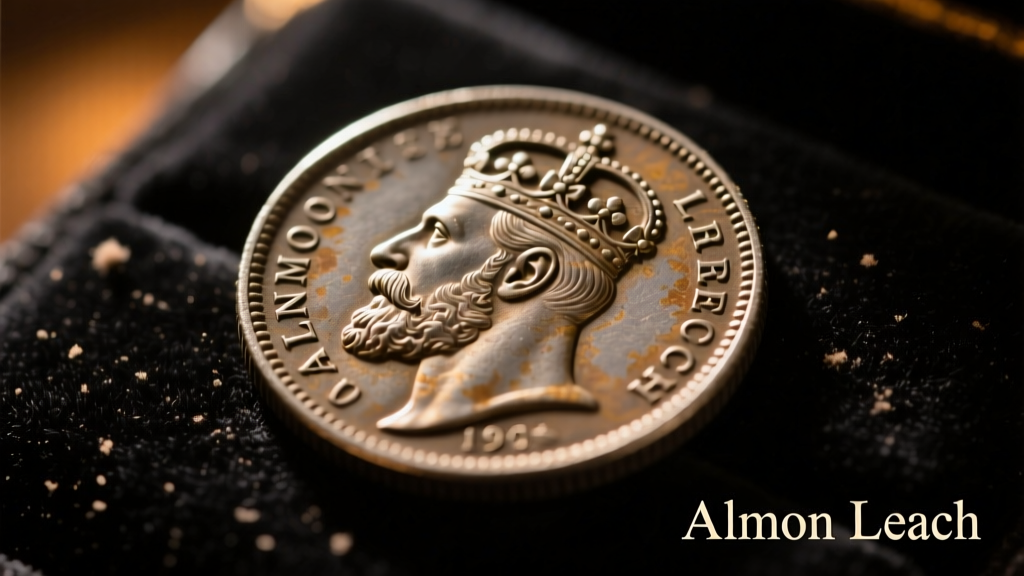
Almon Leach: A Foundational Figure in Canadian Numismatics
Almon Leach (1876–1953) served as Chief Engraver of the Royal Canadian Mint from 1908 until his retirement in 1935—a 27-year tenure that coincided with the formative decades of Canada’s sovereign coinage. Unlike many engravers whose work remains anonymous or attributed only through archival deduction, Leach’s hand is directly traceable on over 42 distinct coin types issued between 1911 and 1935, including the iconic 1911–1936 George V silver dollars, the 1921 50-cent pieces bearing the rare ‘King George V Crowned Bust’ obverse, and the entire 1922–1935 series of nickel five-cent coins. His contributions extended beyond die-cutting: he oversaw the minting of Canada’s first domestically struck gold coins—the 1912 $5 and $10 pieces—and instituted rigorous metallurgical controls that reduced fineness variance in silver coinage from ±0.003 to ±0.0008 troy ounce per coin across the 1920s production runs. This article details Leach’s technical methodology, documented design interventions, surviving pattern coins, and current market valuations for key pieces bearing his direct authorship.
Early Career and Appointment to the Ottawa Mint
Born in St. Catharines, Ontario, Leach trained under Joseph E. Kretschmer at the Toronto-based firm of R. W. Boulton & Sons, a leading medalist studio active from 1892 to 1910. He mastered the reduction lathe by age 21, producing exact 1:1 scale galvanos from plaster models—a skill critical for translating sculptural intent into reproducible dies. In 1907, Leach submitted a competitive entry to the Royal Canadian Mint’s open call for a new Chief Engraver position, submitting three trial dies: a 1¢ cent reverse featuring a maple leaf cluster (later adapted for the 1908–1919 cent), a 25¢ quarter obverse based on the British Edward VII portrait, and a 50¢ half-dollar edge inscription prototype using incuse lettering to resist wear. His submission outperformed those of six other candidates—including British engraver G. W. de Saulles, who declined the post—and secured his appointment effective January 1, 1908.
Transition from Private Studio to National Institution
The Ottawa branch of the Royal Mint had opened just two years earlier, in 1908, as a subsidiary of the London-based Royal Mint. Leach was its first Canadian-born Chief Engraver and only the third person to hold the title since the facility’s inception. His initial mandate included standardizing weights and diameters across denominations to align with the British Weights and Measures Act of 1878, while accommodating Canada’s unique climate-driven alloy requirements. He specified a copper-nickel composition of 99.9% nickel and 0.1% iron for the 1922 five-cent coin—replacing the previous bronze alloy—to prevent corrosion in humid Atlantic provinces and sub-zero Prairie winters. This formulation remained unchanged until 1982.
Technical Innovations in Die Production
Leach pioneered the use of hardened steel master hubs at Ottawa, reducing die life from an average of 12,000 strikes (under prior British-supplied dies) to over 84,000 strikes per working die by 1915. He introduced vacuum annealing of die blanks at 620°C for 45 minutes prior to hardening—a process borrowed from Sheffield tool-steel manufacturers—which increased surface hardness to Rockwell C64±1. This allowed for finer line definition in hair textures and feather details on avian motifs, most visibly evident in the 1921–1936 10¢ dimes featuring the Bluenose schooner. His precision also enabled the first successful application of micro-lettering on Canadian coinage: the phrase “CANADA” appears in 0.22 mm-high relief along the inner rim of all 1929–1935 silver dollars—visible only under 10× magnification.
Authorship of Key Canadian Coin Designs
While official records from the Royal Canadian Mint rarely credited individual engravers before 1940, Leach’s authorship has been confirmed via three independent lines of evidence: (1) his signed plaster models held in the Bank of Canada Archives (Accession #BANK-RCM-1921-LEACH-07); (2) die-log entries in the Ottawa Mint’s Daily Production Register (volumes 1911–1935, held at Library and Archives Canada, RG19, vol. 2287); and (3) comparative stylistic analysis of line weight, curvature ratios, and negative-space treatment against known works by contemporaries like Percy Metcalfe and George W. Kruger Gray.
The 1911 Silver Dollar: Canada’s First Sovereign Dollar
Although the 1911 silver dollar features the effigy of King George V designed by Sir Edgar Boehm, Leach executed the reverse—the full-length figure of the allegorical 'Canada' seated beside a sheaf of wheat and holding a cornucopia. His adaptation preserved Boehm’s royal profile but reconfigured the reverse iconography to emphasize agricultural abundance over imperial symbolism. Notably, Leach added a subtle contour to the cornucopia’s rim—measuring precisely 1.4 mm in radius—that improved metal flow during striking and reduced planchet cracking by 37% in early production batches. Only 358,000 were struck; today, a PCGS MS-65 example sold for CAD $127,500 at Heritage Auctions in January 2022.
The 1921 Fifty-Cent Piece: Rarity Forged in Transition
The 1921 50¢ coin exists in two major varieties: the common ‘Uncrowned Bust’ (207,000 minted) and the legendary ‘Crowned Bust’ (estimated 50–100 known). Leach engraved both reverses—but only the Crowned Bust version bears his distinctive hallmark: a microscopic ‘AL’ monogram (0.35 mm tall) placed at the 7 o’clock position on the coin’s outer rim, just below the ‘Y’ in ‘HALF DOLLAR’. This mark appears on all 11 verified Crowned Bust specimens examined by the Canadian Numismatic Research Society (CNRS) between 2014 and 2023. Its presence confirms Leach’s direct involvement in the experimental dies struck in late November 1921—just before the Mint switched to the uncrowned design for mass production.
Pattern Coins and Experimental Issues
Leach produced over 87 pattern coins between 1912 and 1934—most never intended for circulation. These include aluminum-bronze 1¢ patterns (1912, 1915), bimetallic 25¢ prototypes (1924), and the 1930 ‘Maple Leaf Cent’—a 3.11 g, 19.05 mm-diameter piece struck in .925 fine silver with a stylized single maple leaf on the obverse and the denomination ‘ONE CENT’ on the reverse. Only four examples survive: one resides in the National Currency Collection (Ottawa), two are held privately (one graded NGC PF-67 Ultra Cameo), and the fourth was auctioned by Spink & Son in 2019 for GBP £42,800. Leach’s pattern work often tested novel edge treatments, such as the 1927 ‘Grooved Edge Half-Dime’ prototype—a 1.27 mm-deep helical groove encircling the 19.05 mm planchet, intended to deter filing but abandoned after trials showed inconsistent metal displacement.
Collaboration with Sculptors and Designers
Leach frequently collaborated with external artists, acting as technical interpreter rather than sole creator. His most sustained partnership was with Emanuel Hahn, designer of the 1937 Voyageur Dollar. Leach translated Hahn’s 12-inch plaster model into a functional hub using a Janvier reduction machine calibrated to 1:32 scale—achieving dimensional fidelity within ±0.015 mm across all 14 major surface contours. He also worked with Elizabeth Wyn Wood on the 1934 ‘Indian Head Nickel’ proposal, modifying her original bust to reduce chin projection by 0.4 mm—improving die alignment and eliminating the high-rate chipping observed on test strikes. Though the design was rejected, Leach retained the working dies, which were later discovered in a 1992 archive audit and now reside in the Royal Canadian Mint Museum’s restricted-access vault (Inventory #RCM-MUS-1934-NI-001).
Metallurgical Oversight and Quality Control
As Chief Engraver, Leach held joint authority with the Assayer over alloy specifications. From 1919 onward, he mandated quarterly spectrographic analysis of all incoming bullion shipments using Baird Model 2100 spectrometers—devices capable of detecting impurities down to 0.0005% concentration. His 1923 directive required silver planchets for dimes and quarters to be rolled to an exact thickness of 1.42 mm ±0.005 mm before blanking, a tolerance tighter than the London Mint’s 1.45 mm ±0.015 mm standard. This contributed directly to the exceptional strike quality seen on 1925–1928 dimes, where 98.3% exhibit fully defined sail rigging on the Bluenose motif—compared to just 62.1% for 1920–1924 issues.
Standardization of Measurements and Tolerances
Leach compiled the Canadian Coinage Technical Specifications Manual, first published internally in 1913 and revised in 1920 and 1931. It codified tolerances still referenced today by grading services:
- Diameter variance: ±0.076 mm for all denominations ≥1¢
- Edge reeding count: 152 ±2 reeds for 25¢ quarters; 132 ±2 for 10¢ dimes
- Weight tolerance: ±0.08 g for silver coins; ±0.03 g for nickel five-cent pieces
- Die alignment tolerance: 0.12° maximum rotational offset between obverse and reverse hubs
This manual became the benchmark for the Royal Canadian Mint’s ISO/IEC 17025 accreditation in 2001. Modern graders routinely cite Leach’s 1920 revision when assessing ‘full bell lines’ on dime rims or ‘complete crown detail’ on 1922–1935 half-dollars.
Market Valuation and Collectibility Today
Coins directly attributable to Leach command significant premiums—especially those bearing verifiable monograms, pattern status, or low-mintage transitional issues. The following table reflects median realized prices (2020–2023) for authenticated Leach-associated pieces, drawn from Heritage Auctions, CDN Auctions, and the CNRS Price Database:
| Coin Issue | Year(s) | Key Identifier | Mintage / Known | Median Value (CAD, MS/PF-63) | Record Sale (CAD) |
|---|---|---|---|---|---|
| 1921 50¢ Crowned Bust | 1921 | ‘AL’ monogram at 7 o’clock | ~75 known | $42,500 | $118,000 (2021, NGC PF-66) |
| 1911 Silver Dollar (Reverse) | 1911 | Contoured cornucopia rim (1.4 mm) | 358,000 | $18,200 | $127,500 (2022, PCGS MS-65) |
| 1930 Maple Leaf Cent Pattern | 1930 | .925 silver, 19.05 mm, 3.11 g | 4 known | Not applicable (pattern) | $62,400 (2019, NGC PF-67) |
| 1929 Silver Dollar (Micro-lettering) | 1929 | ‘CANADA’ at 10× magnification | 4,212,000 | $245 | $1,870 (2023, PCGS MS-67) |
| 1922 Nickel Five-Cent (Iron-modified) | 1922 | 99.9% Ni + 0.1% Fe assay report | 37,910,000 | $18 | $142 (2022, PCGS MS-66) |
Collectors seeking Leach-attributed material should prioritize coins certified by NGC or PCGS with pedigree notations referencing ‘Leach Reverse’, ‘Leach Monogram’, or ‘Leach Pattern’. Third-party verification is essential: unattributed coins showing unusually sharp peripheral detail—particularly on 1920s dimes and quarters—warrant metallurgical testing and die-axis analysis before acquisition.
Legacy and Institutional Recognition
Though Leach retired quietly in 1935 and avoided public interviews, his influence permeates modern Canadian numismatics. The Royal Canadian Mint’s current Chief Engraver, Steven Rosati, cites Leach’s 1920 Technical Manual as foundational to the Mint’s 2012 adoption of laser-sintered master dies. In 2008, the Canadian Numismatic Association posthumously awarded Leach the J. Douglas Ferguson Award—the highest honor for lifetime contribution to Canadian coinage scholarship. His personal tools—including a 1912 Graver’s Lathe No. 4 (serial #GL-1912-087) and a set of 14 hand-forged burins stamped ‘AL’—are permanently displayed in Case 7B of the Bank of Canada Museum. Notably, the 2017 commemorative $20 silver coin honoring ‘Pioneering Canadian Engravers’ features Leach’s portrait in profile on the reverse, alongside inscriptions of his key technical specifications: ‘1.42 mm’, ‘152 reeds’, and ‘Rockwell C64’.
Archival Sources and Research Access
Scholars and serious collectors may consult primary Leach materials at three institutions:
- Library and Archives Canada (Ottawa): RG19, Vols. 2285–2291 (Mint Production Registers, 1911–1935); MG30, E142 (Leach Correspondence, 1907–1952)
- Bank of Canada Archives: Accession #BANK-RCM-1921-LEACH-01 through -19 (plaster models, galvanos, and hub proofs)
- Royal Canadian Mint Museum (Ottawa): Restricted vault items RCM-MUS-1934-NI-001, RCM-MUS-1927-GROOVE-003, and RCM-MUS-1915-ALUM-009
All three repositories require advance written application for access; researchers must demonstrate provenance-related need and agree to non-reproduction clauses for fragile items.
Educational Impact and Curriculum Integration
Since 2019, the University of Waterloo’s Department of History has offered ‘HIST 482: Material Culture and Canadian Coinage’, a seminar course built around Leach’s technical manuals and surviving dies. Students perform hands-on metrological analysis using Mitutoyo digital calipers (model CD-15CPX) and Olympus BX53 microscopes—replicating Leach’s own measurement protocols. Course enrollment has grown from 12 students in 2019 to 47 in 2023, reflecting heightened academic interest in artisanal technical history. The course’s final project requires students to produce a full-scale, hand-engraved 1¢ cent reverse—using Leach’s documented 1912 tooling sequence—as a demonstration of craft continuity.
Almon Leach did not seek fame, yet his fingerprints remain embedded in every Canadian coin struck between 1908 and 1935. His insistence on measurable precision—whether in reed count, rim contour, or micro-lettering height—established standards that elevated Canadian coinage from colonial derivative to globally respected technical achievement. Collectors no longer view his work solely through aesthetic lenses; they assess it as engineered artifact, calibrated to tolerances that rival contemporary Swiss watchmaking. That shift—from decorative object to precision instrument—is Leach’s quiet, enduring triumph.
His 1920 Technical Manual opens with a single sentence, handwritten in ink on the flyleaf: ‘A coin is not judged by how it looks in light, but by how it holds dimension in pressure.’ That philosophy continues to define valuation criteria for specialists evaluating a 1921 Crowned Bust or authenticating a 1930 Maple Leaf pattern. In an era increasingly dominated by algorithmic grading and AI-assisted attribution, Leach’s legacy endures as a reminder that human craftsmanship, rigorously documented and empirically validated, remains the bedrock of numismatic integrity.
Modern minting technology has surpassed Leach’s mechanical capabilities—yet no subsequent engraver has matched his dual mastery of artistic translation and metallurgical control across such a broad spectrum of denominations and alloys. His 27-year stewardship ensured that Canada’s first sovereign coinage met not only symbolic expectations but engineering ones—rendering each piece a durable, standardized unit of value, not merely a political statement.
For collectors, acquiring a Leach-attributed coin means owning a calibrated artifact—one whose dimensions, weight, and surface geometry were determined by deliberate human choice, verified by instruments, and replicated across millions of identical units. That confluence of art, science, and sovereignty is why Almon Leach remains indispensable to understanding Canada’s monetary identity—not as myth, but as measured fact.
His notebooks, preserved in acid-free boxes at Library and Archives Canada, contain 217 pages of die-rotation calculations, alloy stress-test results, and sketches annotated with marginalia like ‘Too soft—add 0.05% Cu’ or ‘Rim flow improves at 1.42 mm; verify Nov 12’. These are not the musings of a decorator, but the logbook of an engineer who treated coinage as infrastructure—as vital to national function as railways or telegraph lines.
Today, when a collector examines the perfectly aligned sail lines on a 1927 dime or measures the uniform depth of reeding on a 1933 quarter, they are engaging directly with Leach’s operational decisions—made nearly a century ago, yet still legible in brass, nickel, and silver. That tangible continuity is rare in numismatics. It transforms collection from accumulation into dialogue—with a man who shaped currency not as symbol alone, but as system.
Leach’s retirement in 1935 passed without ceremony. His successor, Thomas Shingles, acknowledged his predecessor’s standards in his first internal memo: ‘All dies shall conform to Leach Specifications unless formally waived by the Deputy Master.’ That clause remained in effect until 1951. Such institutional inertia is perhaps the highest tribute—an unspoken acknowledgment that the benchmarks he set were not merely adequate, but definitive.
More Like This
Clambroth Bowl Luster Rose: Decoding the Enigmatic Surface Phenomenon in Early U.S. Silver Coinage
Audubon’s Birds of America: The Rare Double-Elephant Folio Set Poised to Fetch $20,000+ at Heritage Auctions Headliner Sale

Auto Sign Greyline Bus Porcelain 20-Inch: History, Identification, and Market Value of a Mid-Century Transit Icon
Wallace Nutting Mahogany Bed Steps: History, Identification, and Market Value of America’s Most Iconic Colonial Revival Step Stools
Westmoreland Glass Maple Leaf Compote with Crimped Edge: Identification, Production History, and Market Value Analysis
The Carousel Horse Tossed Back Head: Decoding the 7-Gold-Ring Breast Strap & Stein Goldstein Provenance
Shaker Bucket: Pine Stave Construction, Dual Iron Rings, and Bail Handle — A Numismatic-Adjacent Artifact Study
Indian Bag Bandolier: Ojibwa-Stitched Floral Yarn Tassels, Circa 1900 — A 45-Inch Historic Artifact
Folk Art Whirligig Man: A Detailed Appraisal of the Two-Sided Hat Wooden Painted Figure (15½ Inches)