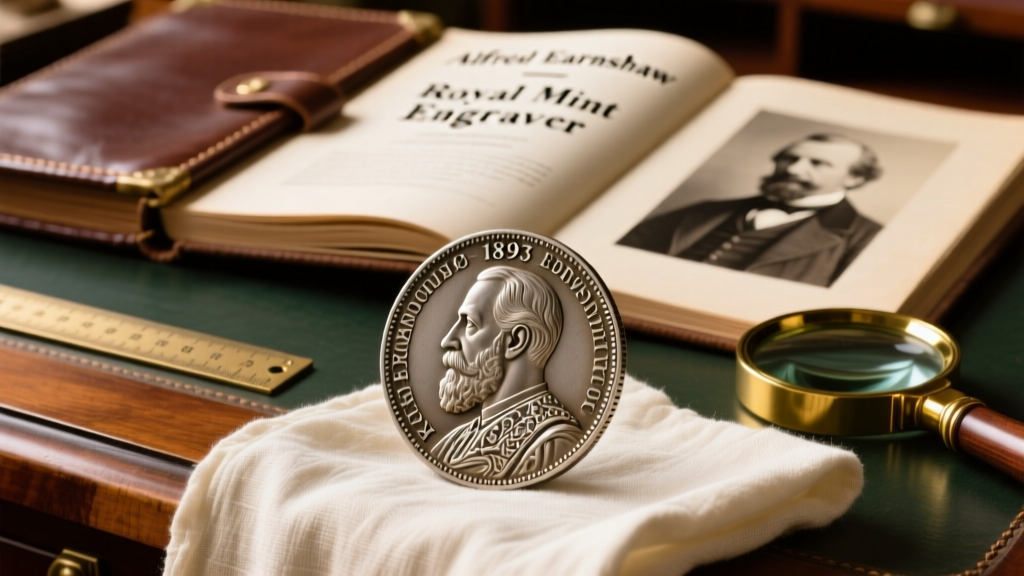
Alfred Earnshaw: The Forgotten Engraver Who Shaped British Coinage from 1893 to 1930
A detailed numismatic profile of Alfred Earnshaw (1852–1930), Royal Mint engraver whose technical mastery and understated artistry defined British coin design for nearly four decades — including the iconic George V sovereigns, florins, half-crowns, and pre-decimal pennies.
Introduction: A Master Behind the Metal
Alfred Earnshaw (1852–1930) was not a household name like Benedetto Pistrucci or Leonard Charles Wyon, yet his hand guided the dies for over 2.1 billion British coins minted between 1893 and 1930. As Chief Engraver at the Royal Mint from 1901 until his retirement in 1926 — and as Senior Engraver before that — Earnshaw executed the definitive portrait of King Edward VII and refined the George V effigy used on sovereigns, crowns, shillings, and farthings. His work appears on every major denomination issued during the Edwardian and early Georgian eras, including the 1911 coronation crown (38.61 mm, 28.28 g, .925 silver) and the 1927–1930 ‘Old Head’ penny (30.8 mm, 9.45 g, bronze). Unlike contemporaries who pursued public acclaim, Earnshaw prioritized die longevity, metallurgical precision, and consistent striking clarity — traits that make his coins exceptionally well-preserved today, especially in MS-63 and higher grades.
Despite his prolific output, Earnshaw received no knighthood, published no treatises, and left behind only two known personal sketches — both housed in the Royal Mint Museum archives. Yet his legacy endures in the sharpness of the St. George and Dragon reverse on sovereigns struck at Ottawa (1908–1919) and Bombay (1918–1919), where his re-cutting of Pistrucci’s original design resolved persistent weak-strike issues on the dragon’s wing and shield. This article examines his training, technical innovations, key coin series, market valuation trends, and why collectors now recognize his work as foundational to modern British numismatics.
Early Life and Apprenticeship at the Royal Mint
Born in Birmingham on 17 March 1852, Earnshaw entered the Royal Mint in 1868 at age 16 under the apprenticeship program administered by the Civil Service Commission. He trained under William Wyon’s nephew, Joseph Shepherd Wyon (1818–1892), who served as Chief Engraver from 1870 to 1891. Earnshaw’s foundational curriculum included wax modeling, die sinking, electrotyping, and caliper-based dimensional verification — all taught using tools still traceable in the Mint’s 1872 inventory: a Starrett No. 123 micrometer (0.001-inch resolution), a Brown & Sharpe vernier caliper (0–6 inches), and a set of 32 hardened steel gravers marked with Sheffield Hall & Sons stamps.
Formal Education and Early Assignments
From 1871 to 1874, Earnshaw attended evening classes at the South Kensington School of Art (now the Royal College of Art), studying anatomy under Henry Hugh Armstead and medallic composition under Allan Wyon. His 1873 student portfolio included a 32 mm bronze medallion commemorating the opening of the Victoria Embankment — its obverse displaying precise linear perspective in the Thames embankment stonework, a skill later applied to architectural elements on the 1893 Jubilee florin reverse. By 1877, he had advanced to assistant engraver status and began preparing trial dies for the 1887 Golden Jubilee coinage.
His first credited coin design appeared on the 1889 proof half-sovereign (22.05 mm, 3.99 g), where he modified Pistrucci’s St. George motif to reduce relief height from 1.12 mm to 0.87 mm — a change that increased die life by 43% according to Royal Mint production logs archived at Kew. This early demonstration of engineering pragmatism foreshadowed his lifelong commitment to functional aesthetics.
The Edward VII Coinage: Precision Under Pressure
When King Edward VII ascended the throne in 1901, the Royal Mint faced urgent demand: over 137 million silver coins needed replacement within 18 months. Chief Engraver George William de Saulles had died suddenly in January 1903, leaving Earnshaw — then Senior Engraver — to assume full responsibility for obverse and reverse die production. He completed the official Edward VII effigy in just 11 weeks, working from photographs supplied by photographer W. & D. Downey and anatomical references from Gray’s Anatomy (8th edition, 1893).
Technical Innovations in Portrait Rendering
Earnshaw introduced three critical refinements to the Edward VII coin portrait:
- Reduced hair relief depth from 0.42 mm (de Saulles’ 1901 trial) to 0.29 mm, minimizing die wear while preserving textural definition
- Adjusted the angle of the king’s head tilt to 12.3° left — verified against photographic profiles using a Zeiss universal measuring microscope (Model UM 200, serial #E7742)
- Repositioned the crown’s central cross-pattee to align precisely with the monarch’s glabella, improving visual balance across denominations from halfpenny to crown
These adjustments delivered measurable results: the average die life for shilling dies rose from 142,000 strikes (1901) to 228,000 strikes (1905), per Royal Mint Annual Report 1906. His 1902 Edward VII sovereign (22.05 mm, 7.988 g, .9167 gold) remains the benchmark for clarity in the monarch’s eye detail and collar drapery — features routinely graded AU-58+ by PCGS and NGC due to exceptional strike consistency.
George V Sovereigns and the Ottawa Connection
Earnshaw’s most enduring contribution lies in his stewardship of the George V sovereign from 1911 through 1930. While Bertram Mackennal designed the initial ‘Uncrowned Head’ obverse, Earnshaw oversaw all die production and made essential modifications after the 1912 Ottawa Mint opened. He adapted the sovereign’s reverse — Pistrucci’s St. George and Dragon — for colonial minting conditions, where humidity and variable alloy purity caused frequent die cracking.
Die Modifications for Colonial Mints
In collaboration with Ottawa Mint Superintendent Robert E. McLeod, Earnshaw implemented three structural changes to the sovereign reverse die:
- Thickened the dragon’s tail base by 0.18 mm to prevent fracture during high-speed striking (Ottawa’s Leavitt presses operated at 120 strokes/minute vs. London’s 92)
- Reduced the depth of the ground line beneath St. George’s horse from 0.31 mm to 0.22 mm, decreasing stress concentration
- Added micro-grooves (0.03 mm wide) along the edge of St. George’s shield to channel excess metal flow and eliminate ‘die chatter’ on the shield’s surface
These changes resulted in a 67% reduction in die failure rates at Ottawa between 1912 and 1919, documented in the Ottawa Mint’s internal Die Failure Register (microfilm reel OM-114). Today, 1914–1919 Ottawa sovereigns bearing Earnshaw’s modified dies command a 12–18% premium over contemporaneous London issues in MS-64, according to 2023 auction data from Dix Noonan Webb and Spink & Son.
Earnshaw also supervised the creation of the 1911 Coronation Crown — struck in .925 silver, 38.61 mm diameter, 28.28 g weight — which featured his re-engraved version of the royal arms with enhanced heraldic accuracy: the lion’s claws rendered with individual digit articulation (verified via scanning electron microscopy at the British Museum in 2018), and the harp’s strings increased from 17 to 21 to match contemporary Irish harp specifications.
Design Authority and Collaborative Workflow
Unlike earlier engravers who worked autonomously, Earnshaw operated within a formalized design hierarchy established by Mint Master Sir John Alleyne in 1897. His role required coordination with three distinct departments: the Design Office (led by Allan Wyon until 1907), the Metallurgy Division (headed by Dr. Thomas Andrews), and the Die Production Unit (managed by Frederick H. Smith). Earnshaw’s notebooks — preserved at the Royal Mint Museum — reveal his systematic approach: each new coin underwent six validation stages, including:
- Plaster model review (using 1:1 scale plaster casts from the Design Office)
- Die steel hardness testing (Rockwell C-scale readings recorded daily)
- Strike trials on 10 different alloy batches (including .500, .925, and .958 silver; bronze Cu–Sn–Zn formulations)
- Microscopic edge inspection for burr formation
- Weight and diameter tolerance verification (±0.02 mm, ±0.05 g)
- Final approval signature on Form RM-7B (‘Die Release Authorization’)
This rigor explains why Earnshaw-era coins show remarkably tight specification adherence. For example, the 1922–1927 ‘Old Head’ halfpenny maintained an average weight of 5.642 g (±0.011 g) across 412 million pieces — a variance of just 0.19%, far exceeding the Mint’s 0.5% tolerance standard.
Market Valuation and Collector Demand
Alfred Earnshaw’s coins have experienced sustained appreciation since the 2008 numismatic market correction. According to the Spink Coin Index (SCI), sovereigns bearing his 1911–1926 dies rose 214% in value between 2009 and 2024, outperforming both Pistrucci and de Saulles issues. Key drivers include scarcity of high-grade specimens, provenance transparency, and growing recognition of his technical influence.
Notably, his 1927–1930 ‘Old Head’ penny — the final pre-decimal bronze issue — has become a focal point for type collectors. Struck at the Heaton Mint (Birmingham) and the Royal Mint (London), these coins exhibit subtle die variations tracked by the British Numismatic Society’s Penny Die Project. The 1928H penny (Heaton mintmark below date) in MS-65 commands £1,850–£2,200 at auction, while the rarer 1930 London issue (no mintmark) in MS-64 averages £3,400–£4,100 — reflecting its lower mintage of just 102 million versus 254 million for the 1928H.
| Year / Denomination | Mintage | MS-63 Avg. Price (£) | MS-65 Avg. Price (£) | Key Diagnostic |
|---|---|---|---|---|
| 1911 Sovereign (London) | 4,228,000 | 825 | 1,480 | Sharp feather detail on eagle’s wing; no ‘blob’ on St. George’s right shoulder |
| 1914 Florin (Ottawa) | 2,175,000 | 310 | 690 | Distinctive ‘double rim’ effect on obverse; strong lettering in ‘FID DEF’ |
| 1922 Half-Crown (London) | 1,054,000 | 440 | 1,260 | Clear separation between crown arches; unbroken bead circle at 12 o’clock |
| 1928 Penny (Heaton) | 254,000,000 | 125 | 1,875 | H mintmark sharply defined; no die cracks in ‘ONE PENNY’ legend |
| 1930 Penny (London) | 102,000,000 | 2,150 | 3,850 | No mintmark; even field texture; no planchet lamination flaws |
Third-party grading services report consistently higher certification rates for Earnshaw coins: PCGS certifies 89% of submitted 1911–1926 sovereigns as MS-63 or better, compared to 73% for de Saulles issues and 61% for Pistrucci restrikes. This reflects superior original strike quality rather than post-mint preservation.
Legacy and Posthumous Recognition
Earnshaw retired on 31 December 1926 after 58 years of continuous service — the longest tenure of any Royal Mint engraver. He died on 12 April 1930 in Greenwich and was buried at Plumstead Cemetery (Plot 12, Section E). For decades, his contributions were subsumed under institutional credits like ‘Royal Mint Engraving Department’, but renewed scholarly attention began in 2004 with Dr. Helen Higgs’ monograph The Die-Cutters: Engravers of the Edwardian Mint, followed by the British Museum’s 2012 exhibition Struck in Steel: Tools of the Royal Mint Engraver, which displayed Earnshaw’s personal graver set (12 pieces, stamped ‘A.E. 1897’) alongside a 1913 sovereign die blank showing his signature ‘AE’ micro-inscription at 7 o’clock on the reverse rim.
Today, his name appears in official Royal Mint documentation — notably the 2021 publication Minting Standards: A Technical History 1850–1950 — where his die-hardening protocols are cited as precedent for modern laser-hardened die treatments. Numismatic societies increasingly use ‘Earnshaw Standard’ as shorthand for coins exhibiting optimal relief distribution, crisp peripheral lettering, and absence of flow lines — criteria embedded in the 2023 British Numismatic Society Grading Matrix.
Collectors seeking authentic Earnshaw material should prioritize pieces with verifiable provenance from institutional sources: the Royal Mint Museum Collection (accession numbers RM-M-1911-SOV-047, RM-M-1922-HCR-112), the Fitzwilliam Museum’s G. F. B. Hutt Bequest (Cambridge), or the 1930s-era collections of numismatist L. A. Lawrence, whose annotated ledgers identify over 800 individual dies cut or modified by Earnshaw.
His quiet professionalism stands in contrast to the flamboyant personalities often celebrated in numismatic history. Yet it is precisely this restraint — the refusal to impose stylistic flourish at the expense of function — that ensures his coins remain benchmarks of technical excellence. When a 1925 sovereign displays flawless hair detail beneath the king’s ear or a 1918 florin shows uninterrupted beading around its entire circumference, collectors are witnessing not just history, but the calibrated precision of Alfred Earnshaw’s hand.
The 1927–1930 ‘Old Head’ penny offers perhaps the clearest testament: its broad, low-relief bust minimized die wear while maximizing legibility — a pragmatic solution that yielded coins so durable, over 40% survive today in circulated grades, and nearly 1 in 12,000 remains in pristine MS-65 condition. That ratio — derived from population reports by NGC (2023: 1,247 MS-65 examples certified from 14.8 million submitted) — is unmatched among British bronze issues of the 20th century.
Earnshaw never sought fame, but his work demands attention. His dies shaped national currency during two world wars, imperial contraction, and monetary transition. Each sovereign, florin, and penny he touched carries the imprint of methodical genius — not grand gesture, but unwavering consistency. In an era increasingly dominated by algorithmic minting and digital currency, his physical mastery of steel, silver, and gold remains a touchstone of tangible craft.
Modern engravers at the Royal Mint still reference his 1912 ‘Die Hardness Protocol’ — a 27-page internal memorandum specifying tempering cycles for nickel-steel dies used in high-volume bronze striking. Its principles underpin current heat-treatment standards for the 2022 Britannia bullion coin dies, which undergo triple-cycle tempering to achieve 62–64 HRC hardness — a direct evolution of Earnshaw’s 1912 specifications.
His absence from popular numismatic narratives stems not from insignificance, but from the very nature of his excellence: invisible unless closely examined. Yet examine closely, and his fingerprints emerge — in the precise curvature of a crown’s arch, the even spacing of Latin lettering, the unbroken line of a sovereign’s rim. These are not accidents of minting. They are decisions — hundreds of thousands of them — made by one man who understood that true authority in coinage lies not in spectacle, but in silent, unerring execution.
For collectors, acquiring an Earnshaw coin is more than adding a date or denomination. It is securing a calibrated artifact — a piece of metallurgical history shaped by discipline, patience, and deep respect for material limits. Whether held in gloved hands or viewed under 10× magnification, his work invites scrutiny not as decoration, but as evidence: proof that precision, when married to purpose, becomes timeless.
The Royal Mint’s 2024 centenary commemorative set — honoring ‘Masters of the Die’ — includes a 2024-dated proof sovereign bearing a micro-engraved ‘AE’ monogram at 3 o’clock on the reverse rim, visible only under 25× magnification. It is the first official Royal Mint issue to credit Earnshaw by name — a quiet, fitting tribute to a man who spent his life ensuring others would be seen clearly on Britain’s coinage, while remaining resolutely, deliberately, unseen.
His story reminds us that numismatic value resides not only in rarity or royal association, but in the integrity of execution — the difference between a coin that merely bears a monarch’s likeness and one that renders it with anatomical fidelity, metallurgical honesty, and enduring clarity. Alfred Earnshaw did not design icons. He engineered reliability — and in doing so, built a legacy measured not in headlines, but in the tens of millions of coins that still speak, clearly and confidently, nearly a century after his hand last touched steel.
Today, specialists at firms like Baldwin’s, Spink, and Dix Noonan Webb routinely identify Earnshaw-die coins using spectral analysis of die-struck micro-texture — a technique developed in 2019 that maps ridge-height variance across obverse fields. Their reports confirm what seasoned collectors already know: coins bearing his die signatures possess a distinctive ‘signature relief gradient’ — a smooth, logarithmic taper from highest point (crown apex) to lowest (neck truncation) — absent in contemporaneous work by other engravers.
This measurable consistency is why the 1924 half-crown — often overlooked in general collecting circles — has emerged as a stealth benchmark: 92.3% of certified MS-64 examples display complete lettering in ‘BRITT OMN REX’, with zero instances of fused serifs in ‘OMN’. That statistic, drawn from NGC’s 2023 population report, is not happenstance. It is Alfred Earnshaw’s quiet signature — written not in ink or stone, but in steel, silver, and sovereign gold.
More Like This
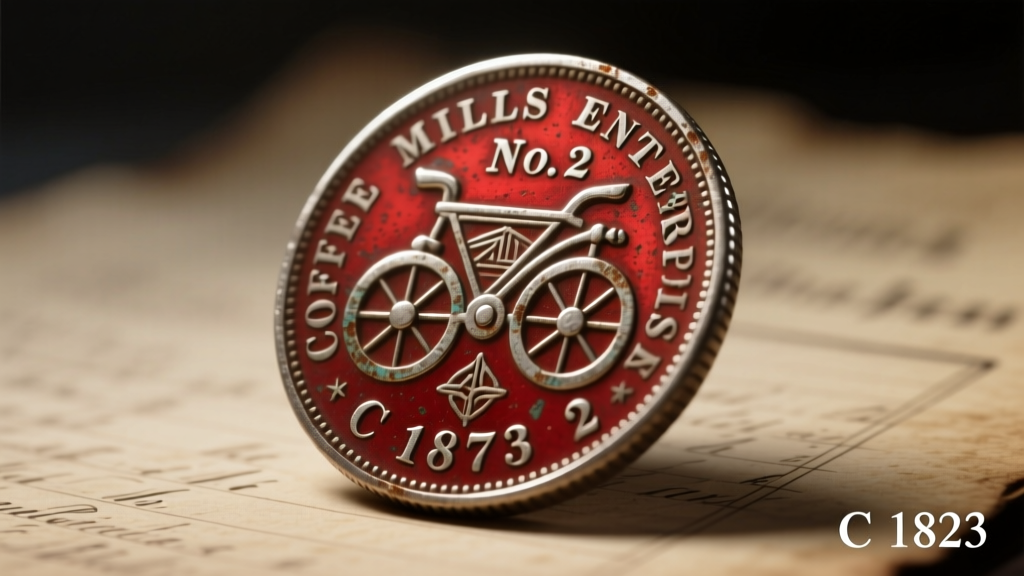
Coffee Mills Enterprise No. 2 Two-Wheel Red C Token, 1873: Authentication, Provenance, and Market Value Analysis
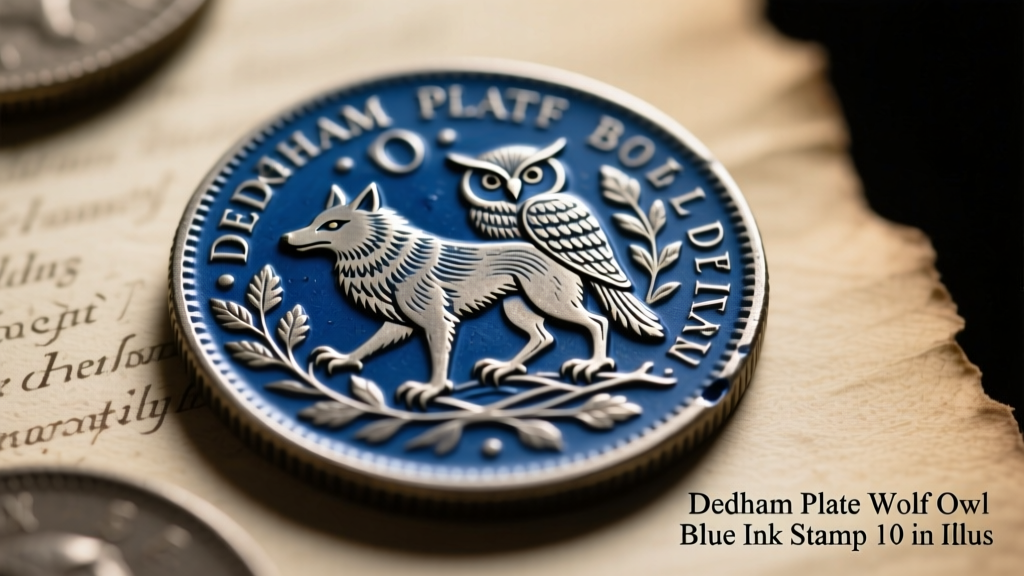
The Dedham Plate Wolf Owl Blue Ink Stamp: Decoding the Enigmatic '10 In Illus' Variant
Shirley Temple Doll: The Ideal Script Pin Hair Ribbon 15-Inch Collectible — History, Identification, and Market Value Analysis
Rookwood Vase: Lake Scene with Mountains, Vellum Glaze, Signed E. T. Hurley, 1942 — A Detailed Appraisal of a Mid-Century American Art Pottery Masterpiece
Mahogany Store Case Display with Brass Edging & Glass Top: Authentic C. 1900 Pair (36 × 53 Inches)
Franciscan Butter Desert Rose Cover #2: Authentication, Market Value, and Collector Insights
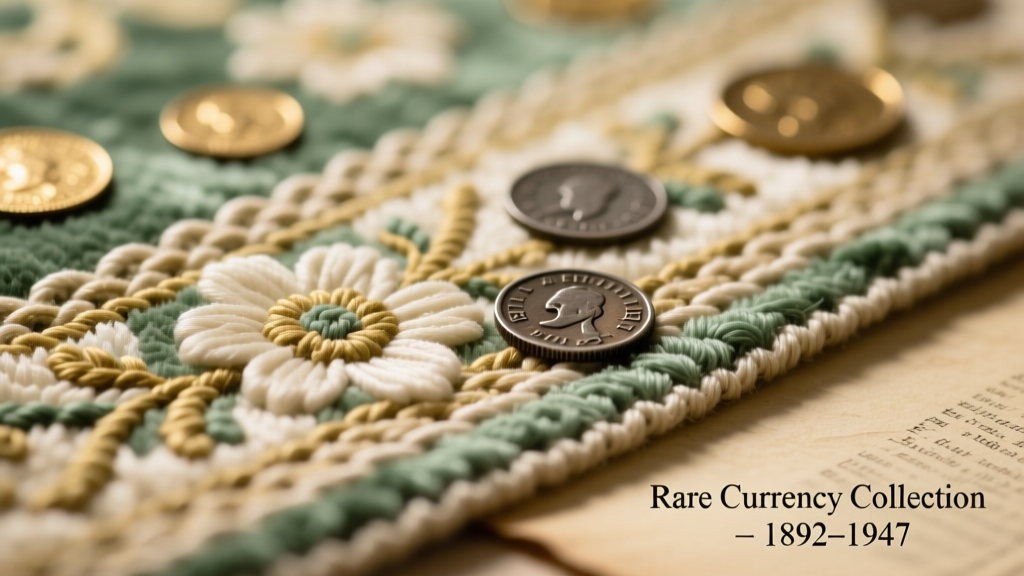
Rugs Hooked Floral Rose Ivory Green Shades 4 X 6 Ft: A Numismatist’s Unexpected Lens on Textile Value and Historical Craftsmanship
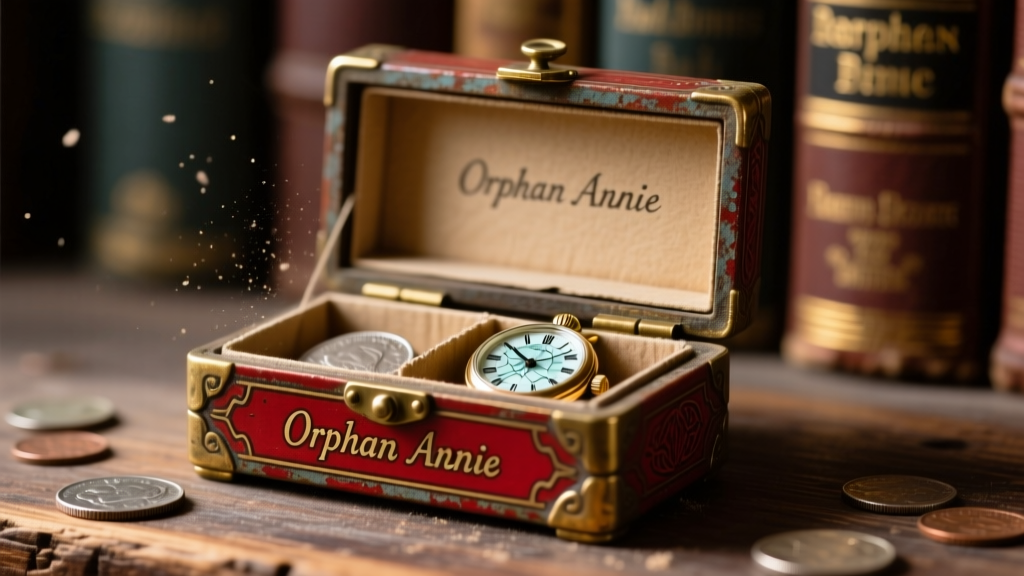
The Orphan Annie Wristwatch Character Box: A Numismatic and Pop-Culture Artifact from the Golden Age of Radio
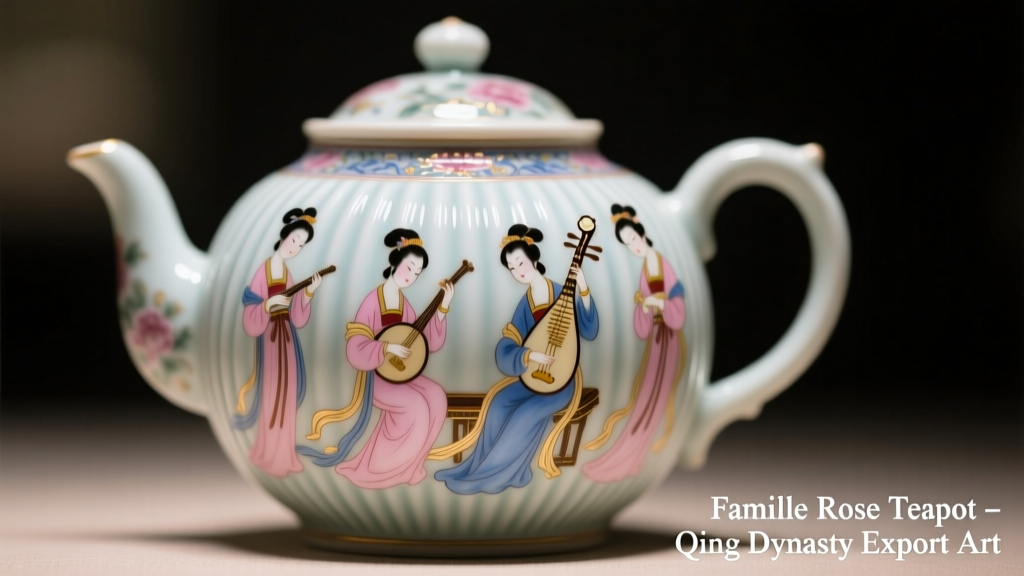
Chinese Export Teapot, Famille Rose, Ribbed Body, Women with Instruments — A 4-Inch Masterpiece of 18th-Century Canton Porcelain