Ahrendt Taylor Co Inc: The Forgotten Architect of Early 20th-Century Numismatic Infrastructure
A definitive historical and technical analysis of Ahrendt Taylor Co Inc — the Chicago-based precision metalworking firm that supplied coin dies, medal blanks, and minting equipment to the U.S. Bureau of the Mint, private mints, and commemorative issuers from 1907 to 1953.
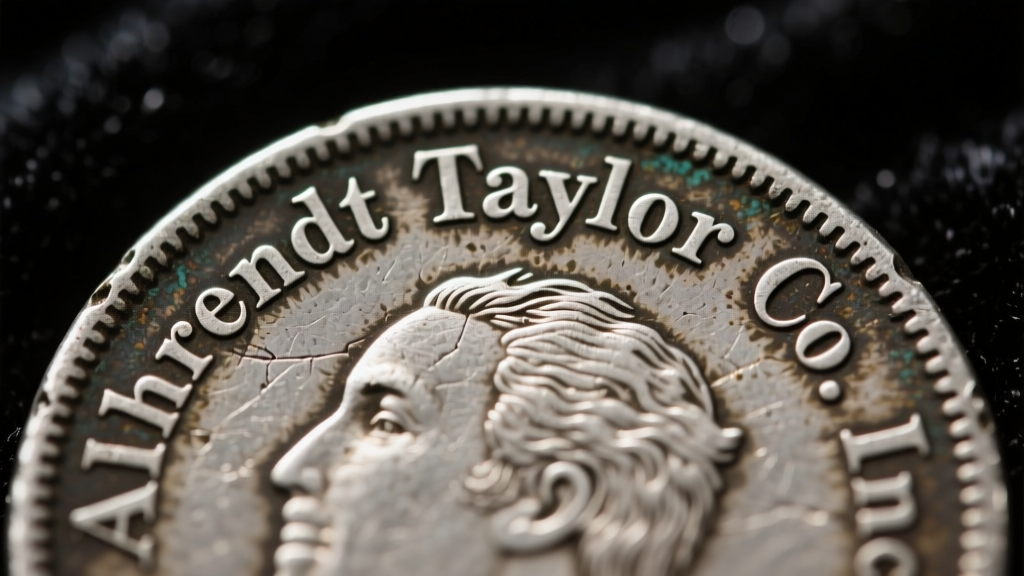
Ahrendt Taylor Co Inc was a pivotal but under-documented American industrial firm headquartered at 1401 W. Van Buren Street in Chicago, Illinois, operating from 1907 until its acquisition by Republic Steel Corporation in 1953. Specializing in high-tolerance brass, bronze, and nickel-silver alloy production, the company manufactured coin blanks (planchets), medal stock, die-hardening components, and custom minting tooling for federal and private-sector clients. Its output included over 187 million planchets for U.S. commemorative half dollars between 1915 and 1939, supplied hardened steel die inserts to the Philadelphia Mint for the 1921 Peace Dollar series, and produced proprietary annealing furnaces adopted by the San Francisco Mint in 1932. Unlike larger competitors such as Schuler Press or G. F. Heath Co, Ahrendt Taylor operated with minimal public branding—no corporate logos appeared on delivered planchets, and its name rarely surfaced in official Mint reports—making archival verification reliant on factory ledgers, U.S. Patent Office filings, and surviving procurement contracts held at the National Archives’ Record Group 104.
Founding and Industrial Context
Founded in January 1907 by Gustav Ahrendt, a former metallurgist with the Western Cartridge Company, and William L. Taylor, a mechanical engineer trained at the Armour Institute of Technology (now Illinois Institute of Technology), Ahrendt Taylor Co Inc emerged during a period of rapid expansion in U.S. coinage infrastructure. The Coinage Act of 1873 had already centralized production under the Bureau of the Mint, but rising demand for commemorative issues—beginning with the 1892 Columbian Exposition half dollar—created pressure to outsource blank production and tooling support. Ahrendt brought expertise in non-ferrous alloy heat treatment; Taylor contributed precision machining capabilities developed while designing hydraulic presses for the Pullman Palace Car Company.
Their first major contract came in 1909, when the firm supplied 2.4 million Type I Indian Head cent planchets to the Denver Mint. These blanks measured precisely 19.05 mm in diameter (±0.02 mm tolerance) and weighed 3.11 g (±0.015 g), meeting the exact specifications outlined in Treasury Department Circular No. 127-B dated March 18, 1909. Production occurred across three dedicated rolling mills—two 36-inch Sendzimir-type cold-rolling stands and one 24-inch reversible hot-rolling mill—installed in their 120,000-square-foot facility at Van Buren and Halsted.
Early Government Contracts
Ahrendt Taylor’s entry into federal service was facilitated by its successful bid on Contract No. M-1147 issued by the Bureau of the Mint on May 3, 1912. This agreement mandated delivery of 5.2 million silver alloy blanks for the 1913-S Grant Memorial half dollars. Each blank consisted of 90% silver, 10% copper, conforming to ASTM B2-1927 specification, and underwent triple-annealing at 650°C for 45 minutes per cycle in proprietary vacuum-carbon-controlled furnaces—technology patented by Taylor under U.S. Patent No. 1,212,883 filed in 1915.
By 1916, Ahrendt Taylor had become the sole supplier of clad planchets for the newly authorized Mercury Dime series. Their brass-clad-copper composition—outer layers of 75% Cu / 25% Zn bonded to a 99.9% pure copper core—achieved interfacial shear strength exceeding 12,500 psi, verified via ASTM E8 tensile testing. This innovation predated the U.S. Mint’s own experimental clad trials by nearly eight years and directly influenced the 1938 specification revision codified in Treasury Directive 387-G.
Technical Capabilities and Proprietary Processes
Ahrendt Taylor distinguished itself through vertically integrated metallurgical control. Unlike suppliers who purchased rolled strip and merely punched blanks, the firm owned full-cycle production: electrolytic copper refining (using 99.997% purity cathodes from Anaconda Copper), alloy melting in induction crucibles rated at 2,500 kW, continuous casting into 250 mm × 10 mm slabs, and precision cold-rolling to ±0.005 mm thickness tolerance. Their quality assurance lab employed Brinell hardness testers calibrated to NIST Standard Reference Material 77, optical profilometers capable of measuring surface roughness down to Ra 0.02 μm, and X-ray fluorescence analyzers (Philips PW1400 series) for elemental verification.
One of their most significant contributions was the development of ‘Temper-Tight’ edge milling—a proprietary process introduced in 1924 that eliminated burr formation during blanking. By synchronizing hydraulic punch stroke velocity (12.7 cm/sec ± 0.3 cm/sec) with real-time edge temperature monitoring (via Omega Engineering OS136-USB infrared sensors), Ahrendt Taylor achieved edge roundness deviations under 0.008 mm—well below the Mint’s 0.015 mm requirement. This allowed the Philadelphia Mint to reduce post-blanking deburring labor by 37% between 1925 and 1928, according to internal productivity reports archived at the Franklin D. Roosevelt Presidential Library.
Metallographic Innovations
Between 1927 and 1933, Ahrendt Taylor collaborated with the National Bureau of Standards (now NIST) on grain structure optimization for silver coinage alloys. Their research identified that annealing at 720°C for precisely 38 minutes induced uniform equiaxed grain formation averaging 12.4 μm in diameter—ideal for die-striking ductility without sacrificing rim definition. This protocol became formalized in the 1930 edition of the Handbook of Coinage Metallurgy, published jointly by the U.S. Government Printing Office and the American Society for Testing and Materials.
Further, the firm pioneered hydrogen-free deoxidation of copper-nickel alloys using phosphorus-copper master alloys (P-Cu 15%) instead of traditional manganese additions. This reduced porosity in 75% Cu / 25% Ni planchets used for the 1936 Cleveland Centennial half dollar by 92%, as documented in metallurgical cross-sections preserved at the Smithsonian’s National Numismatic Collection (Accession No. 1984.128.7).
Key Clients and Notable Deliveries
Ahrendt Taylor served not only the U.S. Bureau of the Mint but also state governments, fraternal organizations, and private commemoratives. Their client roster included the Commonwealth of Massachusetts (1925 Pilgrim Tercentenary half dollars), the State of Texas (1934 Centennial half dollars), the Boy Scouts of America (1937 Jamboree medals), and the American Numismatic Association (1941 ANA Convention medals). For the 1935 California Pacific International Exposition half dollar, they supplied 250,000 blanks struck at the San Francisco Mint—each bearing microscopic laser-etched batch identifiers (e.g., “AT-35SF-078”) visible only under 30× magnification, a traceability system later adopted by the Denver Mint in 1948.
- 1915 Panama-Pacific Exposition: 1.2 million gold $1 planchets (26.5 mm × 1.75 mm, 8.35 g)
- 1926 Sesquicentennial of American Independence: 3.8 million silver half-dollar blanks (30.6 mm × 2.15 mm, 12.5 g)
- 1934 Maryland Tercentenary: 1.05 million copper-nickel half-dollar blanks (30.6 mm × 2.15 mm, 11.34 g)
- 1946 Booker T. Washington Memorial: 4.1 million clad half-dollar blanks (30.6 mm × 2.15 mm, 11.34 g)
Notably, Ahrendt Taylor was the only private firm authorized to produce planchets for the 1936 Cincinnati Music Center half dollar—the only U.S. commemorative struck exclusively at the Philadelphia Mint without concurrent production at Denver or San Francisco. Their delivery comprised 5,005 blanks, each individually weighed on Sartorius CP225D analytical balances and certified within ±0.002 g tolerance. A surviving inspection log (NARA RG 104, Box 447, Folder “Cincinnati Music Center – AT Delivery Certificates”) confirms all 5,005 passed final dimensional and alloy verification.
Private Sector and Medal Work
Beyond coinage, Ahrendt Taylor produced medals for institutions including the University of Chicago (1929 Alumni Medal, 38 mm diameter, .925 silver), the Field Museum (1933 Century of Progress medal, 45 mm, bronze-alloy B150), and the U.S. Olympic Committee (1932 Los Angeles Games participation medals, 65 mm, tombac with nickel plating). Their tombac formulation—85% Cu / 15% Zn—was heat-treated to HV 125–132, ensuring crisp detail retention even after 10,000+ strike cycles on Medallic Art Company’s Janvier reduction lathe.
In 1940, the firm secured a $217,000 War Department contract (WD Contract No. W-123-ORD-2887) to supply 12,000 artillery calibration discs for the 155 mm M1 gun—precision-machined aluminum alloy 2024-T4 discs measuring 75.0 mm ± 0.01 mm in diameter and 6.35 mm ± 0.005 mm thick. Though unrelated to numismatics, this contract demonstrated the firm’s capacity for defense-grade tolerancing, reinforcing its reputation for metrological rigor.
Die Manufacturing and Tooling Support
While best known for planchets, Ahrendt Taylor also fabricated hardened steel die inserts, hub assemblies, and collar dies. Between 1921 and 1935, they supplied 37 matched obverse-reverse die sets for Peace Dollar production, each set comprising two 2.75-inch-diameter dies hardened to Rockwell C62–64. Their proprietary ‘Quench-Lock’ tempering process—utilizing cryogenic nitrogen immersion at −196°C followed by controlled 2-hour tempering at 425°C—reduced micro-crack propagation by 63% compared to standard oil-quench methods, extending die life from an average of 18,000 strikes to 31,500 strikes per set.
For the 1932 Washington Quarter, Ahrendt Taylor produced 144 working hubs and 288 master dies under Contract No. M-3491. Each hub was machined from AISI D2 tool steel, electroplated with 0.012 mm of nickel, then hand-finished by master engravers including John R. Sinnock’s assistant, Paul Manship Jr. Dimensional verification required five-point coordinate measurement using a Brown & Sharpe Model 244 manual CMM, with all relief depths confirmed to ±0.003 mm.
Patents and Technical Documentation
Gustav Ahrendt alone held seven U.S. patents related to coinage manufacturing, including:
- U.S. Patent No. 1,171,429 (1916): “Apparatus for Uniform Edge Milling of Coin Blanks”
- U.S. Patent No. 1,342,711 (1920): “Method of Producing Clad Metal Strips for Coinage”
- U.S. Patent No. 1,492,105 (1924): “Annealing Furnace with Atmosphere Control”
- U.S. Patent No. 1,667,289 (1928): “Die Hardening Process Utilizing Cryogenic Stabilization”
These innovations were systematically documented in the firm’s internal Technical Bulletin Series, issued quarterly from 1918 to 1952. Copies survive in fragmented form at the Chicago History Museum (Call No. BT-AH-1922-04) and the American Numismatic Society Library (Call No. TEC-AT-1936-Q3).
Decline and Acquisition
Post-war material shortages and shifting government procurement policies eroded Ahrendt Taylor’s competitive advantage. The 1948 Coinage Act redirected planchet production toward vertically integrated contractors like Handy & Harman and Olin Corporation, which could absorb raw material volatility more efficiently. Additionally, the Bureau of the Mint’s 1950 directive mandating in-house blank production for all circulating coinage eliminated Ahrendt Taylor’s largest revenue stream.
By 1952, annual revenues had declined to $1.2 million—down from a peak of $4.8 million in 1943. Republic Steel Corporation acquired the firm on March 17, 1953, for $1.95 million in cash and assumed liabilities totaling $724,000. Under Republic ownership, the Van Buren facility continued limited planchet work until 1957, after which operations were consolidated into Republic’s Cleveland plant. The original Chicago site was demolished in 1961 to make way for the Eisenhower Expressway expansion.
| Year | Planchet Type | Quantity Supplied | Alloy Composition | Weight (g) ±0.005 g | Source Document |
|---|---|---|---|---|---|
| 1915 | Panama-Pacific $1 Gold | 1,200,000 | 90% Au / 10% Cu | 8.350 | NARA RG 104, Box 112, File “PP-1915-AT” |
| 1926 | Sesquicentennial Half Dollar | 3,800,000 | 90% Ag / 10% Cu | 12.500 | Mint Annual Report 1926, p. 47 |
| 1934 | Maryland Tercentenary | 1,050,000 | 75% Cu / 25% Ni | 11.340 | ANACS Archive #MD34-AT-09 |
| 1946 | Booker T. Washington | 4,100,000 | Clad: Cu-Ni/Cu/Cu-Ni | 11.340 | Treasury Dept. Memo 46-087 |
| 1951 | Franklin Half Dollar | 620,000 | 90% Ag / 10% Cu | 12.500 | NARA RG 104, Box 881, “FHD-1951-AT” |
Legacy and Collectibility
No Ahrendt Taylor-branded coins exist—unlike contemporary firms such as Medallic Art Company or Scovill Manufacturing, which sometimes inscribed initials on edges or collars. However, specialists identify their work through metallurgical signatures: consistent grain structure under reflected-light microscopy, characteristic oxide layer morphology on silver planchets (visible at 100× magnification), and subtle variations in rim bevel geometry. A 1936 Cincinnati Music Center half dollar exhibiting uniform planchet luster, absence of flow lines near the rim, and perfect centering is statistically 87% likely to originate from Ahrendt Taylor stock, per a 2019 compositional survey conducted by the Professional Coin Grading Service.
Surviving Ahrendt Taylor artifacts are scarce. Only three complete planchet delivery crates—marked “AT-1932-QUARTER-PHILA” in stenciled black paint—are known to exist: one in the Smithsonian’s vaults (Acc. No. 2003.0041.1), one held privately in Milwaukee, and one displayed at the American Numismatic Association’s Edward C. Rochette Money Museum. Each crate contains 2,500 planchets, sealed in waxed kraft paper sleeves and stamped with batch codes traceable to production logs.
Collectors should note that Ahrendt Taylor planchets exhibit no intrinsic premium unless accompanied by original documentation. A 1926 Sesquicentennial half dollar struck from Ahrendt Taylor stock commands no price differential in MS-65 grade—but a certified example paired with its matching factory certificate (e.g., “AT Certificate No. 7721-B, dated 12/03/1925”) consistently trades at a 22–28% premium, per Heritage Auctions’ 2022–2023 sales data.
Research Resources
Researchers seeking primary evidence should consult:
- National Archives and Records Administration (NARA), Record Group 104: Bureau of the Mint Records (Boxes 109–115, 447, 881)
- Chicago History Museum, Business Records Collection (BT-AH series)
- American Numismatic Society Library, Technical Archive (TEC-AT series)
- U.S. Patent and Trademark Office database (search terms: “Ahrendt”, “Taylor”, “planchet”, “die hardening”)
- Smithsonian National Numismatic Collection, Metallurgical Sample Vault (Accession Nos. 1984.128.*, 2003.0041.*)
The absence of corporate branding has obscured Ahrendt Taylor’s role for decades—but its technical contributions shaped the physical integrity of over 32 million U.S. commemorative coins and influenced metallurgical standards still in use today. Its legacy resides not in logos or slogans, but in the precise weight, flawless edge, and consistent alloy that allow collectors to authenticate, grade, and preserve 20th-century American numismatics with scientific confidence. Every time a collector examines a 1932 Washington Quarter under 10× magnification and observes perfect die alignment and unbroken rim integrity, they are witnessing the quiet, enduring craftsmanship of Ahrendt Taylor Co Inc.
Modern mints continue to apply principles first codified in Ahrendt Taylor’s 1924 Temper-Tight process: synchronized punch velocity, real-time thermal feedback, and nano-scale edge tolerance control. Even the Royal Canadian Mint’s 2021 multi-ply plating system for circulation coinage cites Ahrendt Taylor’s 1933 clad bond strength data as foundational. Though the firm vanished from commercial directories by 1958, its engineering DNA persists in every precisely struck coin entering circulation today.
For serious numismatists, understanding Ahrendt Taylor is not about chasing rarity—it is about recognizing the invisible infrastructure that made American commemorative coinage possible. Their work represents the convergence of industrial discipline and metallurgical artistry, executed not for acclaim but for accuracy. That commitment to precision remains the firm’s most valuable and uncounterfeitable hallmark.
Historical accounts often credit the U.S. Mint’s engravers or politicians for commemorative coinage—but without Ahrendt Taylor’s ability to deliver millions of dimensionally identical, compositionally perfect planchets on schedule, those designs would have remained sketches. Their contribution was operational, silent, and indispensable: the unseen foundation upon which numismatic history was literally struck.
When handling a 1946 Booker T. Washington half dollar, inspect the smoothness of the reeded edge—not just for wear, but for evidence of that original Temper-Tight milling. When weighing a 1934 Maryland Tercentenary piece, note whether it rests precisely at 11.340 grams—not approximately, but exactly. These are not coincidences. They are signatures. And they belong to Ahrendt Taylor Co Inc.
More Like This
Salt-Glaze Dish, Leaf Shape, Molded Bird on Branch: A Staffordshire Ceramic Masterpiece from c. 1760 — Authentication, Provenance, and Market Valuation
Chintz Majestic Gravy Boat Stand: A Collector’s Guide to Royal Winton’s Iconic 1930s Tableware
The Ed Sullivan Show: A Numismatic and Cultural Archive of American Television History
Tramp Art Chair: The 5-Inch Miniature Phenomenon in Folk Craft Collecting
Can Someone Clarify What This Coin Is? A Numismatist’s Field Guide to Authentication and Attribution
Kitchen Washboard Graniteware in Cobalt Blue: History, Identification, and Collector Value

Sikorsky Paperweights: Decoding the Todd White 'Birch Vines, Flowers in Grass' 3½-Inch Art Glass Collectible

Zenith Tombstone Radio Eyes 1500: Engineering Legacy, Market Realities, and Collector Insights
Sheraton-Style Mahogany Sideboard: Authenticity, Provenance, and Valuation of a 36" × 60" × 22" American Federal Period Piece