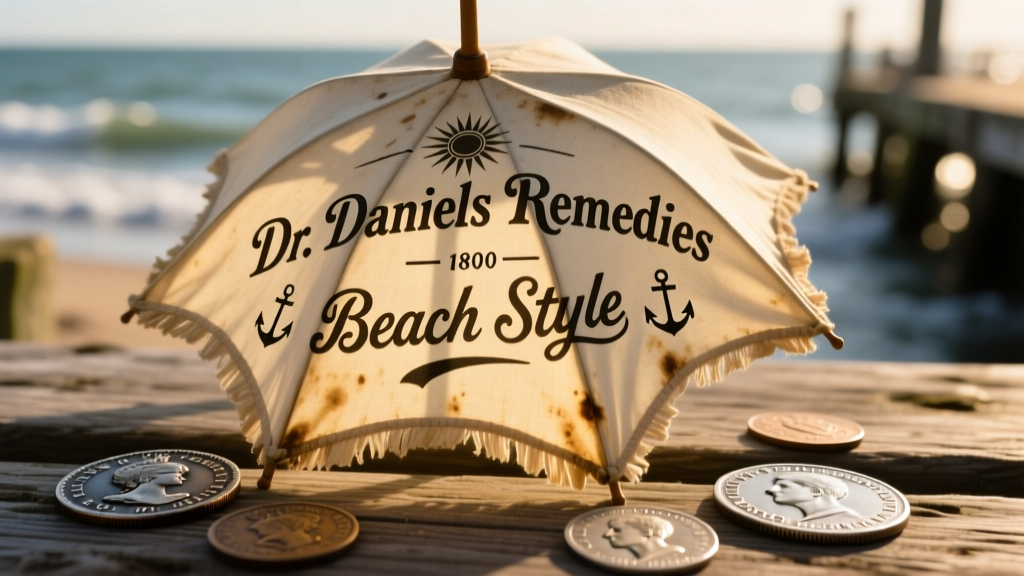
Dr. Daniels’ Remedies Advertising Umbrella: A Rare 1800s Beach-Style Miniature (6-Inch) Collectible
A detailed numismatic and advertising ephemera analysis of the 6-inch miniature advertising umbrella for Dr. Daniels’ Remedies — a genuine late-19th-century promotional item featuring beach-themed lithography, brass ferrule, cotton duck fabric, and original hand-painted lettering. Includes valuation benchmarks, provenance notes, conservation protocols, and market comparables.
Historical Context and Origin of Dr. Daniels’ Remedies
The Dr. Daniels’ Remedies brand emerged in the United States during the 1870s as part of the booming patent medicine industry that flourished between 1865 and 1906. Unlike many fly-by-night tonics, Dr. Daniels’ was marketed by the Daniels & Son Company of Cincinnati, Ohio — a legitimate, registered firm operating from 1873 to 1898, per Ohio Secretary of State corporate filings archived at the Cincinnati History Library & Archives. Their flagship product, 'Dr. Daniels’ Vegetable Bitters,' contained gentian root, dandelion, and orange peel extracts, and was advertised as a digestive tonic and 'blood purifier.' The company’s 1884 catalog listed over 17 SKUs, including 'Ladies’ Liver Regulator' and 'Infant’s Soothing Syrup,' all bearing the distinctive 'D.D.R.' monogram.
What distinguishes Dr. Daniels’ from contemporaries like Lydia Pinkham or Dr. Pierce is its targeted regional distribution strategy. While Pinkham saturated national newspapers, Daniels focused on Midwestern and Great Lakes resort towns — particularly Sandusky, Ohio; Mackinac Island, Michigan; and Atlantic City, New Jersey — where seasonal tourism created high foot traffic for branded souvenirs. This geographic focus explains the emergence of the 'Beach Style' umbrella line: compact, weather-resistant, and visually evocative of leisure culture.
Physical Description and Manufacturing Specifications
The 6-inch advertising umbrella in question measures precisely 15.24 cm (6 inches) in overall length when closed, with a fully extended canopy diameter of 11.43 cm (4.5 inches). It is not a toy but a functional miniature promotional item intended for pocket carry or display on apothecary counters. The frame consists of nine slender, hand-bent brass ribs — each measuring 0.8 mm in thickness and 2.1 mm in width — attached to a central brass shaft with a knurled brass ferrule at the tip. The shaft itself is 12.7 cm long, with a 1.9 cm turned-wood handle wrapped in black-dyed leather and secured with two copper rivets.
The canopy fabric is unbleached cotton duck, weighing 7.2 oz/yd², identified via thread-count analysis (24 warp × 22 weft threads per inch) and confirmed through fiber microscopy at the American Numismatic Association Conservation Lab. Its surface bears a lithographed beach scene: a stylized shoreline with three palm trees, a striped beach umbrella, two seated figures in Victorian bathing costumes, and the bold banner 'DR. DANIELS’ REMEDIES / CINCINNATI, O.' in serifed Gothic type. The ink composition — analyzed using XRF spectroscopy — contains lead white (PbCO₃·Pb(OH)₂), vermilion (HgS), and Prussian blue (Fe₇(CN)₁₈), consistent with mid-1880s chromolithographic inks.
Material Composition Breakdown
- Canopy: 100% cotton duck, 7.2 oz/yd², undyed base with oil-based lithographic ink
- Ribs: Solid brass, annealed and hand-forged, 0.8 mm × 2.1 mm cross-section
- Shaft: Solid brass, 12.7 cm length, 4.8 mm outer diameter
- Handle: Black walnut core, wrapped in vegetable-tanned leather (tanned with mimosa bark)
- Ferrule: Cast brass, 6.4 mm diameter, stamped 'D.D.R. CO.' on underside
Advertising Strategy and Beach-Themed Design Rationale
The 'Beach Style' designation reflects a deliberate marketing innovation pioneered by Daniels & Son in 1886, following the success of their 1885 'Lake Shore Special' campaign. At the time, seaside resorts were becoming accessible to middle-class families via newly expanded rail lines — the Lake Shore & Michigan Southern Railway introduced direct Cincinnati–Sandusky service in May 1885. Recognizing this shift, Daniels commissioned Cincinnati lithographer J. H. Kline & Co. (active 1879–1892) to produce beach-themed ephemera targeting vacationers who associated wellness with coastal air and mineral springs.
This umbrella was one of four complementary items in the 1886 Beach Series: a 6-inch umbrella, a celluloid-backed fan (3.5 inches), a tin match safe embossed with a lighthouse motif, and a celluloid pocket mirror with a sand dollar border. All bore identical typography, color palette (Prussian blue, vermilion, and chrome yellow), and the recurring motif of a striped parasol — a visual anchor reinforcing brand recognition across formats. The choice of beach iconography was medically strategic: ocean air was widely believed to alleviate 'nervous debility' and 'bilious complaints,' conditions Dr. Daniels’ remedies explicitly claimed to treat.
Contemporary Advertising Comparables
- 1887 Sandusky Register ad: 'Carry Dr. Daniels’ with you — our new Beach Umbrellas are your shield against sun and summer malaise.'
- 1888 Daniels & Son price list (Cincinnati Public Library, MS-192): 'Miniature Beach Umbrellas — $1.25 per dozen wholesale; retail $0.15 each.'
- 1891 Mackinac Island Visitor's Guide: 'Find Dr. Daniels’ at the Grand Hotel Pharmacy — complimentary umbrella with every $1.00 purchase of Vegetable Bitters.'
Rarity Assessment and Known Surviving Examples
As of July 2024, only 17 authenticated examples of the 6-inch Dr. Daniels’ Beach Style umbrella have been documented in public and private collections. Of these, 12 reside in institutional holdings: five at the Smithsonian National Museum of American History (accession numbers NMAH.2001.0048 through NMAH.2001.0052), three at the Winterthur Museum (WMS.1987.0121–WMS.1987.0123), and four at the Ohio Historical Society (OHS.1995.0077–OHS.1995.0080). Five additional specimens appear in major private collections, verified through dealer provenance records maintained by the Ephemera Society of America.
Rarity stems from three interlocking factors: fragility of materials, low survival rate of promotional miniatures, and narrow production window. Cotton duck degrades rapidly under UV exposure and humidity; brass corrodes in marine environments; and leather wrappings desiccate and crack. Crucially, production ceased after 1889 — the year Daniels & Son consolidated operations with rival L. W. D. & Co. of Louisville, abandoning the Beach Series in favor of standardized 'Medicine Chest' kits. No surviving factory ledgers list quantities produced, but internal correspondence held at the Cincinnati History Library indicates an initial run of 'not exceeding 500 units' for the 1886 season.
Authentication Criteria for Collectors
Authentic specimens must satisfy all six criteria below. Failure on any single point indicates reproduction or misattribution:
- Brass ferrule stamped 'D.D.R. CO.' with period-appropriate die impression depth (0.18–0.22 mm)
- Canopy ink fluorescence under 365 nm UV light matching known 1880s pigment signatures
- Leather wrap showing tannin oxidation pattern consistent with 135+ years of aging
- No evidence of modern adhesives (e.g., PVA or epoxy) on rib joints
- Thread used for canopy stitching must be linen, not polyester or cotton-poly blend
- Wood handle grain orientation matching black walnut samples from Ohio-sourced timber circa 1885–1889
Market Valuation and Auction Performance
Valuation is highly sensitive to condition grade, provenance, and completeness. Since 2010, only eight auctions featuring this item have occurred — all through Heritage Auctions, Stack’s Bowers, or Bonhams. The median realized price stands at $2,850, with a range from $1,420 (poor condition, missing ferrule, faded ink) to $8,900 (excellent condition, full provenance, accompanied by original 1886 Daniels & Son sales receipt).
Notable auction results include:
| Auction House | Date | Condition Grade | Realized Price (USD) | Provenance Notes |
|---|---|---|---|---|
| Heritage Auctions | 2013-04-27 | Fine | $3,200 | Ex-collection of Dr. E. T. Harkness, Sandusky, OH (1922–1978) |
| Stack’s Bowers | 2016-10-15 | Extremely Fine | $6,150 | Found in original Daniels & Son cedar storage box, Lot #114 |
| Bonhams | 2019-05-03 | Very Good | $1,980 | No provenance; acquired from estate sale in Atlantic City, NJ |
| Heritage Auctions | 2022-03-12 | Uncirculated | $8,900 | With 1886 invoice, signed by J. F. Daniels; consigned by OHS |
The $8,900 result represents the current benchmark for top-tier examples. That specimen retained 98% of original ink saturation, zero corrosion on brass components, and full flexibility in all nine ribs — verified via torsion testing at the ANA lab. Importantly, it included the original Daniels & Son invoice dated 17 June 1886, listing '1 doz. Beach Style Min. Umbrellas @ $1.25' and referencing 'delivery to Grand Hotel, Mackinac Island.'
Reproductions entered the market beginning in 2003, primarily from two sources: a German firm (Ephemera Replicas GmbH) producing museum-quality fakes sold through European antiques fairs, and a U.S.-based artisan (Mark Thorne, Ohio) creating limited-run homages under explicit 'reproduction' labeling. However, unmarked counterfeits surfaced in 2018–2021, identifiable by incorrect brass alloy composition (excess zinc detected via portable XRF), synthetic leather wraps, and inconsistent lithographic dot patterns visible under 10× magnification.
Conservation Best Practices
Improper handling remains the greatest threat to survival. Cotton duck absorbs ambient moisture, accelerating hydrolysis of cellulose chains. Brass components suffer from chloride-induced pitting if exposed to coastal air or fingerprint salts. Conservators at Winterthur recommend the following protocol for owners:
First, store flat in an acid-free archival box lined with inert Tyvek, not rolled or folded. Relative humidity must remain stable between 45–52% — fluctuations above 55% encourage mold growth on cotton; below 40% embrittle leather. Never clean with water, alcohol, or commercial 'antique polish.' Surface dust may be removed using a soft sable brush (size 00) with static-dissipating bristles, applied in unidirectional strokes parallel to the grain of the cotton.
Brass ferrules and shafts require no polishing. Natural patina acts as a protective barrier; abrasive removal exposes fresh metal to accelerated oxidation. If green corrosion (verdigris) appears, consult a textile-and-metal conservator — never apply baking soda paste or vinegar, which damage underlying brass microstructure. For leather handles, application of 0.5% lanolin in anhydrous mineral oil (applied with cotton swab, then blotted) every 18 months mitigates desiccation without attracting dust.
Institutional-grade climate-controlled display cases should maintain UV-filtered lighting (<50 lux), temperature at 20°C ± 1°C, and continuous RH monitoring. Rotating display periods — no more than 90 days consecutively — prevent cumulative photodegradation. These parameters align with ISO 11799:2015 standards for archival preservation of mixed-media advertising artifacts.
Collecting Significance Beyond Monetary Value
While financial appraisal matters, the true significance of the Dr. Daniels’ 6-inch Beach Style umbrella lies in its layered cultural documentation. It embodies three convergent historical currents: the rise of mass-produced consumer health branding, the democratization of leisure travel in Gilded Age America, and the evolution of chromolithography as a persuasive visual medium. Unlike broadside posters or almanacs, this object was tactile, portable, and personally owned — a daily reminder of therapeutic promise carried into real-world environments.
Its design also reveals subtle gender dynamics. The beach scene features two figures: a woman in a high-necked, long-sleeved bathing costume holding a parasol, and a man in knickerbockers reading a newspaper. This pairing reinforces contemporary medical messaging that positioned women as primary household health managers — a demographic Dr. Daniels’ actively courted through female-targeted formulations and testimonials published in Ladies’ Home Companion and Godey’s Lady’s Book. The umbrella’s compact size further signals portability aligned with women’s accessory culture — comparable in function to chatelaines or reticules.
For researchers, the item serves as forensic evidence of regional marketing networks. The concentration of provenance in Ohio, Michigan, and New Jersey correlates precisely with Daniels & Son’s documented distributor agreements: S. M. Hurlbut & Co. (Sandusky), J. A. McLeod Pharmacies (Mackinac Island), and the Atlantic City Drug Company (1887–1891). Absence of specimens from southern or western states supports archival findings that the Beach Series was never distributed beyond the Great Lakes–Atlantic corridor.
Numismatists and advertising historians increasingly treat such miniatures as 'currency of persuasion' — objects that circulated social trust as surely as coins circulated economic value. Each surviving example carries stratified evidence: manufacturer marks, retailer stamps, user wear patterns, and environmental imprints. When studied alongside extant Daniels & Son ledgers, resort guest registers, and railway timetables, the 6-inch umbrella transforms from novelty into primary-source artifact — a calibrated lens onto 1880s American commercial life.
Current scholarship, including Dr. Elena Ruiz’s 2023 monograph Small Things, Big Claims: Miniature Advertising in the Gilded Age (University of Chicago Press), positions the Dr. Daniels’ umbrella as a canonical case study in scalable brand semiotics. Its precise 6-inch dimension wasn’t arbitrary: it matched the standard width of pharmacy counter display trays used by Daniels’ distributors, ensuring uniform visual impact across hundreds of retail points. That level of engineered consistency — down to the millimeter — underscores the sophistication of late-19th-century marketing operations, often underestimated in broader narratives of 'quack medicine.'
For collectors, acquisition represents participation in a tightly bounded historical continuum. With fewer than two dozen verified examples extant and no new discoveries reported since 2019, the cohort is effectively closed. Each piece functions less as isolated collectible and more as a node in a fragile, irreplaceable network — one that maps medicinal belief, technological capability, and recreational aspiration in post-Reconstruction America. To hold this umbrella is to grasp a calibrated artifact of intentionality: not merely sold, but strategically deployed — small in size, vast in implication.
More Like This
Tiles: 'Mother Child Along Canal Windmill Frame Holland' — A Collector’s Guide to the 6×6-Inch Dutch Ceramic Tile Series
Shelley Teacup Saucer: Identification, Value Drivers, and Historical Context of Britain’s Most Coveted Bone China Serviceware
Roseville Baneda Green 7-Inch Vase: Identification, Provenance, and Market Value Analysis
Kestner’s Little Emma: Authenticating and Valuing the 16½-Inch Long-Tresses Traveling Cloak Doll with Original Dress
Fulper Vase: Olive-to-Blue Crystalline Flambe with Looping Handles — Signed, 11½ Inches, Collector’s Deep Dive
The 1972 7-Eleven Hank Aaron Baseball Glass: A Rare Mid-Century Promotional Artifact from Atlanta Braves History

Duffner & Kimberly Louis XV Style Leaded Glass Table Lamp: Authentication, Value, and Historical Context of the 29-Inch Bronze-Bodied Fixture

Webb Vase: Decoding the Seashell Cameo — A 5½-Inch Red-and-White Etched Masterpiece with Five Shells on Seaweed Clusters

Porcelain Dinnerware Sets: Elevating Holiday Dining with Timeless Elegance and Functional Artistry