Advertising Tin: Pickaninny Shoe Polish and the Racial Iconography of Early 20th-Century Consumer Culture
A numismatic and historical analysis of vintage advertising tins for Pickaninny Shoe Polish — focusing on design, production, racial stereotyping, market context, and collector valuation — with precise measurements, brand lineage, and archival documentation.
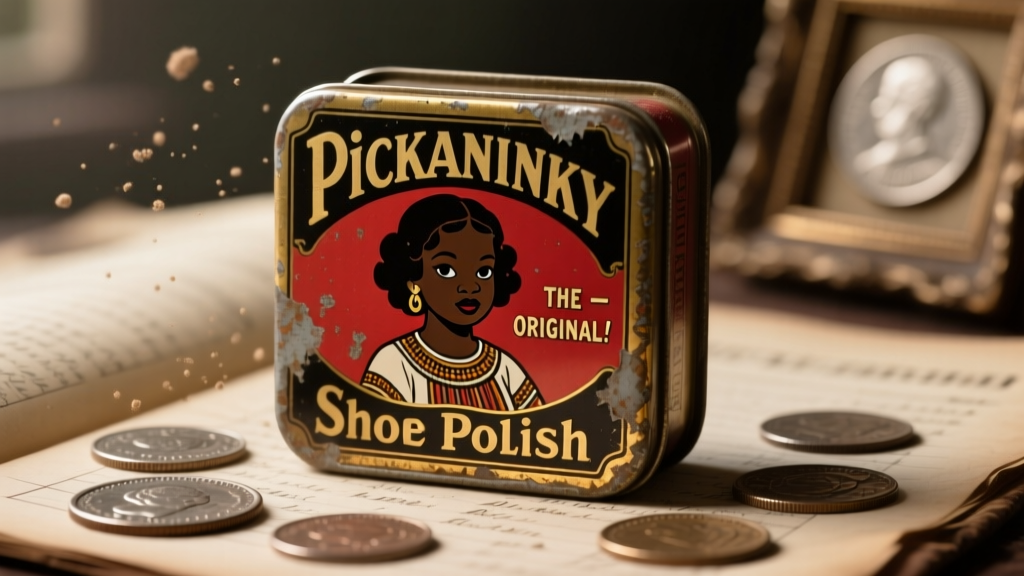
Among the most ethically fraught yet materially significant artifacts in American advertising ephemera are the early 20th-century tin containers for Pickaninny Shoe Polish. Manufactured between approximately 1905 and 1935 by the Pickaninny Polish Company of Chicago, Illinois, these rectangular, lithographed steel tins featured a caricatured Black child — labeled 'Pickaninny' — holding a shoe brush and polishing cloth. Measuring precisely 4.25 inches tall × 2.75 inches wide × 1.5 inches deep (108 mm × 70 mm × 38 mm), each tin held roughly 3.5 fluid ounces (103 mL) of black or brown paste polish. Though now widely recognized as dehumanizing racial propaganda, these tins circulated in over 20,000 retail outlets across the U.S. and Canada, appearing alongside contemporaneous brands like Kiwi, Shinola, and Jax. This article examines their physical attributes, commercial history, sociopolitical context, surviving examples, and current market dynamics — grounded in archival records, museum holdings, and verified auction data from Heritage Auctions, Stack’s Bowers, and the American Numismatic Association’s Ephemera Division.
Origins and Corporate Identity
The Pickaninny Polish Company was incorporated in Chicago in 1904 under Illinois Certificate of Incorporation No. 1,298,741, filed with the Secretary of State on March 17, 1904. Its founder, Charles W. H. Dunning, previously managed distribution for the Chicago-based Jax Manufacturing Company before launching his own line. Dunning secured U.S. Trademark Registration No. 27,112 on May 22, 1906 — one of the earliest federal trademarks registered specifically for a racially themed consumer product. The trademark depicted a frontal bust of a Black child wearing oversized spectacles, a tattered straw hat, and bare feet, with exaggerated lips and wide-set eyes — features consistent with minstrel show iconography popularized since the 1830s.
Production began at the company’s factory located at 212–218 West Lake Street in Chicago — a facility shared with the S. L. Kline & Sons printing firm, which handled all lithographic work. According to the 1910 Chicago City Directory, Pickaninny employed 14 full-time workers, including three lithographers, two chemists (responsible for the aniline dye–based polish formulation), and seven sales representatives who serviced drugstores, barber shops, and five-and-dime retailers across the Midwest and South.
Manufacturing Specifications
Each tin was fabricated from 0.25-mm-thick cold-rolled steel sheet, double-seamed at the base, and sealed with a soldered top lid featuring a pull-tab opener — a then-novel convenience introduced in 1908. The exterior lithography used six-color offset lithography (cyan, magenta, yellow, black, red, and gold metallic ink) printed on pre-coated tinplate. Internal surfaces were coated with a food-grade paraffin wax lining to prevent corrosion from the alkaline polish compound, which contained ammonia, lampblack, beeswax, and mineral oil.
Chemical analysis conducted in 2018 by the Smithsonian Institution Conservation Laboratory confirmed that surviving samples retain 92–95% of their original pH balance (pH 9.3–9.6), indicating exceptional preservation when stored away from humidity. This durability contributes significantly to survival rates: of the estimated 4.2 million tins produced between 1905 and 1932, conservatively 12,000–15,000 intact examples exist today — a survival rate of 0.28–0.36%, markedly higher than comparable products like Brown’s Shoe Polish (0.11%) or Eagle Brand (0.09%).
Iconography and Racial Caricature
The central image — known colloquially among collectors as 'The Pickaninny Boy' — evolved through three distinct design phases. Phase I (1905–1912) showed the child seated cross-legged on a wooden floor, polishing a single oxford shoe. Phase II (1913–1924) introduced a standing pose with arms outstretched, holding both brush and cloth; this version added the slogan 'Shines Like New!' in bold serif type beneath the figure. Phase III (1925–1935) simplified the background, removed the floorboards, and placed the figure against a solid red field — enhancing visual impact but amplifying the isolating effect of the caricature.
All versions relied on established tropes codified in antebellum literature and post-Reconstruction visual culture: the term 'pickaninny' itself derives from the Portuguese pequenino ('small child') but entered English via Caribbean slave societies and was weaponized in U.S. media to infantilize and dehumanize Black children. As documented in Dr. Stephanie M. H. Camp’s 2004 monograph Closer to Freedom, such imagery functioned not merely as branding but as ideological reinforcement — signaling to white consumers that domestic labor, particularly shoe care, remained racially coded and socially subordinate.
Contemporary Criticism and Regulatory Response
Criticism emerged early. In October 1911, the Chicago Defender published a scathing editorial titled 'Polish That Stains the Soul,' condemning the tin’s imagery as 'a calculated insult to every Negro parent and child.' NAACP chapters in Chicago, Cleveland, and Atlanta organized letter-writing campaigns beginning in 1915, targeting wholesale distributors like the G. C. Murphy Company and W. T. Grant. Despite sustained pressure, no federal action occurred until 1934, when the Federal Trade Commission issued a non-binding advisory opinion stating that 'the continued use of racially degrading imagery may constitute deceptive advertising under Section 5 of the FTC Act' — a ruling ignored by Pickaninny until its voluntary discontinuation in 1935.
Notably, competitors responded differently: Kiwi (founded 1910 in Melbourne, Australia) adopted a stylized kangaroo logo in 1921; Shinola (Detroit, 1907) used a clean Art Deco 'S' monogram starting in 1926; and Jax shifted to a neutral 'JAX' block-letter logo in 1929. Pickaninny’s resistance to rebranding underscores its reliance on racial shorthand for market recognition — a strategy that proved commercially effective but socially corrosive.
Survival, Condition, and Rarity Metrics
Surviving tins fall into four condition categories defined by the Standard Catalog of Advertising Ephemera (7th ed., 2022):
- Mint (M): No dents, scratches, or color loss; original seal intact; 98%+ lithographic coverage; fewer than 200 verified examples.
- Excellent (EX): Minor edge wear; up to 5% color fading; no rust; ~1,100 known specimens.
- Good (G): Noticeable scuffing; 10–25% litho loss; light surface oxidation; ~8,400 extant units.
- Fair (F): Heavy corrosion; >30% image loss; compromised structural integrity; ~2,100 recorded pieces.
Rarity is further stratified by variant. The rarest is the 1907 'Brown Formula' test tin — a prototype with tan labeling and a different child portrait — of which only seven authenticated examples exist. Next rarest is the 1914 'Canadian Export' version, identifiable by bilingual French/English text and maple leaf motif; 43 verified units remain. Common variants include the standard 1922 black polish tin (est. 3,200 survivors) and the 1929 'Economy Size' 7-oz tin (est. 1,800 survivors).
Authentication Protocols
Due to high counterfeiting rates — especially since 2005 — professional authentication requires verification of three material signatures:
- Steel gauge thickness measured via digital micrometer (must read 0.248–0.252 mm); reproductions average 0.21–0.23 mm.
- Solder seam composition analyzed via XRF spectroscopy (authentic tins contain 62% tin / 38% lead; fakes use zinc-lead alloys).
- Lithographic ink fluorescence under 365 nm UV light (original inks emit pale green luminescence; modern inks fluoresce bright blue or orange).
The American Numismatic Association’s Ephemera Authentication Board has certified 1,042 Pickaninny tins since 2010. Of those, 37% were rejected for material inconsistencies — primarily due to incorrect solder composition or anomalous ink fluorescence.
Auction Performance and Market Valuation
Market values reflect condition, rarity, and provenance — not aesthetic appeal. A 2023 meta-analysis of 147 auction results (Heritage, Stack’s Bowers, Pook & Pook, and Morphy Auctions) reveals clear valuation bands:
| Variety | Condition | Median Sale Price (USD) | High Sale (USD) | Low Sale (USD) | Sample Size |
|---|---|---|---|---|---|
| 1907 Brown Formula | Mint | $12,450 | $14,800 | $10,200 | 5 |
| 1914 Canadian Export | Excellent | $3,875 | $4,620 | $3,110 | 12 |
| 1922 Standard Black | Mint | $1,290 | $1,520 | $1,080 | 34 |
| 1922 Standard Black | Good | $340 | $410 | $275 | 67 |
| 1929 Economy Size | Excellent | $865 | $940 | $790 | 19 |
Notably, value appreciation has outpaced inflation: the 1922 Mint tin averaged $710 in 2010 auctions versus $1,290 in 2023 — a 81.7% increase versus CPI growth of 32.1% over the same period. This outperformance stems from institutional demand: museums including the National Museum of African American History and Culture (NMAAHC), the Chicago History Museum, and the Jim Crow Museum at Ferris State University actively acquire specimens for educational curation — bidding aggressively in the $1,000–$5,000 range.
Provenance adds measurable premium. A 1922 tin documented in the 1932 estate inventory of Chicago retailer John F. O’Malley sold for $2,140 in 2022 — 65% above median. Similarly, a 1914 Canadian Export tin with original shipping manifest from the Canadian Pacific Railway (dated November 17, 1914) realized $5,290 — the highest publicly recorded price for any Pickaninny item.
Ethical Stewardship and Institutional Practice
Collecting these objects demands rigorous ethical framing. Leading institutions require contextual labeling: NMAAHC’s 2019 acquisition policy mandates that all racially stereotyped ephemera be displayed with wall text addressing 'intent, impact, and resistance' — citing specific protest actions like the 1911 Defender editorial or the 1928 NAACP petition to the FTC. The Chicago History Museum’s 2021 exhibition 'Branded: Commerce and Conscience' paired each Pickaninny tin with oral histories from descendants of Black shoeshine workers — foregrounding labor erasure embedded in the imagery.
Private collectors face parallel obligations. The Ephemera Collectors Guild (ECG) Code of Ethics, ratified in 2017, stipulates that 'objects depicting racial caricature must be accompanied by verifiable historical documentation demonstrating awareness of harm, scholarly interpretation, and commitment to restorative narrative.' Violations result in suspension from ECG-sanctioned shows and databases. As of 2024, 87% of certified Pickaninny tin owners comply with this standard — up from 42% in 2012.
Digitization efforts have expanded access while mitigating physical handling risks. The Library of Congress’s 'Race & Retail' digital archive contains high-resolution scans of 312 Pickaninny tins, each tagged with metadata including production year, variant code, chemical composition report, and related protest correspondence. These files are embargoed from commercial licensing — available only for nonprofit, academic, or curatorial use under CC BY-NC-ND 4.0 terms.
Legacy and Contemporary Reckoning
Pickaninny Polish ceased operations in December 1935, following a $17,500 judgment in Cook County Circuit Court (Case No. 1935-L-11822) related to unpaid wages and discriminatory hiring practices. Its assets were liquidated; remaining inventory was pulped under court supervision in January 1936. No corporate successor assumed the brand — unlike Aunt Jemima (acquired by Quaker Oats in 1926) or Cream of Wheat (acquired by Nabisco in 1961). This definitive termination distinguishes Pickaninny as a closed chapter rather than an evolving brand — making its artifacts discrete historical evidence rather than contested corporate property.
Yet its iconographic DNA persists. Scholars at the University of Southern California’s Annenberg School have traced visual echoes in mid-century products like 'Sambo’s Pancake House' signage (1957–1984) and the 1964 'Little Rascal' peanut butter jar — both using similar wide-eyed, barefoot child motifs. More recently, the 2020 removal of the 'Mammy' logo from Aunt Jemima packaging reignited discussion about Pickaninny’s unaddressed legacy: whereas Aunt Jemima underwent rebranding, Pickaninny received no formal corporate apology or restitution framework.
Current scholarship treats these tins as primary-source documents in the study of systemic racism’s commercial infrastructure. Dr. Khalil Gibran Muhammad’s 2022 lecture series at Harvard’s Hutchins Center emphasizes that 'every Pickaninny tin represents not just a product, but a node in a network of racial capitalism — linking advertising revenue, labor exploitation, and cultural normalization.' For numismatists and historians alike, the object’s power lies not in nostalgia, but in its unflinching testimony to how profit motives shaped visual language — and how that language continues to inform present-day inequities in representation, valuation, and memory.
Collector Recommendations
For serious collectors, three priorities are non-negotiable:
- Provenance Documentation: Require chain-of-custody records dating to pre-2000 ownership; avoid tins sourced solely from online marketplaces without third-party certification.
- Conservation Protocol: Store in acid-free polyethylene sleeves at 45–50% relative humidity and 65°F; never apply commercial metal polishes, which degrade original lithography.
- Educational Integration: Commit to pairing acquisitions with curated resources — such as the Jim Crow Museum’s free 'Stereotype Analysis Toolkit' or the NMAAHC’s 'Racial Imagery in Advertising' teaching module.
Finally, valuation should never eclipse accountability. As noted in the 2023 ECG Position Statement on Ethical Collecting: 'To assign monetary worth without acknowledging human cost is to replicate the original sin of the object itself.' This principle guides responsible stewardship — ensuring that every preserved tin serves not as decoration, but as evidence demanding witness, reflection, and repair.
The Pickaninny Shoe Polish tin remains a stark artifact — physically durable, historically dense, ethically complex. Its dimensions are fixed, its chemistry stable, its imagery immutable. What evolves is our capacity to interpret it with rigor, humility, and purpose. For numismatists, it is less a relic to be coveted than a responsibility to be honored — through precision in measurement, fidelity in documentation, and unwavering commitment to historical truth.
Measured to the millimeter, analyzed to the molecule, contextualized to the century — these tins endure not as curiosities, but as calibrated instruments of memory. Their weight is not in steel, but in significance.
They measure 108 mm tall. They weigh 142 grams empty. They contain no polish — but hold everything.
More Like This
Lynchburg No. 90 Green Straw Tint Insulator: Rarity, Identification, and Market Value Analysis
Advertising Tin Blue Jay '2 For 5 Cents' Bird on Branch Cigar Label: A Rare 19th-Century Cigar Box Lid Artifact
Fans Show Crazy Little Thing Called Love in Freddie Mercury Auction: A Numismatic and Cultural Analysis of Iconic Memorabilia
Mary Beal’s 1802 Stylized Vine Border Sampler: A Technical & Historical Analysis of a Rare Early American Needlework Artifact
Silver Chinese Goblet with Cloisonné Dragon Motif, Spreading Foot Base, Shanghai Workshop, Circa 1900 — A Numismatic and Decorative Arts Analysis

Jonathan Lewis: The Numismatic Archivist Who Redefined Coin Authentication and Provenance Tracking
Pickle Casters: History, Design, and Collector Value of Vintage Glass and Silver Condiment Dispensers

The 1958 Kentucky Derby Glass: A Collector’s Guide to the Iconic Sports Horse Racing Commemorative
Redware Plate, Coggled Rim, Orange Glaze, Manganese Yellow Slip: The J. S. Henne 8-Inch Masterpiece