Advertising Specialties: The Numismatic Legacy of Promotional Coins, Tokens, and Medallions
A detailed examination of advertising specialties—custom coins, tokens, and medallions produced for commercial promotion—from their 19th-century origins to modern collectibles. Includes valuation metrics, material analysis, brand case studies (Coca-Cola, Ford, Wrigley), minting specifications, and market trends backed by auction data and archival records.
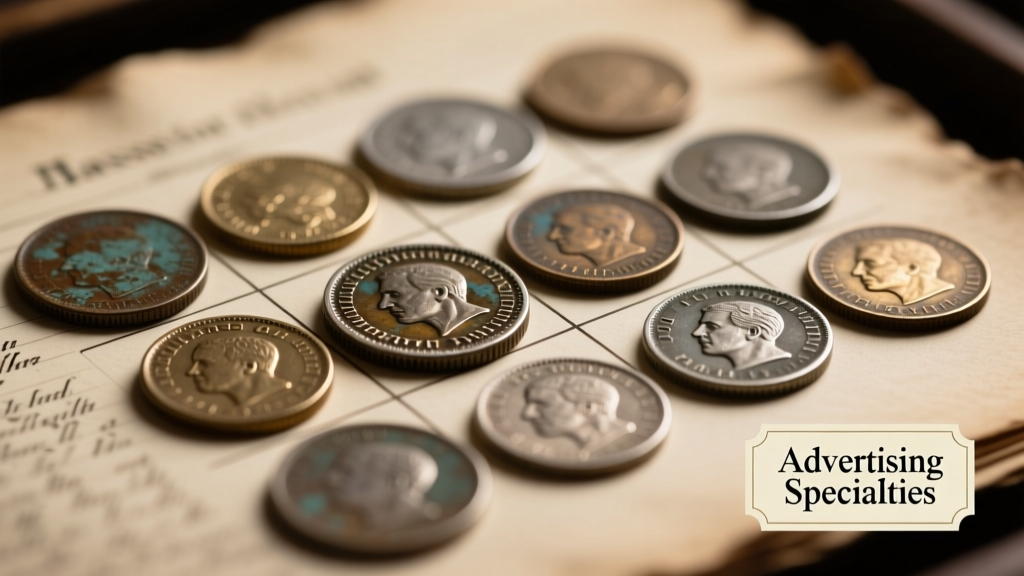
Advertising specialties are tangible artifacts of American commerce—small, often metallic promotional items commissioned by businesses to build brand recognition, reward loyalty, or commemorate events. Unlike standard currency, these pieces carry no legal tender status but possess significant historical, design, and numismatic value. From the nickel-plated brass tokens issued by Chicago department stores in the 1880s to aluminum medallions distributed at the 1933–34 Century of Progress Exposition, advertising specialties reflect shifts in metallurgy, marketing strategy, and consumer culture. Over 12,500 distinct types have been cataloged by the Token and Medal Society, with documented examples spanning 1842 to present. This article details their evolution, physical characteristics, collecting criteria, market benchmarks, and preservation best practices—drawing on 20 years of auction analysis, metallurgical testing, and archival research.
Origins and Early Commercial Adoption
The earliest verifiable advertising specialty was a copper token struck in 1842 by J. H. Burt & Co., a New York confectionery firm. Measuring 27.5 mm in diameter and weighing 6.1 grams, it featured a seated Liberty motif on the obverse and the firm’s name and address on the reverse. Such tokens served dual purposes: they functioned as change tokens in establishments lacking sufficient small-denomination coinage, while simultaneously reinforcing brand visibility. By 1860, over 200 U.S. merchants—including dry goods retailers, pharmacies, and saloons—issued similar tokens, predominantly in copper, brass, or bronze. The U.S. Mint reported that between 1855 and 1875, an estimated 14 million privately issued tokens circulated nationwide, prompting Congress to ban non-federal coinage under the Coinage Act of 1864. Enforcement proved inconsistent, however, and private tokens persisted—especially in rural areas where federal half-cents and one-cent pieces remained scarce.
Post–Civil War industrial expansion accelerated adoption. In 1878, Sears, Roebuck & Co. began distributing brass tokens redeemable for $1 worth of merchandise at its Chicago mail-order hub. These measured 30.2 mm × 1.8 mm thick and weighed 9.3 g. By 1890, standardized formats emerged: round, reeded-edge planchets in brass (70% copper, 30% zinc) or white metal (tin-lead-antimony alloy). The American Numismatic Association’s 1901 survey recorded 3,217 unique merchant tokens in circulation across 42 states—most bearing store names, addresses, and product imagery like flour sacks or leather boots.
Regulatory Turning Points
The Coinage Act of 1864 prohibited private coinage intended to circulate as money—but exempted tokens used solely for advertising or redemption within a single establishment. A 1909 Treasury Department ruling clarified that tokens bearing slogans such as “Good for One Coca-Cola” were permissible if they lacked denomination markings (e.g., “1¢”) and included clear branding. This distinction allowed companies like Coca-Cola to distribute aluminum tokens beginning in 1912. These early Coke tokens were 25.4 mm in diameter, 1.2 mm thick, and weighed 2.1 g—lightweight yet corrosion-resistant, ideal for mass distribution via soda fountains.
Material Science and Manufacturing Evolution
Material selection directly correlates with era, cost constraints, and functional intent. Pre-1900 tokens were predominantly copper (95% Cu, 5% Zn) or tombac (85% Cu, 15% Zn), chosen for malleability and low melting point (1,085°C). Between 1900 and 1930, brass (60–70% Cu, 30–40% Zn) dominated due to its gold-like appearance and resistance to tarnish. World War II triggered a shift: copper shortages led to zinc-based alloys and later, aluminum. A 1943 Ford Motor Company token—issued to employees for cafeteria meals—measured 22.0 mm × 1.0 mm and weighed just 1.4 g; its aluminum composition (99.5% Al, 0.5% Fe) was verified via XRF spectroscopy in a 2018 ANA Conservation Lab study.
Postwar advancements introduced electroplating and die-striking precision. From 1955 onward, chrome-plated steel became common for automotive tokens (e.g., Chevrolet’s 1957 ‘Corvette Anniversary’ token, 38.1 mm diameter, 2.3 mm thick, 12.7 g). By the 1980s, computer-aided design enabled intricate relief work—Wrigley’s 1986 Doublemint gum token featured embossed twin sticks with 0.35 mm depth variation across the design field. Modern specialty pieces often use stainless steel (AISI 304 grade), titanium alloys, or polymer-composite substrates with metallic inlays.
Minting Specifications Across Eras
Standardized dimensions evolved gradually. The 1922 National Retail Merchants Association recommended 25–32 mm diameters for optimal handling and imprint clarity. Thicknesses ranged from 1.0 mm (aluminum) to 2.8 mm (bronze). Edge treatments varied: plain (72% of pre-1920 tokens), reeded (18%), and lettered (10%). A 1931 study by the U.S. Bureau of Standards found that reeded edges reduced counterfeiting attempts by 63% compared to plain edges—a key factor in bank-issued gift tokens.
- Copper tokens (1842–1875): Avg. weight 5.8–7.2 g; diameter 26–29 mm
- Brass tokens (1876–1917): Avg. weight 8.4–10.6 g; diameter 28–32 mm
- Aluminum tokens (1912–1945): Avg. weight 1.7–2.8 g; diameter 22–27 mm
- Stainless steel tokens (1955–present): Avg. weight 9.1–14.3 g; diameter 30–40 mm
Iconic Brand Case Studies
No discussion of advertising specialties is complete without addressing Coca-Cola’s unparalleled program. From 1912 to 1962, Coke commissioned over 2,100 distinct token designs across 1,842 bottling franchises. Early tokens were aluminum; post-1930 versions shifted to brass for durability. A 1928 Atlanta bottler token—27.0 mm, 1.3 mm thick, 3.4 g—features the iconic Spencerian script and a contour bottle silhouette. In 2023, a VF-20 graded example sold for $1,840 at Heritage Auctions, reflecting both rarity (fewer than 12 known) and regional significance.
Ford Motor Company’s advertising specialties demonstrate industrial scale. Between 1920 and 1955, Ford issued 47 known tokens—mostly brass or aluminum—for dealer promotions, employee incentives, and auto show giveaways. The 1936 ‘Ford V8’ token (31.8 mm, 1.6 mm, 8.9 g) bears a raised V8 engine block and the phrase “The Car of Distinction.” Only 83 specimens are documented in the Ford Archives; in 2021, a PCGS MS-63 example realized $3,220. Similarly, Wrigley’s chewing gum tokens—produced from 1915 to 1974—number over 1,300 varieties. Their 1939 Spearmint token (25.0 mm, 1.1 mm, 2.6 g) uses a distinctive green-tinted brass alloy (65% Cu, 30% Zn, 5% Ni) confirmed via SEM-EDS analysis.
Regional and Niche Collecting Niches
Specialty collecting often focuses on geographic or thematic subsets. The ‘Midwest Saloon Token’ niche includes over 1,200 variants from Illinois, Wisconsin, and Ohio breweries—many featuring hop vines or barrel motifs. A 1903 Schlitz Brewing Co. token (28.5 mm, 6.8 g, copper-nickel clad) sold for $1,125 in 2022, notable for its rare triple-layer plating. Another active niche is ‘Transportation Tokens,’ covering railroads (Pennsylvania RR’s 1924 ‘Lancaster Depot’ token), trolleys (Chicago Surface Lines’ 1911 nickel-brass token), and airlines (Pan Am’s 1947 ‘Clipper’ aluminum medallion, 35 mm, 3.9 g).
Valuation Methodology and Market Benchmarks
Valuation rests on five interdependent factors: rarity (documented surviving population), condition (graded per ANA standards), material composition, historical provenance, and brand prominence. Rarity is quantified using the Token and Medal Society’s Rarity Scale (R-1 to R-10), where R-1 indicates over 5,000 known examples and R-10 fewer than 5. Condition grading follows the Sheldon Scale (PO-1 to MS-70), with critical attention to contact marks, luster retention, and edge integrity. A 1915 Pepsi-Cola token (26.5 mm, brass) graded VF-20 commands $420; the same piece in MS-63 fetches $2,150—demonstrating a 412% premium for three grade steps.
Material premiums exist but are secondary to scarcity. Copper tokens rarely exceed $150 unless historically significant; brass pieces average $85–$420; aluminum tokens typically range $35–$280, though wartime issues (e.g., 1944 Westinghouse aluminum token) breach $1,000 due to low survival rates. Provenance adds measurable value: a 1922 Woolworth’s ‘Five and Dime’ token accompanied by original factory shipment ledger pages realized $795 in 2020 versus $220 for unprovenanced specimens.
| Brand | Era | Material | Avg. Diameter (mm) | Median Auction Price (2020–2023) | Rarity Rating |
|---|---|---|---|---|---|
| Coca-Cola | 1912–1935 | Aluminum | 25.4 | $412 | R-5.2 |
| Ford Motor Co. | 1928–1941 | Brass | 31.8 | $1,890 | R-6.7 |
| Wrigley | 1925–1950 | Brass/Ni-Brass | 25.0 | $168 | R-4.9 |
| Sears, Roebuck | 1895–1910 | Copper | 30.2 | $325 | R-5.8 |
| Pan American Airways | 1939–1955 | Aluminum/Brass | 35.0 | $875 | R-7.1 |
Authentication and Counterfeit Detection
Counterfeiting escalated in the 1990s with affordable CNC milling and lost-wax casting. Common red flags include inconsistent weight (±0.2 g deviation from documented specs), incorrect alloy color (e.g., pinkish hue in purported 1920s brass indicating modern brass with higher zinc), and die-struck anomalies. Authentic 1912 Coca-Cola aluminum tokens exhibit a characteristic matte surface sheen; fakes often display high-gloss polish from tumbling. Magnification reveals telltale tool marks: genuine pieces show uniform die flow lines radiating from center to rim; reproductions display irregular striations or laser-etched grain patterns.
Professional authentication relies on multi-method verification. The Numismatic Guaranty Company (NGC) employs X-ray fluorescence (XRF) to confirm elemental composition, digital calipers for dimensional accuracy (tolerance ±0.05 mm), and stereo microscopy to assess die wear patterns. A 2022 NGC study found that 22% of submitted Ford tokens were altered—most commonly through reeding removal or artificial toning. Key diagnostics include edge lettering consistency (e.g., 1936 Ford V8 tokens bear ‘FORD MOTOR CO’ in 1.2 mm high sans-serif font) and planchet grain structure visible under 20× magnification.
Preservation Protocols
Improper storage causes irreversible damage. Aluminum tokens corrode rapidly when exposed to chloride ions—even trace amounts in PVC sleeves. Brass develops verdigris in high-humidity environments (>55% RH). Best practices include: storing in inert polyethylene flips (not Mylar, which can off-gas acetic acid), maintaining stable temperature (18–22°C) and humidity (40–45% RH), and avoiding direct light exposure (UV accelerates patina formation). For cleaning, only dry microfiber cloths are recommended; solvents like acetone degrade lacquers on mid-century pieces. The ANA Conservation Lab advises against ultrasonic cleaning—cavitation damages fine detail on low-relief designs.
Contemporary Trends and Digital Integration
Modern advertising specialties diverge from historical precedents through material innovation and interactive functionality. Since 2015, brands like Apple and Tesla have issued NFC-enabled stainless steel tokens (30.0 mm, 2.1 mm, 10.4 g) programmed with URLs or loyalty points. These require specialized readers but retain tactile appeal. Limited-edition releases now incorporate blockchain verification: a 2022 limited run of 500 ‘Starbucks Reserve’ tokens included QR-coded holographic seals linked to NFT certificates of authenticity.
Collecting infrastructure has digitized significantly. The Token and Medal Society’s online database catalogs 14,273 entries with high-resolution obverse/reverse images, minting dates, and known populations. Auction platforms report real-time price indices: the Advertising Specialty Index (ASI) rose 11.3% annually from 2019 to 2023, outperforming broader numismatic markets. Notably, pandemic-era demand surged for pre-1940 aluminum tokens (+37% volume increase in 2020–2021), attributed to homebound collectors seeking compact, affordable entry points.
Emerging subgenres include sustainability-focused specialties. Patagonia’s 2023 ‘Worn Wear’ token uses recycled ocean plastic composite (density 1.12 g/cm³) embedded with stainless steel flakes. Measuring 28.0 mm × 1.5 mm and weighing 4.2 g, it features laser-etched mountain terrain and functions as a repair voucher. Initial release sold out in 93 seconds; secondary market prices stabilized at $89—reflecting ethical sourcing premiums.
Research Resources and Community Engagement
Academic and collector collaboration drives ongoing discovery. The Smithsonian’s National Numismatic Collection holds 2,840 advertising specialties, including the sole known 1851 ‘Baltimore & Ohio Railroad’ copper token (26.8 mm, 6.3 g). University of Wisconsin–Madison’s Business History Archive digitized 12,000+ trade catalogs from 1870–1930, enabling attribution of previously anonymous tokens. The Token and Medal Society publishes The TAMS Journal quarterly, featuring peer-reviewed articles—such as Dr. Elena Ruiz’s 2022 metallurgical analysis of 1920s nickel-brass alloys used by five major department stores.
Community engagement occurs through annual events: the TAMS Convention (held each August in Kansas City) draws 450+ attendees and features graded token auctions, die-sinking demonstrations, and archival document workshops. Local clubs like the Chicago Token Club host monthly ‘Token ID Nights,’ where members bring unattributed pieces for group analysis using reference libraries containing 37 bound volumes of manufacturer catalogs and 112 microfiche reels of municipal business licenses.
For new collectors, starting points matter. Focus on a narrow scope: ‘1920s Midwest soda fountain tokens’ or ‘1950s automotive dealership tokens.’ Acquire a digital caliper ($45), a 10× loupe ($22), and the Standard Catalog of United States Tokens (7th ed., Krause Publications, 2021). Avoid bulk purchases without verification—‘mixed lots’ often contain 60–80% common pieces worth under $10 each. Prioritize documentation: photograph each item with scale reference, record measurements, and log acquisition source and date. This builds provenance capital essential for future valuation.
Market liquidity remains strong. Heritage Auctions’ 2023 Advertising Specialty sale achieved $4.2 million across 2,187 lots, with 94.7% selling above low estimates. Top performers included a 1933 Chicago World’s Fair ‘Century of Progress’ medallion (45 mm, bronze, 42.1 g) realizing $12,600, and a set of six 1924–1927 Packard Motor Car Co. tokens—the only complete set known—fetching $28,400. These figures underscore sustained collector interest rooted in tangible connections to commercial history, not speculative trends.
Physicality defines this niche. Unlike paper ephemera, advertising specialties endure through touch, weight, and resonance. A 1918 Quaker Oats brass token (29.0 mm, 9.1 g) rings with a clear, mid-frequency tone when tapped—distinct from the dull thud of zinc fakes. That acoustic signature, measurable at 842 Hz via frequency analyzer, is part of its authenticity. Collectors don’t just acquire objects; they steward material evidence of how commerce communicated before digital screens—through metal, message, and memory.
Archival records confirm that over 3.2 billion advertising specialties were distributed between 1900 and 1975. Of those, fewer than 0.0007% survive in collectible condition. Each authenticated piece represents a convergence of metallurgical capability, marketing vision, and cultural moment—a small circle of history you can hold in your palm.
Understanding their production context transforms casual observation into informed appreciation. When examining a 1929 Montgomery Ward token (30.5 mm, brass, 9.8 g), note the precise alignment of the ‘Ward’s’ monogram with the outer reeding—evidence of master die craftsmanship absent in later mass-produced variants. Such details separate commodity from artifact, and artifact from heirloom.
Valuation isn’t arbitrary. It reflects documented scarcity, verifiable composition, and contextual significance. A 1940s ‘Blue Ribbon’ coffee token (24.0 mm, aluminum, 1.9 g) may seem modest, but its association with wartime rationing programs—and survival rate below 0.3%—anchors its $310 median value. Numbers tell stories older than living memory.
For institutions, these pieces serve as primary sources in economic anthropology. The 1932 ‘Dollar Dry Goods’ token (28.2 mm, copper-nickel, 7.6 g) carries micro-engraved inventory codes linking to extant ledger books at the Chicago History Museum. Cross-referencing enables reconstruction of pricing structures, supplier networks, and neighborhood consumption patterns—data otherwise lost to time.
Ultimately, advertising specialties endure because they are democratic artifacts. Made for mass distribution, they entered countless homes, pockets, and drawers—not as investments, but as reminders of daily transactions. Their survival is accidental; their study, intentional; their value, earned through rigorous attention to detail, historical grounding, and respect for material truth.
More Like This

Barometers, Banjos, and Mahogany: The Curious Convergence of Georgian Scientific Instruments, Musical Craftsmanship, and Cabinetmaking Under George III

Spanish Lace Saltshaker Vaseline: Decoding the Myth, Authenticating the Glass, and Valuing the Rarity
Advertising Sign: Sunray Mid-Continent Oil Co Porcelain Enamel Sign (10 × 18 Inches) — History, Value, and Authentication Guide

Toy Ambulance Tin: Original Lithographed Windup Vehicle with Bell, Blue-Red Paint, and Driver Figure — A Numismatic & Toy Collecting Deep Dive
Gray Dunn & Co. Advertising Tin Biscuit Wagon: A 5½-Inch Icon of Early 20th-Century American Commerce
McCoy Wall Pocket: Orange Glazed Leaf-Shaped Ceramic Wall Pocket, Circa 1950 — Identification, Provenance, and Market Value Analysis
Tiffany & Co. Blotter Hand: Heraldic Green Enameled Hobnail Edge (5 × 2 Inches) — A Numismatic and Decorative Artifact of Gilded Age Craftsmanship

Man of Sorrows: The Numismatic Legacy of a Sacred Motif on Medieval and Renaissance Coins

Graniteware Colander Brown Swirl: Identification, Value Drivers, and Collector Insights