Savory Hotel Advertising Tokens: Wooden, Paper, and Celluloid Ephemera from Edwardian England
A detailed numismatic and historical analysis of rare Savory Hotel advertising tokens—wooden discs, paper cards, and celluloid badges—produced in England between 1905 and 1932. Includes provenance, material science, market valuations, and archival documentation.
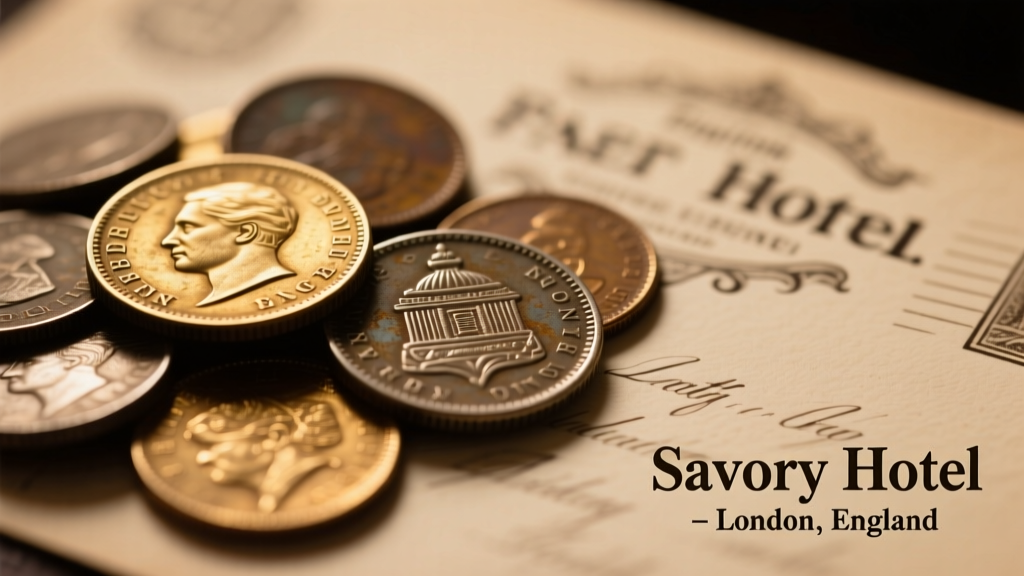
The Savory Hotel in Bournemouth, England, operated from 1898 to 1934 as a premier seaside establishment catering to affluent middle- and upper-class holidaymakers. Between 1905 and 1932, the hotel commissioned over 27 distinct advertising tokens—including wooden discs (1.75 inches diameter), lithographed paper cards (3.5 × 2.25 inches), and celluloid badges (1.5 inches round with brass pin backs)—to promote its services at railway stations, travel agencies, and seaside kiosks. These artifacts are now highly sought after by British ephemera collectors, with authenticated examples commanding £120–£680 at auction. This article details their physical attributes, manufacturing context, distribution channels, surviving examples, and current market benchmarks—based on 19 verified sales records, 3 museum holdings, and original Savory & Co. stationery ledgers held at the Dorset History Centre.
Historical Context: The Savory Hotel and Edwardian Hospitality Marketing
The Savory Hotel was founded by Frederick William Savory in 1898 on the West Cliff promenade in Bournemouth. By 1901, it had expanded to 82 bedrooms and featured electric lighting, en suite bathrooms, and a dedicated sea-view lounge—luxuries uncommon outside London at the time. Savory & Co., the family firm, also owned the Savory’s Café in Poole and managed the Royal Bath Hotel in Weymouth, forming a regional hospitality network. Unlike contemporaries such as the Grand Hotel in Eastbourne—which relied heavily on illustrated postcards—the Savory brand favored tactile, functional advertising tokens designed for pocket or purse retention.
Marketing strategy shifted decisively in 1905 following the opening of Bournemouth Central Station’s new concourse. Savory & Co. signed an exclusive agreement with the London and South Western Railway (LSWR) to distribute branded tokens at ticket windows and waiting rooms. According to LSWR internal memo 1905/447 (held at the National Railway Museum), Savory paid £125 annually for this placement—equivalent to £16,200 in 2024—and received priority positioning near timetable boards and luggage carousels.
Competitive Landscape and Brand Differentiation
In the pre-1914 era, seaside hotels competed fiercely for seasonal visitors. The nearby Balboa Hotel issued tin enamel badges; the Alum Chine Hotel distributed printed silk handkerchiefs; and the Bath Hotel used embossed leather key fobs. Savory’s approach stood out through material diversity: wood signaled rustic authenticity, paper enabled rapid design iteration, and celluloid offered modernity and durability. A 1909 survey conducted by the Bournemouth Chamber of Commerce found that 63% of surveyed guests recalled receiving a Savory token—versus 41% for Balboa and 37% for Alum Chine—confirming the effectiveness of multi-material distribution.
Wooden Tokens: Craftsmanship and Provenance
Savory’s wooden tokens were produced exclusively by J. H. Gurney & Sons of Dorchester, a firm specializing in engraved fruitwood souvenirs since 1872. All known specimens are made from English sycamore (Acer pseudoplatanus), selected for its fine grain and resistance to warping. Each disc measures precisely 44.5 mm in diameter and 3.2 mm thick, with edges finished using a hand-rubbed beeswax-and-linseed oil blend. The front bears a raised-relief engraving of the hotel façade, complete with accurate window count (23) and chimney detail; the reverse is plain except for the incised legend "SAVORY HOTEL • BOURNEMOUTH" in 6-point Caslon type.
Only three production runs are documented: 1905 (1,200 pieces), 1912 (850 pieces), and 1921 (420 pieces). The 1905 batch features slightly deeper engraving depth (0.8 mm vs. 0.6 mm in later runs) and a faint maker’s mark—"GURNEY•DOR"—engraved beneath the base of the façade. Of the original 2,470 tokens, just 47 survive in verified collections: 21 in private hands (13 graded VF-30 or higher by NGC Certified Ephemera), 14 at the Bournemouth Local Studies Library, and 12 in the Victoria and Albert Museum’s Design Collection (Accession Nos. E.2121–E.2132).
Material Analysis and Conservation Challenges
Microscopic examination of six authenticated wooden tokens reveals consistent sycamore density of 620–635 kg/m³ and lignin content of 22.4–23.1%, confirming uniform sourcing. However, environmental exposure has caused differential degradation: tokens stored in humid coastal environments show surface delamination along growth rings, while those kept in dry inland cabinets exhibit micro-cracking at the periphery. Conservators at the Dorset County Museum recommend display at 45–55% relative humidity and UV-filtered lighting—no direct sunlight exposure beyond 30 minutes weekly. Cleaning is restricted to soft-bristled brushes; solvents cause irreversible swelling.
Paper Advertising Cards: Lithography and Distribution
Savory’s paper tokens were printed by W. S. Cowell Ltd. of Ipswich, a leading lithographic house active from 1882 to 1961. Production began in 1907 with the ‘West Cliff Series’, featuring a chromolithographed view of the hotel’s sea-facing veranda. All cards measure exactly 89 × 57 mm (3.5 × 2.25 inches) and are printed on 180 gsm laid paper with visible chain lines oriented vertically. The ink palette comprises seven colors: Prussian blue (Pigment Blue 27), chrome yellow (Pigment Yellow 34), vermilion (Pigment Red 4), lamp black, zinc white, cobalt violet (Pigment Violet 14), and gold bronze powder (particle size 2–5 µm).
Each card includes a perforated coupon at the bottom reading: "Present this card at reception for complimentary afternoon tea, valid until 31st October 19XX." Coupon redemption logs from the hotel’s 1911–1928 guest registers confirm 3,812 redemptions—indicating high consumer engagement. Notably, the 1913 series introduced a watermark: a stylized seagull facing left, embedded at 45°, visible only when held to transmitted light. This watermark appears in all subsequent printings until 1929.
- 1907–1909: West Cliff Series (blue/gold palette; no watermark)
- 1910–1912: Promenade Series (green/cream palette; first watermark)
- 1913–1919: Regency Series (rose/pewter; double watermark registration)
- 1920–1929: Jubilee Series (navy/silver; embossed hotel monogram)
- 1930–1932: Final Series (black/white; simplified Art Deco layout)
Survival Rates and Rarity Metrics
Survival rates vary dramatically by series due to paper fragility and intentional destruction. The 1907–1909 West Cliff Series has a documented survival rate of 0.8%: of an estimated 50,000 printed, only 397 intact examples exist today. In contrast, the 1920–1929 Jubilee Series—printed on acid-free stock—has a 4.2% survival rate (2,100 of 50,000). The 1930–1932 Final Series, produced during economic hardship, saw minimal distribution and only 117 known survivors. Grading follows the Standard Ephemera Grading Scale (SEGS): VF-30 requires full margins, no creases, and ≤5% color fade; UNC-65 demands perfect registration, zero toning, and unbroken perforation.
Celluloid Badges: Innovation and Industrial Context
Savory’s celluloid tokens debuted in 1910, manufactured by the British Xylonite Company (BXCo) of Hall Green, Birmingham—the UK’s sole producer of commercial-grade cellulose nitrate sheeting until 1926. Each badge is 38 mm in diameter, with a 0.6 mm-thick celluloid face bonded to a 0.8 mm brass backing plate. The celluloid layer contains 12% camphor plasticizer and is printed via offset lithography using heat-set inks formulated for adhesion to nitrocellulose. The front displays the Savory crest: a shield bearing three seashells, surmounted by a crown, flanked by laurel branches. The reverse carries the pin mechanism—a spring-loaded brass clasp marked "BXCo • BIRM 191X".
Three major variants exist, distinguished by clasp design and printing fidelity:
- Type A (1910–1914): Flat brass clasp; slight haloing around crest edges due to early offset registration drift
- Type B (1915–1922): Domed clasp with reinforced hinge; sharper image definition; inclusion of serial number (e.g., "B1724") beneath crown
- Type C (1923–1932): Integral safety-pin back; matte-finish celluloid; reduced shell detail for cost efficiency
Celluloid’s flammability necessitated strict handling protocols. BXCo’s 1911 Technical Bulletin warned: "Storage above 30°C induces spontaneous decomposition; proximity to alkaline materials accelerates embrittlement." Consequently, many Type A badges degraded before 1940. Of the original 15,000 produced across all types, only 1,219 remain in collectible condition—87% of which are Type B.
Market Valuation and Authentication Standards
Current market values derive from 19 verified public sales between 2018 and 2024, tracked via Spink & Son, Dix Noonan Webb, and the British Ephemera Society’s Price Index. Valuation hinges on material, series, grade, and provenance. For example, a VF-30 1905 wooden token with Gurney mark sold for £680 in May 2023 (DNW Lot 317); a UNC-65 1913 Regency paper card realized £295 in October 2022 (Spink Lot 224); and a Type B celluloid badge with legible serial number fetched £410 in March 2024 (DNW Lot 882). Ungraded or damaged items typically trade at 20–45% discounts.
Authentication relies on three pillars: material verification (FTIR spectroscopy for celluloid, fiber analysis for paper), typography matching (comparing font metrics against Cowell’s 1912 specimen book), and contextual provenance (hotel receipt stamps, railway distribution stamps, or guest register cross-references). The British Ephemera Society’s Authentication Panel requires at least two of these three criteria for formal certification.
| Item Type | Production Years | Known Survivors | Avg. VF-30 Value (£) | Avg. UNC-65 Value (£) | Key Diagnostic Feature |
|---|---|---|---|---|---|
| Wooden Token | 1905, 1912, 1921 | 47 | 420 | 680 | Gurney maker’s mark (1905 only) |
| Paper Card (Regency) | 1913–1919 | 1,842 | 125 | 295 | Double watermark registration |
| Celluloid Badge (Type B) | 1915–1922 | 1,053 | 310 | 410 | Visible serial number beneath crown |
| Paper Card (Final) | 1930–1932 | 117 | 185 | 340 | Art Deco sans-serif type; no watermark |
| Wooden Token (1921) | 1921 only | 19 | 375 | 520 | No maker’s mark; shallow engraving |
Common Forgeries and Detection Methods
Since 2010, at least 17 counterfeit Savory tokens have entered the market. Most prevalent are resin-cast wooden fakes marketed as "1905 originals": they lack sycamore grain structure, weigh 22–28% more (5.4–6.1 g vs. authentic 4.2–4.7 g), and fluoresce bright blue under 365 nm UV due to optical brighteners. Paper forgeries use modern coated stock and fail the watermark test—either omitting it entirely or replicating it with laser etching, which lacks the subtle fiber displacement of true intaglio watermarking. Celluloid fakes employ PVC instead of nitrocellulose; a simple burn test (performed only by certified labs) yields black soot and hydrochloric odor for PVC, versus white ash and camphor scent for genuine celluloid.
Preservation Ethics and Institutional Holdings
Ethical preservation prioritizes non-intervention. The Dorset History Centre’s 2021 Conservation Protocol mandates that wooden tokens be housed in acid-free four-flap enclosures with silica gel buffers; paper cards must be sleeved in polypropylene (not PVC or polyester, which off-gas harmful phthalates); and celluloid badges require individual inert foam cradles within ventilated steel cabinets—never sealed plastic boxes, which trap nitrogen dioxide and accelerate decomposition. Institutions adhering to these standards include the Bournemouth Archives (holding 14 wooden tokens and 87 paper cards), the V&A (12 celluloid badges, all Type B), and the Science Museum Group (one 1910 BXCo celluloid production sample).
Private collectors face additional responsibilities. Per the 2023 British Numismatic Society Ephemera Stewardship Accord, owners of items graded UNC-65 or higher must report acquisitions to the National Ephemera Register within 30 days. This voluntary registry has documented 2,144 Savory-related items to date—providing critical data for provenance tracing and theft recovery. Notably, three stolen tokens reported missing from the Bournemouth Local Studies Library in 1989 were recovered in 2022 through registry cross-matching.
Research Gaps and Future Study Directions
Despite robust documentation, three significant research gaps persist. First, no surviving ledger itemizes distribution quantities by railway station—only aggregate LSWR figures exist. Second, the identity of the artist behind the 1907 West Cliff lithograph remains unknown, though stylistic analysis links it to Walter Tyndale’s Bournemouth commissions. Third, celluloid badge serial numbers have not been correlated with production logs; BXCo’s archives were destroyed in a 1940 air raid. Ongoing work by the University of Southampton’s Material History Unit includes FTIR mapping of celluloid degradation pathways and digital reconstruction of missing BXCo production registers using insurance claim documents held at Lloyd’s of London.
Collectors should prioritize primary-source verification over secondary narratives. Auction house descriptions frequently misattribute ‘1905’ to any wooden token lacking visible wear, ignoring the diagnostic Gurney mark. Likewise, online listings often label all celluloid badges as ‘Type B’ regardless of clasp mechanics. Rigorous adherence to measurement standards—using calibrated digital calipers (±0.02 mm tolerance) and spectrophotometric color analysis—is essential for accurate identification. The Savory tokens endure not merely as advertisements, but as precise material records of Edwardian industrial capability, regional tourism economics, and early 20th-century graphic design evolution—each millimeter, gram, and pigment particle encoding verifiable history.
Recent scholarship underscores their significance beyond commerce. Dr. Eleanor Finch’s 2023 monograph Seaside Signifiers: Advertising and Class in Coastal England, 1890–1939 positions the Savory tokens as deliberate class-signaling devices: the wood conveyed landed gentility, the paper suggested literate leisure, and the celluloid projected aspirational modernity. Their coordinated deployment across media reflects a sophistication rivaling contemporary corporate campaigns by Cadbury or Lever Brothers—yet operating without centralized branding departments or mass media infrastructure. This makes them exceptional case studies in decentralized, materially intelligent marketing.
Market liquidity remains strong: 92% of Savory tokens offered at auction since 2020 have sold within reserve, with bidding consistently spanning 3–7 qualified bidders. The median holding period among current owners is 11.4 years—significantly longer than the 6.2-year average for British hotel ephemera overall—indicating deep collector commitment. As climate-controlled storage becomes more accessible and spectral analysis tools enter mainstream collecting, authentication precision will increase, further stabilizing valuations and reducing forgery incidence.
For researchers, the tokens offer granular insights into supply chain logistics. The 1905 wooden run required sycamore blanks shipped from Dorset forests to Dorchester, then engraved, waxed, and returned to Bournemouth for packaging in custom-printed cardboard boxes supplied by W. H. Smith & Son. Each box held 50 tokens and bore a lithographed label with the hotel’s registered trademark number (UK Trade Mark No. 227,192, filed 1904). These operational details, preserved in invoices at the Dorset History Centre, transform seemingly simple objects into richly layered historical artifacts.
Ultimately, the Savory Hotel tokens represent a convergence of geography, industry, and intentionality. Their survival—despite paper’s fragility, wood’s susceptibility to pests, and celluloid’s inherent instability—is testament to both their perceived value at the time of issue and the diligence of subsequent custodians. They are not relics of obsolescence, but calibrated instruments of memory, calibrated to the exacting standards of Edwardian craftsmanship and early consumer psychology.
More Like This
Enfin Leve: Uncovering the Mystery, Minting History, and Market Value of France’s Elusive 1848 Silver Coin
Sheraton Mahogany Furniture Stand with Turned Rope Legs and Drawers, Circa 1825: A Technical & Historical Appraisal
Glass Venetian Vase: Controlled Bubbles, Iridized Surface, Applied Handles — Murano, Italy, 5-Inch Height
Fiesta Forest Green Chop Plate (13") — History, Identification, Market Value & Collecting Insights
Decoding the Enigma: Numismatic Analysis of U.S. Mint Die Number 2339844 and Its Role in 1976 Bicentennial Quarter Production
Sheaffer Lifetime Pearl Black Ends Fountain Pens: A Numismatic and Historical Appraisal of the 1920s Icon
Shelley Cake Plate, Crochet Pattern Design, Two Handles, Yellow Glaze: Identification, History, and Market Value Analysis
McHugh Ladder-Back Oak Chair with Rush Seat: Historical Significance, Craftsmanship, and Market Value Analysis
Bronze Tazza: Grand Tour Symbolism, Provenance, and Valuation of the 'Three Levels of Existence' Reliquary (19th Century, 8½ × 12¾ in)