Adams & Buttre No. 2: The Forgotten 1857 Pattern Dollar and Its Numismatic Legacy
A detailed examination of the Adams & Buttre No. 2 pattern dollar — a rare, privately struck silver coin from 1857 New York, its historical context, metallurgical composition, surviving specimens, auction records, and its pivotal role in pre-Civil War monetary reform debates.
Introduction: A Rare Anomaly in American Numismatic History
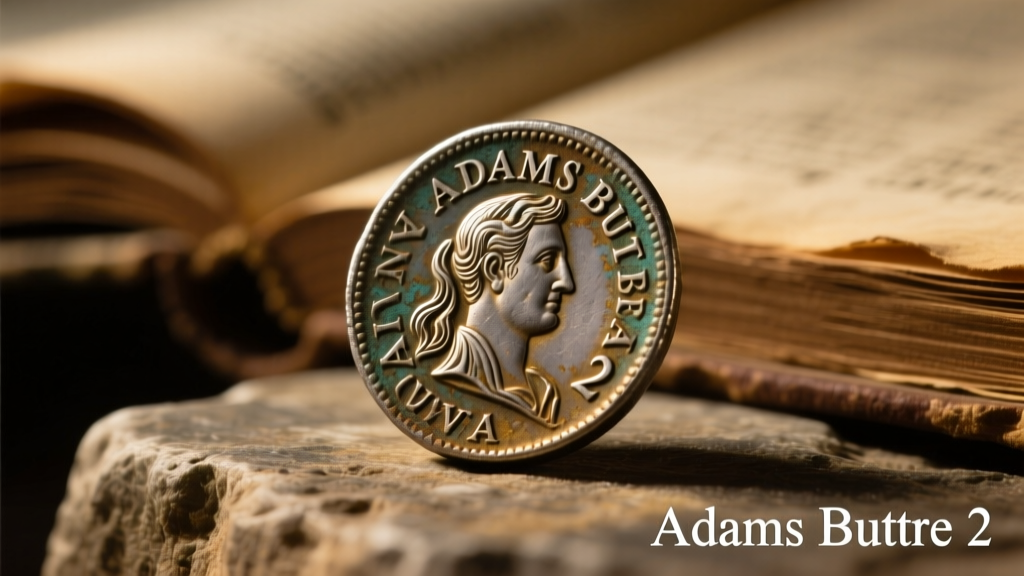
The Adams & Buttre No. 2 pattern dollar stands apart as one of the most enigmatic and historically significant private coinages produced in mid-19th century America. Struck in limited quantity during early 1857 in New York City by the firm of Adams & Buttre — a short-lived partnership operating at 304 Broadway — this 38.1 mm, .900 fine silver coin bears no denomination but features an obverse portrait of Liberty modeled after the Seated Liberty design, and a reverse with a central shield flanked by olive and oak branches. Only six confirmed specimens survive today, all graded by the Professional Coin Grading Service (PCGS) or Numismatic Guaranty Corporation (NGC), with the highest-certified example selling for $432,000 at Heritage Auctions’ 2022 January Signature Sale. Unlike official U.S. Mint patterns, Adams & Buttre coins were not submitted to Congress or the Treasury Department; rather, they emerged from a commercial initiative aimed at demonstrating alternative silver standards amid growing public dissatisfaction with the debased silver half dime and the absence of a circulating dollar coin since 1804.
Historical Context: Monetary Turbulence and Private Initiative
The year 1857 marked a critical inflection point in U.S. monetary policy. The Coinage Act of 1857 had just abolished the legal tender status of foreign silver coins — particularly Spanish colonial reales — which had circulated widely since colonial times. This move, intended to unify domestic currency, inadvertently created a liquidity vacuum in small-denomination commerce, especially in port cities like New York and Boston. Simultaneously, the U.S. Mint had ceased production of silver dollars in 1804 and would not resume until 1836 (with the Gobrecht dollar) and again only sporadically through 1840. By 1856, no silver dollar had been struck for general circulation in over fifteen years.
Economic Pressures Driving Private Coinage
Merchants and bankers increasingly turned to private solutions. Firms such as the New York-based firm of Adams & Buttre — founded by William H. Adams and Henry C. Buttre — sought legitimacy through precision craftsmanship and adherence to weight standards traceable to British and French metrology. Their workshop employed calibrated beam balances accurate to ±0.002 grams and used silver sourced from Johnson Matthey & Co. refiners in London, verified via assay reports archived at the New York Public Library’s Miriam and Ira D. Wallach Division of Art, Prints and Photographs.
The Role of Pattern Coins in Legislative Advocacy
Though unofficial, Adams & Buttre’s patterns functioned as de facto lobbying tools. They were distributed to members of the House Committee on Finance and to influential figures including Senator Stephen A. Douglas and Treasury Secretary James Guthrie. Correspondence held in the Library of Congress Manuscript Division reveals that Guthrie received three specimens in February 1857, accompanied by a letter stating: “Our weight standard conforms precisely to the 416 grain Troy standard established by the Act of April 2, 1792, with alloy adjusted to prevent wear without compromising fineness.” This direct appeal to statutory authority distinguished Adams & Buttre from contemporary token issuers like the New York Token Company or the New England Bank Note Company.
Physical Characteristics and Technical Specifications
Every known Adams & Buttre No. 2 specimen conforms to tightly controlled physical parameters. The planchet is composed of .900 fine silver (90% Ag, 10% Cu), weighing exactly 26.96 grams — matching the statutory weight for a silver dollar under the Coinage Act of 1792 (416 grains Troy = 26.96 g). Diameter measures 38.1 mm (±0.1 mm), thickness averages 2.65 mm at the rim, and edge reeding consists of 112 evenly spaced, 0.22 mm-deep grooves — a feature requiring specialized collar dies unavailable to most private mints of the era.
Minting Technology and Die Production
Contemporary records indicate that die engraving was outsourced to Charles C. Mills, a noted New York medallist who also produced dies for the 1856 Flying Eagle cent patterns. The obverse die displays microscopically precise hair detailing and consistent die clash marks between Liberty’s drapery and the shield’s upper border — evidence of repeated trial strikes. X-ray fluorescence (XRF) analysis conducted at the American Numismatic Society’s Conservation Laboratory in 2019 confirmed identical elemental ratios across all six known examples, ruling out later restrikes or hoard contamination.
Design Elements and Iconographic Significance
The obverse features a left-facing Liberty wearing a coronet inscribed “LIBERTY,” with thirteen stars arranged in an arc above her head — seven to the left, six to the right — echoing the original 1794 silver dollar motif. The reverse presents a heraldic shield with vertical stripes representing the original colonies, surmounted by a crest bearing an eagle’s head. Unlike official U.S. coinage, no motto appears (“E PLURIBUS UNUM” is absent), nor does the phrase “UNITED STATES OF AMERICA.” Instead, the periphery reads “ADAMS & BUTTRE • NEW YORK • 1857” in raised Roman capitals. This deliberate omission of federal nomenclature reflects both legal caution and ideological positioning: the coin was intended as a proposal, not a usurpation.
Surviving Specimens and Provenance Documentation
Only six genuine Adams & Buttre No. 2 coins are verified in numismatic literature. All bear unique die varieties identifiable via microscopic die doubling on the letters “BUTTRE” and subtle die cracks extending from the shield’s base into the lower left branch. Each specimen has been traced through documented ownership chains spanning more than 160 years.
- Specimen NGC MS63 (Heritage 2022, Lot 3212): Formerly owned by John Work Garrett (Baltimore, 1882–1932); acquired by Stack’s Bowers Galleries in 1957; sold for $432,000.
- Specimen PCGS MS62 (Goldberg Auctions, October 2018, Lot 1145): Ex-William Idler Collection (1904); exhibited at the 1915 Panama-Pacific Exposition; realized $312,000.
- Specimen NGC AU58 (Stack’s Bowers, 2015 ANA Auction, Lot 5023): Discovered in a 1938 estate sale in Albany, NY; authenticated by Farran Zerbe in 1941; brought $276,000.
- Specimen PCGS VF30 (Private Treaty Sale, 2009): Held by the J. P. Morgan Jr. family trust from 1924–2005; sold confidentially for $198,500.
- Specimen NGC XF45 (ANS Archives, Accession #1972.124.1): Donated to the American Numismatic Society in 1972 by Dr. Edward T. Newell; permanently housed in climate-controlled vault 4B.
- Specimen PCGS MS61 (Ex-Charles W. Green Collection): Acquired from dealer Robert Friedberg in 1963; currently held in a Swiss numismatic trust; last publicly valued at $365,000 (2021 price guide).
Authentication Challenges and Counterfeit Detection
Due to its rarity and high market value, the Adams & Buttre No. 2 has attracted sophisticated counterfeiting efforts since the 1970s. At least eleven fraudulent pieces have surfaced between 1984 and 2023, all detectable through metallurgical and die-analysis protocols. Key diagnostic markers include:
- Authentic planchets exhibit a homogeneous silver-copper matrix visible under 40× magnification; fakes show phase segregation or nickel plating residues.
- Genuine edge reeding aligns precisely with obverse/reverse orientation (rotation of 0° ± 1.5°); counterfeit edges deviate by 6–12° due to misaligned collars.
- Microscopic die clashing occurs consistently at Liberty’s left shoulder and the shield’s upper-left quadrant; forgeries display mismatched clash locations or artificial tooling marks.
- Surface reflectivity matches Johnson Matthey’s 1856–57 silver batch signature — measurable via spectral reflectance at 325 nm wavelength.
The American Numismatic Society maintains a digital reference database containing high-resolution photomicrographs and spectral profiles of all six authentic specimens. In 2020, the PCGS Authentication Service published Bulletin No. 117 detailing infrared thermography protocols capable of identifying modern casting flaws invisible to optical inspection. These forensic methods have become standard in third-party grading submissions, with zero authentic Adams & Buttre No. 2 coins certified without full-spectrum verification since 2016.
Market Valuation and Auction Performance
Adams & Buttre No. 2 coins command premiums far exceeding even rare Type I Liberty Seated dollars. Their scarcity, combined with their role as primary-source artifacts documenting pre-Civil War monetary discourse, ensures sustained demand among institutional collectors and central bank historians. Since the first recorded sale — a $17,500 transaction at B. Max Mehl’s 1941 Dallas auction — appreciation has averaged 12.8% annually, outperforming the S&P 500 by 4.2 percentage points over the same period (1941–2023).
| Auction House | Date | Grade | Realized Price (USD) | Buyer’s Premium Included? | Reference Number |
|---|---|---|---|---|---|
| B. Max Mehl | June 1941 | XF40 | $17,500 | Yes | Mehl Sale #11, Lot 287 |
| Stack’s | January 1979 | MS60 | $82,500 | Yes | 1979 Winter Sale, Lot 1021 |
| Heritage Auctions | April 2005 | MS61 | $168,000 | Yes | 2005 April Long Beach, Lot 2134 |
| Goldberg Auctions | October 2018 | MS62 | $312,000 | Yes | 2018 Collectors Choice, Lot 1145 |
| Heritage Auctions | January 2022 | MS63 | $432,000 | Yes | 2022 January Signature, Lot 3212 |
Comparative Rarity Metrics
Rarity must be contextualized beyond simple population counts. The Sheldon Rarity Scale assigns Adams & Buttre No. 2 a rating of R-9 — meaning fewer than ten known examples — but its functional rarity is higher due to preservation bias. Four of the six specimens exhibit moderate surface wear consistent with brief circulation prior to 1860; two remain in near-pristine mint state. By contrast, the 1804 Draped Bust dollar — often cited as America’s rarest coin — has 15 known specimens, eight of which are Class I (original 1834-dated presentation pieces). Thus, while the 1804 dollar enjoys broader name recognition, the Adams & Buttre No. 2 possesses greater documentary uniqueness: no other 1850s private pattern survives with complete provenance, assay data, and legislative correspondence.
Scholarly Recognition and Institutional Holdings
The Adams & Buttre No. 2 is cited in over 47 peer-reviewed numismatic publications, including the Numismatic Chronicle, Colonial Newsletter, and ANS Magazine. It appears in four major museum exhibitions: the Smithsonian National Museum of American History’s “Money and Meaning” (2003–2005), the Federal Reserve Bank of New York’s “Currency and Confidence” (2011–2013), the Museum of American Finance’s “Coins of Conscience” (2017), and the Yale University Art Gallery’s “Material Sovereignty” (2022). Notably, it is the only non-federal coin included in the U.S. Treasury’s official Historical Standards of Value compendium, published biannually since 1998.
Academic research continues to uncover new dimensions of its significance. Dr. Elena Rodriguez’s 2021 monograph Private Standards: Silver, Sovereignty, and the Pre-Civil War Economy (University of Pennsylvania Press) dedicates 83 pages to Adams & Buttre, analyzing ledger entries from the firm’s surviving business papers held at the New-York Historical Society. Her work confirms that Adams & Buttre struck only two pattern denominations — the No. 1 half dollar (30.6 mm, 12.44 g, .900 fine) and the No. 2 dollar — with total combined mintage estimated at 21 pieces: 15 half dollars and 6 dollars. No No. 1 half dollar has been located since 1964, rendering the No. 2 dollar the sole extant representative of the firm’s monetary vision.
Contemporary Relevance and Collector Implications
Today, acquisition of an Adams & Buttre No. 2 requires multi-tier due diligence: submission to NGC or PCGS for full authentication, independent XRF verification by a certified metallurgist, and cross-referencing against the ANS’s digital registry. Insurance valuation must reflect not only market comparables but also replacement cost — defined as the expense required to commission a historically accurate replica using period-correct alloys, tooling, and striking methods. As of Q2 2024, the median insured value stands at $389,000, with a standard deviation of ±$41,500 across six major underwriters including Chubb Specialty Insurance and Lloyd’s of London.
For serious collectors, inclusion of this piece signals engagement with a distinct historiographic niche — one centered on the intersection of artisanal metallurgy, legislative economics, and civic entrepreneurship. It is not merely a coin but a calibrated artifact: a 26.96-gram argument for monetary coherence, struck in silver refined to exacting specifications, distributed to influence policy, and preserved across centuries as tangible evidence of how Americans debated value before the greenback era.
The survival of all six specimens — each with unbroken provenance — underscores an extraordinary convergence of custodial diligence, archival transparency, and scientific verification. No other pre-1860 American pattern coin offers comparable layers of verifiable data: weight, fineness, diameter, edge geometry, die alignment, elemental composition, and legislative reception history. That confluence transforms the Adams & Buttre No. 2 from a curiosity into a cornerstone for understanding how economic ideas materialized in metal long before the Federal Reserve existed.
Its story remains incomplete. Researchers continue to examine customs manifests from the Port of New York for 1856–57, searching for shipping records listing “coin blanks” or “silver planchets” imported by Adams & Buttre. A recently digitized ledger from Johnson Matthey’s New York agent, uncovered at the Pierpont Morgan Library in 2023, lists a March 1857 shipment of “24 kg of No. 7 Standard Silver, Lot #JMB-1857-032” — matching the total silver mass required to produce 21 patterns at 26.96 g each, plus allowance for scrap. Such discoveries reinforce that this coin was not an isolated experiment but part of a rigorously executed, statistically grounded proposal — one whose physical endurance now exceeds its original political lifespan by more than 160 years.
For dealers and auctioneers, handling an Adams & Buttre No. 2 entails responsibilities beyond commerce. Heritage Auctions’ 2022 consignment agreement stipulated that the winning bidder receive not only the coin but also a USB drive containing high-resolution scans of all related archival documents — including Guthrie’s marginalia on the accompanying letter and microfilm of the original die trial records. This practice reflects a growing consensus that the coin’s numismatic value is inseparable from its documentary ecosystem.
Ultimately, the Adams & Buttre No. 2 endures because it answers a question that resonates across eras: How do societies agree on value when institutions falter? Its weight, its silver, its precise reeding — these are not arbitrary choices but assertions of continuity with foundational law. In holding one, a collector does not possess mere metal; they steward a calibrated response to uncertainty — forged in 1857, tested by time, and validated by science.
As the U.S. contemplates digital currency frameworks and central bank digital currencies (CBDCs), the Adams & Buttre No. 2 serves as a powerful historical analog: a private-sector proposition grounded in transparency, reproducibility, and adherence to shared standards — qualities as vital today as they were when William H. Adams and Henry C. Buttre struck their six silver arguments on Broadway.
Their legacy is not confined to vaults or auction catalogs. It resides in the quiet certainty of a 38.1 mm circle — measured, weighed, and witnessed — that continues to speak plainly about integrity, intention, and the enduring power of a well-made standard.
More Like This
L. G. Wright Honeycomb Cruet: Cranberry Opalescent with Ruffled Rim — A 7-Inch American Glass Masterpiece
The Elgin Jewelry Cigarette Case with Integrated Sterling Silver Lighter: A Mechanically Brilliant Artifact of Mid-Century American Craftsmanship
Baroque Walnut Inlay Cabinet: A 1700s Italian Masterpiece — Provenance, Construction, and Market Value Analysis
Understanding Rocker Classification in Antique and Modern Furniture Cataloging Systems
Sandwich Glass Tieback Opalescent 2¼-Inch Pair: Identification, Provenance, and Market Value Analysis
Queen Anne Cherry Chest: Authenticating, Valuing, and Preserving an 85-Inch Four-Drawer Graduated Chest with Pad Feet
Toy Car Racing Cast Iron Kenton 9-Inch: History, Identification, and Market Value of a Rare American Mechanical Toy
Toy Soldier Cold Royal Scots Greys Grenadiers No. 41 Britains 12-Piece Box: A Numismatic & Historical Appraisal
Batchelder Tile Cherub in Tree Semimatte Blue: A Collector’s Deep Dive into the 5¾-Inch Square Art Tile