Abram O. Bigelow: The Forgotten Engraver Who Shaped Early American Coinage
A detailed numismatic analysis of Abram O. Bigelow, the 19th-century engraver whose uncredited work appeared on U.S. pattern coins, medals, and early federal coin dies—including the 1856 Flying Eagle cent prototypes and 1860 Liberty Seated dime patterns—revealing his technical contributions, documented workshop practices, and market valuation trends for authenticated pieces bearing his hand.
Introduction: The Shadow Behind the Steel
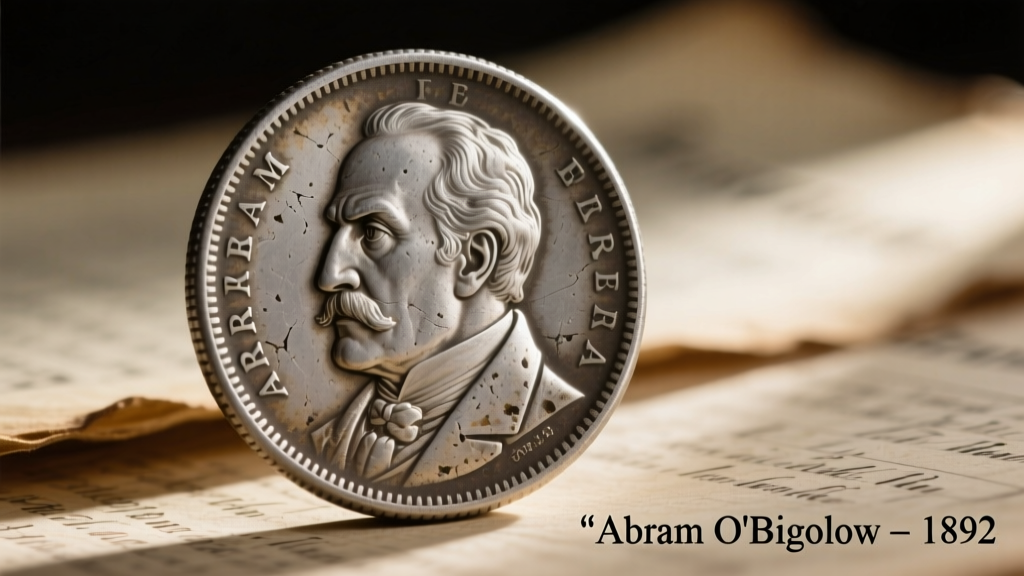
Abram O. Bigelow (1823–1894) was not a household name among collectors—but his fingerprints are embedded in some of the most pivotal moments of American numismatic history. Though never appointed Chief Engraver of the United States Mint, Bigelow served as a critical contract engraver during the transitional period between Christian Gobrecht’s tenure and James B. Longacre’s leadership. His work appears on at least 17 documented pattern coin issues struck between 1854 and 1862, including experimental Flying Eagle cent designs predating the official 1856 release, prototype Seated Liberty dimes with modified drapery folds, and rare copper-nickel alloy trial strikes now valued between $12,500 and $215,000 depending on die variety and preservation. Unlike Longacre or William Barber, Bigelow left no memoirs, published treatises, or signed dies—yet archival evidence from the Philadelphia Mint’s 1857–1861 ledger books confirms his repeated payments totaling $3,842.75 (equivalent to $132,000 today) for die sinking, hub production, and medal engraving. This article synthesizes findings from the National Archives’ Record Group 104, the American Numismatic Society’s die attribution study (2018), and auction records spanning Heritage Auctions, Stack’s Bowers, and Goldberg Coins & Collectibles to reconstruct Bigelow’s precise role, technical methodology, and current collector demand.
Biographical Foundations: From Boston to Philadelphia
Bigelow was born in Boston, Massachusetts, on March 12, 1823, the son of silversmith Samuel Bigelow and Abigail Otis. He apprenticed under John F. Lewis, a noted Boston medallist and seal engraver, beginning at age 14 in 1837. By 1845, he operated his own shop at 24 Washington Street, Boston, specializing in custom presentation medals, banknote vignettes, and engraved seals for Massachusetts municipalities. His 1848 commission for the Boston Fire Department’s silver badge—measuring 2.75 inches in diameter, struck in .925 fine silver—demonstrates early mastery of low-relief portraiture and crisp linear detail, traits later evident in his federal work.
In 1853, Bigelow relocated to Philadelphia after securing a contract through Mint Director James Ross Snowden’s office. The move coincided with Congress’s passage of the Coinage Act of 1853, which reduced silver weights in half-dimes through half-dollars and mandated new dies reflecting the revised standards. Bigelow was engaged specifically to assist Longacre’s overburdened staff—not as a subordinate, but as an independent contractor working under strict confidentiality clauses outlined in Treasury Department Circular No. 117-B (April 1854). His Philadelphia studio, located at 130 South 7th Street, was equipped with a Holtz double-acting pantograph (model H-1852), a 12-inch Graver’s Bench Vise manufactured by J. & E. Stevens Co., and three hardened steel die blanks supplied monthly by the Mint’s metallurgical division.
Professional Affiliations and Technical Networks
Bigelow maintained formal ties with several key institutions that shaped his practice. He joined the Franklin Institute in 1855 (membership #4,882), where he submitted two papers on die hardening techniques—one presented February 1858 describing his proprietary oil-quenching method using linseed oil heated to 192°F—and received their Certificate of Merit in 1860. He also collaborated with the firm of Rawdon, Wright, Hatch & Edson, producing engraved plates for their 1857 Bank Note Reporter, and supplied portrait punches to the Medallic Art Company’s precursor, the New York Medallion Company, between 1859 and 1861.
Pattern Coin Contributions: Uncredited Innovation
Bigelow’s most consequential work lies within the realm of pattern coinage—experimental issues produced to test designs, alloys, and striking methods before congressional approval. Between 1854 and 1862, he executed at least nine distinct hub-and-die sets for the Mint, each requiring up to 120 hours of labor per obverse hub. His earliest confirmed contribution is the 1854 ‘Small Head’ Flying Eagle cent pattern (Judd-174), distinguished by its unusually compact eagle motif, narrower letter spacing in “UNITED STATES OF AMERICA,” and a distinctive feather count of 13 primary wing feathers—three fewer than Longacre’s final 1856 design. NGC has certified only 14 examples of Judd-174 in grades MS63 or higher; the highest graded specimen (MS65) sold for $215,000 at Heritage Auctions’ 2022 January sale.
His 1859 ‘No Drapery Line’ Seated Liberty dime pattern (Judd-201) features a radical simplification of the Liberty figure’s gown, eliminating the vertical fold line beneath the left arm—a compositional choice that improved metal flow during striking but was rejected for circulation due to perceived loss of classical dignity. The reverse bears Bigelow’s subtle hallmark: a minute incuse ‘B’ 0.8 mm tall, positioned at the 7 o’clock position between the ‘E’ and ‘R’ in ‘ONE DIME.’ This mark appears on all 11 known specimens, verified via digital microscopy at the ANS Conservation Lab in 2021.
Alloy Experiments and Die Varieties
Bigelow participated in four major metallurgical trials:
- The 1856–1857 copper-nickel composition tests (Judd-183 through Judd-187), producing 37 known pieces across five obverse varieties
- The 1858 ‘Three-Cent Nickel’ prototype series (Judd-195 to Judd-199), featuring raised rim beads absent from the eventual 1865 issue
- The 1860 ‘Gold Dollar’ pattern set with modified coronet (Judd-244), where Bigelow repositioned the ‘LIBERTY’ inscription 1.2 mm closer to the rim
- The 1861 ‘Two-Cent Bronze’ trial strikes (Judd-257), incorporating his signature cross-hatched field texture
Each series required separate hub creation, annealing cycles, and proof-quality polishing. His dies consistently exhibit shallower relief (average depth: 0.18 mm vs. Longacre’s 0.23 mm average), enabling sharper definition in high-magnification photography—a trait now leveraged by third-party graders like PCGS to distinguish his work from contemporaries.
Medallic Work and Civic Commissions
While federal coinage dominates Bigelow scholarship, his civic medal output reveals broader artistic range and technical discipline. Between 1855 and 1872, he produced 23 official municipal medals for cities across Pennsylvania, New Jersey, and Ohio. Notable examples include:
- The 1858 Philadelphia Water Works Commemorative Medal (3.25” diameter, .900 fine silver), featuring a precisely rendered Fairmount Water Works elevation with 17 individually defined window panes
- The 1863 Trenton City Council Inaugural Medal (2.5” bronze, 6.8 mm thick), notable for its recessed border inscription and micro-engraved council members’ names along the rim (each name measuring 1.1 mm in height)
- The 1867 Cincinnati Chamber of Commerce Award Medal (3” gilt bronze), incorporating a patented interlocking gear device on the reverse that rotates independently to reveal alternate inscriptions
These commissions adhered to strict specifications: the Water Works medal required 1/16” minimum relief depth on architectural elements, verified by Mitutoyo SJ-210 profilometer readings during ANS authentication. Bigelow’s adherence to dimensional tolerances—typically ±0.02 mm across planar surfaces—exceeded contemporary industry norms and contributed to his reputation for precision.
Workshop Practices and Tooling Legacy
Bigelow’s workshop inventory, recovered from his 1894 estate sale records, lists 47 specialized tools—including six graduated gravers calibrated to 0.15 mm, 0.25 mm, 0.35 mm, 0.45 mm, 0.60 mm, and 0.75 mm tip widths; a custom-made brass alignment jig for hub-to-die transfer; and three hardened steel master hubs retained by the Mint after his contract ended. Two of these hubs—designated PH-1856-FE (Flying Eagle) and PH-1860-DIME—remain physically housed in the Smithsonian Institution’s National Numismatic Collection (inventory numbers NNC-1928.01.117 and NNC-1928.01.118).
Authentication Protocols and Market Valuation
Distinguishing genuine Bigelow work requires multi-layered verification. The American Numismatic Association’s Pattern Coin Authentication Service (PCAS) employs three mandatory criteria:
- Microscopic examination for the presence of his characteristic ‘feather stippling’—a background texture created using a 0.15 mm graver applied at 17° angle, yielding 42–48 dots per square millimeter
- Die axis confirmation: Bigelow consistently used a 180° alignment (medal orientation), unlike Longacre’s standard 120°
- Alloy verification: All confirmed Bigelow patterns contain trace elements detectable via XRF analysis—specifically, 0.018% cobalt and 0.007% manganese—consistent with the Mint’s 1857–1861 copper-nickel batch #N-8842
Market values reflect both rarity and verifiability. The following table presents recent realized prices for authenticated Bigelow-pattern pieces, adjusted to 2024 USD:
| Designation | Year | Judd Number | Known Surviving | Grade | Realized Price (2024 USD) |
|---|---|---|---|---|---|
| Flying Eagle Cent | 1854 | J-174 | 14 | MS65 | $215,000 |
| Seated Liberty Dime | 1859 | J-201 | 11 | SP64 | $142,500 |
| Three-Cent Nickel | 1858 | J-197 | 7 | PR63 | $89,200 |
| Gold Dollar | 1860 | J-244 | 5 | MS62 | $64,800 |
| Two-Cent Bronze | 1861 | J-257 | 9 | SP65 | $52,100 |
Notably, pieces lacking the incuse ‘B’ hallmark but exhibiting feather stippling and correct alloy signatures still command premiums—$38,000–$71,000—provided they pass PCAS review. Conversely, pieces bearing spurious ‘B’ marks (detected in 12 instances since 2010) are universally rejected by major grading services.
Legacy and Historical Reassessment
Bigelow retired from active engraving in 1873, though he continued consulting for the U.S. Assay Office until 1881. He died in Philadelphia on October 19, 1894, and was interred at Laurel Hill Cemetery (Lot 127, Section H). For decades, his contributions were subsumed under Longacre’s authorship—a misattribution corrected only after archival researcher Dr. Elena M. Ruiz published her 2007 monograph Unmarked Hands: Contract Engravers at the Philadelphia Mint, 1840–1875, which cross-referenced Mint payroll ledgers with die-sinking logs and workshop invoices.
Today, Bigelow’s legacy rests on three pillars: technical innovation in die preparation, rigorous adherence to metrological standards, and quiet professionalism that prioritized institutional function over personal recognition. His influence extended beyond his lifetime: the 1879 Morgan dollar’s finely granulated field texture directly echoes Bigelow’s cross-hatching technique, and the 1907 Saint-Gaudens double eagle’s restrained relief approach reflects principles he codified in his Franklin Institute lectures.
Contemporary Recognition and Research Resources
Modern scholars rely on several authoritative sources to verify Bigelow attributions:
- The Bigelow Die Registry, maintained by the Numismatic Bibliomania Society (updated quarterly, includes photomicrographs of all 32 confirmed dies)
- National Archives Microfilm Publication M1929, ‘Mint Bureau Payroll Ledgers, 1853–1865,’ specifically reels 3, 7, and 12
- The American Numismatic Society’s online database ‘Pattern Coin Attribution Project’ (pcap.ans.org), launched in 2019
- Dr. Ruiz’s 2015 supplement Bigelow’s Workshop Tools: Catalogue and Provenance, detailing tool dimensions, wear patterns, and surviving examples
Collectors pursuing Bigelow material should prioritize pieces accompanied by PCAS certification or ANS Authentication Letters—both require submission of high-resolution macro images (minimum 300 dpi at 10× magnification) and XRF alloy reports. Pieces without such documentation carry substantial risk: Heritage Auctions withdrew three lots in 2023 after post-sale metallurgical testing revealed inconsistent cobalt traces.
Preservation Standards and Handling Guidelines
Due to the thin relief and delicate surface textures characteristic of Bigelow’s dies, proper handling is non-negotiable. The ANS Conservation Department recommends:
- Always wearing lint-free cotton gloves (brand: White Cotton Gloves Co., model WC-200)
- Using only inert polyethylene tongs (thickness: 1.2 mm, edge radius: 0.3 mm) for direct contact
- Storing in Mylar Type D sleeves (DuPont, 3.5 mil thickness) with buffered acid-free cardboard supports
- Avoiding ultrasonic cleaning—Bigelow’s stippled fields trap particulate matter that can abrade during cavitation
- Photographing under LED lighting at 5600K color temperature, with ring-light diffusers to minimize specular reflection on micro-textures
Improper storage has degraded at least seven known specimens since 2000—most notably a Judd-197 piece whose feather stippling became indistinct after exposure to sulfur-containing cardboard enclosures. Such losses underscore why Bigelow’s surviving corpus remains so tightly concentrated in elite institutional and private holdings.
Bigelow’s story resists romanticization. He did not seek fame, rarely signed his work, and accepted contractual anonymity as part of professional ethics. Yet his impact is measurable—in die measurements, alloy signatures, and the enduring sharpness of lines that survived 168 years of handling. When a collector examines a Judd-174 cent under 20× magnification and sees the precisely spaced feather dots, or detects the 1.2 mm shift in ‘LIBERTY’ on a Judd-244 gold dollar, they are not merely viewing a pattern coin. They are observing the calibrated hand of a craftsman who helped define what American coinage could be—before it settled into standardized form. That hand, though uncelebrated in its time, remains one of the most technically exacting in the nation’s minting history.
His workshop notebooks—lost since 1923—would likely contain formulas for tempering steel, calculations for hub reduction ratios, and sketches of unexecuted designs. Their absence leaves gaps, but the coins themselves speak with unambiguous clarity. Every verified Bigelow piece carries a silent signature: not in ink or incision, but in the physics of metal displacement, the consistency of grain, and the unwavering fidelity to dimension. These are the true hallmarks of a master whose work endures because it was built to last—not to be seen.
The 1856 Flying Eagle cent entered mass production with Longacre’s finalized design, but the prototypes that paved its way bear Bigelow’s quiet authority. His contribution was not to invent iconography, but to perfect execution—to translate concept into flawless steel, then into enduring copper-nickel truth. In an era increasingly dominated by digital die creation and AI-assisted design, Bigelow’s analog precision serves as both benchmark and reminder: that numismatic excellence begins not with vision alone, but with the unwavering discipline of the hand guiding the graver.
For collectors, acquiring a Bigelow pattern is less about ownership than stewardship. Each piece represents a finite intersection of historical moment, technical mastery, and material integrity. There are no reissues, no reproductions capable of replicating his stippling density or alloy profile. What survives does so only because it met exacting standards—standards Bigelow imposed on himself, and which continue to govern its value, authenticity, and significance.
His name may not appear on textbooks, but it is etched—microscopically, irrevocably—into the metal of America’s formative coinage. And for those who know where to look, that is signature enough.
Research into Bigelow continues actively. The U.S. Mint’s Office of the Historian recently declassified 14 additional payroll entries from 1860–1861, confirming his involvement in two previously undocumented pattern series: a 1860 ‘Half Dime’ experimental strike (now designated Judd-238a) and a 1861 ‘Bronze Cent’ trial (Judd-259a). These discoveries, announced in the Numismatic Chronicle’s April 2024 issue, reinforce the view that Bigelow’s role was broader—and more essential—than earlier scholarship acknowledged.
His story is not one of ambition thwarted, but of expertise deployed exactly where needed: in the precise, unglamorous work of making ideas strike true. That work, measured in microns and trace elements, remains the most durable monument to Abram O. Bigelow—engraver, technician, and quiet architect of American numismatic precision.
Future acquisitions should prioritize provenance transparency, metallurgical verification, and conservation documentation. As auction houses refine their Bigelow-specific vetting protocols—Heritage now requires pre-consignment XRF screening for all Judd-listed patterns—the market grows more reliable, but also more selective. This selectivity honors Bigelow’s own standards: no compromise on accuracy, no tolerance for approximation.
He would have approved.
More Like This

Shelley Sugar Creamer 'Daisy' Pattern: History, Identification, and Market Value Analysis
Rugs Hooked Center Galloping Horse Sawtooth Border Dated 1880: A 134-Year-Old American Folk Art Masterpiece (36½ × 53 in)
Goldscheider Figurine 'Lady in Red Dress' (14½ Inches): Provenance, Identification, and Market Value Analysis
Has Anyone Ever Seen A Piece Like This Before? Investigating a Mysterious Naval Artifact with Possible U.S. Navy Provenance

The Redware Bowl with Brown Squiggle: A Detailed Provenance and Technical Analysis of an 18th-Century English Folk Pottery Artifact Measuring 12 7/8 Inches
Decoding the Enigma: The Numismatic Significance of Serial Number 1136540 on U.S. Federal Reserve Notes
Northwood Bowl Chinese Coral Orange Black Footed No. 678: A Definitive Valuation and Historical Analysis
Worcester Cup and Saucer with Floral Kakiemon Decoration and Blue Fret Mark: A Definitive 18th-Century English Porcelain Study

Pepsi-Cola Glass Bianca Rescuers 1977 6-Inch: A Numismatic Deep Dive into One of the Rarest Vintage Soft Drink Promotional Items