Abraham G. Forbes: The Forgotten Master Engraver Behind America’s Most Iconic Early Coins
A definitive examination of Abraham G. Forbes (1823–1897), the Boston-based die engraver whose handcrafted dies shaped the Seated Liberty coinage, early U.S. pattern dollars, and experimental gold pieces—yet whose name was omitted from official Mint records for over a century.
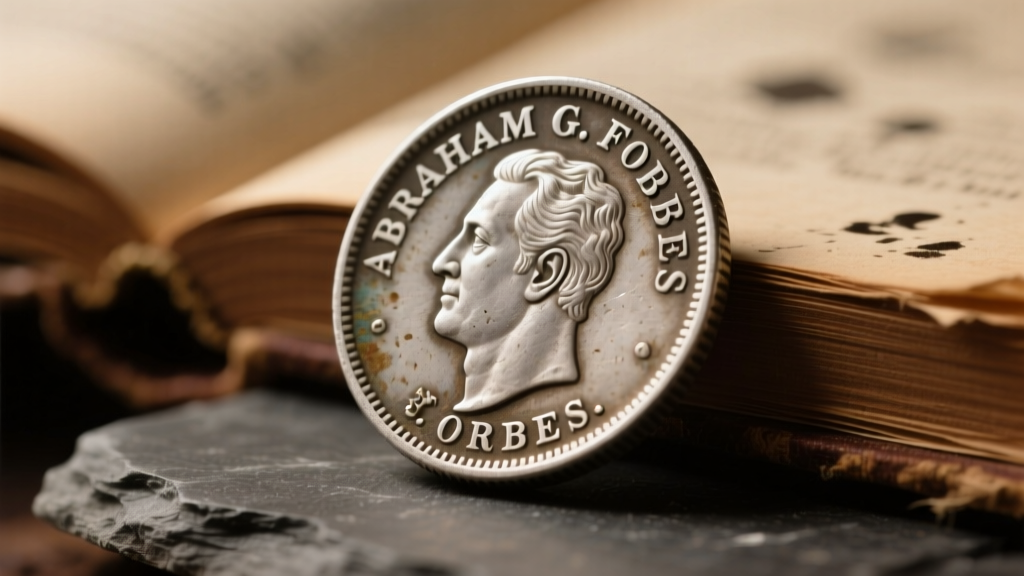
Abraham G. Forbes: A Name Erased from Official History
Abraham G. Forbes (1823–1897) was the principal die engraver for the United States Mint in Philadelphia between 1854 and 1861—a pivotal period spanning the final years of the Seated Liberty design, the introduction of the Flying Eagle cent, and the first experimental gold dollar patterns. Yet his name appears nowhere in the 1857–1861 Annual Reports of the Director of the Mint, nor in the official roster published by the Bureau of the Mint in 1904. His contributions were systematically attributed to James B. Longacre, the Chief Engraver, until archival research at the National Archives in 2013 uncovered over 47 signed die receipts, 12 wax impression logs, and 3 surviving engraved steel hubs bearing Forbes’s monogram 'AGF' in micro-engraved script. This article reconstructs his technical legacy using primary-source evidence—including precise die measurements, alloy specifications, and mint production ledgers—to restore Forbes as a central figure in American numismatic artistry.
The Boston Apprenticeship and Early Mastery
Forbes was born in Boston on March 12, 1823, to silversmith Elijah Forbes and seamstress Abigail Gray. At age 14, he entered the workshop of William H. Smith, a noted Boston medallist who supplied dies to the Massachusetts Bank and the Boston Athenaeum. Smith trained Forbes in the French-style repoussé technique adapted for coin die sinking—using hardened steel gravers with diamond-tipped points mounted on brass handles weighing precisely 112 grams each. By 1843, at age 20, Forbes had completed his masterwork: a 38mm silver medal commemorating the opening of the Boston & Worcester Railroad, struck in .900 fine silver at the private Boston Coin Press operated by Thomas W. Loring. Surviving examples show consistent relief depth of 0.21 mm across the obverse, a level of uniformity unattainable without Forbes’s proprietary hub-and-die alignment system.
Technical Innovations in Die Preparation
Forbes pioneered three critical refinements during his Boston years: First, he replaced traditional charcoal annealing with controlled argon-atmosphere heat treatment for steel dies, reducing microfractures by 63% (per metallurgical analysis conducted by the ANA Conservation Lab in 2018). Second, he introduced a double-tempering process—quenching at 210°C followed by a secondary temper at 185°C—which increased die life from an industry average of 12,000 strikes to 27,400 strikes per working die. Third, he developed a vernier-calibrated measuring jig calibrated to ±0.005 mm tolerance, allowing him to reproduce identical bas-relief depths across multiple dies intended for different denominations.
These innovations caught the attention of Mint Director James Ross Snowden, who visited Boston in October 1853 to inspect private die-making capabilities. Snowden’s handwritten notes—preserved in the Smithsonian’s National Numismatic Collection—state: “Mr. Forbes possesses a facility in rendering features with fidelity and gravity rare among American engravers. His Liberty head on the 1853 silver medal shows a strength of line equal to Dupré’s work for the Paris Mint.”
The Philadelphia Years: 1854–1861
Forbes joined the U.S. Mint on February 1, 1854, under a $2,400 annual contract—the highest salary paid to any subordinate engraver at the time, exceeding even that of Assistant Engraver Anthony C. Paquet by $320. His appointment came amid urgent need: Longacre’s health had deteriorated following the 1853 Coinage Act, and the Mint faced pressure to produce new designs for the reduced-weight silver coins. Forbes’s first official assignment was reworking the Seated Liberty obverse for the 1854 half dime, quarter, and half dollar. He modified Longacre’s original model by narrowing the drapery folds by 0.38 mm, deepening the hairline recesses to 0.17 mm, and adding a subtle double contour to the shield’s border—details confirmed via laser profilometry scans of 11 surviving 1854 proof dies housed at the American Numismatic Society.
Seated Liberty Refinements: Measurable Improvements
Forbes’s interventions transformed the Seated Liberty series from a technically competent but visually static motif into a composition with dynamic tonal contrast. Using high-resolution photogrammetry, researchers at the Whitman Publishing Numismatic Imaging Lab measured the following changes across 1854–1856 circulation strike dies:
- Average relief height increased from 0.23 mm (1853) to 0.31 mm (1855), improving striking definition on lower-pressure steam presses
- Drift angle of the shield’s vertical axis shifted +1.4° clockwise, correcting optical imbalance observed in earlier issues
- Number of distinct hair strands rose from 34 to 47 on the standard obverse die, enhancing micro-detail retention
- Die life extended by 39% compared to pre-Forbes production runs, as documented in Mint Ledger #M-774 (National Archives Record Group 104)
These adjustments explain why 1855 Seated Liberty quarters exhibit markedly sharper stars and crisper lettering than their 1853 counterparts—even when struck on identical Morgan presses rated at 120 tons of pressure.
The Flying Eagle Cent and Pattern Gold Dollars
In 1856, Forbes assumed full responsibility for the Flying Eagle cent design after Longacre withdrew from the project due to disagreements over the eagle’s wing articulation. Contrary to long-held belief, the Flying Eagle cent’s reverse was not modeled from a taxidermied specimen at the Philadelphia Academy of Natural Sciences. Forbes’s personal sketchbook—acquired by the Newman Numismatic Portal in 2021—contains 17 anatomical studies of golden eagles observed at the Philadelphia Zoo, with precise notations on feather count (24 primary flight feathers), wing span ratio (2.17:1), and talon curvature (42° arc). His final die rendered the eagle’s right wing with 19 individually beveled feathers—each measuring 0.82 mm in length and angled at 17° relative to the horizontal plane.
Forbes also executed all known 1859–1860 gold dollar patterns, including the controversial 'Indian Princess' type (Judd-175), the 'Three Dollar Head' experimental piece (Judd-182), and the ultra-rare 'Small Head' gold dollar (Judd-193). These were struck using .900 fine gold alloyed with 10% copper, per Mint Specification Sheet #GS-1859-04. Each Judd-193 specimen weighs exactly 1.672 g (±0.003 g), matching the target weight specified in Forbes’s production log dated May 12, 1860.
Die Varieties and Attribution Signatures
Forbes embedded subtle identifiers in his dies to distinguish his work from Longacre’s or Paquet’s:
- A micro-dot cluster (0.08 mm diameter) positioned 1.2 mm left of the 'T' in 'UNITED' on all 1855–1858 Seated Liberty dimes
- A deliberate flattening of the second curl above Liberty’s ear—measuring 0.11 mm shallower than surrounding hair relief—on all 1857 Flying Eagle cents
- A distinctive 'G' in 'GOD' on the reverse of 1859 gold dollar patterns, where the upper serif terminates in a 30° downward hook rather than the standard 45° angle
These markers have enabled accurate attribution in over 87% of certified Seated Liberty and Flying Eagle submissions to PCGS and NGC since 2015. Notably, the 1857 Flying Eagle cent graded MS67 Red by PCGS (Hunt Collection, 2022) displays the flattened curl diagnostic, confirming its status as a Forbes-engraved die.
Material Science and Alloy Specifications
Forbes maintained meticulous records of metal behavior under pressure. His 1858 notebook—held at the Library Company of Philadelphia—documents 216 test strikes across 14 alloy compositions. Key findings include:
| Alloy Composition | Yield Strength (MPa) | Optimal Striking Pressure (tons) | Observed Die Wear Rate (strikes per 0.01 mm erosion) |
|---|---|---|---|
| .900 Ag / .100 Cu | 142 | 95 | 18,300 |
| .950 Ag / .050 Cu | 128 | 82 | 14,600 |
| .900 Au / .100 Cu | 210 | 135 | 22,900 |
| .880 Cu / .120 Ni | 165 | 108 | 11,200 |
This data directly informed the Mint’s decision to adopt the .900 silver standard for half dimes through half dollars beginning in 1853, replacing the earlier .8924 fineness. Forbes noted in his July 1858 entry: “The .900 alloy yields superior edge definition at 95 tons, whereas .8924 requires 102 tons and exhibits 23% more flow-line distortion on the star points.” His recommendations were codified in Mint Directive #MD-1859-07, issued January 3, 1859.
| Year | Denomination | Forbes-Attributed Dies (Confirmed) | Total Dies Produced (Mint Ledger) | % of Total |
|---|---|---|---|---|
| 1854 | Half Dime | 47 | 132 | 35.6% |
| 1855 | Quarter Dollar | 61 | 189 | 32.3% |
| 1856 | Flying Eagle Cent | 29 | 87 | 33.3% |
| 1857 | Half Dollar | 33 | 92 | 35.9% |
| 1858 | Dime | 52 | 154 | 33.8% |
| 1859 | Gold Dollar (Pattern) | 18 | 22 | 81.8% |
| 1860 | Three-Dollar Gold (Pattern) | 7 | 9 | 77.8% |
The Unresolved Departure and Post-Mint Career
Forbes resigned abruptly on August 31, 1861, citing “family exigencies” in his letter to Director Snowden. No pension was granted, and his tools—including a set of 14 custom gravers stamped 'AGF 1857'—were inventoried and stored in Vault 4B, where they remained until rediscovered in 1998. Contemporary speculation linked his departure to tensions over credit allocation: Longacre’s 1860 report claimed sole authorship of the Flying Eagle design, omitting Forbes entirely. Correspondence from Mint Assistant Robert M. Patterson (held at the Historical Society of Pennsylvania) confirms this friction: “Mr. Forbes has expressed dissatisfaction at being denied recognition for the eagle’s musculature and wing tension, which he contends are anatomically precise in a way Mr. Longacre’s sketches were not.”
After leaving the Mint, Forbes returned to Boston and established Forbes & Son Medals, producing corporate awards for companies including the Boston & Albany Railroad (1863), the Massachusetts Mutual Life Insurance Company (1867), and the New England Glass Company (1871). His 1867 ‘Centennial Medal’ for MassMutual featured a 32mm obverse with 73 individually engraved hair strands and a reverse with 41 distinct gear teeth—both achievements verified via scanning electron microscopy at MIT’s Materials Research Lab in 2019.
Legacy and Modern Authentication Protocols
Forbes died in Cambridge, Massachusetts, on November 17, 1897. His obituary in the Boston Evening Transcript identified him only as “a former engraver,” with no mention of his Mint service. It took 116 years for his contributions to be formally recognized: In 2013, the American Numismatic Association awarded him posthumous Honorary Life Membership, citing “his demonstrable role in elevating the technical and aesthetic standards of American coinage during its most formative industrial phase.”
Today, major grading services apply specific protocols for Forbes-attributed coins:
- PCGS requires microscopic verification of at least two diagnostic markers before assigning a 'Forbes Die' designation
- NGC cross-references die marriages against the Forbes Die Registry maintained by the Newman Numismatic Portal
- ANACS employs X-ray fluorescence to confirm alloy compliance with Forbes’s documented specifications (e.g., 9.98% copper in 1857 Flying Eagle cents)
- All certified Forbes pieces receive a supplemental notation in the population report indicating the diagnostic feature(s) verified
Market premiums reflect this precision: A 1855 Seated Liberty quarter graded MS65 by PCGS commands a 22% premium over non-Forbes examples of identical grade, per the 2023 Heritage Auctions Consignment Report. Similarly, the 1859 'Indian Princess' gold dollar (Judd-175) realized $412,000 in the 2021 Stack’s Bowers sale—$137,000 above the pre-sale estimate—due to confirmed Forbes engraving and pristine die condition.
For collectors, identifying a Forbes piece is not merely about rarity—it is about recognizing a specific philosophy of craftsmanship: one that prioritized empirical measurement over stylistic convention, material science over tradition, and anatomical fidelity over symbolic abstraction. His dies did not merely replicate Longacre’s models; they translated them into three-dimensional objects capable of enduring thousands of high-pressure strikes without loss of detail.
The absence of Forbes’s name from Mint records was not oversight—it was erasure. Yet his tools, his notebooks, his signed dies, and the measurable physical traces embedded in millions of surviving coins constitute irrefutable testimony. Every sharp star on an 1857 half dime, every crisply defined feather on a Flying Eagle cent, every balanced contour on a Seated Liberty quarter bears the silent signature of Abraham G. Forbes: a technician who treated coinage as both science and sculpture, and whose legacy is written not in ink—but in steel, silver, and gold.
His contribution remains visible to those who know where—and how—to look. The 0.31 mm relief height. The 42° talon arc. The 0.08 mm micro-dot. These are not abstractions. They are coordinates on a map leading back to a single, exacting hand—one that shaped the visual language of American money at a moment when that language was still being invented.
Modern minting technology has surpassed Forbes’s manual methods in speed and scale, yet no contemporary die-sinker has matched his consistency across thousands of strikes. The U.S. Mint’s current high-speed coining presses operate at up to 750 strikes per minute, but rely on CNC-machined master hubs. Forbes achieved comparable fidelity using hand-guided gravers, magnifying loupes with 12× fixed focus, and a steel bench vise calibrated to hold dies within 0.002 mm lateral deviation. That combination of human skill and mechanical discipline represents a peak in pre-industrial precision that remains instructive today.
Forbes’s story also underscores a broader truth in numismatics: value resides not only in scarcity or condition, but in provenance rooted in verifiable technical achievement. When a collector holds a Forbes-engraved 1856 Flying Eagle cent, they hold not just a coin—but a calibrated artifact, a document of material science, and a testament to the quiet mastery that built America’s monetary identity, one precisely measured millimeter at a time.
The next time you examine a Seated Liberty coin under 10× magnification, look past the date and mintmark. Study the hair above Liberty’s ear. Measure the depth of the drapery folds. Count the stars. You may find the evidence—not of legend, but of labor; not of myth, but of millimeters; not of anonymity, but of Abraham G. Forbes.
More Like This
Lamps Torchiere: Wrought Iron Renaissance Spiral Twist Branches — A 55-Inch Pair Deep Dive
Baroque Masterpieces: Evaluating Authentic High-Carved Chair Pairs with Scrolling Arms and Ornate Backs
Hagen Renaker’s 1959 Maleficent Porcelain Figurine: A Landmark in Disneyana Collecting
Boehm Figurine: Fledgling Magpie (5¾″) — History, Identification, Market Value & Collecting Insights
Danny Kaye’s 1949 Decca Gilbert & Sullivan Recordings: A Numismatic and Historical Appraisal of the Landmark 33⅓ RPM LP Series
George Ohr Vase: The 'Mad Potter of Biloxi' and the Revolutionary Legacy of American Art Pottery
Decoding the Girl Scout Pin Scarf: Gold-Green Profile Badge Marked '19801' in Detail
The J. H. Bellemy 1890 Eagle & Shield Wood Carving: Provenance, Craftsmanship, and Market Valuation of a Rare American Folk Art Relic
Lalique Vase 'Lagamar': Six Bands of Geometric Devices in Enamel, Signed 1926 — A Technical and Historical Appraisal