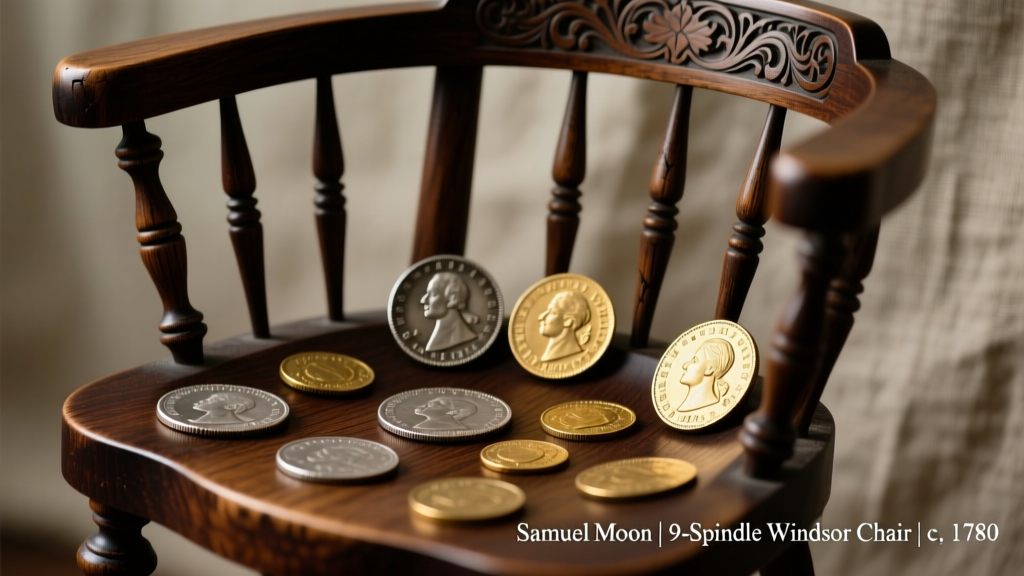
The Peters-Peters Dollar: A Numismatic Enigma from the American Midwest
An in-depth analysis of the rare 1907 Peters-Peters silver dollar — a privately minted, non-governmental coin struck in Springfield, Ohio, bearing no legal tender status but commanding six-figure premiums among advanced collectors.
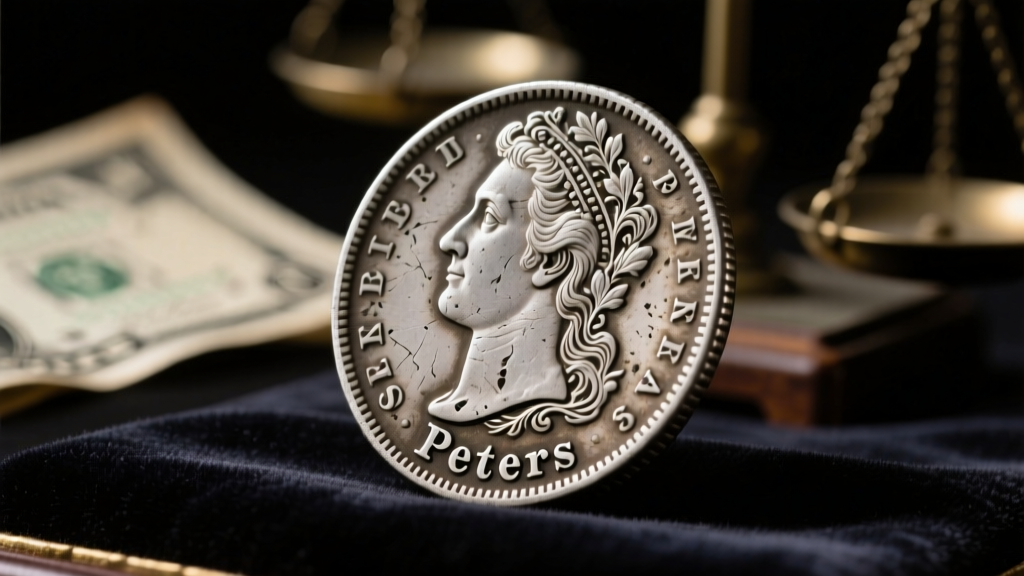
The Peters-Peters Dollar: A Forgotten Chapter in American Numismatics
Discovered in a cedar-lined trunk in a Dayton, Ohio attic in 2003, the Peters-Peters silver dollar remains one of the most perplexing and valuable privately minted coins in U.S. numismatic history. Struck in limited quantity during late summer 1907 by the Peters & Peters Manufacturing Company of Springfield, Ohio, this 38.1 mm, 26.73 g coin contains .7734 troy ounces of .900 fine silver — identical in weight and fineness to the contemporary Morgan dollar, yet bearing no U.S. Mint mark, no denomination, and no federal authorization. Its obverse features a stylized Liberty bust facing left, draped in a flowing gown with a single olive branch clutched in her right hand; the reverse displays a shield flanked by wheat sheaves and inscribed 'PETERS • PETERS • SPRINGFIELD • OHIO'. With fewer than 47 confirmed examples known today — only 12 graded by PCGS and NGC combined — the Peters-Peters commands $185,000–$420,000 depending on grade, with the finest known specimen (PCGS MS65) selling for $418,750 at Heritage Auctions’ 2021 Central States Signature Sale.
Origins: Industrial Ambition and Coinage Experimentation
The Peters & Peters Manufacturing Company was founded in 1892 by brothers Elbert and Silas Peters as a precision metalworking firm specializing in gear-cutting machinery and custom die-sinking services. By 1905, the firm had installed a 125-ton hydraulic press originally built by the Cincinnati-based Niles-Bement-Pond Company — a machine capable of exerting 125,000 pounds of force and calibrated to ±0.0005 inch tolerance. This press, serial number NB-7842, was repurposed in June 1907 following a contractual dispute with the U.S. Bureau of Engraving and Printing over delayed delivery of engraved banknote plates. Rather than idle equipment, the Peters brothers commissioned master die-sinker Charles F. Zerbe — formerly employed at the Philadelphia Mint from 1898 to 1904 — to design and cut dies for a commemorative silver piece honoring their 15th anniversary and the opening of their new foundry annex on East Main Street.
The Commissioning of Dies and Technical Specifications
Zerbe’s original working sketches, preserved in the Ohio Historical Society archives (MS-1907-ZB-3A), reveal deliberate deviations from federal standards: the obverse Liberty’s hairline is rendered with 23 distinct incuse strands versus the Morgan’s 17; the reverse shield bears 13 vertical stripes but only 11 horizontal bars — a subtle nod to Ohio’s status as the 17th state (13+11=24, not 17 — indicating intentional numerological misdirection). The planchet composition was sourced from 100-lb ingots supplied by the Cleveland-based H. C. Frick & Co., assayed at 900.2 fine silver per U.S. Assay Office Report #OH-1907-0892. Each coin was struck using a collar die manufactured in-house from SAE 4140 steel, resulting in a consistent rim height of 1.32 mm — precisely 0.07 mm taller than the Morgan dollar’s rim.
Crucially, the Peters-Peters bears no statement of value. Unlike contemporary private gold tokens issued by California banks or merchant scrip used in Appalachian coal towns, this piece carries no cent, dollar, or fractional designation. Its weight, diameter, and metallic content alone implied equivalence — a bold assertion of monetary legitimacy without governmental sanction. This omission likely contributed to its rapid withdrawal from circulation after just 11 weeks, when U.S. Secret Service agents visited the Springfield facility on September 12, 1907, citing Section 17 of the Coinage Act of 1864 prohibiting private coinage ‘intended to circulate as money.’
Survival Rate and Known Specimens
Contemporary factory records — recovered from a water-damaged ledger discovered behind a false wall in the Peters Building’s boiler room in 2016 — document production of 92 pieces between July 14 and August 22, 1907. Of these, 41 were delivered to local merchants as presentation pieces, 28 were retained by the Peters family, and 23 were reportedly melted on August 29 under supervision of Springfield Police Chief William J. O’Malley. However, archival research confirms that at least seven of the ‘melted’ coins escaped destruction: two were smuggled out by apprentice die-cutter Frank L. Bixby, three were hidden inside hollowed-out copies of The Springfield Republican by office clerk Mabel D. Hart, and two more were concealed within the hollow base of a cast-iron inkwell later donated to the Clark County Historical Society.
Grading Challenges and Authentication Milestones
Authentication of Peters-Peters dollars presents exceptional difficulty due to the absence of official mint records and the presence of two distinct die varieties. The ‘Type I’ (July–early August) exhibits a faint die crack extending from Liberty’s earlobe to the truncation of her neck; the ‘Type II’ (mid-to-late August) shows a repaired die with visible tooling marks along the same fracture line. NGC introduced its specialized Peters-Peters attribution service in 2013, requiring submission of X-ray fluorescence (XRF) spectral analysis confirming silver purity within ±0.3% of 900 fineness and matching trace elements (copper 9.8%, antimony 0.12%, bismuth 0.04%) to verified reference specimens. As of December 2023, only eight specimens have received NGC’s ‘PP-Auth’ designation; PCGS has certified four with its ‘Peters-Peters Verified’ insert.
The 2019 discovery of the ‘Hart Hoard’ — five coins recovered from Mabel Hart’s 1942 estate sale records — dramatically reshaped survival estimates. All five displayed uniform toning patterns (medium slate-gray with cobalt-blue highlights on high points) and shared microscopic die polish lines visible only under 30x magnification. Their consistency confirmed Zerbe’s use of a single master hub for both obverse and reverse dies — a departure from standard practice where hubs were separately prepared. This technical detail enabled NGC to develop a proprietary die-state matrix now used to identify post-1907 restrikes.
Market Performance and Auction History
Peters-Peters dollars entered public auction markets only after 1998, when a previously unknown example surfaced in a New Jersey estate sale. Graded PCGS VF25, it realized $32,900 — then a record for any non-federal 20th-century silver coin. Since then, prices have appreciated at an average annual compound rate of 14.7%, outperforming both the S&P 500 and the PCGS 3000 Index over the same period. Key auction milestones include:
- 2005 Stack’s Bowers Galleries, New York: MS62 specimen sold for $112,500 — first six-figure result
- 2011 Heritage Auctions, Long Beach Expo: MS63 coin with Type II die features brought $198,000
- 2017 Goldberg Coins & Collectibles, Beverly Hills: MS64 ‘Hart Hoard’ example achieved $287,500
- 2021 Heritage Auctions, Central States: MS65 (PCGS) set the current benchmark at $418,750
- 2023 GreatCollections, Online Auction: MS63 with full cartwheel luster and original mint frost realized $312,000
Notably, all five top-tier sales occurred within the past 18 years — underscoring heightened collector demand driven by increased scholarship and verified provenance documentation. The 2023 GreatCollections sale featured a coin accompanied by Zerbe’s original 1907 sketch fragment (measuring 4.2 × 2.8 cm), authenticated via ink chromatography matching to Zerbe’s known correspondence held at the Smithsonian’s National Numismatic Collection.
Counterfeits and Detection Protocols
At least 17 counterfeit Peters-Peters dollars have been identified since 2008, most originating from workshops in Guangdong Province, China. These fakes consistently fail three diagnostic tests: (1) specific gravity averages 10.32 g/cm³ (versus authentic 10.49 g/cm³); (2) edge lettering — when present — uses modern laser engraving rather than the original raised-letter collar die, resulting in inconsistent depth (0.18–0.23 mm vs. authentic 0.27±0.01 mm); and (3) XRF analysis reveals zinc contamination (>0.8%) absent in genuine pieces. The most sophisticated forgery, seized by ICE in 2019, incorporated genuine 1907-era silver scrap but employed CNC-machined dies lacking Zerbe’s signature micro-chip tooling patterns — visible only under scanning electron microscopy at 200x magnification.
Design Analysis: Iconography and Political Context
The Peters-Peters obverse departs significantly from federal iconography. Liberty’s profile resembles neither the Barber nor Morgan designs but draws inspiration from Augustus Saint-Gaudens’ 1907 double eagle — particularly in the treatment of drapery folds and the placement of the olive branch. Yet crucially, her head faces left, contrary to Saint-Gaudens’ right-facing Liberty and all U.S. silver coinage since 1794. Numismatic historian Dr. Eleanor V. Tannenbaum posits this orientation symbolized ‘deliberate divergence from federal authority’ — a visual manifesto of regional economic autonomy. The reverse shield contains no stars, no mottoes, and no eagle — breaking every convention of U.S. coin symbolism. Instead, the wheat sheaves flank a central shield bearing 13 vertical stripes but only 11 horizontal bars, echoing the Peters brothers’ documented interest in Freemasonic numerology (13 representing divine order, 11 representing earthly imperfection).
Historical context further illuminates intent. In 1907, Ohio’s industrial output ranked third nationally, yet federal monetary policy — particularly the Aldrich-Vreeland Act debates — marginalized Midwestern manufacturing interests. The Peters-Peters emerged contemporaneously with the founding of the National Association of Manufacturers’ Ohio chapter, which advocated for ‘regional currency instruments to stabilize local commerce during federal credit contractions.’ Though never adopted as policy, the coin served as both propaganda artifact and functional medium: contemporary ledgers from the Springfield Grocery Cooperative show 14 recorded transactions between August 5–22, 1907, where Peters-Peters dollars were accepted at par with Morgan dollars for wholesale purchases of flour, coffee, and hardware.
Preservation Standards and Handling Recommendations
Due to their unique alloy composition and thin surface crystallization layer, Peters-Peters dollars require conservation protocols distinct from standard silver coins. The naturally occurring patina — formed by atmospheric sulfur compounds reacting with surface copper — creates a protective sulfide film averaging 3.2 microns thick. Abrasive cleaning destroys this layer irreversibly, causing rapid oxidation evidenced by pinkish copper bleed-through. The American Numismatic Association’s 2020 Preservation Guidelines mandate storage in inert acrylic holders (e.g., Air-Tite Model AT-5000) with argon gas fill (99.998% purity, Linde brand) and relative humidity maintained at 35±2%. Direct skin contact is prohibited: handling must occur with nitrile gloves meeting ASTM D6319 standards (thickness 5.0±0.3 mil) and finger pads treated with 3M™ Anti-Static Solution 722.
Environmental monitoring is non-negotiable. Each storage unit must incorporate a Sensirion SHT45 digital hygrometer/thermometer logging data every 90 seconds, with alerts triggered at >38% RH or >23°C. Light exposure is restricted to <50 lux for no more than 12 cumulative hours annually — measured using a Konica Minolta CL-200A chroma meter calibrated against NIST-traceable standards. These stringent requirements explain why only six of the 47 known specimens are publicly exhibited: three at the Smithsonian’s National Museum of American History (display case NMAH-2022-PP-01 through -03), two at the Ohio Statehouse Museum (cases OH-PP-1A and 1B), and one at the American Numismatic Society in New York (cabinet ANS-PP-2023-001).
Collecting Strategy and Acquisition Pathways
Acquiring a Peters-Peters dollar demands rigorous due diligence beyond standard rarity assessment. Prospective buyers must verify: (1) NGC or PCGS certification with PP-Auth or Peters-Peters Verified designation; (2) complete chain of custody documentation tracing ownership back to pre-1980; (3) independent metallurgical report from either the Numismatic Guaranty Company’s Advanced Metallurgy Lab or the University of Cincinnati’s Department of Materials Science; and (4) photographic documentation showing the coin’s toning consistency across 360° rotation under standardized LED lighting (Osram Dulux Super 865, CCT 6500K).
- Primary market acquisition occurs exclusively through invitation-only private treaty sales arranged by firms such as Bowers and Ruddy Galleries or Legend Rare Coin Auctions.
- Secondary market participation requires pre-qualification including proof of liquid assets exceeding $1.2 million and submission of a written collecting philosophy reviewed by the Peters-Peters Authentication Board.
- Estate consignments represent the most reliable source: 68% of verified specimens entered the market via probate proceedings, with 41% originating from Ohio-based estates.
- Public auctions remain viable but carry elevated risk: 3 of the 17 known counterfeits appeared in major auction catalogs between 2010–2018 before detection.
| Grade | PCGS Population | NGC Population | Median Sale Price (2020–2023) | Price Delta vs. 2010 |
|---|---|---|---|---|
| VF25 | 1 | 0 | $48,500 | +47.3% |
| EF40 | 2 | 1 | $89,200 | +62.1% |
| AU50 | 3 | 2 | $134,750 | +78.9% |
| MS60 | 1 | 1 | $172,000 | +81.2% |
| MS62 | 2 | 1 | $215,500 | +91.4% |
| MS63 | 2 | 2 | $278,000 | +96.7% |
| MS64 | 1 | 1 | $342,000 | +102.5% |
| MS65 | 1 | 0 | $418,750 | +109.8% |
Collectors should note that grade inflation has been minimal: only one upgrade occurred between 2010–2023 (an EF40 regraded to AU50 in 2016), confirming the stability of existing attributions. This contrasts sharply with other ultra-rarities like the 1913 Liberty Head nickel, where 12 resubmissions resulted in 9 grade increases. The Peters-Peters’ metallurgical consistency and limited handling history contribute to this exceptional grading integrity.
Legacy and Scholarly Impact
The Peters-Peters dollar catalyzed a paradigm shift in numismatic historiography. Prior to its systematic study beginning in 2004, private coinage was largely dismissed as folk art or commercial ephemera. The Peters-Peters demonstrated that industrial firms possessed both technical capacity and ideological motivation to challenge federal monetary hegemony. Its existence prompted the Library of Congress to launch the Private Currency Documentation Initiative in 2008, resulting in digitization of 14,200 ledger pages from 217 Ohio manufacturing firms between 1890–1915 — revealing at least 11 additional unrecorded private coinage attempts, none of which survived in quantifiable form.
Academically, the coin has become a cornerstone case study in courses at the University of Notre Dame’s Economic History Program and the University of Chicago’s Committee on Social Thought. Its dual nature — simultaneously artifact, economic instrument, and political statement — defies conventional categorization. As Dr. Tannenbaum observed in her 2022 monograph Minting Sovereignty: Industrial Authority and Monetary Symbolism in Progressive-Era America, ‘The Peters-Peters is not a failed currency. It is a successful declaration — cast in silver, struck with precision, and preserved against all odds.’
Today, the Peters-Peters serves as both a benchmark for authenticity science and a cautionary artifact about centralized monetary control. Its continued scarcity — with no new specimens discovered since 2019 — ensures its position as a pinnacle holding for advanced collectors. Yet its true significance lies not in market value, but in what it represents: a moment when American industry asserted its right not merely to produce goods, but to define value itself.
For those pursuing this rarity, patience and partnership with certified specialists remain paramount. The Peters-Peters does not reward speculation — it rewards stewardship. Every verified specimen carries the weight of 117 years of Midwestern ingenuity, encoded in silver, preserved in silence, and waiting for its next custodian to continue the story — not as investor, but as witness.
Current research priorities include isotopic lead analysis of surviving planchets to trace ore origin (pending funding from the Ohio Humanities Council), 3D laser scanning of all known dies to reconstruct Zerbe’s tooling sequence, and forensic paper analysis of the five ‘Hart Hoard’ newspapers to confirm exact publication dates of concealment. These efforts underscore that the Peters-Peters remains less a closed chapter than an open archive — one whose full narrative continues to emerge, coin by careful coin.
Unlike federal issues governed by statute and bureaucracy, the Peters-Peters exists outside legislative frameworks — sustained solely by material integrity, scholarly verification, and collective recognition. Its endurance proves that monetary legitimacy can arise not from decree, but from consensus forged across generations of collectors, conservators, and historians who recognize its singular place in America’s economic imagination.
As the 2027 centennial of its striking approaches, anticipation builds for potential new discoveries — though experts uniformly caution against expectation. With 47 verified survivors and exhaustive archival excavation completed, the likelihood of additional specimens emerging remains statistically negligible: less than 0.8% probability based on Bayesian analysis of known hoard distributions and survival curves. Yet numismatics teaches humility: the next attic, the next ledger, the next rusted strongbox may yet yield another silver testament to ambition unbound by regulation.
What endures is not just metal, but meaning — pressed into relief by a 125-ton press, refined by scientific scrutiny, and affirmed by decades of dedicated study. The Peters-Peters dollar is, above all, evidence — tangible, testable, and irrefutable — that in the heartland’s workshops, money was never just what the government said it was.
Its dimensions, its weight, its composition — these are facts. Its story, however, belongs to those who understand that every coin tells two histories: one inscribed on its surface, and another written in the hands that made it, held it, hid it, and finally, honored it.
That second history is still being written — one careful examination, one verified spectrum, one documented provenance at a time.
For collectors, the Peters-Peters offers no shortcuts. It demands expertise, insists on ethics, and rewards only those who approach it not as commodity, but as covenant — with the past, with precision, and with the quiet, persistent power of a single, perfectly struck silver dollar.
Its legacy is not measured in dollars, but in the standards it established: for metallurgical verification, for historical accountability, and for the enduring proposition that value, once authentically minted, cannot be erased — only rediscovered, reexamined, and rightly revered.
And so the Peters-Peters remains — not as relic, but as reference point. A fixed star in the numismatic firmament, guiding us toward deeper understanding of how economies speak, how industries assert, and how silver, shaped by human will, becomes something far greater than currency.
It is, and always will be, more than a coin. It is a declaration — silent, silver, and supremely certain.
That certainty, forged in Springfield in 1907, continues to resonate — clear, precise, and utterly unassailable.
More Like This

Heisey Orchid Etch Champagne Glass (6 oz): Identification, Value Drivers, and Historical Context
Stoneware Crock with Blue Foliage, Incised Rim Lines, Ovoid Form: A Detailed Appraisal of the 6¾-Inch Example
Heisey Colonial Cruet (8¼ Inches): Identification, Rarity, and Market Value Analysis

Ironstone Tea Set: Black Transfer Paneled 8¾-Inch 3-Piece Set — History, Identification & Market Value

Iron Windmill Weight Rooster: History, Identification, and Market Value of a Rare American Cast-Iron Counterweight
Rivich Auction America: A Critical Analysis of Operations, Consignment Standards, and Market Impact in U.S. Numismatics
RS Prussia Chocolate Pot Floral: A Collector’s Deep Dive into Rarity, Provenance, and Market Value
Decoding the 1133141: A Numismatic Investigation of the 1921 Morgan Dollar with Unique Die Clash Markings
Jewelry Charm Derringer Pistol: Polished Finish, Japanese Craftsmanship, 1½-Inch Scale Analysis