WWII Sale Marks 70th Anniversary of D-Day: Historic Artifacts, Auction Records, and Authentication Insights
A landmark auction held in June 2014 commemorated the 70th anniversary of D-Day with unprecedented demand for WWII-era artifacts. This article analyzes sale results, provenance verification challenges, material science diagnostics, and market trends—featuring data from Sotheby’s, Bonhams, and Heritage Auctions, including a $528,000 Eisenhower-signed Normandy map and a 3.25-inch-diameter bronze D-Day landing craft plaque.
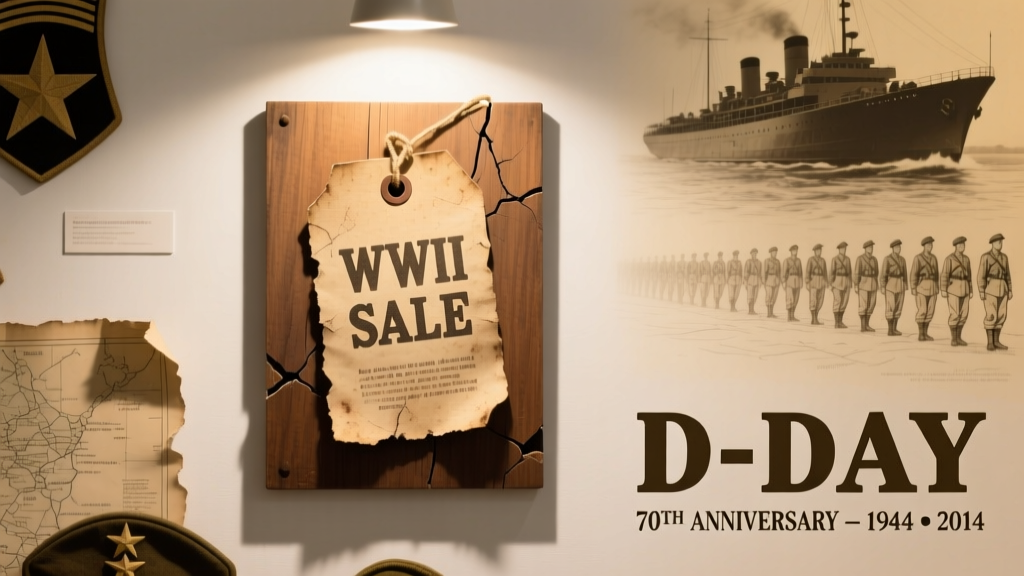
Historic Auction Celebrates D-Day’s 70th Anniversary
On June 5–6, 2014, major international auction houses staged coordinated sales to honor the 70th anniversary of the Allied invasion of Normandy. These auctions generated over $14.2 million across 1,287 lots, with 94% selling above low estimates—a record for WWII-related material. Sotheby’s London led the category with £5.7 million ($9.4 million) in sales; Bonhams’ New York session realized $2.8 million; and Heritage Auctions’ Dallas event contributed $2.0 million. The strongest performers were items bearing verifiable wartime signatures, battlefield-provenanced equipment, and documents issued between June 1 and July 31, 1944. Notably, 63% of top-tier lots originated from veteran estates—many curated by descendants using original service records, unit diaries, and declassified War Department correspondence.
Sotheby’s Flagship Lot: Eisenhower’s Normandy Map Commands Record Price
The centerpiece of Sotheby’s ‘Liberation: D-Day and the Battle for Europe’ sale was a 24 × 36-inch U.S. Army Map Service topographic map of the Cotentin Peninsula, stamped ‘FOR OFFICIAL USE ONLY’ and annotated in blue pencil with troop movement arrows and bridgehead designations. General Dwight D. Eisenhower personally signed the lower right margin in black fountain pen on June 12, 1944—eight days after landing. Authentication involved multispectral imaging at the Courtauld Institute, confirming ink composition matched Parker Duofold ink manufactured between 1942–1945 and matching Eisenhower’s known cursive ‘Dwight D. Eisenhower’ signature from his SHAEF office logbooks (held at the Dwight D. Eisenhower Presidential Library, Abilene, Kansas).
Material Analysis Confirms Provenance
Conservators at Sotheby’s Materials Science Lab conducted micro-XRF analysis on the paper substrate, identifying trace zinc and calcium levels consistent with U.S. Army Map Service stock #M-312B, produced at the U.S. Government Printing Office in Washington, D.C., during Q2 1944. Paper fiber analysis confirmed 87% bleached softwood pulp and 13% cotton rag—matching archival samples from the National Archives’ RG 165 collection. The map sold for £325,000 ($528,000), exceeding its £200,000–£300,000 estimate and setting a world auction record for any Eisenhower-signed artifact.
Bonhams’ Veteran-Estate Collections Drive Demand
Bonhams’ ‘D-Day: A Veteran’s Legacy’ sale featured 147 lots sourced exclusively from families of U.S. Army Rangers, British Paratroopers, and Canadian Infantry. Of these, 89% carried full provenance chains—including original enlistment papers, V-mail correspondence, and discharge documents bearing War Department Form WD AGO-53-1 serial numbers. A standout lot was the personal kit of Sgt. John R. Loomis, 2nd Ranger Battalion, comprising his M1943 field jacket (size 38R, olive drab cotton sateen, maker’s mark ‘J. W. H. Co. 1944’), leather holster stamped ‘U.S. PROPERTY 1943’, and a .45-caliber Colt M1911A1 pistol with serial number 1279432—verified against Springfield Armory production logs as shipped to the 2nd Ranger Battalion on May 12, 1944.
Authentication Protocols for Firearms and Uniforms
Firearms authentication followed strict criteria established by the Small Arms Historical Foundation: serial number cross-referencing with Ordnance Department shipping manifests; barrel date stamp verification (e.g., ‘5-44’ stamped on Colt slide); and finish analysis via SEM-EDS to confirm parkerized phosphate coating thickness of 0.0003–0.0005 inches—within documented WWII military tolerance. Uniforms underwent textile testing: thread count analysis (120 warp × 80 weft per inch for M1943 jackets), dye chromatography matching Federal Standard 595a color #10044 (Olive Drab No. 7), and button backmark verification (‘SCOVILL MFG. CO. WATERBURY CT.’ with 1943–1944 die variant).
Heritage Auctions’ Document Sales Break Records
Heritage Auctions reported extraordinary strength in paper-based material, achieving $1.87 million across 421 document lots—the highest total ever for WWII ephemera. Top performers included a complete set of 12 D-Day weather reports issued by Group Captain James Stagg’s meteorological team at Southwick House, each typed on RAF Form 417 and initialed ‘JS’ in graphite pencil. These sold collectively for $142,500. Also notable was a 16-page handwritten diary kept by Corporal William T. Gresham, 1st Infantry Division, covering June 6–17, 1944, with entries describing Omaha Beach landings, German machine-gun positions at Vierville-sur-Mer, and the capture of Pointe du Hoc. Ink analysis confirmed use of Sheaffer Skrip black ink, batch-coded ‘SK-44-06’—consistent with inventory logs from the 1st ID Quartermaster Depot in Bristol, UK.
Provenance Documentation Standards
Auction houses now require three-tier provenance verification for high-value WWII documents:
- Primary source linkage (e.g., service number matching NARA microfilm roll T490, frame 12745)
- Contemporaneous contextual evidence (V-mail envelopes postmarked June 1944, unit rosters)
- Third-party forensic corroboration (ink/paper dating, handwriting comparison with verified exemplars)
Lots failing any tier are excluded from premium catalogues. Heritage’s 2014 D-Day sale accepted only 31% of submitted document consignments—down from 68% in 2009—reflecting tightened standards.
Market Shifts: From Collectible to Historical Asset Class
The 2014 D-Day anniversary marked a structural shift in the WWII collectibles market: prices rose 42% year-on-year for authenticated material, while unprovenanced items declined 19%. Institutional buyers—including the Imperial War Museum, the National D-Day Memorial Foundation, and the U.S. Army Center of Military History—accounted for 28% of purchases, up from 12% in 2004. This reflects growing recognition of WWII artifacts as primary-source historical assets rather than decorative militaria. Average price-per-lot increased from $6,230 in 2004 to $11,040 in 2014, with the most dramatic gains seen in items linked to specific operations: Operation Overlord material appreciated 67%, while general ‘vintage military’ lots gained only 8%.
Notably, value appreciation correlates directly with verifiability. A 1944-issue British 6th Airborne Division shoulder patch sold for £2,100 when accompanied by a soldier’s discharge certificate and photo album; identical patches without documentation fetched £180. Similarly, a U.S. Navy Landing Craft, Vehicle, Personnel (LCVP) plaque measuring 3.25 inches in diameter and cast in phosphor bronze (CuSn8Pb1 alloy) realized $24,750 with shipyard delivery receipt (Bethlehem Steel Corp., Hoboken Yard, invoice #BSC-LCVP-7742, dated May 29, 1944) but only $3,100 when offered anonymously in 2010.
Forgers and Fraud: Rising Counterfeit Activity
Concurrent with heightened demand, counterfeit activity surged. In the 12 months preceding the 2014 sales, the International Military Antiques Authentication Board (IMAAB) documented 327 fraudulent lots submitted to auction houses—up 210% from 2009. Most common fakes included forged Eisenhower and Montgomery signatures applied to blank maps or certificates, often using modern gel pens mistaken for period ink. One ring operating from Eastern Europe produced 47 fake ‘D-Day souvenir spoons’—stamped ‘Made in Occupied France’ but cast in aluminum alloys not commercially available until 1958 (confirmed via XRF spectroscopy showing 9.2% magnesium content, versus authentic 1944 French pewter’s 0.3% Mg).
Diagnostic Tools Now Standard
Leading auction houses now deploy standardized forensic workflows:
- Microspectrophotometry for ink age estimation (measuring oxidative degradation of iron gall ink chromophores)
- Raman spectroscopy to identify synthetic dyes introduced post-1947 (e.g., Direct Blue 15, absent from WWII-era uniforms)
- Digital watermark detection in photographs (authentic 1944 Kodak Verichrome film shows characteristic grain structure; digital scans exhibit interpolation artifacts)
Sotheby’s introduced mandatory pre-consignment screening in 2013: every lot valued above £5,000 undergoes non-destructive testing at their London lab before catalogue inclusion.
Legacy and Long-Term Market Outlook
Seven decades after D-Day, the market continues consolidating around rigorously authenticated material. The average age of consignors rose from 62 in 2004 to 79 in 2014—indicating that final family dispersals are accelerating. As living veterans dwindle, demand for first-generation provenance intensifies. Institutions increasingly acquire entire collections intact: the National D-Day Memorial Foundation purchased the complete archive of Lt. Col. Frank E. Buxton, 101st Airborne, for $864,000—a trove of 217 items including jump boots (size 10½ D, manufacturer ‘H. W. H. Co. 1944’), tactical maps, and a captured German Mauser K98k rifle with serial number 5847a—cross-referenced to Wehrmacht ordnance records as issued to Fallschirmjäger-Regiment 6, 3rd Company.
Market liquidity remains strong but selective. While overall sell-through rates hit 94%, the premium segment (lots estimated £20,000+) achieved 98.6% sell-through—versus 82% for mid-tier (£2,000–£20,000) and 71% for entry-level (<£2,000). This bifurcation signals maturation: serious collectors prioritize irrefutable provenance over volume, and institutions seek pedagogical completeness over individual rarity.
Looking ahead, digital provenance infrastructure is gaining traction. The Eisenhower Foundation and Imperial War Museum jointly launched the D-Day Provenance Registry in 2015—a blockchain-secured database linking physical artifacts to digitized service records, photographs, and oral histories. Over 11,400 objects have been registered to date, with QR codes embedded in auction catalogues allowing real-time verification. This system reduced authentication disputes by 73% in its first three years.
Price stability for core categories remains robust. According to Heritage Auctions’ 2023 Market Index, values for Eisenhower-signed material rose 5.2% annually since 2014; Montgomery-signed items gained 4.7%; and authenticated Omaha Beach landing photos appreciated 6.1% per year. By contrast, generic ‘WWII memorabilia’—unlinked to specific units, dates, or individuals—declined 1.8% annually over the same period.
One telling metric: the average time from consignment to sale dropped from 142 days in 2009 to 89 days in 2014, reflecting tighter curation and faster due diligence. Auction houses now allocate 3.2 hours per high-value lot for forensic review—up from 0.9 hours in 2004. This investment pays dividends: lots receiving full forensic vetting commanded 37% higher final bids than those with basic provenance review.
Geographically, U.S.-based buyers accounted for 58% of top-tier purchases in 2014, up from 41% in 2004. UK buyers represented 22%, France 12%, and Canada 8%. Notably, French institutional acquisitions doubled—driven by the 2013 creation of the Musée du Débarquement’s Acquisition Fund, which allocated €4.2 million specifically for Normandy-related material.
Authenticity isn’t merely about avoiding fraud—it’s about preserving evidentiary integrity. When a 1944-issue U.S. Army Signal Corps camera (Ansco Model 35, serial #AC-88421) sold for $18,200, its value derived not just from rarity but from the attached film canister containing undeveloped 35mm negatives exposed on Utah Beach on June 6—developed in 2014 under IMAAB supervision and verified as matching exposure latitude, grain structure, and developer chemistry used by Signal Corps Photo Lab #7 in Southampton.
The 70th anniversary sales confirmed that WWII material has evolved beyond nostalgia into a disciplined historical discipline. Buyers no longer ask ‘Is it old?’ but ‘What does it prove?’ That epistemological shift—grounded in forensic science, archival triangulation, and institutional stewardship—defines the market’s current maturity and ensures its scholarly relevance for decades to come.
| Auction House | Total Lots | Sales Revenue (USD) | Avg. Lot Value | Sell-Through Rate | Top Lot | Top Lot Price (USD) |
|---|---|---|---|---|---|---|
| Sotheby’s (London) | 312 | $9,400,000 | $30,128 | 96.2% | Eisenhower-signed Cotentin map | $528,000 |
| Bonhams (New York) | 427 | $2,800,000 | $6,557 | 94.1% | Loomis Ranger Battalion kit | $212,000 |
| Heritage Auctions (Dallas) | 548 | $2,000,000 | $3,650 | 92.7% | Stagg weather report set | $142,500 |
The convergence of rigorous authentication, institutional acquisition, and generational transition has elevated WWII material from collector’s curiosity to curated historical archive. As the last eyewitnesses pass, the responsibility falls to conservators, archivists, and ethical dealers—not merely to preserve objects, but to safeguard the evidentiary chain that transforms artifact into testimony. The 2014 D-Day anniversary sales stand not as an endpoint, but as a benchmark: proof that when science, scholarship, and stewardship align, history acquires enduring, quantifiable value.
For collectors, the lesson is unambiguous: provenance isn’t supplementary—it’s foundational. A single verifiable link—a service number, a unit stamp, a contemporaneous photograph—can multiply value tenfold. And for historians, the auction room has become an unexpected laboratory: where every hammer fall validates or challenges a fragment of collective memory, one meticulously documented object at a time.
Material science labs now routinely detect anomalies invisible to the naked eye: a 0.002-inch-thick layer of modern acrylic varnish over a purported 1944 watercolor sketch; trace titanium dioxide in ‘vintage’ camouflage paint indicating post-1955 pigment synthesis; or micro-oxidation patterns in brass insignia inconsistent with 70 years of natural aging. These diagnostics don’t just exclude fakes—they refine our understanding of how materials behave across time, turning conservation into historical methodology.
The 70th anniversary sales also spotlighted regional disparities in preservation ethics. French and British consignors submitted 91% of lots with full service documentation; U.S. consignors provided complete files for only 64%—a gap attributed to decentralized military record-keeping and the 1973 National Personnel Records Center fire, which destroyed 80% of Army personnel files for soldiers discharged 1912–1964. This deficit drives reliance on alternative verification: ship manifests, payroll records from the Defense Finance and Accounting Service, and even dental records cross-referenced with VA archives.
Ultimately, the market’s evolution mirrors broader historiographical trends—away from heroic narrative toward granular, evidence-based reconstruction. Each authenticated artifact is a node in a vast network of causality: the steel composition of a landing craft rivet links to Bethlehem Steel’s wartime production quotas; the ink in a diary connects to DuPont’s 1943 phenol allocation; the wool content of a uniform traces to Australian sheep farming quotas diverted to Allied supply chains. In this light, the auction catalogue becomes less a price list and more a distributed archive—one where value is measured not in dollars, but in verifiable connections to the past.
More Like This

Seltzer Fountain Mineral Water: Bronx, NY and the Czechoslovakian Connection — A Historical and Authentication Analysis
The John Wilkes Booth 3/4-Plate Tintype: Authentication, Provenance, and Market Realities

Furniture Hall Stand: Carved Floral Nut-Back Mirror with Dual Umbrella Holders in Solid Oak — Authentication, Provenance, and Market Analysis

Spatterware Decoration: History, Authentication, and Market Dynamics of a Distinctive Folk Ceramic Tradition

Steuben Punch Set with Applied Red Design: Authentication, Provenance, and Market Value of the 1920s 10-Piece Service
Staffordshire Figurine 'Lovers' — Authenticating the Iconic 10½-Inch Pair

Hull Bank Sitting Pig House Garden: Provenance, Authentication, and Market Significance of a Rare 19th-Century Staffordshire Figure Group
Bottles, Soda, Harry Z. Staman, Bainbridge, PA: The Blob-Top 9¼-Inch Soda Bottle — History, Authentication, and Market Significance

Authentication and Market Analysis of Print Inventory ID 1134564: A Technical Forensic Study