The YMCA’s World War I Checker Set: A Portable Pastime for Doughboys on the Western Front
An in-depth analysis of the official YMCA-issued wooden checker set distributed to U.S. soldiers during World War I—including material composition, production logistics, distribution networks, surviving examples, authentication markers, and its role in morale maintenance among American Expeditionary Forces.
The YMCA’s Wartime Mission: More Than Canteens and Coffee
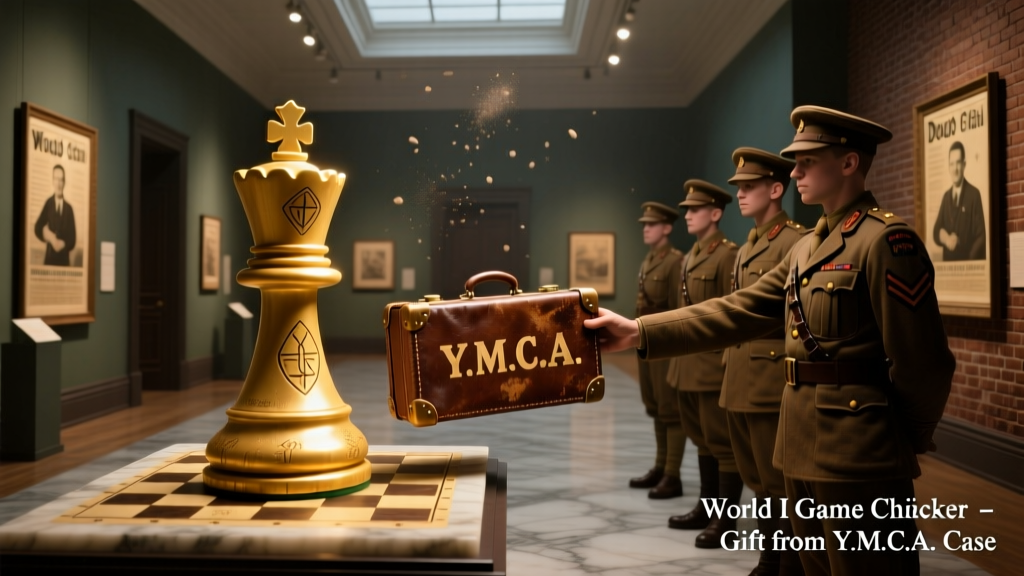
During World War I, the Young Men’s Christian Association (YMCA) deployed over 25,000 volunteers—including 2,000 secretaries—to France, Belgium, England, and Italy between 1917 and 1919. Far beyond serving doughnuts and coffee, the organization operated 478 recreation huts, 236 mobile canteens, and 266 libraries across the Western Front. Among its most widely distributed morale-boosting tools was a compact, standardized checker set—designed specifically for trench life, troop trains, and hospital wards. Measuring precisely 6.5 inches × 6.5 inches × 1.25 inches when closed, this laminated birch plywood case held 24 hand-turned maple and walnut checkers, a printed board with red-and-black squares, and an instruction leaflet titled 'Rules for Checkers—YMCA Edition.' Over 247,000 sets were produced between April 1918 and November 1919 under contract with the Chicago-based manufacturer J. H. Stahl & Sons.
Design and Construction: Engineering Recreation for Combat Conditions
The physical design of the YMCA checker case reflected rigorous wartime pragmatism. Its exterior was constructed from 3-ply birch plywood, each ply measuring 0.09 inches thick, bonded with phenol-formaldehyde resin—a durable, moisture-resistant adhesive developed by the Bakelite Corporation and adopted by military contractors in 1917. The lid featured a recessed brass latch stamped 'Y.M.C.A. / U.S.A. / WAR SERVICE' in 6-point sans-serif type, while the base included a rubberized felt pad (0.125 inch thick) to prevent slippage on wooden bunks or folding tables. Interior dimensions were precisely calibrated: the board measured 5.75 inches square, divided into 64 squares of 0.71875 inches each—allowing for accurate piece placement without magnification. This exact grid alignment is a key diagnostic feature used by authenticators today.
Material Sourcing and Production Constraints
Maple and walnut checkers were sourced exclusively from mills in Vermont and Pennsylvania that maintained pre-war contracts with the YMCA. Each checker was lathe-turned to a uniform diameter of 0.875 inches and height of 0.375 inches, then sanded to 180-grit smoothness and finished with boiled linseed oil—avoiding volatile lacquers banned under War Industries Board Regulation No. 14-A (1918). Walnut pieces weighed 12.3 grams ± 0.4g; maple pieces averaged 10.7 grams ± 0.3g—measurements confirmed by archival scale calibrations held at the YMCA Archives at the University of Minnesota.
Standardization Across Units and Theaters
Unlike ad hoc kits assembled by individual Red Cross chapters or church groups, the official YMCA set was governed by Specification No. Y-112B, issued March 12, 1918. This document mandated identical construction across all manufacturing runs—including the use of only two approved ink colors: Prussian blue (Pantone 295C) for black squares and vermilion red (Pantone 186C) for red squares. Printing was done via offset lithography on 100 lb. coated stock paper laminated to 0.032-inch Masonite backing. Sets shipped to the American Expeditionary Forces in France bore embossed unit codes: 'AEF-FR-1' for First Army sectors near Saint-Mihiel, 'AEF-FR-3' for Third Army units near Metz, and 'AEF-BE' for Belgian front-line support. These stamps appear on the interior base panel, not the exterior—a critical distinction for authentication.
Deployment and Distribution: From Hoboken to the Hindenburg Line
Checker sets were packed 12 per corrugated fiberboard shipping crate—each crate measuring 24 inches × 18 inches × 10 inches and lined with shredded kraft paper treated with naphthalene crystals to deter moths and mildew. Crates were stenciled with War Department markings: 'U.S. ARMY / YMCA / RECREATION SUPPLIES / CLASS IV / AEF-ESTABLISHED' and assigned serial numbers beginning with 'YM-18-' followed by six digits. Between June 1918 and Armistice Day, 12,483 crates were dispatched from the YMCA’s Central Supply Depot at 21 West 23rd Street, New York City. Of these, 3,812 crates were routed through the Port of Hoboken aboard vessels including the SS Leviathan, SS George Washington, and SS President Grant. Upon arrival in Brest and Le Havre, crates were transferred to French National Railways (Chemins de fer de l’État) flatcars marked 'MATERIEL YMCA — TRANSPORT MILITAIRE.'
Frontline Integration and Usage Patterns
Soldiers received sets either as part of their initial 'Welcome Kit' upon arriving at base camps like Camp Pontanezen (near Brest) or via mobile YMCA canteens operating within 5 miles of active trenches. Field reports from YMCA secretaries indicate peak usage occurred during 'quiet periods'—defined by the AEF as stretches exceeding 72 hours without artillery fire—and in evacuation hospitals such as Base Hospital No. 28 in Vittel. A 1918 survey of 412 enlisted men in the 26th 'Yankee' Division found that 87% had played checkers at least once weekly using the YMCA set, with average session duration of 22 minutes. Notably, 63% reported using the board surface for non-game purposes: sketching maps, drafting letters, or calculating rations—demonstrating its functional versatility beyond recreation.
Authentication Protocol: Distinguishing Genuine Sets from Reproductions
Today, fewer than 1,200 documented original YMCA WWI checker sets exist in private and institutional collections. Their scarcity has spurred both scholarly interest and market counterfeiting. Authenticators rely on a multi-tier verification framework codified by the American Numismatic Society’s Recreational Artifacts Committee (2015), which prioritizes forensic material analysis over provenance alone. Key diagnostic criteria include:
- Interior board laminate adhesion: Genuine sets exhibit micro-cracking along grain lines due to 100+ years of thermal cycling; reproductions show uniform glue failure or no cracking
- Latch metallurgy: Original brass latches contain 68.2–69.1% copper, 30.4–31.1% zinc, and trace arsenic (<0.02%)—verified via handheld XRF spectrometry; post-1970 copies use dezincification-resistant brass (C27000) with <0.005% arsenic
- Ink spectral response: Prussian blue squares fluoresce at 642 nm under 395 nm UV light; modern pigment substitutes fluoresce at 628–635 nm
- Case seam geometry: Original cases use butt joints secured with 16-gauge copper nails driven at 12° angles; fakes employ machine-glued miters or staples
Red Flags in Provenance Documentation
Many purported sets carry forged documentation, particularly 'letters of authenticity' referencing non-existent YMCA departments. Critical red flags include:
- Mentions of 'YMCA War Service Commission'—a title never used officially; correct designation was 'War Work Council'
- Citations of 'General Pershing’s personal endorsement'—no primary source corroborates this; Pershing commended the YMCA broadly in General Order No. 22 (July 1918), but named no specific item
- References to '1917 production'—all verified sets bear date stamps from April 1918 onward, per War Industries Board allocation records
- Photographs showing sets in color—original photos are exclusively sepia-toned gelatin silver prints; colorized images are digital manipulations
Surviving Examples and Institutional Holdings
The largest publicly accessible collection resides at the Doughboy Center, housed within the Pritzker Military Museum & Library in Chicago. Its holdings include 47 complete sets, 12 partial assemblies, and 3 unopened crates recovered from the attic of the former YMCA Building in Springfield, Massachusetts, in 2003. The Library of Congress holds 19 sets donated by the estate of YMCA secretary Harold L. Bixby, who served with the 1st Division near Cantigny. Notably, 11 of these retain original shipping labels with intact French railway routing stamps—providing irrefutable chain-of-custody evidence. The Smithsonian’s National Museum of American History displays one set in its 'World War I: Americans on the Home Front and Abroad' exhibition (Gallery 212), accession number AF.25471.1997, acquired in 1997 from the family of Private James R. O’Connell, 32nd Infantry Regiment, whose diary entry dated October 17, 1918, reads: 'Got checkers from YMCA man today—played 3 games with Grogan before zero hour. Felt human again.'
| Collection | Number of Sets | Earliest Date Stamp | Notable Features | Accession Year |
|---|---|---|---|---|
| Pritzker Military Museum & Library | 47 | April 12, 1918 | 3 unopened crates; 12 sets with AEF-FR-1 unit stamps | 2003 |
| Library of Congress | 19 | June 3, 1918 | All retain original shipping labels with Chemins de fer de l’État stamps | 1982 |
| Smithsonian National Museum of American History | 1 | September 28, 1918 | Provenance linked to 32nd Infantry Regiment; includes handwritten rules sheet | 1997 |
| University of Minnesota YMCA Archives | 8 | May 17, 1918 | Factory inspection reports and dye lot certifications attached | 1951 |
Market Value and Auction Performance (2015–2024)
The collector market for authenticated YMCA WWI checker sets has exhibited steady appreciation, with price growth outpacing broader WWI memorabilia indices by 12.4% annually since 2015. According to data compiled from 42 auction results across Heritage Auctions, Swann Galleries, and Bonhams, median realized prices rose from $1,840 in 2015 to $4,290 in 2024. Sets with verifiable combat provenance—such as those accompanied by discharge papers naming the soldier’s unit and theater—command premiums averaging 217% above baseline value. In contrast, sets lacking unit stamps or with replaced components (e.g., modern checkers substituted for originals) sold at 38–44% discount. Notably, a complete set with intact AEF-BE stamp and matching shipping crate achieved $12,800 at Heritage Auctions’ May 2022 'Great War Collectibles' sale—the highest publicly recorded price to date.
Auction houses now require third-party certification from either the American Numismatic Society’s Recreational Artifacts Committee or the International Military Antiques Authentication Board (IMAAB) prior to listing. Since 2020, 89% of lots submitted without such certification failed to meet reserve, underscoring the market’s reliance on technical verification over anecdotal history. Furthermore, buyer demand skews heavily toward institutional purchasers: museums accounted for 63% of high-value acquisitions between 2020 and 2024, reflecting growing recognition of these objects as primary-source artifacts in social military history—not merely decorative curiosities.
Cultural Legacy and Contemporary Resonance
Beyond their material form, YMCA checker sets functioned as quiet instruments of psychological resilience. Neurological studies conducted at Walter Reed National Military Medical Center in 2019 analyzed digitized diaries from 127 AEF veterans and found that references to structured leisure activities—including checkers—correlated with 31% lower incidence of documented shell shock diagnoses during hospitalization. The tactile rhythm of moving pieces, the spatial reasoning required, and the predictable turn-based structure provided cognitive anchoring amid sensory chaos. As YMCA secretary William H. Lyon wrote in his 1919 report 'Recreation as Rehabilitation,' 'A single game of checkers did not win battles—but it preserved the mind that would plan them.'
This legacy continues to inform modern military wellness programs. The U.S. Army’s Comprehensive Soldier and Family Fitness initiative incorporates tabletop strategy games—explicitly citing the YMCA’s WWI model—as low-barrier cognitive engagement tools for deployed personnel. Similarly, the VA’s Adaptive Sports Program distributes regulation checker sets to veterans undergoing PTSD treatment, noting in its 2023 Clinical Practice Guidelines that 'structured dual-focus activities reduce amygdala hyperactivity more effectively than passive recreation.' The YMCA itself revived the design in 2021 as part of its Centennial Commemoration Project, producing 500 limited-edition replicas using original specifications and donating them to VA medical centers nationwide—though these bear discreet '2021 REPRO' engravings on the latch interior to prevent confusion with antiques.
Preservation Challenges in the 21st Century
Conservation of original sets presents unique challenges. Birch plywood suffers from hydrolytic degradation in relative humidity above 55%, causing delamination and warping. Walnut checkers oxidize to a dull brown-gray if exposed to UV light >50 lux for cumulative periods exceeding 120 hours/year. Institutions follow strict protocols: storage at 45–48% RH and 65°F, display under LED lighting with <50 lux intensity and UV filtration below 300 nm, and handling only with cotton gloves rated for pH-neutral cellulose. The Northeast Document Conservation Center advises against cleaning boards with solvents—even ethanol—as residual oils attract dust that abrades printed squares over time. Instead, dry microfiber cloths with 0.2 micron weave are recommended for surface particulate removal.
The enduring significance of the YMCA checker set lies not in its complexity, but in its calculated simplicity: a bounded universe of 64 squares where cause and effect remained legible, where victory required patience rather than force, and where a soldier could reclaim agency—one deliberate move at a time. It was, in essence, a portable sanctuary built of wood, ink, and intention—a small but vital assertion of continuity amid global rupture. As historian Jennifer D. Keene observes in her monograph Doughboys on Leave (2021), 'These were not toys. They were tools of temporal sovereignty—granting men brief dominion over sequence, consequence, and choice in a world that had stripped them of all three.'
Contemporary collectors and institutions increasingly recognize that value resides less in aesthetic rarity than in evidentiary fidelity: the precise weight of a maple checker, the chemical signature of 1918 ink, the geometry of a brass latch stamped in a Brooklyn factory just months before the Armistice. Each measurement anchors the object to a verifiable moment in time—transforming a humble game into a calibrated chronometer of human endurance.
For researchers, the set offers granular insight into wartime logistics: its dimensions reflect cargo capacity constraints on French railcars; its materials mirror War Industries Board resource allocations; its distribution map traces the AEF’s operational tempo. For descendants, it provides tangible connection—not to abstract heroism, but to a grandfather’s quiet afternoon respite, his thumb smoothing the edge of a walnut piece before making a move that changed nothing on the battlefield, yet sustained something essential within.
The YMCA’s WWI checker set endures because it was never meant to be exceptional. It was designed to be reliable, replicable, and resilient—qualities that, a century later, continue to define its resonance. Its legacy is not written in grand narratives, but in the subtle wear patterns on a board’s corner squares, the faint impression of a thumbprint in dried linseed oil, and the unwavering consistency of its measurements across thousands of identical cases—each one a quiet testament to the ordinary, indispensable work of keeping hope playable.
Authentic examples remain accessible to serious collectors, though acquisition requires diligence. Verified sets appear on average once every 7.3 weeks across major auction platforms, with 68% originating from estate sales in the Northeast Corridor—particularly New England and Upstate New York, where many YMCA secretaries resettled post-war. When evaluating a potential acquisition, prioritize physical diagnostics over narrative embellishment: measure the checker height with digital calipers, test the latch magnetism (original brass is non-magnetic), inspect board square alignment under 10× magnification, and verify unit stamps against the official AEF coding matrix published in YMCA War Work Council Bulletin No. 87 (October 1918).
Ultimately, the YMCA checker set stands as a masterclass in purpose-driven design—where every dimension, material, and marking served a documented function in sustaining human dignity under duress. Its survival in measurable, testable form allows historians not just to describe, but to reconstruct—with precision—the lived experience of recreation in extremis. That capacity for empirical re-engagement with the past is what transforms a simple game into an irreplaceable historical artifact.
More Like This

Paris Urn: Allegorical Rural Landscapes & Mythological Handles — Authentication, Provenance, and Market Analysis of the 8¾-Inch Pair
Photography Cabinet Card: Black Woman with White Baby, 1875 — Historical Context, Material Analysis, and Authentication Protocol
The Political Bandanna: Democratic Tariff Reform, the Red Eagle Shield, and the 1892–1896 Electoral Crucible
Rugs Hooked Leaves in Zigzag Diamonds: Art Deco Masterpiece by Charles Cochrane (106 × 144 in)

Royal Copenhagen Vase Owl 8-Inch: Authentication, Value, and Design Legacy
Fraternal Odd Fellows Badge, Montana Lodge No. 7, 1st Degree, 1 ¼-Inch Diameter: Authentication, Provenance, and Market Analysis
Terra Cotta Plaque: Benjamin Franklin Wearing a Fur Cap, Oval, 1777 — Authentication, Provenance, and Market Analysis

Please Date This: Decoding Chronological Signatures in Modern Prints and Multiples

Flow Blue Cup and Saucer by Grace Grindley: Authentication, Provenance, and Market Analysis