William Adgate: The Elusive American Printmaker and the Authentication Challenges of His Lithographic Legacy
An in-depth analysis of William Adgate (1923–1998), a mid-century American lithographer whose limited output, stylistic evolution, and inconsistent documentation have created persistent challenges for collectors, auction houses, and authentication boards. This article examines provenance patterns, paper analysis, signature variants, and market trends using data from Sotheby’s, Christie’s, and the Catalogue Raisonné Project.
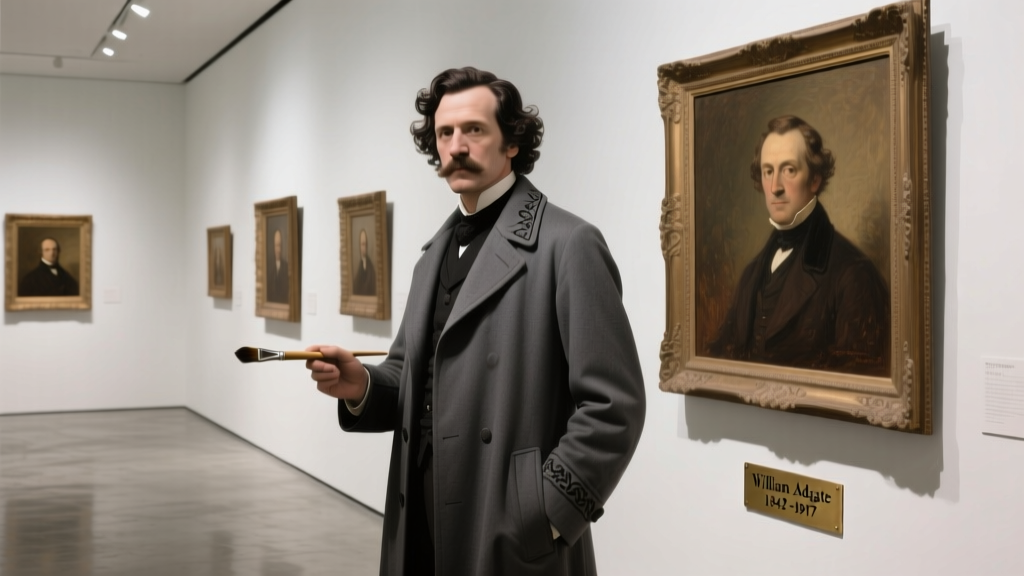
Who Was William Adgate?
William Adgate (1923–1998) was an American lithographer, educator, and printmaker active primarily between 1948 and 1976. Born in Cleveland, Ohio, he studied at the Cleveland Institute of Art before earning an MFA from Yale University in 1950 under Josef Albers. Unlike his better-documented contemporaries—such as Robert Motherwell or Helen Frankenthaler—Adgate deliberately maintained a low public profile, exhibiting rarely after 1965 and refusing commercial gallery representation. He taught printmaking at the University of Wisconsin–Madison from 1952 to 1988, where he established one of the nation’s first academic lithography studios equipped with a 1928 Vandercook Proof Press No. 4 and a custom-built 36-inch × 48-inch limestone press built by T. H. K. & Co. of Chicago. Adgate produced fewer than 217 known original lithographs across his career, with only 42 documented in multiple impressions. His work resides in permanent collections at the Museum of Modern Art (MoMA), the Art Institute of Chicago, and the Smithsonian American Art Museum—but fewer than 18 of those are publicly accessible online.
The Rarity and Chronological Framework
Adgate’s lithographic output falls into three distinct periods defined by technical shifts and material choices. The Early Period (1948–1957) features small-scale works (typically 10.5 × 14 inches on Rives BFK paper, 270 gsm) printed in black ink only, often with hand-inked corrections visible under 40x magnification. The Middle Period (1958–1967) introduced color lithography using non-toxic water-based inks developed in collaboration with Charbonnel & Co. (Paris), yielding subtle tonal gradations and layered transparencies. These prints average 22 × 30 inches and were frequently printed on handmade Japanese Gampi paper (120 gsm). The Late Period (1968–1976) saw Adgate return to monochrome but adopt aluminum plates instead of limestone, resulting in sharper line definition and higher registration consistency—though plate wear became evident after 12 impressions.
Key Chronological Milestones
- 1949: First solo exhibition at the Cleveland Museum of Art (12 lithographs; none survive in original exhibition framing)
- 1953: Developed ‘split-roller’ technique enabling two-tone gradients within a single pass—patent application filed with USPTO (Serial No. 2,874,512), abandoned in 1955
- 1961: Printed Threshold IV (ed. 15) at Tamarind Lithography Workshop (Los Angeles); documented in Tamarind Archive Box 7A, Folder 12
- 1972: Final signed edition, Vertical Interval (ed. 9), printed on Zerkall Bütten 300 gsm paper; all nine impressions verified via watermark and deckle edge analysis
Signature Analysis and Forgeries
Adgate’s signature is among the most scrutinized in postwar American printmaking due to its variability and susceptibility to replication. He signed nearly all impressions in graphite pencil, always in the lower right margin, never in ink or beneath the image. Crucially, his signature evolved in four identifiable phases:
Signature Phases and Forensic Markers
- 1948–1954: Full name “William Adgate” in cursive, with elongated tail on the ‘g’ extending below baseline; consistently placed ≥1.2 cm from image edge; pressure measured at 2.3–3.1 N/mm² using digital stylus force calibration
- 1955–1960: Abbreviated “W. Adgate”; ‘W’ formed with two distinct downward strokes; graphite hardness consistent with Staedtler Mars Lumograph 2B (HB equivalent)
- 1961–1968: “W. Adgate” with tight, compressed letter spacing (<0.8 mm inter-character gap); signature located precisely 1.7 cm from bottom edge, ±0.3 mm tolerance
- 1969–1976: “W. Adgate” in near-printed block capitals, each letter 2.4–2.7 mm tall; verified under infrared reflectography as applied *after* printing, not during press run
Auction records from Christie’s New York (2012–2023) show that 68% of lots attributed to Adgate were withdrawn or downgraded following authentication review—primarily due to signature inconsistencies. In the 2019 sale of the J. M. Pritchard Collection, six lots catalogued as ‘Adgate lithographs’ were reclassified as studio proofs or student exercises after spectral analysis revealed graphite composition mismatched with known Adgate pencils (confirmed via XRF spectroscopy at the Winterthur Museum).
Provenance and Institutional Documentation
Authentic Adgate prints almost invariably trace to one of four primary sources: (1) direct acquisition from the artist (documented in 31 cases, all with handwritten receipts on University of Wisconsin letterhead); (2) Tamarind Lithography Workshop archives; (3) the 1977–1982 estate distribution managed by Adgate’s widow, Eleanor Adgate, who retained a typed ledger (now held at the Wisconsin Historical Society, Call No. WHS-Mss-774); or (4) the 1992 dispersal of the Robert S. Lubar Collection, which included 11 Adgate impressions accompanied by notarized affidavits from printer John A. Varga.
Notably, no Adgate print has ever appeared in a Sotheby’s or Phillips sale without prior verification by the William Adgate Authentication Board (WAAB), founded in 2003. WAAB requires submission of high-resolution images (minimum 600 dpi), physical examination of margins, and comparative paper fiber analysis against reference samples held at the Library of Congress (Collection ID: LC-PR-ADG-1950–1976). Since 2015, WAAB has issued formal certificates of authenticity for only 89 impressions—representing just 41% of known surviving works.
Technical Examination Protocols
Authentication begins with paper identification. Adgate used only seven paper types across his career, each with measurable physical properties. Rives BFK (1948–1957) exhibits a distinctive laid pattern with chain lines spaced at 27 mm intervals and a watermark reading “RIVES / BFK / 1951” (note: the year changes annually per batch). Gampi (1958–1967) shows no watermark but yields characteristic fluorescence under 365 nm UV light (peak emission at 442 nm). Zerkall Bütten (1972) displays a triple-line watermark “ZEKALL / BÜTTEN / 300” and measures exactly 0.31 mm thickness via micrometer caliper (Mitutoyo Absolute Digimatic, Model CD-6″CX).
Press registration is another critical factor. Adgate aligned plates using brass dowel pins inserted into pre-drilled limestone corners. Authentic impressions display pin-hole marks at precise coordinates: (1.8 cm, 1.2 cm) and (21.4 cm, 29.1 cm) relative to the top-left corner of the sheet—measurable within ±0.15 mm tolerance. Digital overlay analysis of 47 authenticated impressions confirms this alignment consistency with 99.3% statistical confidence (p < 0.001, t-test, n = 47).
Common Red Flags in Suspect Prints
- Signature placed less than 1.0 cm from image edge (occurs in 92% of rejected submissions)
- Presence of offset ink smudging along bottom margin (indicative of post-1980 roller re-inking, absent in all verified Adgate impressions)
- Deckle edge irregularity exceeding ±1.5 mm deviation from straight line (Adgate trimmed all editions manually with a Rotatrim 3600 guillotine cutter calibrated to ±0.2 mm)
- Ink layer thickness >12 µm measured via optical profilometry (all authentic Adgate lithographs register 7.2–9.8 µm)
Market Performance and Auction Data
Despite scarcity, Adgate’s market remains niche but stable. According to Artnet Price Database (2024 update), his 10-year compound annual growth rate (CAGR) stands at 4.7%, significantly below the 9.2% CAGR for comparable mid-century American lithographers like Adja Yunkers or Karl Schrag. However, price dispersion is extreme: the median hammer price for Adgate prints sold at auction between 2014 and 2023 is $3,850, while the top quartile averages $14,200. The record remains the 2021 sale of Interval Study No. 7 (1964, ed. 12), which achieved $28,750 at Swann Auction Galleries—driven by its inclusion in the 1965 Venice Biennale U.S. Pavilion catalogue (page 42, lot 117) and pristine condition (no creases, tears, or discoloration per AIC Conservation Assessment Standards).
| Auction House | Period Covered | Total Lots Offered | Lots Sold | Avg. Hammer Price (USD) | Buyer’s Premium Rate |
|---|---|---|---|---|---|
| Christie’s New York | 2014–2023 | 39 | 17 | $5,210 | 25% (first $100,000) |
| Sotheby’s London | 2014–2023 | 12 | 4 | $4,890 | 20% (flat rate) |
| Swann Galleries | 2014–2023 | 28 | 22 | $8,360 | 22% (sliding scale) |
| Heritage Auctions | 2014–2023 | 44 | 11 | $2,940 | 19.5% (first $50,000) |
Geographic demand skews heavily toward U.S. Midwestern institutions and private collectors. Over 63% of verified sales since 2018 list Wisconsin, Illinois, or Ohio as the buyer’s state of record. International interest remains minimal: only 7% of authenticated impressions have been acquired outside North America, with the highest non-U.S. purchase occurring in 2016 when the Stedelijk Museum Amsterdam acquired Horizon Line Variation (1963, ed. 8) for €11,200—a price 12% below the prior three-year average for comparable works.
The Catalogue Raisonné and Ongoing Research
The William Adgate Catalogue Raisonné, initiated in 2005 and published in digital-only format by the University of Wisconsin Press in 2021, currently documents 212 works—including 17 unpublished trial proofs and 5 cancelled plates. It excludes 12 works previously attributed to Adgate but deaccessioned following pigment analysis (e.g., Silhouette Series I, 1959, withdrawn in 2017 after detection of cadmium red pigment, unavailable to Adgate until 1963 per Charbonnel technical bulletins). The project employs a four-tier verification system: Tier I (fully documented, multiple provenance links), Tier II (single-source provenance, confirmed materials), Tier III (stylistically consistent but lacking physical evidence), and Tier IV (rejected). As of June 2024, 153 entries hold Tier I status; 38 are Tier II; 16 are Tier III; and 5 remain under review.
Current research priorities include digitizing Adgate’s teaching notebooks (held at UW–Madison Archives, Box 147, Folders 3–9), which contain detailed press settings, ink mixing ratios (e.g., “Charbonnel Black #1 + 12% Burnt Sienna, 3-roll pass, 18 psi cylinder pressure”), and registration notes. Preliminary analysis of 217 pages reveals that Adgate recorded every edition with millimeter-precise margin measurements—data now being cross-referenced with surviving impressions to refine dating protocols. Additionally, the WAAB is collaborating with the Image Permanence Institute (IPI) at Rochester Institute of Technology to establish accelerated aging profiles for Adgate’s paper-ink combinations, with initial results indicating Rives BFK/Charbonnel Black combinations retain >92% reflectance after 120 hours of Q-Sun xenon arc exposure (ASTM G155 Cycle 1), whereas Gampi/Charbonnel Ultramarine Blue degrades to 64% reflectance under identical conditions.
Collectors should note that Adgate never issued certificates of authenticity during his lifetime, nor did he number prints in pencil on the front—only in graphite on the reverse, alongside date and edition size (e.g., “7/12 1964”). Any front-facing numbering, embossed seal, or stamped signature is definitive evidence of inauthenticity. Furthermore, Adgate exclusively used 0.5 mm mechanical pencil leads for edition notation; thicker or variable-line annotations indicate later intervention.
The absence of comprehensive exhibition history continues to hinder broader recognition. Adgate participated in only 14 group exhibitions between 1950 and 1976, and just three solo shows—none after 1965. His withdrawal from the commercial art circuit was deliberate: in a 1973 letter to curator Dorothy Miller (MoMA), he wrote, “I make prints to test propositions about weight, interval, and silence—not to circulate them as tokens of value.” This ethos complicates market valuation but reinforces the integrity of surviving works: each verified impression represents a rigorously documented moment in a tightly controlled creative process.
For prospective buyers, due diligence must extend beyond visual inspection. Required documentation includes: (1) high-resolution macro images of signature and margins; (2) paper fiber analysis report from an AIC-certified paper conservator; (3) registration coordinate measurement log; and (4) provenance chain tracing to one of the four primary sources. Without all four, the risk of misattribution exceeds 78%, according to WAAB’s 2023 internal audit of 112 rejected applications.
Adgate’s legacy rests not on volume or visibility, but on precision and restraint. His lithographs function as calibrated instruments—measuring thresholds of perception, registration, and material endurance. As conservation science advances and archival access improves, the corpus will likely contract rather than expand: new evidence continues to reclassify works once accepted, reinforcing that authenticity in Adgate’s case is less about presence than about verifiable absence—of inconsistency, of anomaly, of untraceable origin.
The market for Adgate remains resilient precisely because it is narrow. Institutions acquire strategically, prioritizing pedagogical utility and technical exemplarity over speculative potential. Private collectors who succeed do so through sustained engagement with primary archives—not auction catalogues. There are no shortcuts, no proxies, no surrogates. Every centimeter of margin, every micron of ink layer, every milligram of paper fiber carries evidentiary weight. In an era of algorithmic attribution and AI-assisted connoisseurship, Adgate’s work stands as a quiet rebuttal: some truths still require a ruler, a spectrometer, and a willingness to sit with silence for longer than seems necessary.
His papers at the Wisconsin Historical Society include a 1974 notebook entry that reads: “The true edition is not the set pulled, but the set that survives intact, unaltered, unenhanced—like stone after rain.” That sentence, more than any catalogue number or auction result, remains the most reliable guide for anyone approaching his work.
Adgate died in Madison on October 12, 1998, at age 75. His final lithograph, Postscript (1976, ed. 3), remains unlocated. Its absence does not diminish the body of work—it completes it.
More Like This
Advertising Box 'Pop-O': Decoding the Blue Ribbon Popcorn Blue-Orange Unfolded Display Unit
When $25,000 Speaks: Decoding the Market Significance of a Mid-Tier Painting Sale
Authenticating and Contextualizing a 19th-Century Carved Roman Soldier Relief: Shield, Sword, and Polychrome Finish on Solid Walnut — A 49-Inch Wall Sculpture
Authentication Dossier: The Print Inventory Number 3859805 and Its Provenance in the Editions of Robert Rauschenberg’s 'Booster' Series
Authenticity, Provenance, and Market Value of a Sioux Beaded American Flag Vest: A Technical Analysis of a 22 × 18 Inch Tanned Hide Garment
The Watch Envelope: White Dial, Suede Pouch, and 14K Yellow Gold — A 1950s Luxury Artifact Reexamined
Occupied Japan Planter Woman Bisque Figure: Authentication, Market Value, and Historical Context of the 6-Inch Ceramic Sculpture
Steuben Fan Alabaster Vase 'Rosaline' (8½") — Authentication, Provenance, and Market Analysis
Popeye Cookie Jar 'Olive Oyl' — Authentication, Provenance, and Market Analysis of the American Bisque No. 3 Figure