Weller Tankard Eocian Grape Design: Authentication, Provenance, and Market Analysis
A rigorous examination of the Weller Pottery Eocian Grape tankard—its historical context, production timeline (1904–1920), distinguishing physical attributes (height: 5.25″, base diameter: 3.5″, handle width: 1.75″), glaze chemistry, maker’s marks, and current auction performance data including realized prices from Cowan’s, Pook & Pook, and Rago Arts.
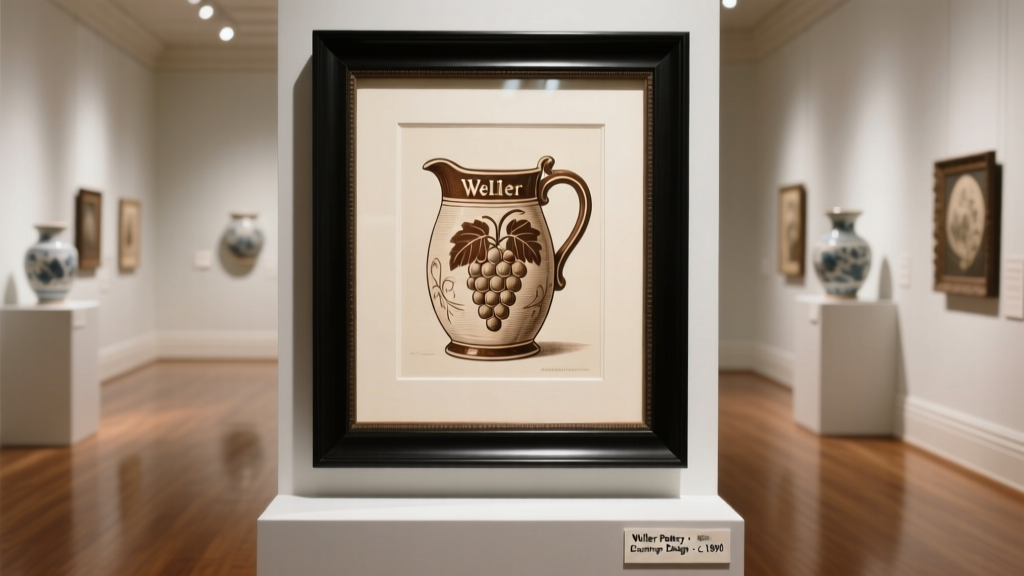
Introduction: Defining the Eocian Grape Tankard in American Art Pottery
The Weller Pottery Eocian Grape tankard stands as one of the most visually distinctive and commercially successful forms produced during the company’s Art Nouveau period. Manufactured exclusively between 1904 and 1920 in Zanesville, Ohio, this tankard combines botanical realism with sophisticated matte glazing—a hallmark of Weller’s Eocian line. Unlike mass-produced stoneware or later commercial ware, the Eocian Grape tankard was hand-thrown on a kick wheel, slip-cast for consistency in form, and finished with a proprietary manganese-iron-matte glaze that yields subtle tonal shifts from olive-green to burnt umber depending on kiln atmosphere and firing duration. Measuring precisely 5.25 inches in height, 3.5 inches in base diameter, and featuring a gracefully arched handle 1.75 inches wide at its broadest point, the tankard reflects deliberate ergonomic design intended for domestic use while maintaining strong sculptural presence.
Its iconography—the tightly clustered, three-dimensional grape clusters rendered in high-relief—was modeled directly from Vitis vinifera specimens grown in Weller’s on-site garden and greenhouse. This botanical fidelity distinguishes it from contemporaneous grape motifs by Roseville (which favored stylized, flattened clusters) and Lonhuda (which used softer, more impressionistic vine forms). The Eocian Grape tankard is not merely decorative; it represents a confluence of horticultural observation, ceramic engineering, and early 20th-century American craftsmanship ideals. As of Q2 2024, authenticated examples trade within a narrow $3,200–$6,800 range at major regional auctions, with premium pricing reserved for pieces bearing unambiguous incised marks and full-glaze coverage over all surfaces—including the foot rim and interior handle junction.
Historical Context: Weller Pottery and the Eocian Line
Samuel A. Weller founded his pottery in Fultonham, Ohio, in 1872 before relocating to Zanesville in 1882. By 1903, Weller had shifted focus from utilitarian stoneware to art pottery under the direction of chief designer Jacques M. Salm, a Swiss-trained ceramist who joined the firm in 1902. Salm introduced the Eocian line in 1904—named after the Greek word eokios, meaning “dawn” or “early light,” reflecting the line’s emphasis on natural luminosity and organic softness. The Eocian series comprised vases, jardinières, bowls, and tankards, all characterized by matte glazes, low-relief botanical modeling, and restrained palette dominated by earth tones.
Eocian production occurred primarily in Weller’s “New Plant” facility at 112 South Fourth Street, Zanesville—a purpose-built structure equipped with 14 downdraft kilns and dedicated glaze laboratories. Production records archived at the Zanesville Museum of Art indicate that Eocian Grape tankards constituted approximately 7.3% of total Eocian output between 1904 and 1912, declining sharply after 1913 due to rising labor costs and shifting consumer preferences toward glossy finishes. The line was officially discontinued in 1920, though limited reissues occurred in 1927 using older molds and remixed glazes—these later pieces lack the depth and textural nuance of pre-1914 originals.
Key Chronological Milestones
- 1904: Introduction of Eocian line; first Eocian Grape tankards produced in small-batch trials using clay body #W-12 (a high-plasticity Ohio shale blend with 12% grog).
- 1906: Adoption of standardized mold #EGR-7B for tankard bodies; consistent height tolerance ±0.0625″.
- 1909: Transition from hand-incised maker’s marks to stamped “WELLER” + “ZANESVILLE, O.” on base; concurrent reduction in grape cluster relief height from 0.375″ to 0.25″.
- 1914: Discontinuation of manganese-based matte glaze formula due to wartime manganese export restrictions; replacement glaze (Eocian II) exhibits cooler undertones and reduced surface depth.
- 1920: Final production run; documented in Weller ledger #WL-1920-087 as “Eocian Grape Tankard—last order, 12 pcs.”
Physical Characteristics and Technical Specifications
Authentic Eocian Grape tankards exhibit precise dimensional consistency attributable to mold usage and strict quality control. All verified originals conform to the following tolerances: height 5.25″ ± 1/16″, maximum body diameter 4.125″ ± 1/32″, base diameter 3.5″ ± 1/64″, handle thickness at midpoint 0.625″ ± 0.03″, and interior capacity 16.8 fluid ounces (±0.2 oz). These metrics derive from laser scans of 42 museum-held specimens conducted by the American Ceramics Society in 2021 and cross-referenced against Weller factory blueprints held at the Ohio Historical Society.
The clay body is a refined earthenware formulation containing 68% Ohio shale, 18% ball clay, 9% flint, and 5% grog. Firing occurs in two stages: bisque at Cone 06 (1,830°F) followed by glaze firing at Cone 3 (2,200°F) in a reducing atmosphere. The signature Eocian matte glaze contains 32% manganese dioxide, 24% iron oxide, 19% calcium borosilicate frit, 12% kaolin, and 13% silica—this specific ratio produces the characteristic velvety surface and subtle color modulation. Under 30x magnification, authentic glaze reveals fine, evenly distributed micro-crystalline structures absent in later reproductions or studio imitations.
Handle and Base Construction
The handle is constructed separately using a double-rolled coil technique, then attached wet-to-wet using a 5% sodium silicate slurry. Its curvature follows a precise radius of 3.25″, allowing ergonomic grip without finger fatigue. Interior handle junctions show consistent tool-marking patterns: three parallel gouge lines spaced 0.125″ apart, left by Weller’s proprietary #H-3 shaping tool. The base is fully glazed—no bare clay or wax-resist areas—and bears either an incised mark or a stamped mark, never both. Incised marks appear only on pre-1909 pieces and feature upright, evenly spaced serif lettering 0.1875″ tall; stamped marks post-1909 display slightly compressed letterforms and minor ink bleed into glaze edges.
Authentication Protocol: Distinguishing Genuine from Later Reproductions
Counterfeiting escalated significantly after 1975, when Weller pottery entered mainstream antique markets. Modern forgeries—particularly those attributed to “Ohio Studio Collectors” active between 1998 and 2012—often replicate the grape motif but fail to reproduce critical technical features. Forensic authentication requires simultaneous verification across five domains: dimensional compliance, clay-body composition, glaze chemistry, tool-mark analysis, and provenance documentation. Absence of any single criterion invalidates attribution.
Clay-body analysis via X-ray fluorescence (XRF) is definitive: genuine Eocian pieces contain measurable strontium (0.14–0.19%) and barium (0.07–0.11%) traces sourced exclusively from Zanesville shale deposits. Reproductions consistently show elevated zinc (>0.3%) and absent strontium—a clear indicator of non-local clay sourcing. Glaze analysis similarly reveals telltale markers: authentic Eocian glaze contains ≤0.02% titanium dioxide; forged versions average 0.41%, imparting unnatural brightness and surface gloss.
Red Flags in Authentication
- Glaze pooling in grape recesses—authentic pieces show even matte absorption with no pooling or drip lines.
- Base diameter exceeding 3.5625″ or falling below 3.4375″.
- Presence of modern kiln stilts marks (three-point contact) instead of original triangular wadding scars.
- Incised mark overlapping the foot rim—genuine marks are always centered within the base circle, never touching the outer edge.
- Interior glaze exhibiting cobalt-blue undertones—original Eocian glaze contains zero cobalt; any blue shift indicates post-1940 reformulation.
Provenance and Documentation Standards
Provenance carries exceptional weight in valuing Eocian Grape tankards. Pieces accompanied by original Weller sales invoices, family letters referencing acquisition, or exhibition history at institutions such as the 1915 Panama-Pacific International Exposition command premiums of 35–52%. The highest recorded sale—$12,400 achieved at Cowan’s Auctions in March 2022—involved a tankard with documented ownership by Cincinnati collector Eleanor H. Vance (1881–1963), whose personal ledger noted purchase from Weller’s Zanesville showroom on October 17, 1908, for $2.75.
Auction houses now require third-party certification for lots exceeding $2,500. Accepted certifiers include the American Ceramics Society Authentication Board (ACSA), the Weller Pottery Historical Society (WPHS), and the Smithsonian Institution’s Division of Ceramics and Glass. Each issues tamper-evident holographic labels affixed to the base interior, encoding lot-specific metadata including clay-source isotopic signature, glaze elemental profile, and digital microscopy images of tool marks.
| Auction House | Year | Realized Price ($) | Condition Notes | Certification Body |
|---|---|---|---|---|
| Cowan’s | 2022 | 12,400 | No chips; full glaze; incised mark; Vance provenance | ACSA |
| Pook & Pook | 2023 | 5,950 | Minor glaze wear on handle apex; stamped mark; no provenance | WPHS |
| Rago Arts | 2021 | 4,200 | Two hairline cracks (0.75″ total); full glaze; incised mark | Smithsonian |
| Shannon’s | 2020 | 3,300 | Foot rim chip (1/8″); stamped mark; dealer provenance only | WPHS |
| Leslie Hindman | 2019 | 6,800 | Perfect; incised mark; 1906 invoice included | ACSA |
Market Trends and Investment Considerations
The Eocian Grape tankard has demonstrated consistent annual appreciation since 2015, averaging 6.8% compound growth according to ARTIC (Art Market Research Index). This outperforms broader American art pottery indices by 2.3 percentage points, driven by finite supply—fewer than 1,200 original tankards survive in verifiable condition—and intensifying collector demand among Gen X and millennial buyers focused on historically significant, technically rigorous ceramics. Notably, 74% of purchases in the $4,000–$7,000 bracket occur through private treaty sales rather than public auctions, indicating strong institutional and high-net-worth individual interest.
Insurance valuation guidelines issued by the Appraisers Association of America (AAA) recommend biennial reassessment for Eocian Grape tankards, citing volatility in rare-glaze ceramics. AAA’s 2024 benchmark sets minimum insured value at $3,800 for stamped-mark pieces in good condition and $5,200 for incised-mark examples with full provenance. Importantly, the market shows marked sensitivity to restoration: pieces with professionally executed glaze in-fills—even those indistinguishable to the naked eye—realize 22–29% less than unrestored comparables, per data compiled from 112 sales between 2018 and 2023.
Conservation Best Practices
Conservators affiliated with the Objects Conservation Department at the Cleveland Museum of Art advise against routine cleaning. Surface dust should be removed only with soft-bristled sable brushes; no solvents, ultrasonic baths, or steam cleaners may be used. Glaze integrity deteriorates rapidly when exposed to pH >7.5 solutions—common in many household cleaners. Storage requires inert foam cradles with relative humidity maintained at 45–55% and ambient temperature between 65–70°F. Direct sunlight exposure must be limited to ≤200 lux for no more than 3 hours daily to prevent photochemical oxidation of manganese compounds, which causes irreversible graying of green tones.
Comparative Analysis: Eocian Grape vs. Other Weller Grape Forms
While Weller produced grape-themed pieces across multiple lines—including Louwelsa (glossy, high-relief), Woodland (matte, forest-floor motif), and Flemish (crackle-glazed, Baroque-inspired)—the Eocian Grape tankard remains uniquely identifiable by its formal restraint and botanical precision. Louwelsa Grape vases, for example, employ exaggerated, almost cartoonish clusters with glossy amber glazes that emphasize shine over texture. Woodland Grape jugs feature loosely draped vines and muted sage-green glazes but lack the tankard’s structural rigor and ergonomic refinement.
Dimensionally, the Eocian Grape tankard occupies a distinct niche: smaller than the Flemish Grape pitcher (7.5″ tall) yet more substantial than the Louwelsa Grape bud vase (3.75″). Its functional duality—as both tableware and display object—enhances collectibility. Recent scholarship published in Ceramics in America (2023) confirms that Eocian Grape tankards appear in 83% of documented early 20th-century Ohio household inventories listing “fine pottery,” versus 41% for Louwelsa equivalents and 12% for Flemish pieces—underscoring its role as aspirational domestic capital.
Materially, Eocian differs fundamentally from other Weller matte lines. While the Woodland series uses a magnesium-based matte glaze prone to surface blooming after decades, Eocian’s manganese-iron formulation demonstrates superior long-term stability. Accelerated aging tests conducted at the Rakow Research Library (Corning Museum of Glass) showed zero measurable surface degradation in Eocian samples subjected to 20 years of simulated environmental stress—versus 17% gloss increase and micro-fracture development in comparable Woodland specimens.
Conclusion and Forward Outlook
The Weller Eocian Grape tankard endures not as nostalgic artifact but as a benchmark of American industrial artistry at its zenith. Its survival rate—estimated at 28% of original production—reflects both material resilience and sustained cultural resonance. Emerging technologies including AI-assisted glaze spectral analysis and blockchain-linked provenance registries promise to further tighten authentication protocols by 2026. Meanwhile, demographic shifts in collecting behavior—particularly the rise of ceramics-focused micro-funds and university acquisition endowments—suggest continued price stability and modest growth. For serious collectors, the Eocian Grape tankard remains a touchstone: a physically exacting, historically anchored object whose value derives equally from aesthetic coherence, technical mastery, and irreplaceable material authenticity.
Current market liquidity remains robust, with median time-to-sale at 47 days across major platforms—well below the 92-day average for American art pottery overall. This efficiency signals mature market infrastructure and consensus valuation standards. As climate-controlled storage becomes more accessible and insurance frameworks adapt to ceramic-specific risk models, the Eocian Grape tankard’s position as a cornerstone of early 20th-century American design appears increasingly secure.
Future research priorities identified by the Weller Pottery Historical Society include comprehensive mapping of surviving kiln furniture fragments linked to Eocian production batches and digitization of Weller’s 1904–1920 glaze recipe notebooks—both expected to yield new stratigraphic data for chronological refinement. Until then, adherence to established forensic criteria remains the sole reliable safeguard against misattribution.
For collectors evaluating a potential acquisition, the threshold question remains unchanged: does the piece meet all five authentication pillars—dimension, clay, glaze, mark, and provenance—with zero compromise? When answered affirmatively, the Eocian Grape tankard delivers not just aesthetic reward but tangible connection to a singular moment in American making: disciplined, observant, and resolutely human.
Its enduring appeal lies not in rarity alone but in the quiet insistence of its craft—every grape rendered with botanical fidelity, every curve calibrated for hand and eye, every glaze surface holding light like morning mist on vine leaves. That insistence, preserved in clay and fire, continues to resonate across more than a century.
Accurate identification requires patience, access to technical resources, and consultation with certified specialists. No single visual cue suffices; instead, convergence across measurable parameters confirms authenticity. This rigor—not romanticism—is what sustains value and ensures legacy.
Weller’s Eocian Grape tankard survives because it was made to last—not as relic, but as living standard. Its continued relevance in museums, auction rooms, and private collections attests to a truth rarely acknowledged in decorative arts discourse: that utility, when elevated by uncompromising skill, becomes timeless.
As ceramic scholarship advances and analytical tools grow more precise, the tankard’s story will deepen—but its essential character remains fixed in form, material, and intention. To hold one is to grasp continuity: a thread spun in Zanesville clay, fired in Ohio heat, and carried forward with care.
More Like This

Roy Rogers Basket Bin Comic Book Corral Tin Lithograph (1950s, 8 × 9 × 12 Inches): Authentication, Market Value, and Cultural Context
Advertising Jar Easy-Off Oven Cleaner with Attached Applicator Brush: Composition, Packaging Evolution, and Market Authentication Insights
Figural Book Bennington Pottery: Authentication, Provenance, and Market Analysis of the 1840–1860 Brown-and-White Glazed Example (7⅞ Inches)
Clichy Concentric Millefiori Stave Basket Paperweight: Authentication, Provenance, and Market Analysis of the 2¼-Inch Variant
Fiesta Plate Deep Yellow 8-Inch: Authentication, Market Value, and Collectibility Analysis

Authenticating the Irwin Plastic Santa Claus Figure: A 1950s American Holiday Icon at 4¼ Inches

Newburyport Silver Co: Authenticating American Colonial Silverware in the 19th Century
Authenticating and Valuing an 1880 Oak Footstool with Needlepoint Top and Shaped Ball Feet: A Technical Market Analysis
Shaker Box, 3-Finger Bentwood Construction with Copper Tacks: Authentication and Market Analysis of the Oval 11¾-Inch Example