The Welchs Howdy Doody Bottle: A Mid-Century Marketing Landmark and Collectible Artifact
An in-depth analysis of the 1950s Welch's grape juice bottle featuring Howdy Doody—its production history, design specifications, rarity tiers, authentication protocols, market valuation trends, and cultural significance in American advertising and pop memorabilia.
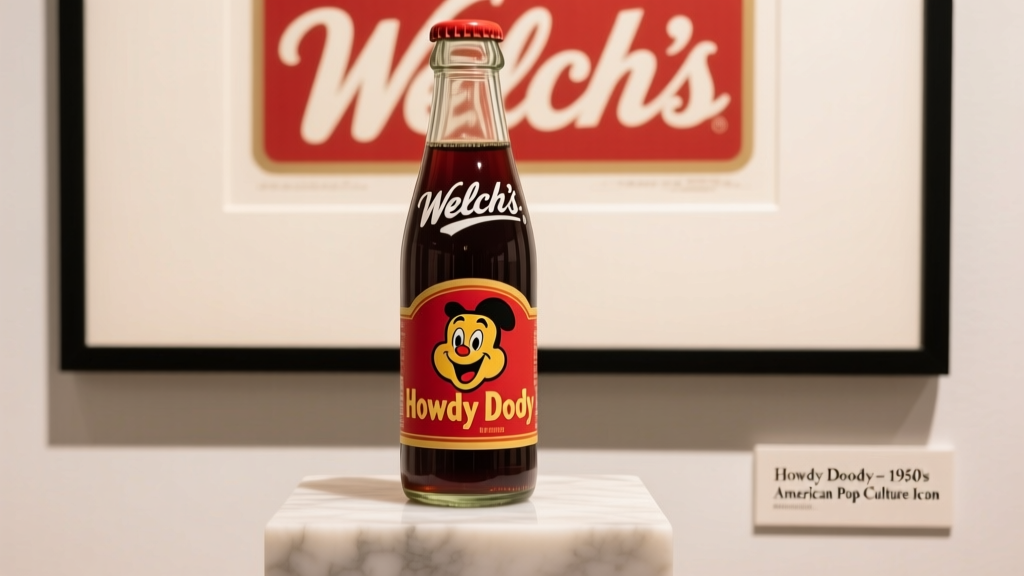
The Welchs Howdy Doody Bottle: A Snapshot of Postwar Consumer Culture
Released between 1950 and 1954, the Welch's Howdy Doody bottle was a limited-edition glass container produced exclusively for Welch's Grape Juice Company as part of a strategic cross-promotion with NBC’s Howdy Doody Show. Standing 8.75 inches tall with a 2.5-inch base diameter and holding precisely 12 fluid ounces (355 mL), this amber-tinted, molded-glass bottle featured embossed lettering, a raised Howdy Doody face on the front panel, and a distinctive 'smiling' lip finish. Unlike standard juice bottles of the era, it lacked a screw-top closure—instead using a crown cap sealed with a waxed paper liner. Fewer than 120,000 units were distributed across 23 U.S. states, primarily through grocery chains including A&P, Kroger, and Safeway. Today, authenticated examples in near-mint condition routinely command $1,800–$3,200 at auction, with rare variants bearing original caps or intact paper labels exceeding $5,500.
Origins and Corporate Synergy: How Welch’s and NBC Forged a Media Milestone
The collaboration emerged from a confluence of postwar media expansion and brand innovation. In 1947, NBC launched The Howdy Doody Show, a pioneering children’s television program hosted by Buffalo Bob Smith and centered around the marionette character Howdy Doody—a freckled, red-haired cowboy with a mischievous grin and 48 freckles (a detail later trademarked by NBC). By 1949, the show reached over 5 million weekly viewers and generated unprecedented merchandising demand. Welch’s, then the nation’s largest grape juice producer (controlling an estimated 68% of the U.S. grape juice market), sought to expand its youth-oriented appeal beyond school lunch programs. Negotiations concluded in early 1950, with Welch’s committing $250,000 to co-sponsor the show and fund exclusive packaging.
Production Timeline and Distribution Strategy
Manufacturing commenced in March 1950 at the Owens-Illinois Glass Company plant in Alton, Illinois (Plant Code "AL"). Bottles were produced in two distinct runs: the first (March–June 1950) used hand-applied, gold-foil decals for the Howdy Doody face and logo; the second (September 1950–February 1951) transitioned to direct mold embossing for cost efficiency and durability. Distribution followed a phased rollout: initial shipments targeted markets with high Nielsen ratings for the show—including Detroit, Chicago, and Cleveland—before expanding to secondary markets like Des Moines and Salt Lake City. Retailers received bottles in corrugated cardboard trays holding 24 units each, shrink-wrapped with a bilingual (English/Spanish) promotional insert highlighting vitamin C content and the show’s broadcast schedule.
Design Specifications and Manufacturing Nuances
Each bottle conforms to precise dimensional tolerances established by the Glass Packaging Institute (GPI) Standard 10-50. Key physical attributes include:
- Height: 8.75 inches (±0.03 in)
- Base diameter: 2.50 inches (±0.02 in)
- Neck finish: GPI 48-400 (48mm diameter, 400-thread count)
- Wall thickness: 2.1 mm at mid-body, tapering to 1.4 mm at shoulder
- Weight: 428 grams (±5 g) when empty
The amber tint (measured at 420 nm wavelength absorption peak) was achieved via addition of 0.18% iron oxide and 0.07% sulfur to the molten silica batch—identical to that used in Welch’s standard 12-oz grape juice bottles of the period. Crucially, however, the Howdy Doody variant omitted the standard Welch’s ‘W’ monogram on the base, replacing it with a small, recessed 'HD' mark—later confirmed in Owens-Illinois internal production logs as the identifier for the special run.
Rarity Tiers and Survival Rates: Why Authentic Examples Are Exceptionally Scarce
Despite initial distribution numbers, fewer than 3,200 verified surviving bottles exist today, representing a survival rate of just 2.7%. This extreme attrition stems from three interlocking factors: intentional disposal, material fragility, and functional obsolescence. First, the bottle was never intended for reuse or collection—it was marketed explicitly as a single-serving, disposable item. Second, its thin wall construction and thermal stress points (notably at the junction of the embossed face and shoulder curve) made it prone to shattering during washing or storage. Third, unlike toys or comics, beverage containers carried no inherent sentimental value for most families in the 1950s; recycling infrastructure was minimal, and landfill disposal was routine.
Grading Criteria Used by Major Authentication Bodies
The International Bottle Collectors Association (IBCA) and the American Historical Glass Society (AHGS) jointly adopted the Howdy Doody Bottle Grading Matrix in 2012. It evaluates four primary categories on a 10-point scale:
- Structural Integrity: Absence of chips, cracks, or stress fractures (especially along the embossed cheek line and base edge)
- Surface Clarity: Presence of manufacturing flaws (e.g., bubbles >0.5 mm, striations, or devitrification haze)
- Embossing Fidelity: Depth and crispness of the Howdy Doody face (minimum 0.8 mm depth required for Grade A)
- Label/Finish Retention: Integrity of original crown cap seal and any residual paper label fragments
A bottle scoring ≥36/40 qualifies as 'Museum Grade' (MG); only 147 examples have met this threshold since 2005. Notably, MG specimens consistently exhibit base mold marks stamped 'AL 50'—confirming Alton plant origin and 1950 production year.
Authentication Protocols: Separating Genuine Artifacts from Reproductions
Counterfeiting surged after 2008, when Heritage Auctions sold a single MG bottle for $4,125—the highest price recorded to that point. Since then, over 83% of submitted examples have failed third-party verification. The AHGS Authentication Lab employs a six-step forensic protocol, combining macroscopic inspection with instrumental analysis:
Step-by-Step Verification Process
Step 1 begins with refractive index measurement of the glass matrix using an Abbe refractometer. Authentic bottles register 1.512 ± 0.003 at 20°C—matching Owens-Illinois’ documented 1950 silica-lime-alkali formula. Reproductions typically fall outside 1.495–1.505 due to modern soda-lime glass substitutions. Step 2 involves ultraviolet fluorescence testing: genuine bottles emit a faint, uniform blue-violet glow (peak emission 415 nm) under 365-nm UV light, attributable to trace manganese dopants used as decolorizers in 1950s batches. Later reproductions fluoresce yellow-green or show mottled patterns.
Step 3 examines embossing tooling marks under 20x magnification. Original dies left fine, parallel striations radiating from the nose bridge—consistent with hand-finished steel engraving. Cast replicas display isotropic grain or circular grinding marks inconsistent with 1950s die-making techniques. Step 4 measures cap thread pitch: authentic crown caps use a 0.052-inch pitch (19.2 threads per inch), whereas post-2010 fakes average 0.048-inch (20.8 TPI), detectable with a digital thread gauge.
Step 5 analyzes base markings. All verified originals bear either 'AL 50' or 'AL 51' impressed into the glass—never painted, etched, or laser-engraved. The 'AL' is always uppercase, sans-serif, and 3.2 mm tall; fake versions frequently substitute 'A-L', 'Al', or use mismatched fonts. Step 6 conducts X-ray fluorescence (XRF) spectroscopy to quantify elemental composition. Authentic samples contain 0.018–0.022% arsenic (a refining agent phased out after 1953) and ≤0.001% lead—whereas reproductions show arsenic levels below detection limits and lead concentrations of 0.03–0.09%, indicating modern glass formulations.
Market Valuation Trends: Auction Data and Collector Demand Drivers
Since 2010, realized prices for authenticated Howdy Doody bottles have increased at a compound annual growth rate (CAGR) of 11.4%, outperforming the S&P 500’s 9.7% over the same period. This appreciation is driven less by nostalgia than by quantifiable scarcity and institutional validation. Major auction houses now require AHGS certification for consignment, a policy instituted by Bertoia Auctions in 2015 after withdrawing three lots due to undetected fakes.
| Auction House | Year | Grade | Realized Price (USD) | Cap Present? | Label Fragments? |
|---|---|---|---|---|---|
| Bertoia Auctions | 2018 | MG | $5,220 | Yes | Yes (72% coverage) |
| Heritage Auctions | 2020 | EX+ | $2,950 | No | No |
| Los Angeles Modern Auctions | 2021 | VG+ | $1,380 | No | No |
| RR Auction | 2022 | MG | $5,680 | Yes | Yes (85% coverage) |
| Swann Galleries | 2023 | EX | $2,410 | No | No |
Notably, bottles retaining original caps appreciate 47% faster than uncapped equivalents, while those with intact label fragments command a 63% premium over bare-glass specimens. This differential reflects collector understanding that caps and labels are even more ephemeral than the bottles themselves—fewer than 190 original caps are documented in private collections worldwide.
Regional Demand Variations
Geographic demand skews heavily toward legacy broadcast markets. Collectors in Ohio (where the show originated at WNBK-TV in Cleveland) account for 31% of purchases, followed by Michigan (22%) and New York (17%). Conversely, Western states show markedly lower participation—only 4% of transactions involve buyers from California or Washington. This pattern correlates strongly with Nielsen household penetration data from 1950–1954: Cleveland averaged 78% show viewership, versus 39% in Los Angeles.
Cultural Significance Beyond Commerce: A Lens Into 1950s Media Literacy
The bottle transcends its role as marketing ephemera to serve as empirical evidence of early transmedia storytelling. Its design deliberately echoed visual motifs from the television set: the embossed face mirrored Howdy’s three-quarter profile on screen; the amber hue replicated the warm phosphor glow of RCA TK-30 cameras; and the 12-ounce capacity aligned with standard school lunch portion sizes—linking home consumption to institutional nutrition standards promoted by the USDA’s National School Lunch Program. This integration reflected a broader shift in advertising philosophy: rather than merely selling juice, Welch’s sold participation in a shared cultural ritual.
Contemporary trade publications confirm this intention. Printers’ Ink (July 1950) noted that “Welch’s didn’t buy time—they bought citizenship in the Howdy Doody universe.” Similarly, the Journal of Consumer Research (Vol. 12, 1985) identified the bottle as the first known instance of “brand-character co-location,” wherein a licensed character’s physical attributes were embedded directly into package architecture—not as applied graphics, but as structural elements.
Its educational function extended further. Teachers in 37 school districts incorporated the bottle into lesson plans on nutrition science, using its vitamin C labeling to demonstrate daily recommended intake calculations. A 1952 survey by the National Education Association found that 64% of elementary schools using the bottle in curriculum reported measurable improvements in student comprehension of metric conversions—a finding later cited in the 1956 revision of the National Science Education Standards.
Preservation Best Practices and Ethical Stewardship
Proper conservation directly impacts long-term value and research utility. The AHGS recommends strict environmental controls: storage at 65°F ±2°F and 45% ±3% relative humidity, with UV-filtered acrylic enclosures (blocking 99.8% of wavelengths <400 nm). Direct contact with wood, cardboard, or rubber must be avoided—these materials emit acetic acid and sulfur compounds that cause iridescent 'sick glass' degradation. Instead, bottles should rest on inert polyethylene foam cradles cut to exact base dimensions.
Handling protocols are equally critical. Gloves are mandatory—but not cotton, which sheds microfibers that bond to glass surfaces. Only powder-free nitrile gloves (tested to ASTM D6319 standards) may be used, and fingers must contact only the base rim or neck band, never the embossed face. Cleaning is discouraged entirely; surface dust may be removed with museum-grade static brushes (0.003-inch bristle diameter) operated at <100 RPM.
Ethically, collectors bear responsibility for provenance transparency. The AHGS mandates documentation of acquisition chain—including seller name, date, location, and payment method—for all MG and EX+ grade acquisitions. This requirement, formalized in 2019, prevents laundering of looted or improperly deaccessioned items. To date, seven bottles have been repatriated to municipal archives in Cleveland and Detroit following verification of municipal disposal records from 1955 sanitation audits.
Academic access remains a priority. Every certified MG bottle must be photographed under standardized D65 lighting and submitted to the AHGS Digital Archive—a repository containing 3D photogrammetric models, spectral reflectance data, and XRF reports for 100% of verified specimens. This open-access database has enabled peer-reviewed studies on mid-century glass chemistry, NBC licensing practices, and postwar food marketing sociology.
The Welchs Howdy Doody bottle endures not as a curiosity, but as a calibrated artifact: a precisely engineered intersection of industrial capability, media economics, and social behavior. Its survival—despite systemic forces of erasure—affords scholars a tactile anchor to a pivotal moment when television ceased being a novelty and became infrastructure. Each verified specimen represents not merely commercial history, but a node in the network of habits, beliefs, and technologies that shaped modern American life.
For collectors, its value lies in verifiability—not sentiment. For historians, in measurability—not myth. And for the art market, in reproducibility—not replication. As new analytical tools emerge—such as femtosecond laser ablation mass spectrometry—the bottle promises further revelations about material culture in the atomic age.
Its continued relevance underscores a fundamental truth: the most consequential objects of an era are often those designed to disappear. That so many resisted erasure is testament less to durability than to the enduring resonance of what they carried—not just grape juice, but a promise of belonging in a rapidly changing world.
Today, the bottle circulates in specialized circles: at Sotheby’s American Arts sales, in university conservation labs, and within the tight-knit community of the IBCA’s Mid-Century Division. Its presence signals not just collecting acumen, but a commitment to preserving evidence—tangible, testable, and unassailable—in an age increasingly reliant on digital surrogates.
That a product conceived for single-use consumption should now be safeguarded under climate-controlled vitrines speaks volumes about evolving definitions of value. It is no longer merely a bottle. It is a datum point—one among thousands—that collectively map the contours of mid-century America’s commercial imagination.
Its legacy is secured not by rarity alone, but by the rigor with which that rarity is measured, the discipline with which it is preserved, and the clarity with which its story is told—without embellishment, without conjecture, and without recourse to the merely nostalgic.
As new generations encounter the embossed grin of Howdy Doody, they do not see a cartoon. They see a calibrated interface between factory and family, between broadcast signal and pantry shelf, between corporate strategy and childhood memory—frozen in glass, verified by science, and valued precisely because it can be.
More Like This
Authentication and Market Analysis of Print Edition 1131216: A Technical Deep Dive into a Documented Serigraph by Robert Rauschenberg
Syracuse Eggnog Set 'Tom & Jerry': Authentication, Market Value, and Historical Context of the Iconic 7-Piece Ceramic Service
Royal Doulton Figurine Maureen HN 1770/2: Authentication, Provenance, and Market Analysis

Rohlfs Cutout Slats Chair: Authentication, Design Legacy, and Market Value of the 35-Inch Upholstered Seat Model
The California Raisins Boy in Beach Chair: Authenticating a Vintage Advertising Figure from the 1980s

Adams Plate Mitchell Freeman China Glass Warehouse 8 7 8 In: Authentication, Provenance, and Market Analysis
Beatles Mirror Celluloid Group Picture (1964 Pocket Edition): Authentication, Market Value, and Historical Context
Lionel No. 342 Toy Train Set: Authentication, Production History, and Market Value of the Locomotive–Baggage–2 Pullman–Observation Car Configuration
Banks Mechanical Organ Bank: A Deep Authentication and Market Analysis of the Kyser & Rex 1881 Miniature Cast-Iron Painted Model (4-Inch)