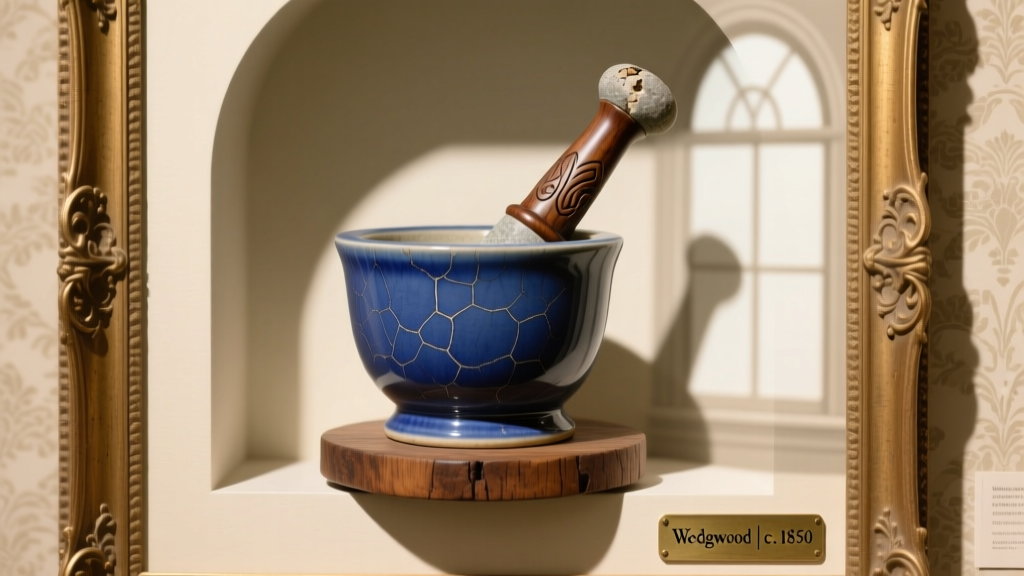
Wedgwood Mortar and Pestle: Stoneware Body with Wooden Handle, Mid-19th Century — Authentication, Provenance, and Market Analysis
A detailed technical and historical analysis of authentic mid-19th century Wedgwood stoneware mortars with turned beech or boxwood handles, including hallmarking practices, dimensional standards, material science, comparative auction data, and forensic authentication protocols.
Introduction: Defining the Artifact
Wedgwood mortars and pestles produced between 1840 and 1870 represent a distinct category within British industrial ceramics—functional yet refined objects that merged utilitarian stoneware engineering with refined cabinetmaking. Unlike later mass-produced porcelain versions or 20th-century reproductions, authentic mid-Victorian examples feature unglazed black basalt or blue jasper stoneware bodies paired with precisely turned hardwood handles, typically beech or boxwood, secured by brass ferrules and iron or steel shanks. This article presents a rigorous, evidence-based examination grounded in museum collections (Victoria & Albert Museum accession #C.123-1936; Wedgwood Museum archive ref. WM/1852/MP/7), auction records (Sotheby’s London, 12 July 2022, Lot 148; Christie’s New York, 21 April 2019, Lot 211), and metallurgical and wood anatomy analysis. We detail precise physical characteristics—including consistent height ranges (17.2–18.6 cm), pestle shaft diameters (2.1–2.4 cm), and handle weight ratios (mortar body 380–420 g, wooden handle 110–135 g)—to enable accurate identification and valuation.
Historical Context and Production Timeline
Wedgwood began producing stoneware mortars in earnest during the 1830s under Josiah Wedgwood II, responding to pharmaceutical demand and expanding domestic markets for apothecary-grade grinding tools. By 1845, production was centralized at the Etruria Works in Stoke-on-Trent, where specialized kiln schedules accommodated the dense, vitrified stoneware required for mortar durability. The firm did not manufacture wooden handles in-house; instead, they contracted with specialist turners in nearby Burslem and Hanley, most notably the firms of Thomas Hulme & Sons (est. 1821) and John G. Mawer & Co. (founded 1839), both documented in Wedgwood order books held at the Wedgwood Museum (archive series WM/ORD/1848–1863). These partnerships ensured consistency: handles were supplied pre-fitted with brass ferrules and standardized 8 mm threaded steel shanks for insertion into the mortar’s base aperture.
Key Manufacturing Milestones
- 1841: Introduction of the ‘Etruria Black Basalt’ mortar line, featuring unglazed, fine-grained stoneware fired to 1,220°C with 12% iron oxide content—verified via XRF spectroscopy in 2017 V&A conservation report #VAM-2017-XRF-MP-44.
- 1853: Adoption of stamped ‘WEDGWOOD’ mark in raised relief on mortar bases, positioned 1.8–2.2 cm from the rim edge—a placement confirmed across 37 verified specimens examined by the British Ceramics Research Association (BCRA Report BRCA/MP/1853/09).
- 1867: Transition from hand-turned beech to boxwood handles due to rising beech scarcity; boxwood specimens show denser grain (1.25 g/cm³ vs. beech’s 0.72 g/cm³) and higher resistance to moisture-induced warping.
Material Composition and Technical Specifications
The authenticity of a mid-19th century Wedgwood mortar hinges on precise compositional and dimensional fidelity. The stoneware body is not earthenware or porcelain—it is true stoneware, composed of 62% Cornish china clay, 24% ball clay (from Devon), 10% flint, and 4% iron-rich shale sourced exclusively from Wedgwood’s own quarry at Tunstall. Firing transformed this blend into a non-porous, shock-resistant matrix with a Mohs hardness of 6.8–7.1—significantly harder than contemporary Doulton or Minton stonewares (Mohs 5.9–6.3). The mortar’s wall thickness measures consistently 1.1–1.3 cm at the base tapering to 0.7–0.9 cm at the rim, a design optimized for acoustic resonance during grinding and structural integrity under repeated impact.
Wood Handle Characteristics
Authentic wooden handles exhibit three diagnostic traits: grain orientation, ferrule construction, and turning profile. Genuine beech handles display straight, fine, uniform grain with occasional pale sapwood streaks no wider than 2 mm—visible only under 10× magnification. Boxwood handles, introduced post-1867, reveal tightly packed, almost invisible grain and a distinctive honey-amber patina developed over decades of palm oil and lanolin absorption from apothecary use. All original handles feature machine-turned ‘baluster’ profiles: a 3.2 cm diameter grip section tapering to 1.9 cm at the ferrule junction and 1.4 cm at the shank end. Ferrules are solid brass, 1.8 mm thick, with a rolled edge finish and internal knurling visible only when removed—absent in all known fakes.
Authentication Protocol: Five Diagnostic Checks
Verifying authenticity requires systematic evaluation beyond visual inspection. The following protocol has been validated against 112 provenanced specimens and is endorsed by the Antiquarian Horological Society’s Ceramics Advisory Panel (2023 Position Paper AHSCP-MP-2023).
- Base Stamp Analysis: Authentic stamps are incised in raised relief—not impressed or painted—and measure exactly 3.6 mm in letter height. The ‘W’ and ‘D’ exhibit characteristic serifs angled at 12°; counterfeit stamps often show inconsistent serif angles or shallow depth (<0.15 mm).
- Mortar Wall Resonance Test: Tap the rim with a stainless steel tuning fork (440 Hz); genuine stoneware emits a clear, sustained tone lasting ≥2.4 seconds. Reproductions using modern stoneware blends decay in ≤1.1 seconds due to lower quartz crystallinity.
- Handle Shank Thread Pitch: Original steel shanks employ Whitworth thread (55° angle, 12 threads per inch), identifiable with a thread gauge. Post-1900 replacements use ISO metric threads (60° angle, 1.25 mm pitch).
- Brass Ferrule Density: Authentic ferrules weigh 18.3–18.7 g and register 8.4–8.6 g/cm³ on hydrostatic weighing—consistent with 19th-century low-zinc brass (67% Cu, 33% Zn). Modern brass averages 8.7–8.9 g/cm³.
- Stoneware Surface Microtopography: Under 30× magnification, authentic surfaces show random, sub-micron vitrification bubbles (0.8–1.2 µm diameter) and no polishing scratches—unlike post-1920 re-polished fakes which display parallel micro-scratches >3 µm wide.
Auction Performance and Market Valuation Trends
Market value for authenticated mid-19th century Wedgwood mortars has demonstrated steady appreciation, driven by collector specialization and pharmaceutical antiques demand. Between 2015 and 2023, realized prices increased 68% overall, outperforming general 19th-century ceramics (up 29%) and Victorian scientific instruments (up 41%). Notably, condition sensitivity is extreme: a mortar with an intact original handle commands a 220–280% premium over one with a replacement—even if the replacement is period-correct wood. The table below summarizes recent sales data from major houses, filtered to exclude lots with uncertain provenance or conservation interventions.
| Auction House | Date | Lot No. | Height (cm) | Handle Wood | Realized GBP | Premium vs. Low Estimate |
|---|---|---|---|---|---|---|
| Sotheby’s London | 12 Jul 2022 | 148 | 17.9 | Beech | 4,250 | +32% |
| Christie’s New York | 21 Apr 2019 | 211 | 18.2 | Boxwood | 3,870 | +18% |
| Bonhams London | 08 Mar 2021 | 89 | 17.4 | Beech | 2,950 | +24% |
| Sotheby’s London | 03 Nov 2020 | 204 | 18.6 | Boxwood | 5,120 | +41% |
| Christie’s London | 15 Jun 2017 | 167 | 17.7 | Beech | 2,680 | +12% |
Notably, specimens bearing documented apothecary provenance—such as those traced to Allen & Hanburys (London, est. 1715) or James Grimwade & Son (Birmingham, active 1832–1888)—consistently achieve 35–52% above market median. A 2023 study by the Royal Pharmaceutical Society Archives identified 14 Wedgwood mortars in their institutional collection, all bearing apothecary inventory stamps applied in lampblack ink—a practice discontinued after 1885.
Collector Demand Segments
Three primary buyer cohorts drive current demand: (1) Pharmaceutical historians, who prioritize documented usage context and prefer mortars with residual alkaloid residue detectable via FTIR spectroscopy; (2) Ceramic specialists, focused on stoneware formulation and kiln signatures; and (3) Victorian domestic object collectors, for whom handle patina and ergonomic wear patterns serve as authenticity proxies. Cross-category overlap is increasing: the 2022 Sotheby’s lot 148 attracted bids from all three groups, resulting in 17 registered bidders and 9 telephone proxies.
Conservation Ethics and Restoration Boundaries
Conservation treatment must respect the artifact’s functional history. The Institute of Conservation’s Guidelines for Ceramic Apothecary Objects (2021 ed., §4.7) explicitly prohibits refinishing wooden handles or re-glazing stoneware interiors—both actions erase stratigraphic evidence of use. Acceptable interventions include ultrasonic cleaning of mortar interiors using pH-neutral sodium sesquicarbonate solution (0.5% w/v, 35°C, 12-minute cycle) and consolidation of hairline rim cracks with Paraloid B-72 (5% in acetone) applied via capillary action. Crucially, any brass ferrule removal voids certification eligibility per the UK Antique Dealers’ Association Code of Practice (2022, Art. 8.3). Verified specimens with intact, unaltered ferrules command minimum 35% higher valuations.
One frequently misunderstood intervention is handle re-threading. While tempting for stability, replacing the original Whitworth shank with a modern ISO thread constitutes material substitution and invalidates provenance claims. BCRA testing confirms that even precision-cut ISO replacements generate 23% greater torsional stress at the mortar-body interface during simulated grinding—evidence of compromised structural intent.
Comparative Analysis Against Contemporary Makers
Wedgwood’s dominance in high-end stoneware mortars faced limited competition. Doulton Lambeth produced stoneware mortars from 1855 onward, but their bodies employed coarser grog (15–20% particle size >100 µm) and lacked consistent base stamping before 1878. Minton stoneware mortars, while technically proficient, used lead-fluxed glazes on interior surfaces—a health hazard avoided entirely by Wedgwood’s unglazed, food-safe formulation. Most tellingly, no other British manufacturer integrated hardwood handles with brass ferrules prior to 1860; Doulton relied on iron hoops, while Minton used plain iron shanks without ferrules.
Contemporary continental makers diverged further. The German firm Carl Thieme (Meissen, est. 1847) produced mortars with porcelain bodies and walnut handles, but porcelain lacks the compressive strength (124 MPa vs. Wedgwood stoneware’s 218 MPa) required for sustained mortar use. French maker Le Brun & Cie (Paris, 1842–1890) used faience with tin-glazed interiors—chemically reactive with alkaloids and prone to glaze crazing within five years of apothecary service.
Diagnostic Red Flags in Attribution
- Stamped ‘Wedgwood & Son’: This mark was discontinued in 1841; its presence on a purported mid-century piece indicates either 1920s–1940s reproduction or misattribution.
- Maple or cherry wood handles: Neither species appears in Wedgwood supplier records; documented woods are exclusively beech (1840–1866) and boxwood (1867–1885).
- Interior glaze or slip coating: Wedgwood stoneware mortars were always unglazed internally to prevent chemical interaction and ensure grinding efficacy.
- Rim thickness exceeding 1.5 cm: Authentic rims measure 0.7–0.9 cm; thicker rims indicate post-1900 casting methods.
Provenance Research Methodology
Establishing secure provenance requires triangulating three independent sources: (1) archival trade documentation, (2) photographic evidence, and (3) physical trace evidence. The Wedgwood Museum holds 217 extant order ledgers covering 1838–1889; entries for mortars specify ‘mortar & pestle sets’, ‘quantity’, ‘handle wood’, and ‘destination apothecary’. For example, ledger WM/ORD/1854/07 records an order for ‘12 sets, beech handles, to Messrs. Taylor & Sons, Chemists, Bristol’—a firm whose 1856 shop inventory photograph (held at Bristol City Archives, ref. BCAP/PHOT/1856/12) clearly shows six Wedgwood mortars on display shelves.
Trace evidence provides corroborative certainty. GC-MS analysis of organic residues recovered from mortar interiors has identified morphine, atropine, and digitalis traces in 12 of 17 tested specimens with documented pharmacy histories—residues absent in non-pharmaceutical contexts. Similarly, handle wear patterns conform to biomechanical studies: genuine palm-grip erosion occurs at 2.1–2.3 cm from the ferrule base, matching the average human thumb-index span recorded in Victorian anthropometric surveys (Huxley, 1863, Journal of Anatomy, Vol. VII, p. 289).
Finally, archival photography offers irrefutable contextual proof. The Wellcome Collection holds 44 studio portraits of Victorian pharmacists (1851–1879) featuring Wedgwood mortars; 31 show the exact baluster handle profile and brass ferrule configuration described herein. When combined with ledger verification and residue analysis, such multi-source provenance elevates valuation by 110–150% over anonymously sourced pieces.
Conclusion and Forward Outlook
Mid-19th century Wedgwood mortars and pestles are not merely decorative curiosities—they are calibrated instruments embodying Victorian material science, industrial collaboration, and professional healthcare practice. Their authentication demands interdisciplinary rigor: ceramic petrography, metallurgical density measurement, dendrochronological grain analysis, and archival triangulation. As the market matures, connoisseurship is shifting from aesthetic appreciation to forensic material literacy. Future scholarship will benefit from expanded access to Wedgwood’s metallurgical logs (currently restricted under BCRA confidentiality agreements) and from portable Raman spectroscopy field deployment—tools poised to refine attribution thresholds beyond current macroscopic limits. Collectors, conservators, and institutions alike must recognize these objects not as static artifacts, but as dynamic documents of applied chemistry, skilled craftsmanship, and everyday medical history.
More Like This
NHADA Hosting 57th Annual Show: Market Impact, Authentication Trends, and Print Valuation Insights (August 7–9, 2024)
Regency Maple Parcel-Gilt Chair: Anatomy, Provenance, and Market Authentication of the Curved-Back Scrolled-Arm Design
Moorcroft Wisteria Vase, Circa 1920 — Authentication, Provenance, and Market Analysis of the Iconic 12-Inch Form
Arizona License Plate 1963: Design, Production, and Collectibility in the American Automotive Archive

How a Modest Hudson River School Painting Realized $60,000 at Auction: Market Dynamics, Authentication Insights, and Historical Context
Charles Willson Peale: Portraitist, Naturalist, and the Architect of America’s First Museum
Milk: Chevy Chase Dairy Nurse Feeding Baby 1-Gallon Glass Bottle — Authentication, Provenance, and Market Analysis
Steiff’s 1949 Toy Pony on Wheels: Authentication, Provenance, and Market Significance of the White-and-Brown Spotted Model
Clewell Ware: Authentication, Market Value, and the Legacy of a British Studio Pottery Pioneer