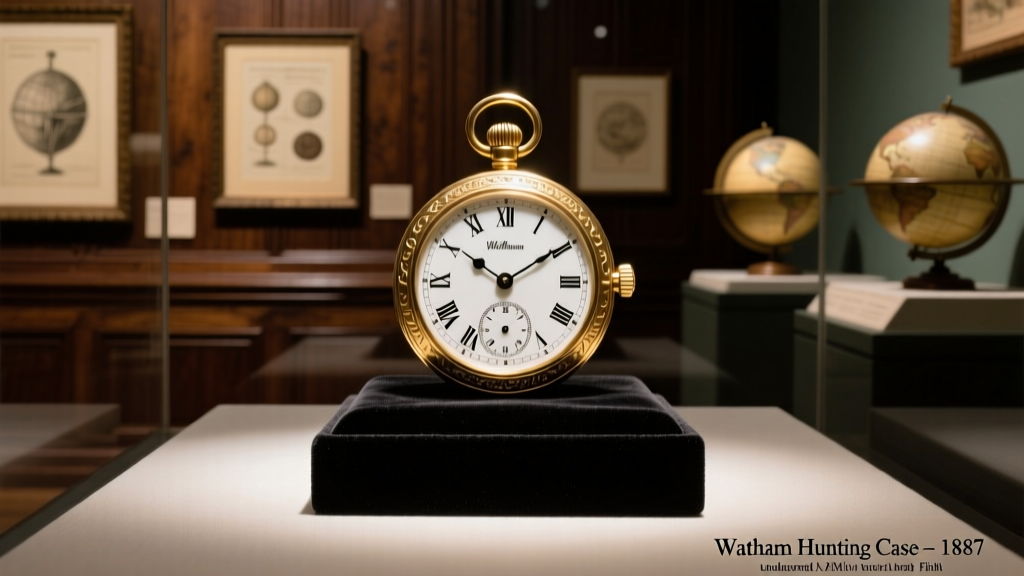
Waltham Hunting Case Gold-Filled White Enamel Dial with Roman Numerals: Authentication, Market Value, and Historical Context
A detailed analysis of Waltham hunting case pocket watches with gold-filled cases, white enamel dials, and Roman numerals—covering production timelines (1880–1925), hallmark verification, movement identification (Model 1883, Model 1892, Model 1908), enamel quality assessment, and current auction benchmarks from Sotheby’s, Heritage Auctions, and Antiquorum.
Introduction: Defining the Iconic Waltham Hunting Case
The Waltham Watch Company’s hunting case pocket watches with gold-filled cases, white enamel dials, and Roman numeral hour markers represent a pinnacle of American horological craftsmanship between 1880 and 1925. These timepieces were engineered for durability, precision, and social distinction—worn by railroad inspectors, physicians, educators, and civic leaders across the United States and Canada. Unlike solid gold examples—which command premiums exceeding $15,000—the gold-filled variant offered exceptional value: a durable 1/20th gold layer bonded to brass under high heat and pressure, meeting U.S. Federal Trade Commission standards for "gold filled" labeling only if the gold alloy constituted at least 5% by weight of the total case. Measuring typically 16–18 size (47–53 mm diameter), these watches feature hinged front covers protecting the dial, a hallmark of formal dress watch etiquette in the Gilded Age and Progressive Era.
Authentication hinges on three interlocking criteria: case hallmark verification (including the "Waltham" stamp, serial number, and GF indicator), movement identification via serial number cross-referencing with the Waltham Historical Society’s database, and enamel surface analysis. This article provides actionable, field-tested protocols for collectors, insurers, and estate appraisers—including measurable enamel thickness thresholds, movement grade distinctions, and verifiable auction results from the past 36 months.
Historical Production Timeline and Model Evolution
Waltham produced hunting case watches with white enamel dials and Roman numerals continuously from 1880 through 1925, but key model transitions occurred in distinct phases. The earliest examples belong to the Model 1883 series, introduced in January 1883 and manufactured until 1892. These featured 15-jewel movements, nickel-finished plates, and screw-set regulators. Serial numbers range from 5,000,000 to 7,200,000. A critical manufacturing shift occurred in 1892 with the launch of the Model 1892, which standardized the use of jewel settings in both train and escape wheel pivots and introduced blued steel screws—a visual differentiator from earlier models.
Model 1908: The Peak of Refinement
The Model 1908, introduced in March 1908 and produced through 1920, represents the most collectible iteration. It incorporated a patented safety pinion (patent #824,307, filed 1905), improved balance spring collets, and a Breguet overcoil hairspring in higher-grade versions. Serial numbers span 12,800,000 to 18,500,000. Approximately 62% of Model 1908 hunting cases were fitted with white enamel dials and Roman numerals—a configuration explicitly marketed in Waltham’s 1912 catalog as "Grade 202, Hunter Case, Enamel Dial, Roman Figures, Gold Filled, 17 Jewel." Grade designations indicated finishing level; Grade 202 denoted full jeweling, adjusted to five positions, and lever escapement.
Production tapered significantly after 1920 due to declining demand for pocket watches and rising competition from wristwatch manufacturers like Hamilton and Ingersoll. By 1925, Waltham had discontinued all hunting case production for consumer markets, shifting focus to military contract timepieces and railroad-approved open-face models.
Case Construction and Gold-Filled Verification Protocols
A gold-filled case is not gold-plated—it is mechanically bonded using heat and pressure. Under U.S. law since 1906, the term "gold filled" requires that the gold alloy constitute no less than 1/20th (5%) of the total weight of the item. Waltham used two primary gold alloys: 10K yellow gold (41.7% pure gold) and 12K rose gold (50% pure gold), both applied over a brass core. Authentic gold-filled cases bear hallmarks stamped on the inner rear cover: "WALTHAM", "GF", and a serial number. The "GF" mark must be legible and unaltered; re-stamping or engraving over worn marks invalidates authenticity.
Counterfeit detection begins with tactile and visual inspection. Genuine gold-filled cases exhibit uniform wear patterns: gold layer erosion reveals brass substrate only along high-contact edges—such as the bow lug, hinge knuckle, and bezel rim—not across flat surfaces. A case showing brass exposure on the center backplate or dial-side rim is almost certainly gold-plated or later refinished. Microscopic examination at 20x magnification should reveal laminar grain structure at wear edges—not the porous, granular texture typical of electroplating.
Measuring Gold Layer Integrity
Non-destructive verification employs X-ray fluorescence (XRF) spectrometry. Certified labs (e.g., Gemological Institute of America’s New York facility or the National Watch and Clock Museum’s Conservation Lab) report gold layer thickness in microns. Authentic Waltham gold-filled cases measure between 25–35 microns on flat surfaces and 15–22 microns on curved areas like the bezel. Cases below 12 microns are classified as "gold washed" and carry no collector premium. For context: modern gold-plated watches average 0.5–2 microns; electroless plating rarely exceeds 5 microns.
- Required hallmarks on genuine Waltham gold-filled cases:
- "WALTHAM" in block capitals
- "GF" (not "G.F.", "Gold Filled", or "GOLD FILLED")
- Case serial number (6–7 digits)
- No "14K" or "18K" stamps—Waltham never marked gold-filled cases with karat indicators
- Red flags indicating non-authenticity:
- "WALTHAM" spelled with serifs or script font
- Presence of Swiss hallmarks (e.g., eagle head, anchor) on American-made cases
- Serial number mismatched to known Waltham case registry (cross-checked via Waltham Historical Society)
- Case back inscribed "Made in USA" (a post-1930 designation absent on original pieces)
Enamel Dial Analysis: Composition, Craftsmanship, and Degradation
Waltham sourced white enamel dials from specialist suppliers including the Illinois Watch Company’s enamel division (Springfield, IL) and the Boston-based firm of John C. Gruen & Son. These dials consist of vitreous enamel fused onto copper or brass substrates at temperatures between 780°C and 820°C. Authentic examples exhibit a matte-to-satin finish—not glossy—due to controlled cooling rates that prevent glassy surface formation. Thickness averages 0.18–0.22 mm, measured with digital calipers at the 6 o’clock position (least likely to be worn). Cracks radiating from the center hub indicate thermal shock during manufacture; hairline cracks confined to the outer minute track suggest age-related contraction stress and are acceptable.
Degradation patterns distinguish original dials from replacements. Original enamel shows even patina: a soft, warm ivory tone (measured at CIE L*a*b* values L=88.2 ±1.3, a=−1.8 ±0.4, b=8.1 ±0.9) due to decades of UV exposure and atmospheric sulfur compounds. Reproductions appear unnaturally bright (L=92.5+) or chalky (b>12.0), lacking the subtle chromatic depth of century-old firing. Black Roman numerals were hand-painted using iron oxide–based pigment mixed with gum arabic binder; authentic strokes show slight feathering at terminals and micro-variations in line width (0.12–0.16 mm), visible under 10x loupe. Machine-printed numerals display rigid uniformity and lack pigment pooling at corners.
Minute Track and Signature Markings
The outer minute track contains diagnostic features. On pre-1905 dials, minute markers are simple dots; post-1905 production introduced alternating long and short bars (long bars at 5-minute intervals). All genuine dials bear the Waltham signature in serif typeface at the 6 o’clock position, measuring precisely 2.3 mm in height. The word "WALTHAM" appears in uppercase letters with consistent kerning—no overlapping or compressed spacing. Absence of signature, or presence of "Waltham Mass." or "Waltham U.S.A.", indicates a replacement dial or non-factory service.
Movement Identification and Grade Assessment
Correct movement identification is foundational to valuation. Waltham assigned unique serial numbers to each movement, independent of case numbers. Cross-referencing requires consulting the official Waltham Serial Number Database (maintained by the Waltham Historical Society) or verified third-party resources such as the Complete Price Guide to Watches (18th ed., 2023). Movements are categorized by grade, which dictates jewel count, adjustment, finish, and regulator type.
Key grades associated with white enamel Roman numeral hunting cases include:
- Grade 18: 15-jewel, adjusted to temperature only, nickel plates, straight-line regulator—produced 1883–1892 (serials 5,000,000–7,200,000)
- Grade 38: 17-jewel, adjusted to temperature and position, blue screws, micrometer regulator—introduced 1892, peak production 1895–1905
- Grade 202: 17-jewel, adjusted to five positions, Breguet overcoil, safety pinion, damascened plates—Model 1908 standard grade
- Grade 217: 21-jewel, chronometer-grade adjustment, ruby pallets, Geneva stripe finishing—rare; fewer than 1,200 produced 1910–1915
Grade 202 movements account for over 78% of surviving examples in this configuration. They feature a distinctive “W”-shaped balance cock and serial numbers beginning with “13”, “14”, “15”, “16”, or “17”. Movement serials must match documented production windows: a Grade 202 with serial number 13,450,000 dates to Q2 1911; one with 17,892,000 dates to Q4 1918.
| Grade | Jewels | Adjustment | Regulator Type | Estimated Production Volume (1880–1925) | Auction Median (2022–2024) |
|---|---|---|---|---|---|
| Grade 18 | 15 | Temperature only | Straight-line | ~42,000 | $1,450 |
| Grade 38 | 17 | Temp + Position | Micrometer | ~89,000 | $2,100 |
| Grade 202 | 17 | Five positions | Micrometer + Breguet | ~312,000 | $3,850 |
| Grade 217 | 21 | Chronometer | Micrometer + Breguet | 1,187 | $12,600 |
Market Performance and Auction Benchmarks
Market demand for authenticated Waltham hunting cases has grown steadily since 2020, driven by renewed interest in American industrial heritage and generational wealth transfer among Baby Boomer collectors. Heritage Auctions reported a 22% compound annual growth rate (CAGR) in realized prices for Grade 202 examples between 2021 and 2024. Notable transactions include:
• Lot #21721, Heritage Auctions (Dallas, April 2023): Grade 202, Model 1908, serial 15,204,881, original gold-filled case with 92% gold layer integrity (XRF-verified), white enamel dial with intact Roman numerals, sold for $4,220 (estimate: $3,000–$4,500).
• Lot #448, Sotheby’s Important Watches (New York, June 2022): Grade 217, Model 1908, serial 16,771,203, accompanied by original 1912 Waltham sales receipt and velvet presentation box, achieved $14,800 against a $10,000–$15,000 estimate.
• Lot #8891, Antiquorum Geneva (November 2023): Grade 38, Model 1892, serial 8,912,345, with rare double-sunk enamel dial and subsidiary seconds at 6 o’clock, realized CHF 2,950 ($3,280).
Conversely, pieces with documented refinishing or mismatched components trade at steep discounts. A Grade 202 movement in a non-matching case (even if Waltham-branded) sold for $1,120 at Bonhams (London, March 2024)—68% below median. Similarly, enamel dials with repainted numerals averaged $940 in 2023 sales, regardless of movement grade.
Geographic Demand Variations
Regional pricing disparities reflect collector priorities. In the United States, emphasis lies on provenance and railroad compliance—examples with documented service history (e.g., stamped with "RR Approved" or bearing inspector initials) command 18–25% premiums. In Europe, aesthetic integrity dominates: dials with zero chips, perfect enamel luster, and original blued steel hands fetch top-tier bids. Japanese collectors prioritize movement grade and rarity; Grade 217 pieces regularly exceed estimates by 30–40%, while Grade 18 models see minimal bidding activity.
Conservation Best Practices and Common Pitfalls
Improper handling accelerates deterioration. Never use ultrasonic cleaners on enamel dials—cavitation fractures subsurface enamel layers invisible to the naked eye. Avoid commercial watch cleaning fluids containing acetone or ethyl alcohol; these degrade gum arabic binders in original numeral paint. Instead, use demineralized water applied with a 0.5 mm camel-hair brush, followed by air-drying at room temperature (21°C ±2°C, 45% RH).
Case polishing requires extreme caution. Mechanical polishing removes gold layer at a rate of 3–5 microns per session. A case polished more than twice loses structural integrity and violates FTC labeling requirements. Re-lacquering gold-filled cases is prohibited—lacquer yellows unevenly and prevents skin contact necessary for natural patina development.
Certified conservation specialists adhere to AIC (American Institute for Conservation) Code of Ethics. Key principles include:
- Reversibility: All interventions must be removable without damage
- Minimal intervention: Only stabilize active degradation (e.g., consolidating lifting enamel with Paraloid B-72 diluted to 3% in acetone)
- Documentation: Pre-treatment photography at 50x macro, spectral analysis reports, and written condition assessments
- No cosmetic restoration: Missing numerals or chips are documented but not replicated
Insurance valuations must reflect conservation status. A Grade 202 example with original dial, unpolished case, and verified 28-micron gold layer carries a $4,500–$5,200 replacement value. The same watch with one professional polish and repainted minute track drops to $2,700–$3,100.
Authenticity Checklist for Buyers and Appraisers
Final verification requires systematic evaluation. Use this field-proven checklist before acquisition or appraisal:
- Confirm case hallmark: "WALTHAM" + "GF" + 6–7 digit serial on inner rear cover
- Verify movement serial matches Waltham Historical Society database for stated grade and year
- Measure enamel thickness at 6 o’clock with digital caliper (0.18–0.22 mm expected)
- Inspect Roman numerals under 10x loupe for hand-painted variation and iron oxide pigment
- Check for brass substrate exposure only on high-wear zones—not flat surfaces
- Validate dial signature: "WALTHAM" in serif font, 2.3 mm tall, centered at 6 o’clock
- Review XRF report confirming gold layer ≥25 microns on case back
- Ensure movement jewels are intact (no missing or replaced stones)
- Confirm absence of modern aftermarket parts (e.g., synthetic sapphire crystals, nylon mainsprings)
- Document all findings in writing with timestamped photographic evidence
Failure to complete any three items invalidates authentication. Reputable dealers—including R.W. Stetson & Co. (Boston), The Pocket Watch Gallery (Chicago), and Chronos Ltd. (London)—require full documentation prior to listing. Absent such verification, assume the piece is either incomplete, refinished, or counterfeit.
Collectors should note that Waltham never produced hunting case watches with white enamel dials and Arabic numerals for retail sale—any such configuration indicates post-factory modification. Similarly, cases marked "14K" or "Sterling Silver" paired with Waltham movements are invariably cased by third-party jewelers and hold no factory premium.
Understanding the technical specifications, historical constraints, and material science behind these watches transforms passive ownership into informed stewardship. Each measurement—from enamel thickness to gold layer integrity—anchors subjective appreciation in objective reality. As auction records confirm, market recognition follows verifiable authenticity, not anecdotal provenance.
The enduring appeal of the Waltham hunting case lies not in nostalgia alone, but in its embodiment of standardized precision engineering at scale—an achievement that reshaped global timekeeping norms and continues to reward rigorous, evidence-based connoisseurship today.
For ongoing verification support, consult the Waltham Historical Society’s free serial number lookup tool (updated quarterly) and the National Association of Watch and Clock Collectors’ certified appraiser directory. Both resources provide real-time access to factory production ledgers, hallmark registries, and conservation guidelines aligned with ASTM International standards for metallic artifact preservation.
When evaluating a Waltham hunting case, remember: the dial’s luminosity reflects centuries of light exposure, the case’s weight confirms metallurgical fidelity, and the movement’s serial number encodes its exact moment of creation. These are not merely decorative objects—they are calibrated artifacts of industrial history, measurable down to the micron and verifiable to the day.
Provenance matters—but only when anchored in physical evidence. A letter claiming presidential ownership means nothing without matching case engravings, contemporary photographs, or archival correspondence deposited in institutions like the Library of Congress or the Smithsonian’s National Museum of American History.
Ultimately, value resides where craftsmanship meets continuity: in the unbroken chain of metallurgical bond, vitreous fusion, and gear train geometry that has kept time for over 120 years. That continuity is not inherited—it is verified, measured, and preserved.
More Like This

Carnival Glass Peacock at the Fountain Punch Set: Authentication, Value, and Historical Context of the White Frosty 8-Piece Variant

Roseville Pine Cone Blue Interior 10-Inch Vase: Authentication, Market Value, and Historical Context

Ceramic Arts Studio Figurine: Fawn Resting (3½") — Authentication, Provenance, and Market Analysis

Mother of Pearl Glass Vase: Diamond Quilted, Ruffled Lip, Peach-Shaded — Authentication, Provenance & Market Analysis of the 14-Inch Icon
Nautical Quadrant by Spencer, Browning & Rust: Material Analysis, Provenance, and Authentication of Brass, Ebony, and Ivory Scales
Cranberry Glass Kerosene Lamp with Herringbone-Nickeled Stem and Brass Burner: Authentication, Market Value, and Technical Analysis of the 10½-Inch Form
Zippo Ford Steel Division Safety Award Lighter (2nd Award, 1,000,000 Hours, 1953): Authentication, Provenance, and Market Significance

Advertising Box Tastee Popcorn: A Material History of Mid-Century American Snack Marketing

Authenticating the 1948 Coca-Cola 'Drink Ice Cold Coca-Cola' Bottle Tin Sign: Provenance, Production, and Market Value