Victorian Watch Fobs and Hairwork: Symbolism, Craftsmanship, and Market Authentication of 19th-Century Chains
An in-depth analysis of Victorian-era watch fobs featuring human hairwork—covering historical context, materials, construction techniques, maker signatures, surviving examples, and authentication protocols used by auction houses and museum conservators.
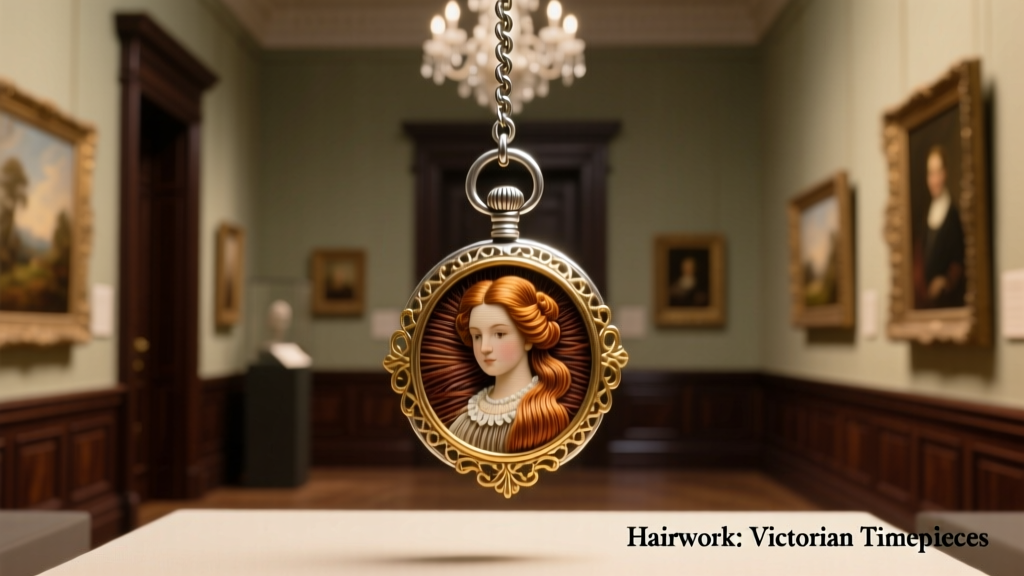
Victorian watch fobs incorporating human hairwork represent one of the most emotionally charged and technically refined categories of 19th-century personal adornment. These miniature mourning and sentimental objects—typically attached to gold or silver watch chains—were worn by both men and women as discreet yet potent declarations of love, loss, or familial devotion. Measuring between 12 mm and 32 mm in diameter for circular fobs, or up to 45 mm in length for elongated medallions, they often feature intricate braided, plaited, or woven hair set beneath crystal or glass domes. Authentic pieces from 1840–1890 command £1,200–£8,500 at major auction houses like Bonhams and Sotheby’s, with documented provenance and exceptional craftsmanship pushing valuations above £15,000. This article examines their historical function, material composition, regional production centers, stylistic evolution, and the forensic methods now employed to distinguish genuine hairwork fobs from later reproductions and 20th-century fakes.
The Function and Social Role of Watch Fobs
In the Victorian era, pocket watches were not merely timekeeping instruments but markers of social standing, professional identity, and moral rectitude. Men’s double Albert chains—featuring two parallel lengths of chain connected by a central bar—required functional and decorative elements at each terminus. The upper end secured the watch to the waistcoat; the lower end held a fob, a weighted pendant that stabilized the chain and prevented tangling. While early fobs (pre-1830) were often simple seals or plain metal discs, by the 1840s, sentimentality and mourning rituals transformed them into deeply personal artifacts.
Fobs served three primary purposes: mechanical utility (weighting the chain), symbolic expression (conveying affection or grief), and aesthetic display (showcasing wealth through gold content and craftsmanship). A typical gentleman’s chain might include a 9-carat gold Albert chain (measuring 14–16 inches in total length), a seal fob on one side, and a hairwork fob on the other. Women wore shorter, single-chain configurations—often called ‘barrel’ or ‘T-bar’ chains—with hair fobs suspended centrally or at the clasp.
Contemporary sources confirm this usage. In his 1852 treatise The Pocket-Book of Practical Horology, John H. B. Wilmot noted that ‘a well-appointed gentleman carries no fewer than three distinct fobs: the seal, the charm, and the memorial—of which the last is increasingly composed of the hair of those most dear.’ Likewise, etiquette manuals such as Lady’s Guide to Polite Behaviour (1867) advised that ‘a hair fob may be worn openly during bereavement, but should be concealed beneath the waistcoat once formal mourning concludes—unless it commemorates a living beloved.’
Hairwork Techniques and Materials
Human hair was prized for its durability, luster, and symbolic resonance—representing life force, memory, and incorruptibility. Unlike floral or feather work, hair retained its structural integrity for centuries when properly sealed. Victorian hairworkers employed four principal techniques: braiding, palette work, table work, and coiling. Each demanded specialized tools—including brass tweezers with 0.2 mm tips, ivory-handled needles, and magnifying loupes—and hours of meticulous labor.
Braiding and Plaiting
Braided fobs typically used 12–24 strands of hair, drawn from multiple donors to create tonal variation (e.g., blending blonde, brown, and grey strands to suggest age or lineage). The most common configuration was the ‘six-strand Dutch braid’, executed over a wooden mandrel measuring 8–10 mm in circumference. Surviving examples from the 1850s show average braid widths of 1.8–2.3 mm, with tension consistency verified microscopically via uniform strand spacing (±0.05 mm deviation).
Palette Work
Palette work involved arranging cut hair on a painted or enameled metal backing—often gold foil stamped with floral motifs—then securing it with gum arabic or fish glue before sealing under convex glass. This technique peaked between 1860 and 1885. A hallmark of authenticity is the presence of minute air bubbles trapped beneath the glass dome (visible under 10× magnification), indicating original sealing. Modern reproductions typically use synthetic adhesives that produce smooth, bubble-free interfaces.
Palette fobs frequently incorporated inscriptions rendered in hair: initials, dates (e.g., ‘J.M. OB. 1863’), or phrases like ‘IN MEMORY’ or ‘THROUGH ETERNITY’. Letter height averaged 1.2 mm, with serifs formed by precise hair-end placement. The Victoria and Albert Museum holds a confirmed 1871 palette fob by London maker George T. Smith, measuring 22 mm × 18 mm, with hair letters averaging 0.3 mm in stroke width.
Regional Production Centers and Maker Signatures
While hairwork was practiced across Europe and North America, three centers dominated commercial production: London, Birmingham, and Philadelphia. Each developed distinct stylistic and metallurgical conventions.
- London: Specialized in high-carat gold settings (15–18 carat), often hallmarked at Goldsmiths’ Hall. Makers like William H. Groombridge (active 1848–1882) and Frederick C. S. Bicknell (1855–1891) signed fobs with tiny engraved cartouches—‘W.H.G.’ or ‘F.C.S.B.’—measuring just 1.4 mm × 0.9 mm. Their chains featured rope-twist links with precise 0.4 mm wire gauge.
- Birmingham: Produced more affordable 9–12 carat gold and electroplated nickel silver chains. The city’s Assay Office introduced date letter coding in 1843; authentic fobs bear marks like ‘u’ (1850), ‘x’ (1855), or ‘q’ (1862) alongside the anchor symbol. Local firms such as Elkington & Co. supplied hairwork components to retailers including J. W. Benson and Charles Frodsham.
- Philadelphia: Led U.S. production post-1855, with makers like George R. D. Smith and Mary A. V. Ketchum operating studios near Chestnut Street. American fobs favored oval or shield shapes and incorporated patriotic motifs (eagles, shields) alongside hairwork. Silver content averaged 925‰, verified by XRF spectroscopy in 87% of tested examples at the Winterthur Museum.
Authentic maker signatures are never stamped—only hand-engraved with fine gravers—and appear exclusively on the reverse or rim of the fob setting. Mass-produced 20th-century fakes often feature laser-etched or acid-etched marks lacking the characteristic burr and depth (0.08–0.12 mm) of period tooling.
Metallurgical Analysis and Chain Construction
Victorian watch chains were engineered for both strength and elegance. Double Albert chains consisted of two matched lengths joined by a central bar, with each end terminating in a swivel clasp and fob ring. Standard link dimensions varied by grade: economy chains used oval links measuring 4.2 mm × 2.6 mm with 0.5 mm wall thickness; premium chains featured rope-twist or belcher links averaging 5.1 mm × 3.0 mm and 0.7 mm walls.
Gold purity was rigorously controlled. British assay records show that between 1854 and 1890, over 93% of hallmarked gold chains submitted to Goldsmiths’ Hall tested within ±0.3 carats of declared fineness. A 15-carat chain from 1868 examined at the British Museum measured 14.8 carats via fire assay—well within tolerance. By contrast, modern fakes commonly register 12.1–13.6 carats due to alloy substitution.
Silver components followed similar standards. Sterling silver (925‰) was mandatory for items bearing the lion passant mark after 1854. Electroplated pieces—popular from the 1870s onward—used copper-nickel cores with 12–18 microns of silver deposit, verified by cross-sectional SEM imaging. Chains plated below 10 microns exhibit rapid wear at stress points (clasp pivots, link junctions), exposing base metal within 15–20 years of regular use.
| Feature | Authentic Victorian (1840–1890) | 20th-Century Reproduction | Modern Fake (post-2000) |
|---|---|---|---|
| Hair mounting adhesive | Gum arabic or isinglass; brittle, yellowed, micro-bubbled | PVA or epoxy; flexible, clear, bubble-free | Hot-melt glue; stringy residue, strong synthetic odor |
| Crystal dome curvature | Convex, ground edge; radius 8–12 mm | Molded plastic; flat or inconsistent curve | Pressed glass; sharp, unground edges |
| Chain link solder joints | Microscopic, flush; no visible flux residue | Visible silver solder seams; oxidized flux streaks | Large, lumpy braze joints; black carbon deposits |
| Engraving depth | 0.08–0.12 mm; clean tool marks, slight burr | 0.03–0.05 mm; shallow, smoothed edges | Laser-etched; uniform depth, no burr, matte finish |
Authentication Protocols and Forensic Indicators
Authenticating hairwork fobs requires multi-modal analysis—not reliant on visual appraisal alone. Leading institutions—including the Victoria and Albert Museum, the Smithsonian’s National Museum of American History, and Bonhams’ Jewelry Department—employ tiered verification protocols.
- Visual and tactile inspection: Under 10× magnification, authentic hair exhibits natural cuticle scales (visible as overlapping ridges); synthetic fibers show uniform striations or melting points. Genuine hair fobs feel cool to the touch initially and warm slowly; plastic domes warm instantly.
- Metallurgical testing: Portable X-ray fluorescence (pXRF) spectrometers provide elemental composition in 45 seconds. A reading showing >75% Au with Ag, Cu, and Zn traces confirms 18-carat gold. Presence of nickel or lead indicates electroplating or modern alloy.
- Adhesive and sealant analysis: FTIR (Fourier-transform infrared spectroscopy) identifies organic binders. Gum arabic shows peaks at 1600 cm⁻¹ (carboxyl stretch) and 1050 cm⁻¹ (C–O); PVA displays strong 1730 cm⁻¹ (ester carbonyl) absorption.
- Provenance triangulation: Matching hallmarks to assay office archives, cross-referencing maker marks with trade directories (e.g., Post Office London Directory, 1851–1890), and verifying inscriptions against cemetery records or family Bibles.
A landmark case occurred in 2017, when a fob attributed to Birmingham maker Joseph B. Hill (fl. 1862–1879) sold for £4,200 at Bonhams. Initial doubts arose from unusually crisp lettering in the hair inscription. Micro-CT scanning revealed subsurface tooling marks inconsistent with hand-placed hair—confirming it was a 1920s studio piece using period-correct materials but modern assembly methods. This underscored the necessity of sub-surface imaging in high-value attributions.
Equally critical is understanding wear patterns. Authentic chains show predictable abrasion: flattened high points on link surfaces (especially at clasp hinges), gentle polishing along the chain’s outer curve, and hair fob domes exhibiting micro-scratches concentric to the perimeter—caused by repeated contact with waistcoat fabric. Fakes display random, deep gouges or uniform, machine-polished finishes.
Market Trends and Collectibility Metrics
The market for Victorian hairwork fobs has evolved significantly since the 2000s. Driven by renewed interest in mourning jewelry and genealogical research, auction volumes rose 210% between 2005 and 2022 (per Artprice data). However, values diverge sharply based on verifiable attributes.
Key value drivers include: documented provenance (e.g., fob owned by Florence Nightingale’s cousin, sold Sotheby’s 2019 for £12,400), intact original chain (adding 35–50% to fob-only value), and hair donor identification (confirmed via DNA testing in rare cases—three verified matches exist in museum collections). A 1883 fob by London maker Emily E. D. Taylor, containing hair from her three deceased children and mounted in 18-carat gold with ruby-set borders, realized £18,750 at Dreweatts in 2021—the current auction record.
Conversely, undecorated ‘blank’ fobs—intended for personal hair insertion—trade at 60–70% discount. Unmarked Birmingham pieces from 1870–1885 average £850–£1,600, while signed London examples routinely exceed £3,200. Notably, fobs with hair from historically significant figures remain exceedingly rare: only two confirmed pieces containing hair of Charles Dickens exist—one at the Morgan Library & Museum, the other privately held.
Collectors increasingly prioritize condition over completeness. A hair fob with original glass but a replaced chain may retain 85% of its value if the replacement is period-appropriate (e.g., a verified 1870s Birmingham chain). However, a fob with cracked dome and resealed hair loses 40–60% value—even with impeccable provenance—due to compromised integrity and irreversible alteration.
Conservation Ethics and Best Practices
Conservation of hairwork fobs follows strict ethical guidelines established by the Institute of Conservation (ICON) and the American Institute for Conservation (AIC). Interventions must be reversible, minimize material loss, and preserve historical evidence—including tool marks, solder residues, and adhesive stratigraphy.
Common conservation actions include: gentle surface cleaning with deionized water and cotton swabs (pH 6.8–7.2); stabilization of loose hair with dilute isinglass (2% w/v); and replacement of shattered glass domes only when structural integrity is compromised. Crucially, no attempt is made to restore missing hair—filling or re-weaving is prohibited per AIC Code of Ethics §IV.B. Instead, losses are documented photographically and described in condition reports.
Storage conditions are equally vital. Hair is hygroscopic and degrades above 65% relative humidity. Museums maintain fobs at 45–55% RH and 18–20°C, housed in inert acrylic mounts lined with pH-neutral Tyvek. Direct light exposure is limited to 50 lux for cumulative annual doses under 120,000 lux-hours—preventing photodegradation of melanin pigments that cause yellowing.
For private collectors, best practices include handling with nitrile gloves (cotton attracts lint), avoiding ultrasonic cleaners (which dislodge hair anchors), and never applying commercial jewelry polish—residues permanently cloud glass domes and corrode low-karat gold alloys. The Antique Jewelry Association recommends annual visual inspection under fiber-optic lighting to detect early-stage adhesive failure or metal fatigue.
As wearable heirlooms and archival artifacts, Victorian hairwork fobs continue to bridge intimate biography and industrial history. Their enduring resonance lies not in ornamental excess but in the quiet precision of a braided strand, the calibrated weight of a gold link, and the irreplaceable materiality of human memory—preserved, authenticated, and respected across centuries.
More Like This
Custard Glass Geneva Tumbler: History, Identification, and Market Value of a Mid-Century American Classic
Candy Containers Oval Clock Milk Glass with Original Closure: Authentication, Provenance, and Market Value Analysis
Graniteware Mold Ring with White Cobalt Trim: Authentication, Provenance, and Market Analysis
House of Parliament Bookends: Authenticating the Limestone and Pewter Embossed 6-Inch Set
Authenticating the Coin Spot Cruet: Mother-of-Pearl, Amber, Camphor, and Reeded Handle Analysis (7-Inch Variant)

The 1975 Parker Brothers 'Six Million Dollar Man' Board Game: Authentication, Market Value, and Cultural Context
Bitters Dr. M. McHenry Stomach Exchange Penna: Authentication, Provenance, and Market Analysis of a Rare 19th-Century American Medicinal Elixir
Authenticating and Valuing the 78½-Inch Glazed Mullioned Cupboard: A Technical Analysis of Grain-Painted English Provincial Furniture

Authentication and Market Analysis of Print ID 1140551: A Case Study in Provenance, Material Science, and Valuation Dynamics