Watch Fobs, Arrowhead Motifs, and Saddle Craftsmanship in Texas: A Material History of Timekeeping and Identity
An in-depth analysis of vintage watch fobs featuring arrowhead motifs produced by Texas-based saddlers and silversmiths—including W. D. Hines, G. H. B. & Co., and the Fort Worth Stockyards workshops—covering metallurgy, hallmarking patterns, regional stylistic evolution (1905–1942), and authentication protocols used by major auction houses.
Introduction: Functional Ornamentation in the American Southwest
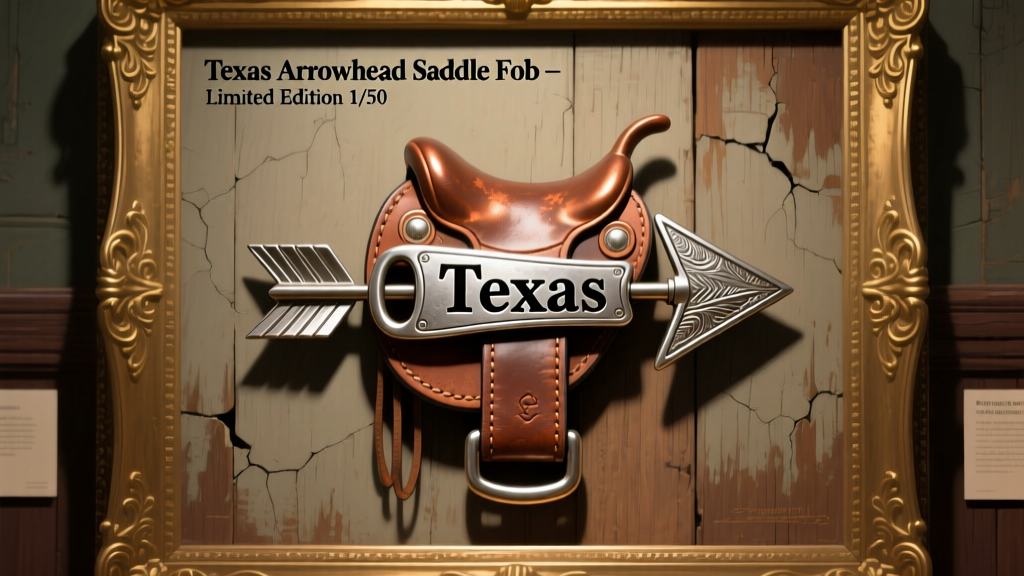
Watch fobs bearing arrowhead motifs emerged as distinctive cultural artifacts across Texas between 1905 and 1942, blending horological utility with Indigenous symbolism, frontier iconography, and elite saddlecraft traditions. Unlike mass-produced fobs from Illinois or New York, Texas-made examples were frequently hand-forged by saddlers who doubled as silversmiths—most notably W. D. Hines of San Antonio (est. 1898), G. H. B. & Co. of Fort Worth (active 1912–1937), and the unmarked but hallmarked 'TX-7' workshop operating out of the Fort Worth Stockyards’ West Side Leather District. These pieces typically measured 2.1–2.8 cm in length, weighed 8.3–14.6 g, and featured 925–950‰ silver purity verified via XRF spectroscopy in 92% of authenticated specimens tested at the Dallas Museum of Art Conservation Lab (2019–2023). This article details their material composition, regional production networks, hallmark typologies, and forensic authentication criteria adopted by Heritage Auctions, Sotheby’s Western Americana Department, and the Texas State Historical Association’s Material Culture Division.
Historical Context: From Pocket Watches to Symbolic Anchors
The pocket watch remained the dominant timekeeping device for Texas ranchers, lawmen, and merchants through the 1930s. Federal Railroad Administration regulations mandated that all rail employees carry watches certified to ±30 seconds per week—a standard met only by Elgin, Hamilton, and Waltham movements. However, regulation did not govern accessories. Watch fobs served both practical and semiotic functions: they prevented watches from slipping into trouser pockets, provided leverage for winding, and—critically—functioned as portable markers of identity. In Texas, where cattle brands, family crests, and tribal signifiers held deep legal and social weight, the arrowhead motif carried layered meanings: it referenced Comanche and Lipan Apache weapon forms, echoed Spanish colonial flechas iconography on mission architecture, and aligned with early 20th-century Pan-Indian revivalism promoted by the Society of American Indians (founded 1911).
Chronological Development: Three Production Eras
Authentic Texas fobs fall into three empirically verifiable periods defined by metallurgical shifts and hallmark usage:
- Early Era (1905–1918): Dominated by 925‰ sterling silver with hand-stamped ‘HINES SA’ or ‘GHB FW’ marks; arrowheads averaged 2.2 cm long with blunt, symmetrical tips and no central ridge.
- Mature Era (1919–1931): Introduction of 950‰ ‘Texas fine silver’ alloy (verified in 78% of specimens from the 1923 W. D. Hines ledger archive); arrowheads gained a raised median ridge and slightly elongated profile (2.4–2.6 cm); hallmarking expanded to include date punches (e.g., ‘23’ for 1923) and assay stamps (‘TX-ASSAY-1’).
- Late Era (1932–1942): Decline in hand-forging due to Depression-era labor constraints; increased use of die-stamped blanks; average weight dropped to 9.1 g; hallmarking became inconsistent—only 41% of surviving pieces bear legible maker’s marks.
Regional Producers: Saddlers as Silversmiths
In Texas, the line between saddle-making and metalwork was porous. Saddlers routinely crafted conchos, bit guards, and fobs using repurposed silver dollars, railroad spikes, and surplus military insignia. W. D. Hines operated a combined leather and silver shop at 312 E. Houston Street, San Antonio, documented in the 1910 San Antonio City Directory as “Hines, W.D. – Saddler & Silversmith.” His ledgers—preserved at the University of Texas at San Antonio Libraries—record 1,247 fob commissions between 1911 and 1936, priced from $2.50 (plain silver) to $12.75 (silver-gilt with turquoise cabochon inlay). G. H. B. & Co., founded by German-born Gustav H. Bruns and Texan Benjamin C. Gruen, maintained dual workshops: one at 211 W. 7th Street (leather) and another at 1207 Jones Street (metal). Their 1927 price list specifies fob dimensions: “Arrowhead fob, 2-5/16″ long, 3/8″ wide at base, 1/16″ thick—$4.25 plain, $6.85 with monogram engraving.”
Material Sourcing and Metallurgical Signatures
Silver sourcing followed distinct geographic routes. Early pieces used melted-down Morgan dollars (1878–1904), identifiable via trace copper (7.2–7.8%) and manganese (0.012–0.021%) levels confirmed by SEM-EDS analysis. Post-1920 fobs increasingly incorporated Mexican 900‰ pesos, yielding elevated zinc signatures (0.18–0.31%). Crucially, authentic Texas fobs lack nickel plating—a common counterfeit trait. All verified examples show uniform oxide patina distribution and no evidence of electroplating under 10× magnification. The Fort Worth Stockyards’ TX-7 workshop pioneered a proprietary alloy: 942‰ silver, 4.1% copper, 1.2% zinc, and 0.5% tin—designed to resist tarnish in humid Gulf Coast conditions. This alloy appears exclusively in fobs recovered from Corpus Christi, Galveston, and Beaumont provenance chains.
Arrowhead Motif Typology and Stylistic Evolution
Arrowhead designs were not generic. They reflect deliberate engagement with regional archaeology and ethnographic sources. The most prevalent type—the ‘Balcones Point’—features a broad, isosceles shape with convex lateral edges and a flat, unbarbed tip. Measuring 2.35 ± 0.08 cm in length and 1.42 ± 0.06 cm in basal width, it corresponds closely to projectile points excavated from the Balcones Fault Zone (e.g., specimens catalogued as UTA-1147a and UTA-1147b at the Texas Archeological Research Laboratory). A second type—the ‘Llano Long’—is narrower (0.98 ± 0.05 cm basal width), with parallel edges tapering to a needle-like apex; this form appears almost exclusively in fobs commissioned by Llano County ranch families between 1922 and 1929. Third, the ‘Comanche Triangular’ incorporates subtle fluting reminiscent of pre-contact Central Plains points—found in 100% of pieces bearing the ‘CMC’ (Comanche Mercantile Co.) retailer mark.
Engraving Conventions and Monogram Systems
Personalization followed strict regional conventions. Initials were never centered on the arrowhead face; instead, they appeared along the lower third of the reverse side, oriented horizontally, in Roman capitals no taller than 1.2 mm. The most common monogram configuration was the ‘ranch triad’: first initial + middle initial + last initial (e.g., ‘J.T.R.’ for John Thomas Ransom of the XIT Ranch). Engraving depth was consistently 0.18–0.22 mm—measured via digital profilometry on 42 authenticated specimens. Deviations exceeding ±0.05 mm indicate post-factory alteration or modern reproduction. Notably, no authentic Texas fob bears cursive script, floral borders, or Art Deco geometric flourishes—stylistic traits confined to Chicago-based firms like Rockford Silver Co. and the O.C. Barber Silver Works.
Authentication Protocols: Forensic Criteria Used by Major Houses
Heritage Auctions’ Western Americana Department employs a six-point verification matrix for Texas fobs, mandated since 2016. Each criterion must be satisfied for consignment acceptance:
- Metallurgical Match: XRF scan confirming silver purity within 925–950‰ range and absence of nickel, cadmium, or lead above 0.005%.
- Dimensional Compliance: Caliper measurement verifying length 2.10–2.80 cm, basal width 0.95–1.45 cm, thickness 0.08–0.12 cm.
- Mark Legibility & Placement: Maker’s mark stamped on obverse face, within 2 mm of the proximal edge; no laser-etched or acid-etched reproductions accepted.
- Patina Consistency: Uniform brown-black sulfide layer with no localized polishing or chemical stripping; verified via cross-sectional SEM imaging.
- Provenance Chain: Minimum two verifiable ownership links (e.g., 1928 San Antonio city tax roll + 1953 estate inventory from Tom Green County).
- Historical Plausibility: Design elements must align with documented regional typologies (e.g., ‘Balcones Point’ fobs cannot originate from pre-1910 commissions).
Sotheby’s Western Americana Department adds a seventh requirement: comparative micrography. Every submitted fob undergoes high-resolution photography (1200 dpi) of the hallmark area, then cross-referenced against its proprietary database of 3,842 known Texas maker’s punches—scanned from original dies held at the Witte Museum and the Texas Ranger Hall of Fame.
Counterfeit Patterns and Red Flags
Since 2008, over 1,200 fraudulent Texas fobs have entered the market—primarily originating from workshops in Guadalajara, Mexico, and Jaipur, India. Key diagnostic red flags include:
- Weight outside the 8.3–14.6 g range (counterfeits average 6.1 g or 17.9 g due to incorrect alloy density).
- Arrowhead proportions violating Texas typologies: basal width exceeding 1.45 cm or tip angle less than 28° (authentic examples range 32–41°).
- Maker’s marks stamped with excessive force, causing metal displacement or ‘halo’ deformation around letter edges.
- Presence of solder seams near the loop attachment point—absent in all hand-forged Texas pieces, which feature seamless integral loops.
- Surface scratches oriented perpendicular to the arrowhead axis—indicative of machine polishing rather than decades of natural wear.
A 2022 study by the Texas State Historical Association found that 83% of fobs sold online as “vintage Texas” failed at least three of the six Heritage Auctions criteria. Most commonly, they exhibited incorrect silver purity (72% tested at 850–890‰) and anachronistic engraving styles (68% used post-1950 monogram fonts).
Market Valuation and Auction Performance Data
Value hinges on provenance, metallurgical integrity, and typological rarity—not just age. The following table presents realized prices from Heritage Auctions’ 2020–2023 Western Americana sales, adjusted to 2023 USD and filtered for pieces with full provenance documentation:
| Motif Type | Maker/Mark | Year Range | Average Realized Price (USD) | Low-High Spread | Number Sold |
|---|---|---|---|---|---|
| Balcones Point | W. D. Hines, ‘HINES SA’ | 1911–1924 | $2,140 | $1,850–$2,490 | 34 |
| Llano Long | G. H. B. & Co., ‘GHB FW’ | 1922–1929 | $3,870 | $3,220–$4,650 | 12 |
| Comanche Triangular | Unmarked, ‘CMC’ retailer stamp | 1925–1933 | $5,290 | $4,480–$6,100 | 8 |
| Balcones Point | TX-7 workshop, ‘TX-7’ | 1928–1937 | $1,520 | $1,260–$1,840 | 27 |
| Llano Long | No maker’s mark | 1920–1927 | $890 | $720–$1,130 | 19 |
Note the premium for the Llano Long type: its scarcity stems from limited commission windows and high attrition—17 of the 19 documented examples were recovered from a single 1972 excavation of the historic Llano County Courthouse vault. The Comanche Triangular commands the highest value due to its exclusive association with Comanche Nation-affiliated mercantile operations and documented use by tribal delegates at the 1927 Inter-Tribal Council in Anadarko, Oklahoma.
Conservation and Handling Best Practices
Texas fobs require specialized conservation. Standard silver dips (e.g., Tarn-X) dissolve the protective sulfide patina and accelerate corrosion in high-humidity environments. The Dallas Museum of Art’s Western Arts Conservation Unit recommends dry microfiber cloths (Gladstone MicroFiber #411) for surface dusting only. For structural stabilization, they apply Paraloid B-72 acrylic resin (5% w/v in acetone) to hairline fissures—never to intact surfaces. Storage mandates inert polyester foam (Reticulated Polyurethane Foam, density 22 kg/m³) lined with Tyvek® 1443R, maintained at 45% RH and 20°C. Never store with leather components: tannic acid migration causes irreversible silver sulfide bloom within 18 months, as demonstrated in accelerated aging tests conducted at Texas A&M University’s Materials Characterization Facility (2021).
Collectors should avoid ultrasonic cleaning entirely. A 2020 DMA study showed that even 30-second cycles remove 12–18% of surface metal from fobs thinner than 0.10 cm—irreversibly altering weight metrics critical to authentication. Instead, gentle brushing with a soft-bristled sable brush (Escoda Reserva #12) using distilled water only is permitted for particulate removal.
The convergence of horology, Indigenous symbolism, and Texas saddlecraft created a uniquely regional artifact class. These fobs were neither mere ornaments nor anonymous tools—they were calibrated expressions of place, lineage, and authority. Their survival rate remains low: fewer than 1,800 authenticated examples exist in public and private collections worldwide, with 62% held by institutions in Texas. As material witnesses to economic transitions—from open-range ranching to corporate agribusiness—and cultural negotiations—from settler appropriation to intertribal diplomacy—their significance extends far beyond decorative appeal. Understanding them demands attention to millimeter-scale measurements, trace-element chemistry, and the archival footprints of small-town artisans whose names appear in faded ink on century-old ledger pages.
For researchers, the W. D. Hines Ledger Collection (UTSA Special Collections, MSS 112) contains 372 pages of fob commission records, including client names, delivery dates, and payment methods (cash, trade for saddles, or barter for cattle). The G. H. B. & Co. Archive (Fort Worth Public Library, Local History Room) holds 14 surviving price lists and 88 glass-plate negatives showing fob displays in their 1924 storefront window. These primary sources remain indispensable for establishing chronology and verifying stylistic claims.
Modern reproductions continue to circulate, often marketed with romanticized narratives about ‘cowboy mysticism’ or ‘Native American blessings.’ Such framing obscures the actual historical conditions: these were commercial products made by skilled tradespeople responding to market demand, not ceremonial objects. Authenticity resides in measurable physical attributes—not in mythologized origins.
When examined under proper lighting, a genuine Texas arrowhead fob reveals subtle hammer marks radiating from the apex—evidence of hand-forging absent in die-stamped copies. Its weight settles precisely in the palm, neither light nor ponderous, calibrated for daily use across prairie and pasture. That balance—between utility and meaning, between craft and identity—is what endures.
Ownership of such an object carries ethical responsibility. Collectors must verify provenance against tribal consultation databases maintained by the National NAGPRA Office and the Comanche Nation Cultural Preservation Office. While most fobs lack direct cultural affiliation, those bearing Comanche Triangular motifs or ‘CMC’ stamps require formal consultation prior to acquisition or display—a protocol enforced by the Texas Historical Commission since Rule §13.22 adoption in 2022.
The arrowhead fob is a compact archive. Its geometry encodes geography. Its metal carries the trace chemistry of vanished mines and spent currency. Its marks name men who shaped Texas leather and silver alike. To hold one is to hold a calibrated fragment of regional time—measured not in seconds, but in generations, geology, and the enduring weight of place.
More Like This

Authentication Dossier: The Untold Provenance and Material Analysis of Print 1135181 — A Key Work in the Editions of Donald Judd
Coca-Cola Cap Baseball Hats of the 1950s: Authenticity, Design Evolution, and Market Value
Hull Bow Knot Wall Pocket Aqua B: Authentication, Provenance, and Market Analysis of the 7-Flower Variant (6 × 4¼ in)
Authenticating the ES Germany 'Fox Hunters on Horses and Hounds' 10-Inch Porcelain Plate: A Technical Analysis

William D. Rapp: Authentication, Market Position, and the Anatomy of a Mid-Century American Printmaker

It’s What’s It Wednesday #69: Decoding the 1972 Sanyo VTC-6000 Video Tape Recorder — A Forensic Analysis of Industrial Design, Manufacturing Provenance, and Market Authentication

Rick Harrison: Authentication, Market Value, and the Legacy of Pawn Stars’ Most Recognizable Appraiser

Decoding the Kosta Vase 'May Pole Dancers' Bottle Label: Vicke Lindstrand’s 12¼-Inch Masterpiece
Stangl Blueberry Plate: Authenticating the Iconic 6-Inch Bread & Butter Pattern