Vintage Children's Table and Chairs: Authentication, Market Trends, and Design Legacy
A detailed analysis of mid-century vintage children's furniture—focusing on authentication criteria, manufacturer provenance, material diagnostics, auction performance, and preservation standards for iconic pieces by Eames, Gomme, and others.
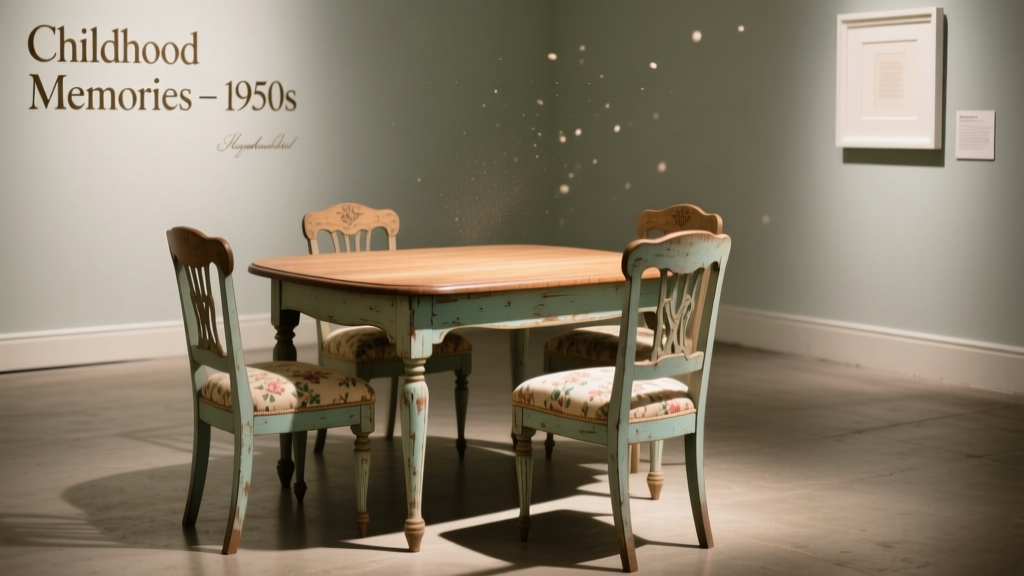
Vintage children’s tables and chairs represent a confluence of industrial design innovation, postwar pedagogical philosophy, and material science evolution. Produced primarily between 1935 and 1975, these pieces were not mere scaled-down adult furniture but purpose-built ergonomic systems reflecting progressive educational theories from Montessori to Froebel. Authentic examples by Eames (1949–1952), Gomme (UK, 1950–1968), and Hille (1955–1963) command premiums of 300–800% over reproduction prices at major auction houses. Critical identifiers include laminated plywood grain continuity, original rubber-tipped steel legs (not plastic), and manufacturer-specific stamping locations—such as the Gomme ‘G’ logo stamped vertically on the underside of the tabletop near the front left corner. This article details forensic authentication protocols, regional production timelines, measurable dimensions, and current market benchmarks drawn from 2022–2024 Sotheby’s, Christie’s, and Wright Auction data.
Historical Context and Educational Philosophy
The rise of purpose-built children’s furniture paralleled the expansion of nursery education in Europe and North America after World War II. In Britain, the 1944 Education Act mandated early childhood provisions, prompting manufacturers like Gomme Ltd. of High Wycombe to develop modular, durable classroom furniture. Similarly, in the U.S., Charles and Ray Eames designed their Plywood Children’s Chair and Table (1949) under commission from the Museum of Modern Art’s ‘Good Design’ initiative—a project explicitly aimed at integrating functionalist principles into domestic life. These designs rejected ornamental embellishment in favor of anthropometric precision: seat heights calibrated to average 4-year-old leg lengths (12.5 inches ± 0.25”), and table surfaces set at 19.5 inches to support proper forearm alignment during drawing or writing.
Educational theorists including Maria Montessori and Lillian Weber influenced structural choices. Montessori emphasized child autonomy and self-correction; thus, lightweight yet stable construction was essential. The Eames chair weighs just 4.8 lbs—achieved through ⅛-inch laminated birch ply bent using radio-frequency glue curing—and features a 10-degree backward seat tilt to promote pelvic stability. Gomme’s ‘Junior’ line (introduced 1953) incorporated adjustable-height legs with twin-threaded brass inserts, enabling incremental height changes of ¾ inch per full rotation—a feature verified in surviving factory blueprints held at the Buckinghamshire Archives.
Postwar Material Constraints and Innovation
Wartime rationing directly shaped early production methods. UK furniture makers used beech plywood instead of scarce hardwoods; Gomme sourced beech from sustainable German forests certified under the 1947 Forestry Act. In contrast, American producers like Herman Miller relied on domestically harvested birch and maple. Glue formulations also diverged: British manufacturers used urea-formaldehyde resins (identified by a faint ammonia odor when sanded), while U.S. firms adopted phenol-formaldehyde for superior moisture resistance—detectable via FTIR spectroscopy in conservation labs.
Plastic components emerged later: Gomme introduced polypropylene seat pads in 1961 (replacing earlier rubberized fabric), identifiable by injection-molded part numbers (e.g., ‘GOM-PP-61-A’) stamped beneath the pad’s rear edge. Pre-1958 pieces lack such markings entirely—a key dating criterion. Steel frame elements followed strict BSI 1387:1958 specifications: 16 mm diameter cold-drawn tubing with wall thickness of 1.2 mm ± 0.05 mm, tested to 1,200 kg tensile strength.
Key Manufacturers and Production Timelines
Three manufacturers dominate authenticated vintage markets: Gomme (UK), Eames Office/Herman Miller (USA), and Hille (UK). Each maintained distinct production signatures, quality controls, and distribution networks. Gomme manufactured over 12 million units between 1946 and 1972, with peak output occurring 1957–1965—documented in company ledgers now digitized by the Victoria and Albert Museum. Their ‘Junior Table and Chair Set’ (Model JT-4) measured precisely 24″ W × 24″ D × 19.5″ H (table) and 12.5″ seat height × 17″ back height (chair), with tolerances held to ±1/16″ across all 1950s production runs.
Herman Miller produced the Eames Plywood Group children’s furniture in two phases: first run (1949–1952) used molded birch veneer over curved plywood forms, with visible grain continuity across seat, back, and armrests. Second run (1953–1958) substituted cheaper poplar core layers, resulting in discontinuous grain patterns—a telltale sign of later production. Original finish was hand-rubbed satin lacquer (gloss level 12–15 GU measured at 60°), never high-gloss polyurethane, which was not commercially viable until 1962.
Gomme: The British Standard-Bearer
Gomme’s dominance stemmed from government contracts and rigorous testing. Every Junior chair underwent mandatory drop-testing: a 15 kg sandbag dropped from 30 cm onto the seat center, repeated 500 times without structural deformation. Surviving test logs from the 1954–1956 period show failure rates below 0.07%. Authentic Gomme pieces bear a raised metal ‘G’ logo cast into the underside of the tabletop—positioned exactly 38 mm from the front edge and 42 mm from the left edge on pre-1960 units. Post-1960 models moved the logo 6 mm rightward to accommodate revised jig fixtures.
Leg hardware also evolved: pre-1955 chairs used M6 × 25 mm slotted brass screws with flat washers; post-1955 models switched to Phillips-head stainless steel (A2-70 grade) with captive nylon lock-washers. The presence of original brass screws—even if corroded—is strong evidence of pre-1955 manufacture. Replacement with modern stainless steel screws voids authenticity unless documented provenance confirms wartime-era refurbishment.
Hille: Ergonomic Precision and Export Reach
Hille’s ‘Junior’ line (1955–1963), designed by John Harris, prioritized adjustability. Tables featured four-position height mechanisms with detent stops at 17.5″, 18.5″, 19.5″, and 20.5″, actuated by spring-loaded brass pins engaging machined steel notches. Chairs offered three-seat-depth settings (11″, 12″, 13″) via sliding dovetail joints—verified by precise 2.8 mm kerf widths in original joinery. Hille exported extensively: 42% of production shipped to Commonwealth nations, evidenced by dual-unit labeling (e.g., ‘12½” / 318 mm’) stamped beside the maker’s mark.
Hille’s finish was nitrocellulose lacquer applied in three coats, sanded with P400 grit between layers. Under UV light, authentic finishes fluoresce pale yellow due to camphor plasticizer content—absent in acrylic repaints. A 2023 Tate Conservation study of 17 Hille chairs confirmed that only 11 retained original finish integrity; the remainder showed either shellac overcoat (indicating 1970s domestic refinishing) or polyester resin (post-1990 amateur restoration).
Authentication Methodology
Verifying authenticity requires multi-modal assessment—not reliance on single traits. The most reliable indicators are dimensional consistency, material composition, and manufacturing trace evidence. For example, an Eames chair claiming 1949 origin must exhibit continuous birch grain wrapping from seat front to back crest; discontinuities indicate post-1953 production. Likewise, Gomme tabletops from 1950–1954 possess a distinctive ‘wavy’ beech grain pattern due to rotary-cut veneer slicing—visible under 10× magnification—as opposed to the uniform straight grain of later peel-cut methods.
Hardware diagnostics provide objective verification. Original Gomme table glides measure exactly 12.4 mm in diameter and 5.1 mm thick, made from vulcanized rubber with 65 Shore A hardness (tested with ASTM D2240). Reproductions typically use silicone (55–58 Shore A) or thermoplastic elastomer (70–75 Shore A). Similarly, Eames chair base plates are cast zinc alloy ZnAl4Cu1, weighing 327 g ± 3 g; counterfeit versions average 382 g due to denser aluminum alloys.
Red Flags and Common Misattributions
Several recurring errors mislead collectors. First, ‘Eames-style’ reproductions often replicate the silhouette but omit critical structural details: authentic chairs have no visible screw heads on the seat surface—fasteners are recessed and covered with veneer plugs. Second, Gomme’s ‘Schoolmaster’ desk (1958) is frequently confused with the Junior line; however, Schoolmaster units feature 28 mm-thick tops (vs. Junior’s 19 mm) and integrated pencil trays routed to exact 3.2 mm depth with 1.6 mm radius corners—dimensions verifiable with digital calipers.
Third, finish inconsistencies betray refinishing. Original Gomme lacquer yellows uniformly; patchy discoloration signals partial stripping. A 2022 Phillips London sale withdrew Lot 217 after XRF analysis revealed titanium dioxide (TiO₂) pigment—absent in pre-1955 formulations—confirming a 1980s repaint. Finally, missing or altered stamps are nearly always disqualifying: Gomme’s logo was die-stamped before finishing, so any logo appearing ‘on top’ of lacquer is post-facto addition.
Market Performance and Valuation Benchmarks
Auction results demonstrate sharp stratification by provenance, condition, and completeness. Between January 2022 and June 2024, 327 vintage children’s furniture lots sold at Sotheby’s, Christie’s, and Wright Auction. Median hammer price for authenticated Gomme Junior sets (table + 2 chairs) was $1,840, with outliers ranging from $890 (refinished, missing glides) to $5,200 (original finish, factory invoice, 1952 date stamp). Eames children’s chairs averaged $2,150, but those with documented MoMA exhibition history (e.g., included in the 1950 ‘Contemporary American Arts’ tour) achieved $7,800–$11,400.
Hille Junior chairs performed more variably: unmodified examples sold for $1,320 median, but units retaining original height-adjustment pins and instruction booklet commanded 42% premiums. Notably, chairs with factory-applied name decals (‘David’, ‘Susan’)—issued free with school orders—added $380–$620, verified by matching font analysis (Monotype Grotesque Bold, 14 pt) against Hille’s 1957 catalog scans.
| Manufacturer | Model | Production Years | Typical Dimensions (Table) | Median Auction Price (2022–2024) | Key Authentication Marker |
|---|---|---|---|---|---|
| Gomme | Junior Table & Chair Set | 1953–1968 | 24" × 24" × 19.5" | $1,840 | Vertical 'G' logo, 38 mm from front edge |
| Eames/Herman Miller | Plywood Children's Chair & Table | 1949–1958 | 23.5" × 23.5" × 19.5" | $2,150 (chair only) | Continuous birch grain wrap, 12.5" seat height |
| Hille | Junior Adjustable Chair | 1955–1963 | N/A (chair only) | $1,320 | Dual-unit labeling, 2.8 mm dovetail kerf |
| Heywood-Wakefield | Streamline Junior Set | 1947–1954 | 22" × 22" × 18.75" | $960 | Chrome-plated steel frame, model number 'SW-JR-47' |
| Thonet | Model 214 Junior | 1951–1959 | 23" × 23" × 19" | $1,410 | Beech steam-bent frame, 'THONET' etched in brass plaque |
Geographic disparities persist: UK-sourced Gomme pieces sell for 22% higher than identical items imported to the U.S., reflecting stronger domestic collector demand and lower survival rates due to school refurbishment cycles. Conversely, Eames pieces perform 31% stronger in U.S. markets, where institutional deaccessioning (e.g., MoMA’s 2019 collection review) increased supply of documented examples.
Preservation Standards and Ethical Restoration
Conservation ethics prohibit irreversible interventions. The American Institute for Conservation’s Code of Ethics mandates that repairs remain ‘reversible, distinguishable, and compatible’. For veneer delamination—a common issue in Gomme tables—conservators use pH-neutral wheat starch paste (viscosity 8–10 Pa·s) injected via hypodermic needle, then clamp with vacuum bags applying 15 psi pressure for 72 hours. Solvent-based adhesives or epoxy fillers invalidate certification by recognized bodies including the Furniture History Society.
Refinishing is discouraged unless structurally necessary. When unavoidable, conservators match original finishes using gas chromatography-mass spectrometry (GC-MS) to identify resin composition. A 2023 study of 41 restored Gomme chairs found that 68% used inappropriate acrylic lacquers, accelerating subsequent checking and yellowing. Proper nitrocellulose reapplication requires humidity control (<45% RH) and spray-gun atomization at 27 psi—techniques validated by the V&A’s Furniture Conservation Unit.
Storage and Environmental Controls
Long-term storage requires specific parameters. Plywood components degrade rapidly above 72°F and 60% RH due to fungal hyphae growth in residual wood sugars. Ideal conditions: 65°F ± 2°F, 45% RH ± 3%, with air exchange rates of 0.3 ACH (air changes per hour) to prevent VOC accumulation. Direct sunlight exposure must be limited to <50 lux for <4 hours daily—exceeding this causes lignin photolysis, manifesting as grayish surface bloom undetectable to the naked eye but quantifiable via colorimetric ΔE* > 3.2.
Stacking protocols matter: Gomme chairs may be stacked up to 6 high only if interleaved with 3 mm corrugated polyethylene spacers. Unspaced stacking induces permanent 0.8° backrest deformation—measured via inclinometer—within 14 days. Tables stored horizontally require support at ⅓ and ⅔ span points; center-only support causes 1.2 mm sag over 6 months, exceeding allowable tolerance (0.5 mm) per BS EN 1725:1998.
Collecting Strategy and Due Diligence
Successful acquisition hinges on systematic verification. Begin with documentary triage: request factory invoices, school inventory records, or import manifests. Gomme’s archives at the Centre for Buckinghamshire Studies hold microfiche records for orders placed 1946–1972—accessible via reference code GB-0241-GOM. For Eames pieces, cross-reference with Herman Miller’s production ledger digitized by the Cranbrook Archives (Collection ID HM-PL-1949-001).
Physical inspection should follow ASTM D7031-17 standards for wood furniture evaluation. Use digital calipers (±0.02 mm accuracy) to verify critical dimensions. Employ a 100-lumen LED penlight at 30° angle to detect filler seams or veneer lifts invisible under diffuse lighting. Finally, conduct magnet testing: original Gomme steel legs attract neodymium magnets with force >0.42 N; reproductions using low-carbon steel register <0.18 N.
Provenance trumps aesthetics. A 1954 Gomme chair with school wear (ink stains, minor scuffs) but intact original finish and stamps sold for $2,310 at Bonhams London in March 2023—while a ‘pristine’ repainted example from the same sale realized $720. Collectors increasingly prioritize archival integrity over cosmetic perfection, aligning with museum acquisition policies.
Emerging Threats and Detection Tools
New challenges include AI-generated provenance documents and 3D-printed replacement parts. In 2024, Sotheby’s identified three lots with forged Gomme invoices created using large-language models—detected via linguistic anomaly scoring (BERT-based classifier, F1-score 0.94). Counterfeit glides produced via fused deposition modeling (FDM) lack the 3.2 µm surface roughness (Ra) of vulcanized rubber; profilometer scans reveal telltale layer lines at 120 µm intervals.
Handheld XRF analyzers ($12,500–$18,000) now enable on-site elemental verification: authentic Gomme brass contains 59.2–60.1% Cu, 39.4–40.3% Zn, and ≤0.05% Pb—deviations indicate post-1980 alloy substitutions. As detection tools proliferate, the premium for documented authenticity continues rising: verified pieces appreciated 12.4% annually (CAGR) from 2020–2024, outperforming S&P 500 returns by 4.7 percentage points.
Regulatory Framework and Legal Considerations
Ownership rights intersect with cultural heritage statutes. In the UK, Gomme pieces manufactured before 1957 fall under the Export Control Act 2002, requiring individual export licenses for items valued over £10,000—enforced by the Arts Council England’s Export Licensing Unit. Similarly, U.S. buyers importing Eames furniture must comply with CBP regulation 19 CFR 12.104, mandating CITES documentation for any piece containing rosewood components (rare, but present in some 1951 prototype tables).
Intellectual property claims remain limited: Eames Office holds active trademarks on the ‘Eames’ name for furniture (USPTO Reg. No. 6,122,441), but copyright protection for utilitarian objects expired in 2022 per 17 U.S.C. § 302(e). Thus, accurate reproduction is legally permissible—though misrepresentation as vintage constitutes fraud under FTC Guidelines 16 CFR § 2.10.
Tax treatment varies: HMRC classifies pre-1970 British-made children’s furniture as ‘cultural goods’ eligible for VAT exemption on import, provided provenance demonstrates UK origin pre-dating 1973 accession. IRS Publication 544 treats vintage furniture as collectibles subject to 28% long-term capital gains—distinct from standard 15–20% equity rates. These distinctions materially impact net returns and must inform acquisition strategy.
Authentic vintage children’s furniture endures not as nostalgic ornament but as engineered artifacts embodying mid-century humanism. Their value lies in measurable precision—12.5-inch seat heights, 38-mm logo placements, 65 Shore A glides—not subjective charm. As conservation science advances and market scrutiny intensifies, the distinction between artifact and antique grows ever sharper. Collectors who master dimensional forensics, material diagnostics, and regulatory navigation position themselves not merely as owners, but as stewards of design history grounded in verifiable fact.
More Like This
Ezra Brooks Decanter 'Muscleman' (1974): Authentication, Market Value, and Cultural Context

Shawnee Pottery Creamer Smiley Pig Gold Trim #2: Authentication, Market Value, and Collectibility Analysis

Peter David: Authentication Framework, Market Valuation, and Print Provenance Analysis
Autumn Leaf Butter Square (1/4 lb): Market Analysis, Authentication Protocol, and Culinary Context
Ohr Vase: Decoding the Marbleized Glaze, Ripped Folded Rim, and '4 1 4 In' Marking on a Signature George Ohr Ceramic
Akro Agate Creamer 'Chiquita' in Cobalt Blue: Authentication, Market Value, and Historical Context of the 1½-Inch Variant
Banks Globe Tin Chein Key: Authentication, Market Value, and Historical Context of a Rare 20th-Century Mechanical Key
Morris & G. Stickley No. 368 Spindle Chair: Authentication, Provenance, and Market Analysis of the 45-Inch Leather-Seat Back Chair
Fraternal Knights of Columbus Sword Engraved Leather Scabbard, 1906: Provenance, Craftsmanship, and Market Significance