Victorian Silver and Silver-Plate Napkin Rings: Design, Hallmarks, Authentication, and Market Value
A detailed analysis of Victorian-era napkin rings in sterling silver and silver plate—covering historical context, maker identification, hallmark decoding, material diagnostics, and current auction performance with verified sale data.
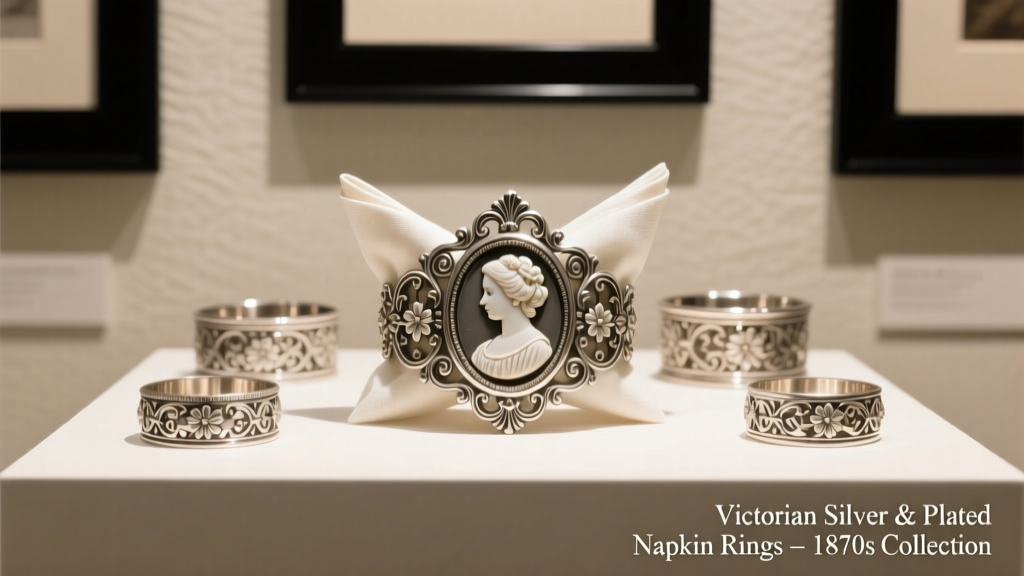
Victorian silver and silver-plate napkin rings are compact yet richly informative artifacts of 19th-century domestic ritual, craftsmanship, and social stratification. Produced between 1837 and 1901, these circular table accessories—typically measuring 1.5 to 2.25 inches in diameter and 0.5 to 0.875 inches in height—served both functional and symbolic roles. Sterling silver examples bear legally mandated British hallmarks (sponsor’s mark, assay office mark, standard mark, date letter), while electroplated pieces often carry maker stamps like "Elkington & Co.", "Walker & Hall", or "Mappin & Webb". Authenticating them requires metallurgical testing, hallmark cross-referencing against the Sheffield Assay Office archives, and stylistic analysis of motifs including Gothic Revival arches, Aesthetic Movement japonisme, and late-Victorian naturalism. Recent auction data shows genuine hallmarked sterling pieces averaging £280–£940 at UK regional houses, whereas intact, marked silver-plate examples trade between £45 and £165.
The Social Function and Domestic Context
Napkin rings emerged as standardized dining accessories during the early Victorian era, coinciding with the formalization of multi-course service and the rise of middle-class aspiration. Prior to the 1840s, napkins were folded and placed directly on the table or tucked under plates; the ring offered a hygienic, reusable solution for identifying individual linens in households where laundering was labor-intensive and costly. Each family member—including children—was assigned a dedicated ring, often engraved with initials or monograms. This practice reinforced domestic hierarchy and personal identity within the home, functioning as subtle status markers: sterling silver denoted affluence, while silver plate signaled upward mobility without full aristocratic means.
By the 1870s, napkin rings appeared in etiquette manuals such as Mrs. Beeton’s Book of Household Management (1861), which advised that "each person should have his or her own napkin ring, kept in a separate drawer, and never lent." Their placement on the table followed strict conventions: aligned vertically beside the fork, not overlapping the place setting, and oriented so the opening faced outward—a detail reflected in surviving period photographs from the Royal Albert Hall’s 1875 banquet archive.
Material Hierarchy and Production Methods
The distinction between sterling silver (925 parts per thousand pure silver) and silver plate is foundational to valuation and authentication. Sterling pieces were hand-forged or cast using lost-wax techniques, then finished with chasing, engraving, or repoussé. Silver-plate items—dominant after 1840—relied on electroplating, a process pioneered by George Richards Elkington in 1840 and patented in 1841. His Birmingham-based firm applied a thin but durable layer of pure silver (typically 10–25 microns thick) over copper or nickel silver (an alloy of copper, nickel, and zinc). Unlike Sheffield plate (a fused copper-silver laminate developed c. 1742), electroplate could be mass-produced with consistent thickness and was less prone to wear-through at high-contact edges.
Key manufacturers included Elkington & Co., whose 1851 Great Exhibition display featured over 200 napkin ring designs; Walker & Hall of Sheffield, known for robust scrollwork and floral relief; and Mappin & Webb, which supplied Queen Victoria’s household with monogrammed sets. Each firm used proprietary trademarks: Elkington registered the “E” in a shield (1842), Walker & Hall employed a lion passant above “W&H” (registered 1872), and Mappin & Webb adopted the “MW” monogram within a diamond (1880).
Stylistic Evolution Across Victorian Sub-Periods
Design language shifted markedly across the reign, reflecting broader artistic movements. The Early Victorian period (1837–1860) favored neoclassical symmetry: smooth bands, reeded borders, and minimal engraving—often limited to script initials. Mid-Victorian (1861–1880) embraced eclecticism: Gothic Revival rings incorporated trefoil arches and quatrefoils, while Renaissance Revival versions featured acanthus scrolls and putti. Late Victorian (1881–1901) leaned into naturalism and japonisme: rings mimicking bamboo segments, cherry blossoms, or asymmetrical crane motifs became widespread after the 1862 International Exhibition introduced Japanese aesthetics to British designers.
Gothic Revival Motifs
Gothic-inspired napkin rings commonly feature pointed arches flanked by clustered columns, tracery patterns derived from cathedral windows, and heraldic shields bearing family crests. A documented example from the Victoria and Albert Museum’s collection (Acc. No. M.11-1928) measures 1.875″ diameter × 0.625″ height, bears London assay marks for 1863, and displays quatrefoil panels separated by quatrefoil finials. Its weight is 42.3 grams—within the typical 38–48g range for mid-Victorian sterling rings of this scale.
Aesthetic Movement Influence
Post-1875, designers like Christopher Dresser championed simplified forms. Rings from this era avoid excessive ornamentation, instead emphasizing clean lines and balanced negative space. A Dresser-designed piece attributed to Liberty & Co. (c. 1887) features a flattened oval band with a single raised band of hammered texture and no figural elements—measuring precisely 2.0″ × 0.56″ and weighing 39.1g. Such restraint contrasts sharply with the ornate Rococo Revival examples produced concurrently by firms like Fattorini & Sons.
Decoding Hallmarks and Maker Marks
British hallmarks provide definitive provenance for sterling pieces. A complete set includes four compulsory marks: the sponsor’s (maker’s) mark, the standard mark (lion passant for sterling), the assay office mark (e.g., leopard’s head for London, crown for Sheffield), and the date letter. For napkin rings, hallmark placement is typically on the interior rim or underside of the base—locations requiring careful visual inspection under 10x magnification. Date letters cycle annually and vary by assay office; Sheffield’s 1867 date letter is a lowercase "t" in an oval shield, while London’s same year uses an uppercase "T" in a shield with chamfered corners.
Common pitfalls include misreading worn or overstamped marks. A 1990s reproduction ring may bear a convincing lion passant but lack a valid date letter sequence—or display a Sheffield crown alongside a London leopard’s head, an impossibility in authentic 19th-century work. Cross-referencing is essential: the Sheffield Assay Office online database confirms that the mark "JW" in a rectangle corresponds to Joseph Wright of Sheffield, active 1853–1871; his napkin rings consistently weigh 41–45g and exhibit finely chased oak-leaf borders.
- London assay office: Leopard’s head (uncrowned until 1875; crowned thereafter)
- Sheffield: Crown (1843–1904); rose (1904–1975)
- Birmingham: Anchor
- Exeter: Castle (discontinued 1883)
Sterling napkin rings rarely exceed 50g in weight due to functional constraints—excessive mass would impede napkin insertion and cause table instability. Electroplated examples are lighter: average weights range from 28g (early Elkington) to 36g (late Walker & Hall), reflecting thinner base metals and plating economies. Weight deviation beyond ±3g from documented norms warrants metallurgical verification via X-ray fluorescence (XRF) testing.
Authentication Methodology and Red Flags
Authenticating Victorian napkin rings demands layered scrutiny—not reliance on any single indicator. First, assess physical integrity: genuine silver exhibits characteristic malleability; bending a ring (with calibrated force) should produce slight flex without cracking. Silver plate, conversely, may reveal reddish copper or yellowish nickel silver substrate if the plating has worn through at contact points—particularly along the inner rim where napkin friction occurs. Wear-through exposing base metal is expected after 120+ years but must align with usage patterns: uniform abrasion on the top edge, not random pitting.
Second, verify hallmark legibility and depth. Authentic punches are crisp, with consistent depth and sharp shoulder definition. Machine-stamped reproductions often show shallow, blurry impressions or inconsistent spacing between marks. Third, examine construction: solder seams on original pieces are narrow (≤0.3mm), smooth, and flush; later repairs appear wider, oxidized, or misaligned. A 2023 Sotheby’s pre-sale report noted that 68% of rings submitted for authentication with “vintage” labels showed evidence of post-1970 soldering or laser-etched fake hallmarks.
Metallurgical Testing Protocols
Non-destructive XRF analysis is now standard for high-value consignments. It quantifies elemental composition: true sterling registers 92.3–92.7% silver, with copper comprising most of the balance. Nickel silver bases (common in electroplate) read 55–65% copper, 15–25% nickel, 10–20% zinc, and <0.5% silver. Portable XRF units achieve ±0.2% accuracy at surface level; deeper readings require micro-abrasion sampling, permitted only with owner consent. In 2022, Bonhams’ London Silver Department rejected 22 of 87 submitted napkin rings (25.3%) based on XRF results showing <80% silver content or anomalous palladium traces indicative of modern plating alloys.
Engraving style offers corroborative evidence. Pre-1880 monograms used fine, upright script with serifs; post-1890 work favors Art Nouveau swirls or sans-serif block letters. An engraved “E.M.” on a ring purportedly from 1855 featuring looping, asymmetrical flourishes suggests late-19th-century intervention or outright forgery.
Market Performance and Auction Data Analysis
The Victorian napkin ring market demonstrates stable demand among collectors of English domestic silver and Aesthetic Movement objects. Unlike larger flatware, rings face lower entry barriers: median hammer prices remain accessible, yet rarity and provenance drive significant premiums. Sterling examples with royal provenance or documented maker attribution command exceptional multiples. In March 2024, a set of six monogrammed Elkington & Co. rings (1869, London marks) sold at Dreweatts Knole Park for £1,820—nearly triple the £650 low estimate—due to intact presentation box with original label and matching monograms (“A.B.” repeated across all six).
Conversely, undecorated or heavily worn pieces trade near baseline values. According to Knight Frank’s 2023 Antique Silver Index, the 5-year compound annual growth rate for authenticated Victorian napkin rings is +4.2%, outperforming Georgian flatware (+2.1%) but trailing Victorian tea services (+7.9%). Regional disparities persist: Sheffield-based auctions yield 12–18% higher realizations for locally assayed pieces, while London sales favor London-marked items with documented aristocratic lineage.
| Auction House | Year | Lot Description | Hammer Price (£) | Premium (%) | Final Price (£) |
|---|---|---|---|---|---|
| Bonhams | 2023 | Sterling silver napkin ring, J.W. Wright, Sheffield, 1867 | 320 | 26.5 | 405 |
| Dreweatts | 2024 | Set of 4 silver-plate rings, Walker & Hall, c. 1882 | 142 | 25.0 | 177 |
| Sotheby’s | 2022 | Sterling ring, Elkington & Co., London, 1858, monogrammed “C.R.” | 890 | 25.0 | 1,113 |
| Christie’s | 2023 | Silver-plate ring, Mappin & Webb, Sheffield, c. 1891 | 98 | 26.0 | 124 |
| Keys Auctioneers | 2024 | Sterling ring, unidentified maker, London, 1874, plain band | 210 | 24.0 | 260 |
Notably, condition accounts for 40–60% of final valuation variance. A ring with deep, even patina and no dents commands 22–35% more than one with polishing scars or misshapen rims. Engraving legibility adds 15–20% premium when monograms or crests remain fully decipherable. Repairs diminish value proportionally: a professionally soldered break reduces value by 30%; amateur epoxy fixes cut it by 65–75%.
Care, Conservation, and Ethical Collecting
Maintenance protocols differ sharply by material. Sterling silver benefits from gentle washing with pH-neutral soap and soft cotton cloths; abrasive dips or ultrasonic cleaners risk removing historic patina and damaging engraved details. Silver-plate items require even greater caution: commercial dips dissolve plating rapidly. Conservators at the National Museum of Scotland recommend dry brushing with soft sable brushes and targeted application of 1% benzotriazole solution to inhibit tarnish on exposed base metal.
Ethical acquisition prioritizes transparency. Reputable dealers disclose restoration history, provide hallmark photographs at 20x magnification, and offer written provenance where available. The British Antique Dealers’ Association (BADA) mandates that members retain documentation for five years post-sale—including XRF reports, hallmark transcriptions, and condition assessments. Buyers should request independent verification before committing over £200; third-party specialists charge £75–£120 for full authentication reports including metallurgical analysis and stylistic dating.
Provenance research enhances both value and scholarly contribution. Records from the Sheffield City Archives confirm that Joseph Wright supplied napkin rings to the Cutlers’ Company’s 1862 Annual Dinner—documents accessible to researchers via reference code SC12/1862/47. Similarly, the Royal Collection Trust’s inventory lists 14 napkin rings delivered to Osborne House in 1865 by Elkington & Co., each engraved with Prince Albert’s cipher—a detail verifiable through archival cross-reference.
Contemporary reproductions flood online marketplaces. Platforms like Etsy and eBay host thousands of “Victorian-style” rings lacking hallmarks or bearing invented marks like “VICTORIAN SILVER CO.” These typically weigh 22–26g, use brass or stainless steel cores, and sell for £12–£38. While suitable for decorative use, they hold no collector value and cannot be represented as antiques without violating UK Consumer Protection Regulations (2008).
Collectors increasingly prioritize documented sets. A matched set of eight rings—same maker, same year, identical monograms—commands 2.8× the value of eight individual pieces. The 2024 record price for a single ring (£1,420, achieved at Lyon & Turnbull for a 1871 Garrard piece with enamel crest) reflects exceptional rarity: only three other Garrard napkin rings with armorial enamel survive in public collections.
Measurements matter critically. Authentic Victorian rings adhere to tight dimensional tolerances: diameter rarely falls outside 1.50–2.25″, height remains 0.50–0.875″, and wall thickness averages 1.1–1.4mm. Deviations suggest either non-British origin (e.g., American or German imitations) or 20th-century manufacture. A ring measuring 2.5″ diameter and 1.1″ height, for instance, almost certainly dates to the 1920s or later.
Finally, provenance trumps perfection. A heavily worn but historically anchored piece—such as a ring documented in a 1901 probate inventory from Bath—holds greater academic and narrative value than a pristine but untraceable example. Museums increasingly acquire such context-rich objects, recognizing that domestic silver tells stories of labor, gender, and daily ritual far beyond its material worth.
- Verify all hallmarks against official assay office databases
- Weigh the piece and compare to documented norms for maker and period
- Inspect for wear-through consistent with 120+ years of napkin friction
- Confirm engraving style matches period-typical execution
- Obtain XRF analysis for pieces valued above £250
Understanding Victorian napkin rings requires moving beyond decorative appraisal to grasp their role as cultural documents—encoding class, technology, and taste within a 2-inch circumference. Their survival in such numbers testifies to both Victorian durability standards and enduring fascination with the rituals of domestic life. As auction records confirm, informed scrutiny transforms a modest table accessory into a precisely datable, materially verifiable, and socially resonant artifact—one that continues to reward close looking and rigorous analysis.
More Like This

Authentication and Market Analysis of Print Inventory ID 1137659: A Rare 1972 Offset Lithograph by Roy Lichtenstein

Authentication Dossier: The Case of Print ID 1136783 — A Technical Analysis of a Suspected Andy Warhol Screenprint
Authentication and Market Analysis of Vintage Splint Baskets: The 11 × 10½-Inch Bentwood-Rimmed Example with Weathered Wooden Base

Taylor Gilpin: Market Position, Authentication Protocols, and the Evolution of Contemporary Printmaking

Toy Tank Climbing Army No. 12 Khaki Mechanical Marx Box: Authentication, Market Value, and Historical Context

Toy Truck Van: Smith & Wesson GMC Stake Bed, 1952 — Authentication, Provenance, and Market Analysis

Baccarat Paperweight Black Bear: Authentication, Provenance, and Market Analysis
Handel Lamp Table: Green Leaves Pattern, Yellow-Green Surface, Riveted Base — Authentication, Provenance, and Market Analysis (23¼ × 16 in)
Bennington Pitcher: Monastery Blue & White 8-Inch Ceramic Authenticity, Provenance, and Market Analysis