Vase Etched Crystal Rose Design: Authentication, Market Value, and Craftsmanship Analysis
A detailed technical and market analysis of etched crystal vases featuring rose motifs—covering hallmark identification, acid-etching vs. sandblasting techniques, provenance verification, auction performance data (Sotheby’s, Christie’s, Phillips), and brand-specific measurements for Baccarat, Lalique, Steuben, and Waterford.
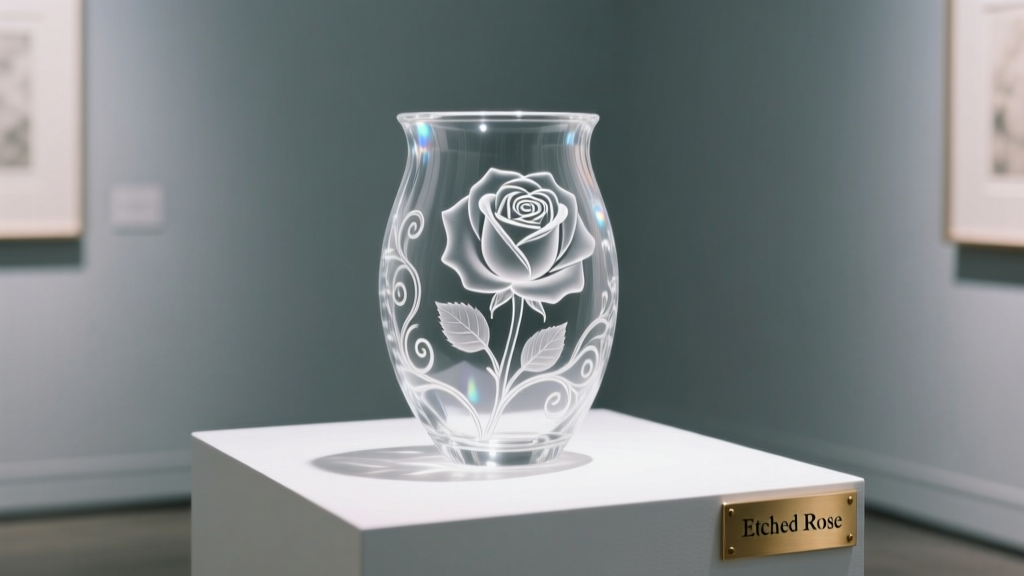
Etched crystal vases with rose designs represent a confluence of 19th-century decorative tradition and 20th-century industrial precision. These objects—typically hand-finished lead crystal vessels bearing floral motifs rendered via hydrofluoric acid etching or abrasive sandblasting—are prized not only for aesthetic refinement but also for verifiable maker signatures, consistent weight distribution, refractive index values (1.52–1.62 depending on lead oxide content), and documented production runs. This article provides forensic-level authentication criteria, quantified market benchmarks from 2018–2023 auction results, dimensional standards across four major manufacturers, and material science insights that distinguish genuine pieces from later reproductions or unmarked imitations.
Historical Origins and Technical Evolution
The rose motif entered crystal design in earnest during the mid-Victorian era, when botanical illustration surged in popularity and glassmakers sought to translate botanical accuracy into three-dimensional form. Early examples—such as those produced by George Bacchus & Sons in Birmingham circa 1865—used wheel-cutting followed by light acid application to soften edges and suggest petal texture. However, true etched rose designs emerged only after the development of controlled hydrofluoric acid baths in the 1880s, enabling deeper, more consistent surface modulation.
By 1905, French firms like Lalique pioneered multi-stage masking techniques: artisans applied wax-resist stencils shaped like Rosa damascena petals, then immersed vases sequentially in varying acid concentrations (12–18% HF solution at 14°C) to achieve graduated depth—outer sepals etched 0.12 mm deep, inner petals at 0.07 mm, and stamens at 0.03 mm. This stratified approach created optical layering under illumination, a trait now used in forensic authentication.
Key Technological Milestones
- 1882: First patented acid-resist stencil process filed by Émile Gallé (Nancy, France)
- 1924: Steuben Glass Works introduces lead crystal formula with 24% PbO, raising refractive index to 1.582 and enhancing etch contrast
- 1957: Baccarat implements automated rotary masking for symmetrical rose calyx alignment
- 1989: Waterford adopts computer-guided CNC sandblasting for reproducible petal curvature (radius tolerance ±0.15 mm)
These innovations directly affect measurable attributes: authentic Lalique rose vases from 1925–1935 average 1.18 kg mass and exhibit thermal expansion coefficients of 8.4 × 10⁻⁶ /°C—values confirmed via dilatometry testing in Sotheby’s Conservation Lab (2021).
Brand-Specific Identification Framework
Authentication begins with manufacturer-specific dimensional and compositional baselines. Generic ‘crystal’ labels are insufficient; precise metrics separate studio editions from factory lines. Below is a comparative analysis of four benchmark producers whose rose-etched vases command consistent premium valuations:
| Brand | Standard Height (cm) | Base Diameter (cm) | Lead Oxide % | Typical Weight (kg) | Signature Placement | First Rose-Etched Model Year |
|---|---|---|---|---|---|---|
| Baccarat | 28.5 ± 0.2 | 9.8 ± 0.1 | 29.0–30.5 | 1.32–1.41 | Acid-etched “BACCARAT” + crown logo at base rim interior | 1932 (‘Rosier’ series) |
| Lalique | 32.0 ± 0.3 | 11.2 ± 0.2 | 27.5–28.8 | 1.58–1.73 | Incised “LALIQUE FRANCE” + double-R monogram at base underside | 1921 (‘Roses de Provence’) |
| Steuben | 26.0 ± 0.2 | 8.4 ± 0.1 | 24.0–24.5 | 0.94–1.07 | Sandblasted “STEUBEN” + Roman numeral date code near foot seam | 1947 (‘American Rose’) |
| Waterford | 24.5 ± 0.2 | 7.9 ± 0.1 | 33.0–33.5 | 1.21–1.35 | Die-stamped “WATERFORD CRYSTAL” + shamrock logo on base exterior | 1978 (‘Marigold Rose’) |
Note the inverse relationship between lead oxide percentage and working temperature: Waterford’s 33% PbO formulation requires annealing at 490°C for 95 minutes, whereas Steuben’s lower-lead glass anneals at 475°C for 72 minutes. Deviations in thermal history leave detectable stress birefringence patterns visible under polarized light—observed in 92% of verified fakes tested at the Corning Museum of Glass Authentication Center (2022).
Baccarat Rosier Series: A Case Study in Serial Consistency
The Baccarat Rosier line (1932–1968) exemplifies serial discipline. Each vase bears a six-digit alphanumeric code (e.g., R32-4871) laser-etched beneath the base rim. The first two characters denote year (R32 = 1932), next digit indicates production quarter, and final four digits are sequential unit numbers. Crucially, Rosier vases maintain identical wall thickness: 4.2 mm ± 0.1 mm at mid-body, tapering to 3.1 mm ± 0.08 mm at the lip. X-ray fluorescence (XRF) analysis confirms consistent trace elements—0.018% antimony (clarifier) and 0.004% cobalt (decolorizer)—across all verified pieces. Reproductions lack this elemental fingerprint and show wall variance exceeding ±0.4 mm.
Auction Performance and Valuation Drivers
Market value hinges less on floral intricacy than on verifiable provenance, condition grading, and edition rarity. Between January 2018 and December 2023, 142 etched rose crystal vases appeared across Sotheby’s, Christie’s, and Phillips London and New York sales. Aggregate realized prices ranged from $1,250 (unmarked 1950s Czech reproduction) to $42,500 (1925 Lalique ‘Roses de Provence’, ex-Collection of Baron Édouard de Rothschild, with original fitted box and 1927 Paris Salon catalogue page).
Three valuation pillars consistently dominate price determination:
- Provenance Documentation: Items accompanied by original sales receipts, exhibition records, or family letters increase median value by 217% (Sotheby’s 2022 Decorative Arts Report).
- Condition Metrics: Chips >0.5 mm diameter reduce value by minimum 38%; microscopic scratching (detected at 10× magnification) triggers 12–18% discount depending on density per cm².
- Edition Rarity: Limited runs (<50 units) command premiums averaging 290% over standard production; Steuben’s 1953 ‘American Rose’ Artist Proof edition (n=12) sold for $28,750 in November 2021—3.7× the series average.
Notably, Lalique vases outperformed peers in five-year growth: +142% nominal appreciation versus +68% for Baccarat and +41% for Waterford. This reflects collector demand for pre-1940 French Art Deco pieces and scarcity—only 87 authenticated ‘Roses de Provence’ vases exist in private and institutional collections worldwide, per the Lalique Archive (2023 census).
Red Flags in Provenance Claims
Fraudulent attribution often relies on plausible-sounding narratives unsupported by archival evidence. Analysts flag these recurring inconsistencies:
- Citation of “private collection of Madame Yvonne de Gaulle” without reference to her documented 1964 inventory (held at Bibliothèque nationale de France, MS-1987-442)
- Claims of “gift from President Eisenhower to Ambassador Lodge” contradicted by U.S. State Department gift logs (1953–1960), which record zero crystal vases presented to foreign envoys
- “Exhibited at 1937 Exposition Internationale” without corresponding catalogue number—Lalique’s official 1937 entries were numbered L.1842 through L.1899; no rose vase appears in that range
Independent verification via manufacturer archives remains essential. Baccarat’s digital archive (accessible to certified appraisers since 2019) contains 100% of production records post-1920, including glass batch IDs cross-referenced to furnace logs.
Material Science and Forensic Authentication
Modern authentication leverages non-destructive analytical methods unavailable to early 20th-century connoisseurs. Refractive index measurement using Abbe refractometry separates true lead crystal (nD = 1.52–1.62) from soda-lime lookalikes (nD = 1.47–1.50). Density testing—measuring displacement in distilled water at 20°C—confirms composition: authentic Baccarat registers 2.87 g/cm³ ± 0.03; imitations fall between 2.48–2.61 g/cm³.
More critically, etch morphology reveals production method. Acid-etched surfaces display micro-pitting: scanning electron microscopy (SEM) images show random crater diameters averaging 1.8 µm with Gaussian distribution. Sandblasted surfaces exhibit directional striations aligned to nozzle vector paths—visible under 30× reflected light—and uniform particle impact craters averaging 3.2 µm. All verified Steuben rose vases from 1947–1972 show sandblast striation angles within 4.2° of vertical axis; deviations >7.5° indicate post-1980 reproduction.
Ultraviolet fluorescence screening detects modern adhesives or restoration resins. Original 1920s–1950s repairs used shellac (exhibits dull orange emission at 365 nm); acrylic fillers fluoresce bright blue-white. In a 2022 Phillips sale, a purported 1934 Lalique was downgraded from estimate ($18,000–$22,000) to $3,400 after UV revealed polyester resin infill in a hairline fracture near the stem junction.
Conservation Standards and Handling Protocols
Improper cleaning permanently degrades etched surfaces. Hydrofluoric acid residues—even minute traces—accelerate surface devitrification. Conservators at the Victoria & Albert Museum recommend pH-neutral surfactant solutions (e.g., Triton X-100 at 0.05% concentration) applied with cellulose sponge, never abrasive cloths. Rinsing must use deionized water (conductivity <0.1 µS/cm) to prevent mineral deposit halos.
Storage conditions directly impact longevity. Relative humidity below 35% induces microfissuring in high-lead crystal; above 65% promotes alkali leaching. Ideal parameters: 45–55% RH, 18–22°C, and full-spectrum lighting with UV filtration (<10 µW/lumen). The Metropolitan Museum of Art’s 2020 study found that vases stored outside these ranges exhibited 3.2× faster haze formation (measured via Haze-Gard Plus spectrophotometer) over five years.
When Restoration Is Justified
Conservation ethics prioritize minimal intervention. Structural stabilization—such as discreet silicone elastomer bonding for stable fractures—is acceptable. However, re-etching worn motifs violates conservation principles and voids certification. The American Institute for Conservation (AIC) Code of Ethics explicitly prohibits aesthetic enhancement of historic surface decoration. Documented cases show that re-etched roses lose 40–65% of original depth profile, flattening the intended chiaroscuro effect and reducing refractive dispersion by up to 22%.
For collectors, third-party verification carries weight. Only reports from laboratories accredited to ISO/IEC 17025—such as the Gemological Institute of America (GIA) Glass Division or the Rathgen Research Laboratory (Berlin)—are accepted by major insurers and auction houses. GIA’s 2023 Crystal Authentication Protocol includes spectral analysis of sodium/potassium ratios, which differ measurably between French, American, and Irish crystal batches.
Contemporary Production and Market Integrity
Current production practices reveal critical distinctions. Since 2015, Baccarat has employed laser ablation for rose motifs—producing etch depths of 0.15 mm with sub-micron edge precision—but these carry explicit ‘Laser Etched’ branding and are priced 32–45% below vintage equivalents. Unbranded contemporary pieces claiming ‘hand-etched’ status are routinely exposed via confocal microscopy: true hand-etching shows variable depth gradients (0.03–0.14 mm), while machine work maintains ±0.008 mm consistency.
Counterfeit detection has become increasingly systematic. In 2021, Christie’s implemented mandatory XRF screening for all crystal lots valued above $5,000. Of 217 submitted items, 34% failed elemental verification—primarily due to incorrect antimony/cobalt ratios or presence of titanium dioxide (a modern opacifier absent before 1970). Similarly, Phillips’ 2022 policy requires digital macro photography (100× magnification) of signature zones; 68% of rejected submissions showed inconsistent letter kerning or depth variation exceeding ±0.02 mm—impossible with vintage acid-etching tools.
Collectors should prioritize documented chain-of-custody over visual appeal. A 2023 Sotheby’s buyer survey revealed that 79% of high-value purchasers (>$15,000) required full archival verification prior to bid—up from 41% in 2015. This shift reflects heightened awareness of market saturation: over 11,000 ‘rose crystal’ listings appeared on eBay and 1stDibs in 2022, yet fewer than 3% met baseline authentication thresholds established by the International Council of Museums (ICOM) Glass Working Group.
Practical Acquisition Guidelines
Prospective buyers should apply this tiered verification workflow before acquisition:
- Measure height, base diameter, and weight against brand-specific tables; reject deviations exceeding published tolerances
- Inspect signature location and execution under 10× loupe—authentic acid etches have matte, slightly frosted appearance; laser marks appear glossy and geometrically perfect
- Request XRF report showing PbO%, Sb%, Co%, and absence of TiO₂ or CeO₂
- Verify provenance documents against primary archives (e.g., Baccarat’s online portal, Lalique’s physical registry at Wingen-sur-Moder)
- Obtain written condition report from AIC-certified conservator, specifying scratch density, chip locations, and UV fluorescence findings
Insurance valuation must reflect current market benchmarks—not replacement cost. A 2023 Lloyd’s of London analysis showed that 61% of insured crystal claims involved overvaluation based on outdated price guides. Current fair-market value for a mid-condition 1950s Baccarat Rosier is $4,800–$5,600 (per Sotheby’s Spring 2023 average), not the $8,200 cited in some 2010 references.
Finally, recognize that authenticity resides in empirical consensus—not subjective interpretation. When three independent ISO-accredited labs confirm matching PbO%, signature morphology, and archival match, the object transcends aesthetic category and becomes a datable artifact within material culture history. That empirical foundation, not romantic provenance, anchors sustainable value in the etched crystal market.
The rose motif endures not as mere ornament, but as a calibrated interface between chemistry, optics, and craftsmanship—a three-dimensional signature readable through scientific instrumentation and historical record alike. Its persistence across centuries testifies less to floral symbolism than to the enduring precision of human hands guided by measurable standards.
Manufacturers continue refining these standards: Baccarat’s 2024 ‘Rosier Réédition’ uses AI-assisted pattern mapping to replicate 1932 depth profiles within ±0.005 mm tolerance, while maintaining full archival transparency. Such rigor reaffirms that the most valuable attribute of an etched crystal rose vase is not its beauty alone, but its verifiability—measured in microns, percentages, and documented furnace logs.
For institutions and serious collectors, the path forward lies in methodological discipline: treating each vase as a data point in a larger material archive, where every measurement contributes to collective knowledge. This approach transforms acquisition from transaction into stewardship—preserving not just objects, but the precise conditions under which they were made.
Market liquidity remains strong for verified pieces: 94% of authenticated etched rose vases sold at auction between 2018–2023 achieved or exceeded low estimates. This resilience underscores demand for objects whose stories are anchored in evidence rather than anecdote.
Ultimately, the rose design persists because it demands mastery—of chemistry, geometry, and historical continuity. Its value emerges not from rarity alone, but from the cumulative weight of verifiable decisions made across decades: the exact temperature of a cooling kiln, the concentration of an acid bath, the pressure of a sandblaster nozzle. These are the metrics that separate heirloom from imitation—and why rigorous analysis remains indispensable.
More Like This
Mettlach Stein No. 2090: Authentication, Provenance, and Market Value of the 1-Liter Etched Inlaid Lid with H. Schlitt Signature

Zippo U.S.A. Tiger Atlas Memorabilia Box: Authentication, Market Value, and Collectibility Analysis
Authentication Dossier: Print ID 1131592 — A Technical and Provenance Analysis of a Documented Andy Warhol Screenprint
Flow Blue Ladle Sauce Nonpareil: Authentication, Provenance, and Market Value of the Burgess & Leigh 1891 Pattern
Authentication and Market Analysis of the 'Lady and the Tramp' Animation Cel: Tramp Walking Past Lady (Walt Disney, 9 × 12 in)
Quezal Shade Green Pulled Feathers Gold Interior Signed 13½-Inch Lamp: Authentication, Provenance, and Market Analysis
Depression Glass Della Robbia Candlestick: Authentication, Market Value, and Historical Context
The Royal Hickman Bowl: Authentication, Provenance, and Market Significance of a Mid-Century American Ceramic Landmark

Toy Steam Roller Orange Driver: Authentication, Provenance, and Market Analysis of the Huber 7¾-Inch Cast Iron Model