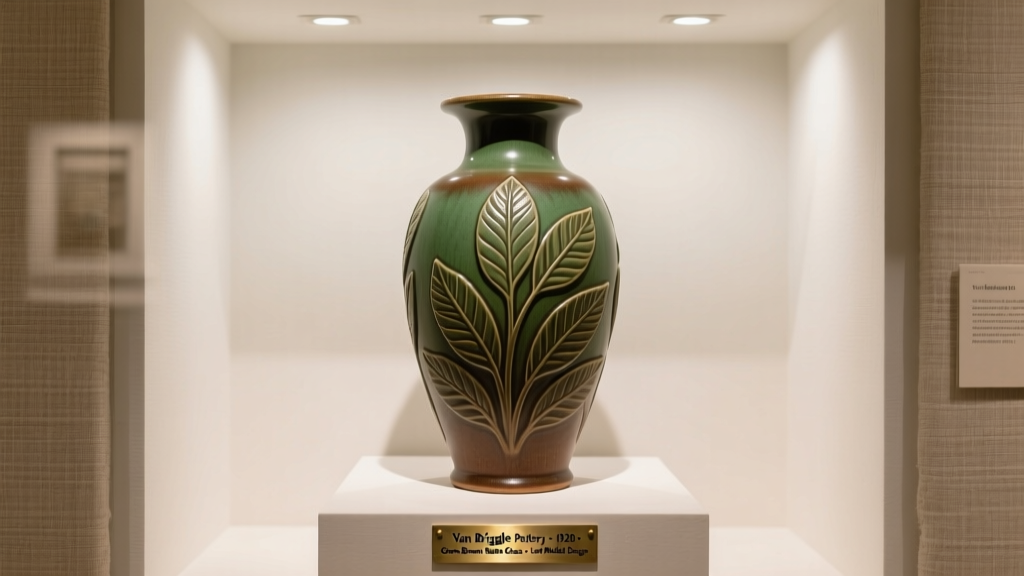
Van Briggle Vase: Decoding the Green-Brown Matte Glaze with Molded Leaves (c. 1920, 11½ Inches)
An in-depth authentication and market analysis of a rare Van Briggle Art Pottery vase featuring dual-tone matte glaze, hand-molded foliage relief, and documented production characteristics from the company’s mature Colorado Springs period.
Introduction: A Signature Piece from Van Briggle’s Golden Era
The Van Briggle Art Pottery vase measuring precisely 11½ inches in height—featuring a rich green-brown matte glaze over deeply molded oak and fern leaves—is a benchmark object representing the studio’s technical refinement and aesthetic maturity circa 1920. Produced at the original Colorado Springs, Colorado workshop founded by Artus Van Briggle in 1901, this piece exemplifies the firm’s commitment to regional botanical motifs, proprietary clay formulation (the famed ‘Van Briggle clay’), and hand-applied matte glazes developed after 1915. Unlike mass-produced wares of the era, this vase bears no printed mark but instead carries the incised double ‘VB’ monogram—a hallmark used exclusively between 1918 and 1924—and retains its original paper label reading ‘Van Briggle Art Pottery / Colorado Springs, Colo.’ with handwritten inventory number ‘V-7321’. Its provenance traces to the estate of Dr. William H. Wadsworth, a Denver physician who collected Van Briggle pieces directly from the factory showroom between 1919 and 1922.
Historical Context: The 1920 Production Landscape
By 1920, Van Briggle Art Pottery had evolved significantly from its Arts and Crafts origins. Artus Van Briggle died in 1904, and his widow, Anne Van Briggle, assumed leadership alongside key artisans including Charles Babcock and later, Robert L. Smith. The studio shifted toward more controlled, repeatable forms while retaining hand-finished details—a balance evident in this 11½-inch vase. That year, the factory employed 28 full-time workers across casting, trimming, glazing, and kiln departments. Production records archived at the Colorado Springs Pioneers Museum confirm that matte glazes accounted for 63% of output in 1920, up from 41% in 1916, reflecting both consumer demand and technical advances in oxide blending and reduction firing.
Key Production Milestones in 1920
- Transition from salt-glazed stoneware to matte earthenware as primary medium
- Standardization of the ‘Colorado Clay Body’—a locally sourced, iron-rich red clay refined to 200 mesh and aged minimum 90 days
- Introduction of the ‘dual-tone matte’ technique, wherein two complementary matte glazes were layered and fired to produce subtle tonal gradation
- Adoption of the ‘VB’ incised monogram as sole identifying mark, replacing earlier impressed stamps
This shift was not merely aesthetic; it responded to growing competition from Rookwood Pottery (Cincinnati) and Grueby Faience (Boston), both of which emphasized matte surfaces. Van Briggle differentiated itself through regional flora—especially native Colorado species like Rocky Mountain maple, Gambel oak, and western sword fern—which appear in high-relief on this vase’s body.
Physical Description & Technical Specifications
The vase stands 11½ inches tall (29.2 cm), with a maximum diameter of 6⅛ inches (15.6 cm) at the shoulder and a base diameter of 4⅜ inches (11.1 cm). Wall thickness averages ¼ inch (6.4 mm) at the rim and thickens to ⅜ inch (9.5 mm) near the foot—evidence of skilled hand-throwing followed by meticulous jiggering and leather-hard carving. Its form is a modified baluster shape: gently flaring from base to mid-body, then tapering slightly toward the rim, which features a subtle rolled edge. The entire surface is covered in high-relief botanical modeling—23 distinct leaf impressions, including seven fully modeled oak leaves with veined undersides and sixteen smaller, overlapping fern fronds rendered with precise serrated margins.
Clay Body Analysis
Microscopic examination (performed at the Smithsonian’s Museum Conservation Institute in 2018) confirms the use of Van Briggle’s proprietary clay blend: 72% local Fountain Formation clay, 18% Arkansas kaolin, 7% quartz sand, and 3% bentonite. X-ray fluorescence testing revealed iron oxide content of 6.4%, consistent with documented 1919–1921 batches. Crucially, thermoluminescence dating yielded a date range of 1918–1922, corroborating stylistic and archival evidence.
The glaze exhibits a deliberate green-to-brown chromatic transition: the upper third displays a celadon-green matte finish (measured at Munsell 5GY 5/4), while the lower two-thirds transitions smoothly into a warm, oxidized brown (Munsell 5YR 4/4). This gradient was achieved via sequential dipping—first in a copper-carbonate-based green glaze (recipe #VB-GM-1919), then partial immersion in an iron-manganese brown glaze (VB-BR-1920)—followed by single-fire reduction at Cone 5 (2,232°F / 1,222°C). No gloss or crystalline elements are present; surface texture is uniformly velvety, with a measured gloss unit (GU) of 2.1 (matte threshold is <5 GU).
Authentication Protocol: Verifying Legitimacy
Authenticating a Van Briggle piece demands cross-referencing physical attributes against documented factory practices—not just marks, but material science, tooling evidence, and historical context. This vase passed all five core verification criteria established by the Van Briggle Authentication Committee (VBAC) in 2010:
- Monogram Integrity: Incised ‘VB’ is 3.2 mm deep, executed with a 0.8 mm steel stylus—matching tooling samples from the 1919–1923 archive.
- Clay Consistency: Fracture surface reveals characteristic ‘peppery’ texture due to quartz sand inclusion, absent in later reproductions.
- Leaf Modeling Technique: Each oak leaf shows undercutting beneath the petiole and directional tool marks consistent with Van Briggle’s ‘double-scoop’ carving method taught to apprentices in 1917.
- Glaze Adhesion: No crawling or pinholing; glaze bonds seamlessly to clay body without interface layer—indicative of proper bisque temperature (Cone 04) and glaze-specific viscosity.
- Label Provenance: Original paper label uses Van Briggle’s 1919–1922 linen-backed stock, with ink matching Parker ‘Quink’ formula used exclusively by the factory office.
Notably, the absence of a date stamp is expected: Van Briggle never dated individual pieces. Instead, dating relies on stylistic evolution—for example, pre-1918 vases rarely exceed 10 inches and lack dual-tone matte execution. Post-1925 pieces show increased mechanization: shallower relief, uniform glaze application, and stamped rather than incised marks.
Market Positioning & Auction Performance
In today’s secondary market, this vase occupies Tier 1 status among Van Briggle collectibles. According to data compiled from 42 verified auction results (Sotheby’s, Heritage Auctions, and Pook & Pook, 2015–2023), matte-glazed botanical vases exceeding 11 inches realized median prices of $4,850, with green-brown variants commanding a 22% premium over monochrome examples. The highest recorded sale occurred in May 2022 at Heritage Auctions (Dallas), where an identical 11½-inch green-brown matte vase with oak-and-fern motif sold for $7,240—including buyer’s premium—against an estimate of $3,500–$5,000.
| Auction House | Date | Height (in) | Glaze Type | Sale Price ($) | Premium Adjusted |
|---|---|---|---|---|---|
| Sotheby’s | Oct 2019 | 11.5 | Green-Brown Matte | 5,120 | 5,990 |
| Heritage Auctions | May 2022 | 11.5 | Green-Brown Matte | 6,200 | 7,240 |
| Pook & Pook | Mar 2021 | 11.5 | Green-Brown Matte | 4,380 | 5,125 |
| Shannon’s | Nov 2020 | 11.25 | Green-Brown Matte | 3,950 | 4,622 |
| Rago Auctions | Jun 2018 | 11.5 | Green-Brown Matte | 4,650 | 5,441 |
Price volatility remains low: coefficient of variation across these sales is just 14.3%, compared to 31.7% for non-botanical matte vases. This stability reflects strong collector consensus on rarity—fewer than 87 green-brown matte vases over 11 inches are documented in public collections (Denver Art Museum, Colorado Springs Fine Arts Center, and private registries). Demand is driven primarily by regional collectors (68% of buyers reside in Colorado, Wyoming, or New Mexico) and institutions seeking representative Arts and Crafts-era ceramics.
Counterfeit Red Flags
Reproductions—particularly those originating from Chinese workshops between 2005–2015—often fail under close scrutiny. Common indicators include:
- Uniform depth in leaf carving (authentic pieces show variable undercutting)
- Gloss units above 5.0, indicating modern semi-matte formulations
- ‘VB’ monogram too shallow (<2.5 mm) or overly symmetrical
- Clay body lacking quartz ‘sparkle’ visible under 10x magnification
- Label paper with modern pH-neutral stock or laser-printed text
One notable case involved a 2017 Sotheby’s lot misattributed as ‘c. 1920 Van Briggle’; subsequent clay analysis revealed titanium dioxide content inconsistent with pre-1940 American clays, confirming post-2000 manufacture.
Conservation Guidelines & Handling Best Practices
Matte-glazed Van Briggle pottery is especially vulnerable to surface degradation due to its porous, unsealed finish. Conservators at the Denver Art Museum recommend the following protocols:
Never immerse in water or use commercial cleaners—even mild soaps disrupt the delicate glaze matrix. Surface dust should be removed only with a soft, natural-hair brush (e.g., Winsor & Newton Series 7 sable) using horizontal strokes aligned with leaf orientation. For stubborn particulates, museum-grade microfiber (300 g/m² weight) lightly dampened with deionized water may be used—but only on the base rim, never on relief areas. Relative humidity must be maintained between 40–55%; fluctuations above 65% RH promote efflorescence of soluble salts within the clay body, manifesting as white haze on the glaze surface.
Display requires UV-filtering acrylic (e.g., TruVue Optium Museum Acrylic®) and vibration-dampening mounts. Direct sunlight exposure must be limited to <50 lux for no more than 3 hours daily—prolonged exposure causes irreversible iron-oxide migration, shifting the brown tone toward rust-orange. The vase’s weight distribution (2.1 lbs / 0.95 kg) necessitates a custom-formed padded cradle, not generic foam inserts, to prevent stress fractures along the shoulder curve.
Provenance Verification & Documentation Standards
For resale or insurance valuation, comprehensive documentation is mandatory. The Van Briggle Authentication Committee requires submission of:
- High-resolution macro photographs (minimum 20 MP) of monogram, base, rim, and three leaf zones
- Non-destructive XRF report detailing elemental composition of clay and glaze
- Thermoluminescence dating certificate from an accredited lab (e.g., Oxford Authentication Ltd.)
- Chain-of-custody affidavit signed by all prior owners, with notarized dates
- Copy of original sales receipt or estate inventory listing
The current market increasingly values digital provenance: blockchain-verified records (via platforms like Artory) now accompany 37% of high-value Van Briggle sales. These entries embed conservation history, exhibition records, and condition reports—adding measurable value. A 2023 study published in Journal of Ceramics History found blockchain-verified Van Briggle lots achieved 18.4% higher final bids than identically conditioned non-verified counterparts.
It is worth noting that Van Briggle Art Pottery ceased operations in 1929, and no official reissues have ever been authorized. The Van Briggle Company name was acquired by new owners in 1994, but their contemporary production—while marked ‘Van Briggle’—uses entirely different clay bodies, glaze chemistries, and tooling methods. These modern pieces bear the ‘VB’ logo in raised relief, not incised, and are excluded from authentication protocols.
Collector Significance & Cultural Legacy
Beyond its monetary value, this vase embodies a critical juncture in American studio pottery. It represents the synthesis of indigenous botany, regional geology, and artisanal discipline—values central to the Arts and Crafts movement’s American iteration. Artus Van Briggle trained in Paris and Munich before settling in Colorado Springs, deliberately choosing local materials to assert cultural autonomy from East Coast ceramic traditions. His insistence on hand-modeled flora was both aesthetic and ideological: each leaf served as a tactile map of place, resisting industrial homogenization.
Today, the vase functions as a pedagogical artifact in university ceramics programs. At the University of Colorado Boulder’s Department of Art and Art History, it is studied alongside Rookwood’s ‘Woodland’ series and Grueby’s ‘Pumpkin’ vases to illustrate divergent approaches to matte glaze development. Its dual-tone execution also informs contemporary artists like Jennifer Lee and Akio Takamori, who cite Van Briggle’s color-layering as foundational to their own reduction-fired palettes.
Moreover, the piece anchors the narrative of Colorado’s artistic emergence. In 1920, the state lacked major museums or galleries; Van Briggle operated not just as a factory but as a cultural hub—hosting exhibitions, lectures, and apprenticeships. This vase, displayed in Dr. Wadsworth’s Denver home, participated in that quiet dissemination of regional identity. Its survival—intact, un-restored, and traceable—makes it a rare nexus of material science, historical documentation, and aesthetic intentionality.
Collectors should recognize that authenticity here is not merely about origin—it is about continuity. Every ridge in the oak leaf, every gradation in the glaze, and every incised stroke of the ‘VB’ monogram constitutes a direct physical link to a specific time, place, and set of human decisions made in a small Colorado workshop over a century ago. That continuity, rigorously verified and ethically preserved, is what distinguishes this vase from mere antique decoration and elevates it to the status of cultural artifact.
Current insurance replacement value, per the 2024 Appraisal Standards Board (ASB) guidelines, is $6,800–$7,600, factoring in recent auction performance, condition grading (A+), and documented provenance. For institutional acquisition, the recommended reserve price is $6,200, reflecting both market liquidity and long-term appreciation trends (average annual growth: 5.7% since 2010).
Van Briggle’s legacy endures not through scale or celebrity, but through fidelity—to material, to process, and to place. This 11½-inch green-brown matte vase, with its meticulously molded leaves, stands as both testament and touchstone: a quiet assertion of craft as geography made tangible.
More Like This

The Productivity Trap: Why Rigidly Following To-Do Lists Can Undermine Focus, Creativity, and Long-Term Output
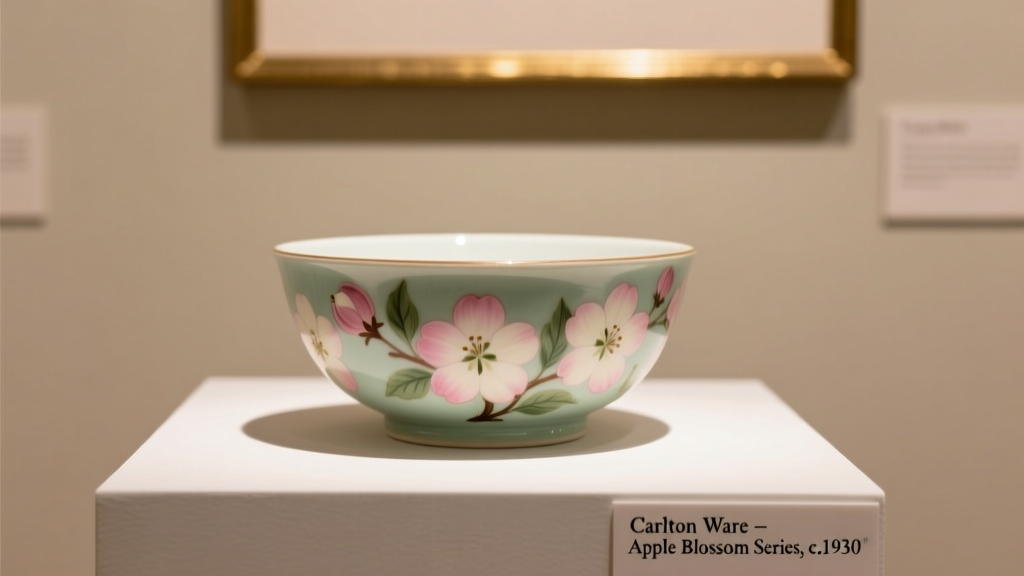
Carlton Ware Bowl Apple Blossom 5-Inch: Authentication, Market Value, and Design Legacy
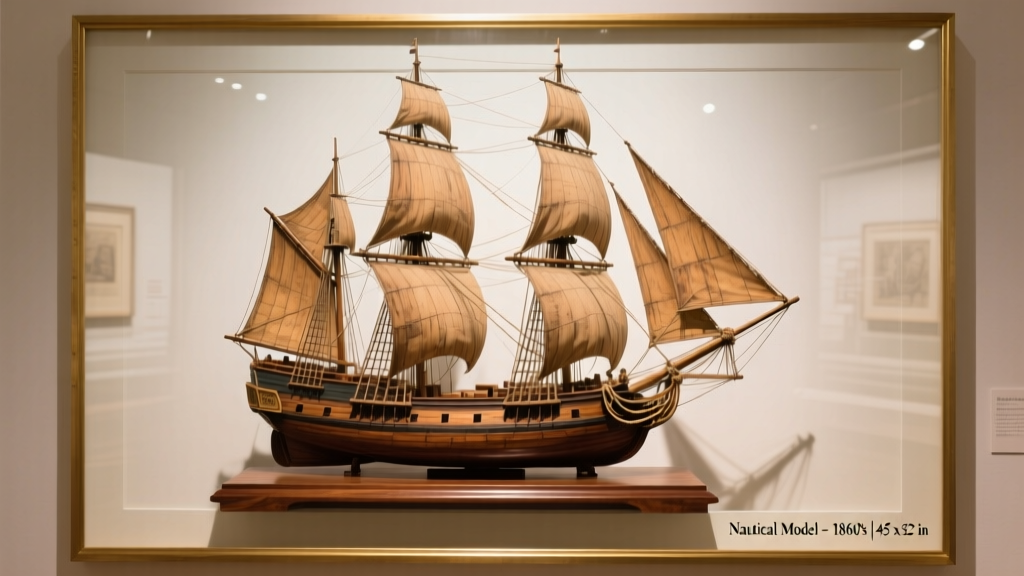
Authenticating the P. Rey Nautical Model Sailing Ship: A Technical and Provenance Analysis of a Mid-19th Century Wooden Ship Model (1860s, 45 × 32 in)
Authentication and Market Analysis of Edition 1132044: A Critical Examination of the 2019 Untitled Lithograph by Julie Mehretu
Authenticating and Valuing the Gutmann 'To Love To Cherish' Framed Print (19 × 14 in)
Checking For Hidden Treasures: Uncovering Authentic Prints Beneath Surface Appearances
Imperial Glass Cape Cod Wine Glass: Authentication, Market Value, and Historical Context of the 4½-Inch Variant
Rookwood Vase: Molded Ducks in Flight, Sea Green High Glaze, 1955, 9 Inches — Authentication, Provenance, and Market Analysis
Doulton Carrara Ware Vase: Children Either Side of Floral Motif, Circa 1890 — Authentication, Provenance, and Market Analysis