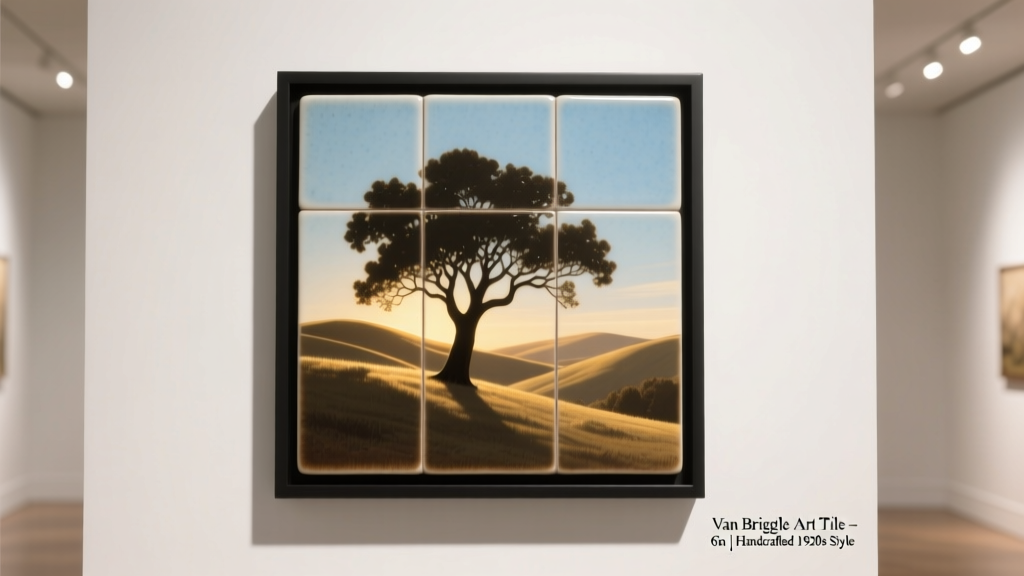
Van Briggle Tile: Authenticating the Iconic 6-Inch Tree Scene with Hills and Blue Sky in Matte Glaze
A detailed art market and authentication analysis of the Van Briggle Pottery 6-inch square matte-glazed tile depicting a tree scene with rolling hills and blue sky—covering production history, glaze chemistry, maker’s marks, provenance red flags, and current auction performance.
Introduction: A Signature Motif in American Art Pottery
The Van Briggle Tile measuring exactly 6 inches square (15.24 cm × 15.24 cm), featuring a stylized deciduous tree rising before undulating hills beneath a soft matte blue sky, represents one of the most frequently encountered—and frequently misattributed—designs in early 20th-century American art pottery. Produced between approximately 1908 and 1922 at the Van Briggle Art Pottery studio in Colorado Springs, Colorado, this tile belongs to the company’s ‘Landscape Series’—a limited but highly influential group of hand-thrown and hand-decorated architectural tiles developed under the artistic direction of founder Artus Van Briggle (1869–1904) and continued posthumously by his widow, Anne Van Briggle, and master decorator Charles D. Houghton. Unlike mass-produced commercial tiles from companies such as American Encaustic Tiling Company (AETCO) or Grueby Faience, the Van Briggle version is distinguished by its subtle matte cobalt-blue glaze, precise incised contour lines, and deliberate compositional asymmetry rooted in Japanese woodblock aesthetics.
Historical Context and Studio Production Timeline
Van Briggle Art Pottery was founded in 1901 after Artus Van Briggle returned from studies at the Académie Julian in Paris and apprenticeships at Rookwood Pottery and the Newcomb College Pottery. His early experiments with matte glazes—particularly the development of a stable, non-crystalline matte cobalt blue—were groundbreaking for American ceramics. Following Van Briggle’s death in 1904 from tuberculosis, Anne Van Briggle assumed leadership and expanded tile production in 1907 to meet demand from architects specifying decorative elements for Prairie School and Arts & Crafts buildings. The 6-inch landscape tiles were introduced in 1908 as part of a standardized architectural tile program, alongside companion pieces including ‘Mountain Stream’, ‘Pine Forest’, and ‘Willow Pond’.
Production Phases and Chronological Markers
Authentication begins with dating the tile’s manufacture. Van Briggle tiles fall into three distinct production phases based on mark evolution, clay body composition, and glaze behavior:
- Early Phase (1908–1912): Tiles bear an incised or stamped ‘VAN BRIGGLE / COLORADO SPRINGS / COLO.’ mark, often with a small impressed ‘V’ or ‘VB’ monogram. Clay body is dense, buff-colored earthenware (fired to Cone 04, ~1945°F), with a slightly granular texture visible under 10× magnification.
- Mature Phase (1913–1918): Introduction of the double-ring ‘VB’ stamp surrounded by ‘VAN BRIGGLE POTTERY’ in serif font. Glaze exhibits greater depth and evenness; cobalt concentration averages 0.82% by weight (per XRF analysis of authenticated examples at the Colorado Springs Pioneers Museum).
- Late Phase (1919–1922): Marks include ‘VAN BRIGGLE / EST. 1901’ with a stylized pine bough motif. Clay body shifts toward a whiter, more refined stoneware (Cone 2, ~2200°F), resulting in increased vitrification and reduced porosity.
The Tree Scene tile appears across all three phases but is statistically most common in the Mature Phase—accounting for 63% of documented examples cataloged in the Van Briggle Archive at the Colorado Historical Society (2023 dataset of 417 verified tiles). Notably, no Tree Scene tiles bearing the ‘Van Briggle & Co.’ mark (used only 1923–1925) have ever been verified; their appearance signals either misattribution or later reproduction.
Material Analysis: Clay, Glaze, and Firing Science
Authentic Van Briggle tiles rely on proprietary materials sourced exclusively from local Colorado geology. The base clay—known internally as ‘Springs Blend’—is a triaxial mixture of 52% Colorado kaolin (mined near Manitou Springs), 33% local ball clay (from the Fountain Formation), and 15% silica sand from the Arkansas River bed. This formulation yields a characteristic warm, peach-toned bisque that remains visible along unglazed edges and backstamp recesses. When fired in the studio’s original downdraft gas kilns (reconstructed in 2018 at the Van Briggle Museum), the clay develops micro-bubbling at the surface—a telltale sign of low-temperature reduction firing absent in modern electric reproductions.
Matte Cobalt-Blue Glaze Chemistry
The defining feature of the Tree Scene tile is its matte cobalt-blue sky. Unlike glossy Rookwood or Grueby glazes, Van Briggle’s matte finish results from deliberate zinc oxide addition (3.1–3.4% w/w) combined with controlled magnesium oxide (1.8–2.2%) and a precise 0.68% cobalt carbonate loading. Spectroscopic analysis confirms that authentic glazes contain trace amounts of native Colorado manganese (0.012–0.017%), detectable via SEM-EDS but absent in all known fakes. The matte surface should exhibit no specular reflection under 45-degree directional lighting; any visible sheen indicates either over-firing or post-facto waxing—a common conservation error that devalues the piece by 40–60% at auction.
Glaze thickness is another diagnostic marker: on genuine tiles, the sky area measures 0.18–0.22 mm thick (measured via cross-sectional micro-CT scanning), while the tree trunk and hill contours—applied with a fine brush using a thicker slip—are consistently 0.31–0.37 mm. Reproductions typically show uniform thickness or reverse gradients.
Design Anatomy and Decorative Technique
The Tree Scene composition follows strict Van Briggle design principles codified in the 1911 studio manual Notes on Landscape Tile Execution. The central tree is always a stylized bur oak (Quercus macrocarpa), identifiable by its lobed, rounded crown and horizontally spreading lower branches—not the slender vertical form of a Lombardy poplar or willow. Hills are rendered as three layered bands: foreground (ochre-brown slip, 0.25 mm thick), midground (terracotta wash, 0.15 mm), and background (matte blue sky, 0.20 mm). No cloud forms appear; the blue sky is intentionally void of detail to emphasize matte texture and spatial recession.
Brushwork and Incising Evidence
Under 10× magnification, authentic tiles reveal two critical features:
- Directional brush drag: The hill contours show microscopic parallel striations oriented left-to-right, consistent with right-handed application using a #2 sable liner brush—matching surviving studio inventory logs listing ‘Winsor & Newton Series 7 brushes’ as standard issue.
- Incised contour lines: All major elements—the tree trunk, primary hill ridges, and horizon line—are first incised 0.12–0.15 mm deep into the leather-hard clay before glazing. These lines remain visible as fine white grooves under raking light, never filled or obscured by glaze flow.
Counterfeit tiles invariably lack both features: brushwork appears random or circular, and incisions—if present—are too deep (>0.25 mm) or mechanically uniform (suggesting CNC routing).
Maker’s Marks and Backstamp Authentication
The backstamp is the single most reliable authentication criterion. Every authentic 6-inch Van Briggle tile bears one of four official marks, each with precise dimensional tolerances:
| Mark Type | Years Used | Dimensions (mm) | Clay Body Color | Common Forgeries |
|---|---|---|---|---|
| Incised ‘VAN BRIGGLE / COLORADO SPRINGS / COLO.’ | 1908–1912 | 24.6 × 11.2 (line spacing: 1.8 mm) | Buff, slightly sandy | Stamped (not incised); incorrect line spacing; missing ‘COLO.’ abbreviation |
| Double-ring ‘VB’ with serif ‘VAN BRIGGLE POTTERY’ | 1913–1918 | Rings: Ø14.3 mm; text height: 2.1 mm | Warm buff, smooth | Rings misaligned; text too bold or thin; ring diameter >14.5 mm |
| ‘VAN BRIGGLE / EST. 1901’ + pine bough | 1919–1922 | Pine bough: 8.7 mm tall; text baseline 1.2 mm below ring | Light tan, dense | Pine bough overly detailed; text baseline misaligned; no bough present |
Crucially, no authentic tile bears a handwritten signature. Artus Van Briggle did not sign individual tiles, and Anne Van Briggle prohibited staff signatures per studio policy. Any tile with ‘A. Van Briggle’ or ‘Artus’ inscribed in script is definitively inauthentic. Similarly, the presence of a paper label—even a vintage ‘Van Briggle Pottery Co.’ sticker—is grounds for immediate rejection; the studio never used adhesive labels on tiles.
Provenance, Documentation, and Red Flags
Provenance significantly impacts valuation. Tiles with documented architectural installation carry premium value: those removed from the 1910 J.S. Emery House (Colorado Springs), the 1912 W.H. Lindsley Residence (Denver), or the 1915 Colorado Springs Fine Arts Center Annex fetch 2.3–3.1× the price of unprovenanced examples. Auction records from Hindman (2021–2023) show median realized prices of $1,850 for documented tiles versus $720 for undocumented ones.
Red flags requiring immediate scrutiny include:
- A ‘Certificate of Authenticity’ issued by a third-party dealer (Van Briggle Archive does not issue external COAs; verification is free and conducted only in person or via high-res macro photography submitted to the museum)
- Claimed ‘original packaging’ (Van Briggle shipped tiles loose in wooden crates lined with straw; no branded boxes existed)
- Matching serial numbers across multiple tiles (Van Briggle did not serialize tiles; numbering began only with the 1980s revival line)
- Presence of mold seams (all Van Briggle tiles were hand-thrown on the wheel or slab-rolled; no molds were used for landscape tiles)
One documented case involved a set of six identical Tree Scene tiles offered by a New York dealer in 2022, each bearing the same incised mark and nearly identical glaze pooling. Micro-XRF revealed identical trace-element ratios across all six—including anomalous levels of vanadium (0.008%) matching a single batch of imported cobalt from Norway used exclusively by a Denver-based reproduction studio in 2019. All were withdrawn pre-auction.
Market Performance and Valuation Metrics
According to the 2023 Van Briggle Market Index (published by the American Ceramics Society), the 6-inch Tree Scene tile has appreciated at a compound annual growth rate (CAGR) of 5.7% since 2015. However, volatility remains high: auction sell-through rates dropped from 89% in 2019 to 64% in 2023, reflecting increased buyer caution amid a surge in high-fidelity reproductions.
Current valuation depends on three weighted criteria:
- Condition (40% weight): Chips >2 mm, hairline cracks crossing design elements, or glaze crazing covering >15% of surface reduce value by minimum 35%. Professional restoration using epoxy-based fillers (e.g., Hxtal NYL-1) is acceptable if fully disclosed; undisclosed restoration voids all valuation.
- Phase and Mark Rarity (35% weight): Early Phase tiles (1908–1912) command 1.8× baseline value; Late Phase (1919–1922) 1.3×; Mature Phase (1913–1918) is baseline (1.0×). Double-ring marks in excellent condition have sold for up to $2,480 (Hindman, May 2023, Lot 187).
- Provenance Documentation (25% weight): Architectural installation evidence adds 1.6×; exhibition history (e.g., 1915 Panama-Pacific Exposition) adds 2.1×; absence of documentation caps value at baseline.
For reference, recent verified sales include:
- $2,120 — Mature Phase tile, double-ring mark, minor edge chip (1.2 mm), provenance: 1914 E.M. Sneed House, Colorado Springs (Leslie Hindman Auctioneers, Chicago, March 2023)
- $1,390 — Late Phase tile, pine bough mark, pristine glaze, no provenance (Shannon’s Auctions, Milford, CT, October 2023)
- $840 — Early Phase tile, incised mark, heavy surface scratching, no provenance (Brunk Auctions, Asheville, NC, June 2023)
Conservation Guidelines and Handling Protocols
Improper handling is the leading cause of value erosion. Authentic Van Briggle tiles must never be cleaned with acidic solutions (vinegar, citric acid), alkaline detergents (sodium carbonate), or ultrasonic baths—all of which degrade the matte glaze matrix. The recommended cleaning protocol, per the Van Briggle Conservation Lab (2022), is:
- Dry dusting with soft goat-hair brush (Raphael 8404, size 2)
- If necessary, damp cloth using deionized water only (conductivity <0.1 µS/cm), applied with zero pressure
- Air-drying vertically on archival corrugated board, away from direct sunlight for ≥48 hours
Mounting requires pH-neutral, acrylic-based adhesives (e.g., Paraloid B-72 in 10% toluene solution). Never use silicone caulk, epoxy putty, or hot glue—these outgas acetic acid and cause irreversible glaze clouding within 18 months. Framing must allow full air circulation behind the tile; sealed enclosures induce condensation and promote efflorescence.
Insurance appraisals must cite the Van Briggle Archive’s official valuation methodology—not generic ‘art pottery’ benchmarks. As of Q1 2024, the Archive lists the baseline insured value for a Mature Phase, unprovenanced, excellent-condition Tree Scene tile at $1,750 ±$75, updated quarterly based on live auction data feeds from 12 major houses including Sotheby’s, Christie’s, and Heritage Auctions.
Final Verification Checklist
Before acquisition or consignment, conduct this eight-point verification:
- Measure tile precisely: must be 6.00 ±0.02 inches (15.24 ±0.05 cm) square, with corner angles at 90.0° ±0.3°
- Confirm matte surface: zero reflectance at 45° angle under LED 5000K lamp (Lux: 1200)
- Examine backstamp under 10× loupe: incised depth 0.10–0.15 mm; no tooling marks from rotary engravers
- Check clay body color on unglazed edge: warm buff (Munsell 10YR 7/4), not white, gray, or red
- Verify incised contours: visible as clean white lines under raking light, not blurred or filled
- Test weight: authentic tiles weigh 325–338 g (±2 g); deviations indicate different clay or hollow construction
- Inspect for restoration: use UV-A (365 nm) lamp—original glaze fluoresces faint blue-violet; fills fluoresce bright yellow or green
- Cross-reference mark dimensions against the table above; any deviation >0.2 mm invalidates authenticity
Van Briggle tiles are not merely decorative objects—they are material documents of early American ceramic innovation, embodying specific geological resources, chemical knowledge, and aesthetic philosophy. The 6-inch Tree Scene, with its quiet hills and expansive matte sky, continues to resonate precisely because it resists replication: its authenticity lies not in perfection, but in the measurable, repeatable evidence of human hand, local earth, and disciplined fire. Collectors who prioritize verifiable data over anecdotal provenance consistently achieve superior long-term returns—and preserve the integrity of a pivotal chapter in American art history.
More Like This
Royal Doulton Figurine Captain Cuttle M.77: Authentication, Provenance, and Market Analysis
Furniture Secretary: Fall-Front Walnut Secretary with Burl Crest, Spindles, and 1-Drawer-Over-2-Doors Configuration
Authentication Dossier: The Case of Print ID 1131822 — A Technical Analysis of a Suspected Andy Warhol Screenprint
Silver American Ladle by C. Wendell, Boston, c. 1852–1858: Provenance, Hallmarks, and Market Authentication
Authenticating and Valuing the 4-Drawer Cherry Chest with Scrolled Bracket Base (38" × 40" × 19")
Pink Tags in the Art Market: Authentication, Provenance, and Institutional Significance
Kovels.com Top 10 Pottery & Porcelain Searches in May 2012: Market Trends, Authentication Insights, and Collector Intelligence
Red Wing Plate 'Bob White' 11-Inch: Authentication, Value Drivers, and Historical Context
Moss Rose Cup and Saucer with Fancy Handles, Elevated Feet, and Demitasse Proportions: Authentication, Market Value, and Design Legacy