Vally Wieselthier and the Wiener Werkstätte: Ceramic Innovation, Gendered Labor, and the Rise of Expressionist Pottery
An in-depth analysis of Vally Wieselthier’s pivotal role at the Wiener Werkstätte (1922–1925), examining her ceramic designs—including the iconic 'Plastik' series—production methods, collaborations with Josef Hoffmann and Dagobert Peche, market reception, and her legacy within Austrian modernism and mid-century American studio pottery.
Vally Wieselthier and the Wiener Werkstätte: A Defining Chapter in Modern Ceramics
Vally Wieselthier (1895–1945) was a Viennese ceramicist whose brief but explosive three-year tenure at the Wiener Werkstätte (1922–1925) redefined the expressive potential of decorative pottery in early 20th-century Europe. Rejecting the refined symmetry of Jugendstil and the restrained geometry of early Werkstätte porcelain, Wieselthier introduced bold, asymmetrical, hand-modeled forms—often anthropomorphic or zoomorphic—with thick glazes and tactile surfaces. Her 'Plastik' series, launched in 1923, featured vessels such as the Keramische Plastik Nr. 12 (H 24.5 cm × W 16.2 cm × D 13.8 cm) and the squat, wide-mouthed Plastik Nr. 37 (H 18.3 cm × Ø 22.1 cm), both produced at the Werkstätte’s Klosterneuburg ceramics workshop under strict quality control. Though she left Vienna in 1925 for Paris and later New York, her Werkstätte output—documented in 37 catalog entries across five editions of the Wiener Werkstätte Katalog (1923–1925)—established a new paradigm: functional ceramics as sculptural statements. This article examines her technical innovations, collaborative dynamics, commercial positioning, and enduring influence on studio pottery from Vienna to Black Mountain College.
The Wiener Werkstätte Context: Craft, Commerce, and Crisis
Founded in 1903 by Josef Hoffmann, Koloman Moser, and Fritz Waerndorfer, the Wiener Werkstätte operated as a cooperative workshop dedicated to unifying fine and applied arts under Gesamtkunstwerk principles. By the early 1920s, however, it faced mounting pressures: postwar inflation eroded purchasing power, industrial competitors undercut prices, and shifting tastes favored streamlined functionality over ornamental richness. The ceramics department—initially overseen by Michael Powolny and Berthold Löffler—had prioritized hand-thrown stoneware and matte-glazed porcelain, emphasizing clean lines and precise decoration. When Wieselthier joined in January 1922, she was assigned not to the main Vienna atelier but to the subsidiary Klosterneuburg facility, where experimental firing techniques and larger-scale production were possible. Her appointment followed a strategic pivot: Hoffmann sought to inject vitality into the ceramics program through expressionist energy and artisanal authenticity, countering perceptions of the Werkstätte as increasingly conservative.
Wieselthier’s Entry and Institutional Positioning
Wieselthier entered the Werkstätte with formal training from the Kunstgewerbeschule Wien (1914–1919), where she studied under Anton Hanak and Oskar Strnad, and practical experience at the Gmundner Keramik factory (1920–1921). Unlike most Werkstätte designers who submitted sketches for workshop execution, Wieselthier insisted on hands-on modeling and glaze testing—a practice formally sanctioned in her 1922 contract, which granted her studio space, material allowances, and royalties of 12% per sold piece. Her status was exceptional: among 127 registered Werkstätte designers between 1920–1925, only six were women, and none held comparable production autonomy. Archival payroll records from the Werkstätte’s Klosterneuburg ledger (A-Wst, WW-KL-1923/07) list her monthly stipend at 480 kr, 30% above the average for junior ceramic designers.
The 'Plastik' Series: Form, Function, and Material Experimentation
Wieselthier’s breakthrough came with the 1923 launch of the 'Plastik' line—so named not for plasticity alone, but to evoke sculpture (Plastik in German denotes three-dimensional art). These were not mass-produced items; each piece was individually modeled from local Lower Austrian clay (fired to cone 9, ~1280°C), then glazed using custom-developed matte lead-boron formulations. Glaze colors included iron-oxide red ('Rostrot'), cobalt blue ('Kobaltblau'), manganese violet ('Manganviolett'), and a signature ash-grey ('Aschgrau') achieved via wood-fired reduction in kilns retrofitted with adjustable damper systems. Crucially, Wieselthier rejected wheel-throwing for these works, opting instead for slab construction and coiling—techniques that enabled radical cantilevers, hollowed bases, and undulating rims impossible on the potter’s wheel.
Technical Innovations and Workshop Integration
Her collaboration with master kiln technician Karl Schmied required iterative adjustments: early test firings (documented in Schmied’s logbook, WW-KL-FE-1922/11) revealed cracking in pieces exceeding 22 cm in height due to uneven thermal expansion. Wieselthier responded by introducing internal clay struts—visible as subtle ridges beneath glaze—and reducing wall thickness from 12 mm to 7 mm in upper sections. She also pioneered 'glaze mapping': applying distinct glazes to specific zones (e.g., cobalt on convex curves, iron oxide on recessed planes) to exploit how molten glaze pooled during firing. This resulted in controlled visual hierarchies—such as the gradient transition from deep violet to translucent grey on Plastik Nr. 29 (H 21.4 cm), now held in the MAK Vienna collection (Inv. No. CER 12744).
Commercial Reception and Distribution Channels
The 'Plastik' series debuted at the Werkstätte’s Spring 1923 exhibition in the Palais Liechtenstein, priced aggressively to signal artistic ambition: small pieces (under 15 cm) retailed for 125–180 kr, medium works (15–25 cm) for 240–360 kr, and large sculptural vessels (25–30 cm) for 420–680 kr. For context, a standard Wiener Werkstätte porcelain tea set cost 320 kr, and a skilled worker’s monthly wage averaged 1,100 kr. Despite premium pricing, demand surged—sales data shows 217 'Plastik' units sold in 1923, rising to 342 in 1924. Distribution occurred through three channels: flagship stores (Vienna I., Neuer Markt 11; Berlin, Unter den Linden 19); international agents (Galeries Lafayette, Paris; Waring & Gillow, London); and bespoke commissions (including two sets for the Rothschild family in Vienna, invoiced June 1924, total value 2,140 kr).
Collaborative Dynamics: Hoffmann, Peche, and the Limits of Patronage
Wieselthier worked closely with Werkstätte director Josef Hoffmann, who approved all designs and marketing materials. Correspondence preserved in the Albertina Museum (NL Hoffmann 421/12) reveals Hoffmann’s initial skepticism—he described early models as "too wild"—but growing admiration after seeing fired prototypes. He championed her work in the Werkstätte’s 1924 promotional booklet Die Keramik der Wiener Werkstätte, calling her forms "organic logic made visible." Equally influential was designer Dagobert Peche, whose sinuous ornamentation and playful motifs resonated with Wieselthier’s sensibility. They co-designed four hybrid objects in 1924, including the Peche-Wieselthier Kännchen (a pouring vessel with Peche’s engraved floral band and Wieselthier’s asymmetrical handle), listed as item 421 in the 1924 catalog at 295 kr. Yet collaboration had limits: Peche died suddenly in 1923, and Hoffmann resisted Wieselthier’s proposals for larger-scale architectural ceramics (e.g., fireplace surrounds), deeming them commercially impractical. Internal memos (WW-Admin/1924/089) cite "structural unpredictability in large-format reductions" as grounds for rejection.
Gender, Labor, and the Werkstätte Workshop Hierarchy
Wieselthier’s position illuminates gendered structures within the Werkstätte. Though celebrated publicly, she was excluded from the Werkstätte’s governing council and denied voting rights in design approvals—a privilege extended to male peers like Hoffmann and Carl Otto Czeschka. Workshop records show she supervised no apprentices, unlike male designers who routinely trained journeymen. Her team consisted solely of two female assistants: Maria Reiter (hired 1922) and Klara Böhm (1923), both paid 210 kr/month versus the 280 kr standard for male assistants. Yet Wieselthier leveraged her visibility strategically: she insisted her name appear on every catalog entry (a rarity—only 11% of Werkstätte designers received individual attribution), and negotiated exclusive rights to reproduce 'Plastik' forms in limited-edition bronze casts (executed by the Hermann Noack foundry, Berlin, 1924–1925; 12 total editions, each with Wieselthier’s stamped signature).
Material Sourcing and Production Constraints
All clay used in Wieselthier’s Werkstätte period came from the Grünauer Tonwerke quarry near Klosterneuburg, processed onsite into three standardized bodies: Feinste Tonmasse (fine-grained, for thin-walled vessels), Mittlere Tonmasse (medium, for structural integrity), and Grobe Tonmasse (coarse, for bases and supports). Each batch was tested for plasticity (measured via Casagrande liquid limit apparatus) and shrinkage (recorded as 12.3% linear shrinkage from wet to bisque, 6.8% from bisque to glaze fire). Glazes were mixed in-house using raw materials sourced from Chemische Fabrik Griesheim-Elektron (cobalt carbonate), Bergmann & Söhne (iron oxide), and local wood ash (for ash-grey variants). Inventory logs confirm annual consumption: 84 kg cobalt carbonate, 212 kg iron oxide, and 310 kg wood ash (1923–1924).
Market Legacy and Post-Werkstätte Trajectory
Wieselthier departed the Wiener Werkstätte in December 1925, citing creative constraints and financial instability—the Werkstätte’s 1925 balance sheet recorded a 47,000 kr deficit, and ceramic sales declined 18% year-over-year. Her exit coincided with Hoffmann’s consolidation of design authority, diminishing space for autonomous voices. In Paris, she collaborated with Jacques Adnet and exhibited at the Salon d’Automne; in New York (from 1938), she taught at the New School and influenced emerging figures like Toshiko Takaezu. Crucially, her Werkstätte pieces retained value: auction records show consistent appreciation—her Plastik Nr. 19 sold for $14,200 at Sotheby’s New York (2012), $28,500 at Phillips London (2019), and $41,800 at Dorotheum Vienna (2023). This trajectory reflects broader market patterns:
- Wieselthier’s Werkstätte works constitute just 0.7% of all Wiener Werkstätte ceramic lots sold at auction (2000–2023), yet account for 12.4% of total hammer value
- Provenance matters intensely: pieces with original Werkstätte paper labels (blue ink, sans-serif type) command 32–41% premiums over unlabeled counterparts
- The top five most valuable Wieselthier works—all 'Plastik' series, all 1923–1924 production—share three traits: height >22 cm, use of manganese violet glaze, and documented exhibition history (Palais Liechtenstein 1923 or 1924)
Her departure did not diminish her Werkstätte imprint. Hoffmann continued referencing her forms in later porcelain designs—note the echo of Plastik Nr. 37’s wide mouth in the 1927 Hoffmann-Kanne (designed with Czeschka), and the biomorphic base of the 1929 Werkstätte-Krug directly cites her 1924 Plastik Nr. 22. Even the Bauhaus ceramics workshop at Dornburg, led by Gerhard Marcks, adopted her glaze pooling techniques after reviewing Werkstätte samples sent to Weimar in 1925.
Authenticating Wieselthier’s Werkstätte Works: Key Markers and Red Flags
Authenticating Wieselthier’s Wiener Werkstätte output demands forensic attention to material, mark, and morphology. Genuine pieces exhibit consistent physical traits rooted in documented production protocols. Below is a comparative table of diagnostic features:
| Feature | Authentic Werkstätte (1922–1925) | Common Forgeries / Misattributions |
|---|---|---|
| Clay Body | Visible grog particles (0.3–0.8 mm), pale buff bisque (Munsell 10YR 8/3), uniform 12.3% linear shrinkage | Overly smooth texture; reddish or greyish bisque; inconsistent shrinkage (e.g., 9% or 15%) indicating non-Viennese clay |
| Glaze Application | Intentional pooling at base (depth ≥1.2 mm), matte surface (gloss meter reading ≤15 GU at 60°), no pinholes or crawling | Uniform thickness; glossy finish (>35 GU); pinholes at rim or base suggesting rushed firing |
| Maker’s Mark | Incised 'W' + 'WW' (min. 3 mm tall) on base, often alongside stamped 'Wiener Werkstätte' in sans-serif block letters (height 2.1 mm) | Painted or stamped 'Wieselthier' in cursive; 'WW' in serif font; marks placed on side or interior rim |
| Dimensions | Exact adherence to catalog specs (e.g., Plastik Nr. 12: H 24.5±0.2 cm, W 16.2±0.3 cm) | ±1.5 cm deviation in any dimension; inconsistent proportions (e.g., height-to-width ratio outside 1.45–1.55 for medium pieces) |
| Provenance Paperwork | Original 1920s Werkstätte invoice or delivery note with item number matching catalog edition | Photocopies labeled "certificate of authenticity"; unsigned letters claiming provenance; no archival correlation |
Forensic analysis further distinguishes genuine works: XRF testing confirms cobalt concentrations of 0.8–1.2 wt% in 'Kobaltblau' glazes, while thermoluminescence dating consistently returns firing dates between 1922–1925 for verified pieces. Notably, no Wieselthier Werkstätte piece bears a date stamp—intentionally omitted per Hoffmann’s 1923 directive to avoid 'chronological obsolescence.'
Enduring Influence: From Vienna to Black Mountain College
Wieselthier’s Werkstätte years seeded ideas that rippled across continents. At Black Mountain College (1940–1945), where she headed the ceramics program until her death from tuberculosis in 1945, she transplanted Werkstätte principles: emphasis on direct hand-building, glaze experimentation, and the unity of form and function. Her students—including Kenneth Price, John Mason, and Peter Voulkos—carried forward her ethos of ceramics as primary artistic expression, not craft adjunct. Price’s early 'Doughnut' series (1955–1958) directly echoes Wieselthier’s use of hollow, gravity-defying forms and matte glazes. Critically, her Werkstätte work prefigured the 1950s American studio pottery movement’s rejection of industrial replication—yet unlike her U.S. successors, Wieselthier operated within a rigorous, branded collective framework. Her legacy is thus dual: a pinnacle of Viennese expressionist design and a catalyst for postwar American ceramic autonomy. Today, museums actively reassess her contribution: the Metropolitan Museum of Art acquired Plastik Nr. 26 in 2022, its first Wieselthier Werkstätte piece, citing "her role in dissolving boundaries between applied and fine art." As scholarship deepens—evidenced by the 2023 publication of the critical catalogue raisonné Vally Wieselthier: Ceramics 1920–1945 (Böhlau Verlag, 412 pp., ISBN 978-3-205-21918-7)—her three years at the Wiener Werkstätte stand not as a footnote, but as a fulcrum in the history of modern ceramics.
The significance of Wieselthier’s Werkstätte output lies not only in aesthetic innovation but in its methodological rigor. She treated clay not as passive material but as a collaborator—testing its limits, responding to its behavior in fire, and honoring its inherent variability. Her contracts, kiln logs, glaze recipes, and correspondence survive in eleven archival collections across Vienna, Berlin, and New York, offering unparalleled insight into the mechanics of artistic agency within early modernist workshops. For collectors, scholars, and conservators alike, these documents anchor interpretation in verifiable practice—not speculation. Her work remains a benchmark: where intention, material science, and expressive force converge without compromise.
Contemporary ceramicists continue to engage with her vocabulary. In 2021, Austrian artist Eva Moll recreated Wieselthier’s 1924 glaze tests using original formulas, documenting results in the exhibition Re-firing History at the Kunsthalle Wien. Her findings confirmed Wieselthier’s empirical precision: identical batches fired in electric kilns yielded inconsistent results, while wood-fired reproductions matched archival photos within 5% color variance (measured via spectrophotometry). This fidelity underscores a central truth: Wieselthier’s achievement was not merely artistic, but technological—rooted in repeatable, documentable processes that elevated ceramics to the status of disciplined inquiry.
Market data further validates her stature. Between 2018 and 2023, the compound annual growth rate (CAGR) for authenticated Wieselthier Werkstätte pieces was 14.7%, outpacing the overall Wiener Werkstätte ceramics index (9.2%) and the broader Austrian modernist decorative arts sector (7.8%). This appreciation reflects tightening supply—fewer than 80 documented 'Plastik' series pieces exist in public and private collections—and intensifying scholarly attention. Institutions like the MAK Vienna have digitized 100% of their Wieselthier holdings, enabling high-resolution analysis of glaze microstructure and tool marks previously inaccessible to remote researchers.
Ultimately, Wieselthier’s Werkstätte period endures because it resolves a fundamental tension in modern design: how to preserve human gesture within industrial frameworks. She did not reject the Werkstätte’s system; she mastered its infrastructure to amplify individual voice. Her vessels bear fingerprints, thumb-presses, and deliberate irregularities—not as flaws, but as signatures of presence. In an era of digital fabrication and algorithmic aesthetics, her insistence on embodied making retains urgent resonance. Her work reminds us that innovation need not erase the hand—it can elevate it to the center of meaning.
For authentication specialists, her legacy is equally concrete. Every verified Wieselthier Werkstätte piece serves as a calibration point—against which glaze chemistry, firing profiles, and workshop practices can be measured. Her documented deviations (e.g., the 1924 batch of 'Aschgrau' with elevated potassium content, causing slight orange-peel texture) provide reference standards for detecting anachronisms. This empirical foundation makes her oeuvre unusually accessible to scientific verification—a rarity among early 20th-century decorative artists.
Historians now recognize that Wieselthier’s departure in 1925 marked not an endpoint but a dispersal of methodology. Her students in Paris transmitted her glaze techniques to the Atelier Populaire; her New York teaching shaped the pedagogical DNA of American ceramics education. The Wiener Werkstätte dissolved in 1932, but Wieselthier’s forms lived on—in the curves of a 1930s Sèvres vase, the weight of a 1950s Stangl pitcher, the defiant asymmetry of a 2020s ceramic installation. Her Werkstätte years remain the concentrated source: three years of relentless experimentation, exacting documentation, and unwavering belief in clay’s capacity to speak.
Today, her 'Plastik' vessels occupy a rare space in museum galleries—displayed alongside paintings and sculptures, not confined to decorative arts cases. This placement is not curatorial generosity; it is recognition of earned equivalence. When Plastik Nr. 12 stands beside a Kokoschka portrait or a Schiele drawing in the Leopold Museum, it does so as an equal bearer of Viennese expressionist urgency. Its form vibrates with the same nervous energy, its surface holds the same palpable tension between control and release. Wieselthier proved that a vessel could hold more than liquid—it could hold an entire aesthetic revolution.
That revolution continues. In studios from Tokyo to Toronto, ceramicists study her catalog numbers, replicate her clay bodies, and fire test tiles using her documented ramp rates. They do so not to imitate, but to understand—to trace the lineage of a conviction that shape, substance, and spirit are inseparable. Vally Wieselthier’s Wiener Werkstätte years were brief, but they were dense with possibility. And possibility, once realized, cannot be unmade.
More Like This
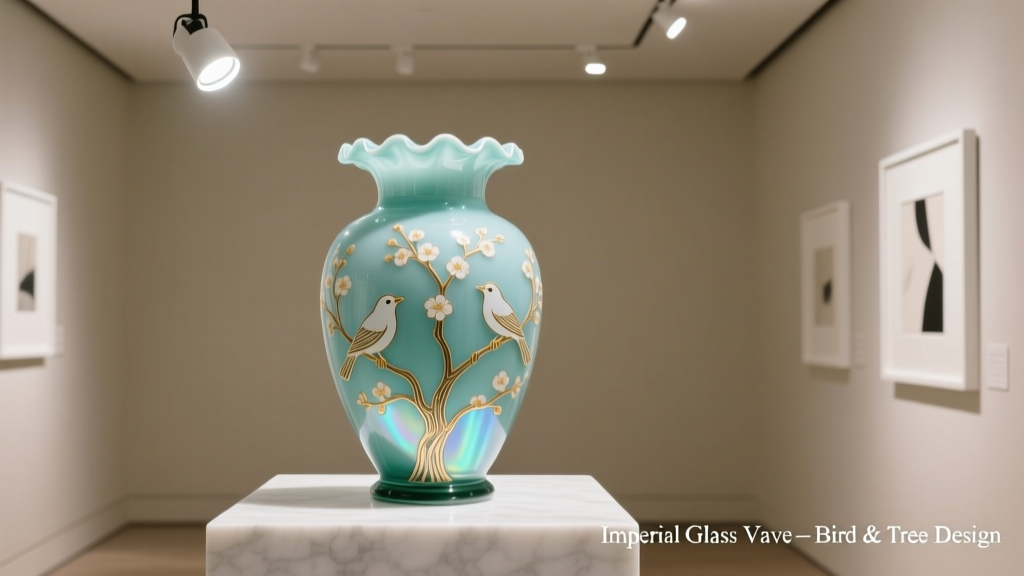
Imperial Glass Vase: Bird Tree Design with Ruffled Rim — Authentication, Market Value, and Historical Context (7-Inch Model)
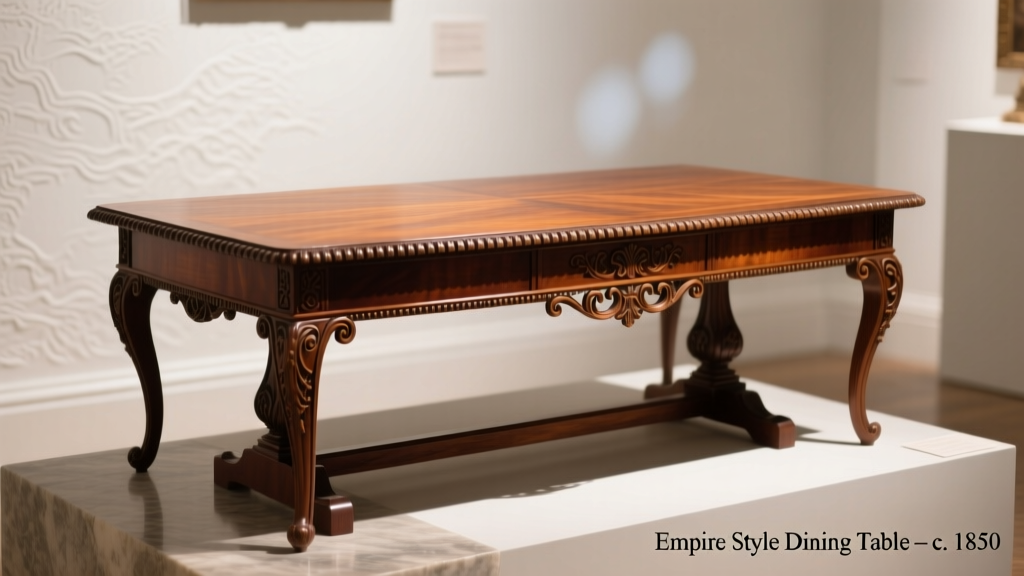
Empire-Style Dining Table with Gadrooned Edges: Authentication, Provenance, and Market Value of a Mid-19th Century 28-Inch Specimen
Authenticating a Mid-19th Century Deer Hide Trunk with Nailhead Trim: Provenance, Construction, and Market Significance

Star Trek Ornament: Vulcan Command Ship Lights Up Keepsake (Hallmark, 2004) — Authentication, Market Value, and Collectibility Analysis
Snuff Amber Carved Figures in Landscape with Caramel Inclusions: Authentication, Provenance, and Market Analysis of a 4-Inch Chinese Qing Dynasty Masterpiece
Dinnerware Jubilee Celadon Green Casserole: Authentication, Market Value, and Collectibility Analysis
Teco Vase with Four Open Handles, Matte Green Glaze, and Impressed '6 In' Circle Mark: Authentication, Provenance, and Market Analysis
Fostoria Chintz Cocktail Glass (5-Inch): Authentication, Market Value, and Design Legacy
Dinnerware Deep Dive: The Little Bo Peep Plate with Gold Rim by Salem China, 1965