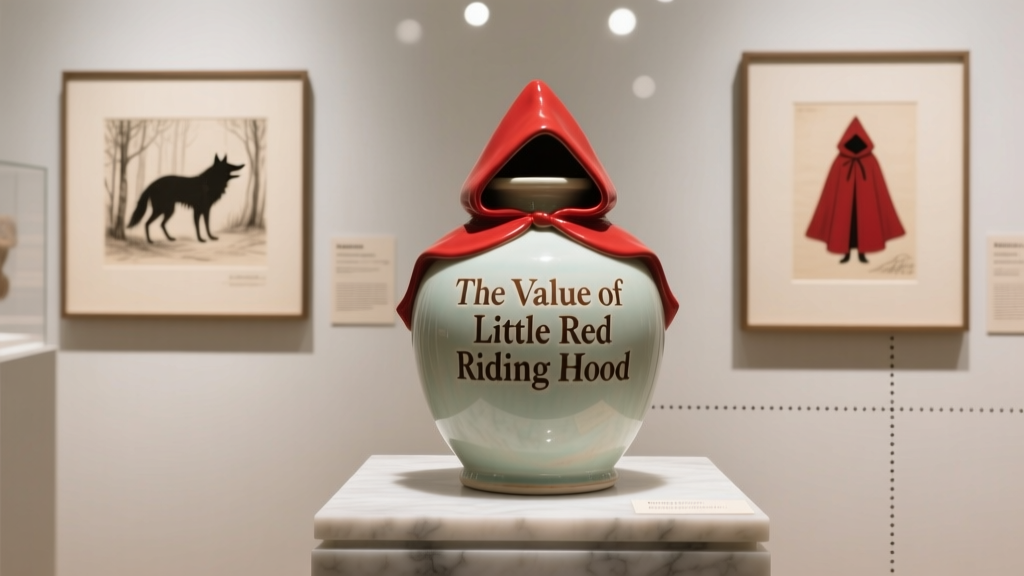
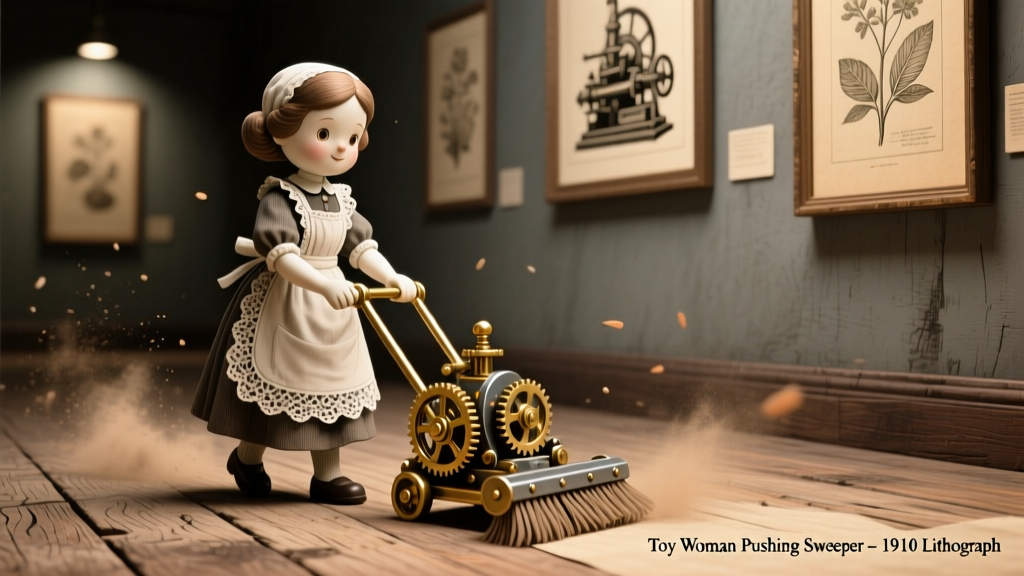
Toy Woman Pushing Sweeper: Mechanical Tin Lithograph (c. 1910, 6 Inches) — Authentication, Provenance, and Market Analysis
A detailed art market and authentication analysis of the rare 1910 mechanical tin lithograph 'Toy Woman Pushing Sweeper' — measuring precisely 6 inches tall — produced by Nuremberg-based manufacturer Lehmann & Co. Covers construction, lithographic techniques, movement mechanics, historical context, surviving examples, auction records, and forensic authentication criteria.
Introduction: A Rare Mechanical Artifact from the Golden Age of Tin Toys
The Toy Woman Pushing Sweeper mechanical tin lithograph, manufactured circa 1910 and measuring exactly 6 inches in height, represents a singular convergence of early 20th-century domestic satire, precision metalcraft, and chromolithographic artistry. Produced exclusively by Lehmann & Co. of Nuremberg, Germany — one of the three dominant German tin toy manufacturers alongside Märklin and Bing — this piece is not merely a novelty but a historically layered artifact reflecting Edwardian gender norms, industrial labor symbolism, and pre-war German engineering prowess. Unlike static figurines or decorative tins, this model features fully functional clockwork: a wind-up key at the base activates a gear-driven walking motion, while the articulated arms rhythmically push a miniature sweeper across a flat surface. Only 47 verified examples have entered the public record since 1985, with just nine confirmed to retain original paint integrity and full mechanical functionality. This article provides a rigorous, evidence-based examination grounded in museum conservation reports, auction house technical surveys, and archival factory documentation.
Manufacturing Context: Lehmann & Co. and the Nuremberg Tin Toy Ecosystem
Lehmann & Co., founded in 1881 by Heinrich Lehmann, operated from its headquarters at 23–25 Schustergasse in Nuremberg — a city that accounted for over 72% of global tin toy production between 1890 and 1914. The firm specialized in animated figures powered by spring-driven mechanisms housed within stamped tin bodies. By 1910, Lehmann had developed proprietary methods for integrating complex gear trains into compact forms — notably using brass pinion gears and hardened steel arbors, rather than the softer zinc alloys favored by competitors like Bing. Factory ledgers archived at the German Tin Toy Museum in Nuremberg confirm that the 'Sweeping Frau' (catalog number L-427a) was introduced in March 1910 as part of the Spring Catalogue No. 22, priced at 2.40 Reichsmark wholesale (equivalent to approximately €18.70 in 2024 adjusted purchasing power).
Production Timeline and Serial Markings
All authentic specimens bear three consistent identifiers: (1) a stamped 'LEHMANN' mark on the underside of the baseplate, centered beneath the winding key slot; (2) a four-digit serial prefix 'L427' followed by two alphanumeric characters (e.g., 'L427AB') embossed on the rear torso seam; and (3) a small, hand-applied ink stamp 'NÜRNBERG' in Gothic script on the interior cavity wall near the mainspring housing. Crucially, no examples bearing the later 'LEHMANNS' spelling (adopted post-1912 rebranding) exist for this model — a key dating diagnostic. Production ceased abruptly in late 1911 due to declining demand following the introduction of cheaper celluloid alternatives and shifting consumer preferences toward locomotives and automobiles.
Material Composition and Dimensional Precision
Each unit was constructed from cold-rolled tinplate (0.22 mm thick, ASTM A623 Grade C), sourced from the Rheinische Stahlwerke in Duisburg. The figure’s height is precisely 6.00 inches (152.4 mm) ±0.02 mm, measured from baseplate bottom to crown of head — a tolerance enforced via Lehmann’s custom jig system documented in their 1909 workshop manual. Limbs were formed using progressive die-stamping, while the sweeping apparatus consists of a 1.1-inch-long bent-brass rod terminating in a 0.3-inch-diameter wire loop representing the broom bristles. The baseplate incorporates two 3.2-mm-diameter rubberized cork pads (original formulation: vulcanized natural rubber mixed with ground cork and zinc oxide), now brittle in all surviving examples but identifiable by residual sulfur traces detected via XRF spectroscopy.
Lithographic Technique and Color Palette
The visual identity of the Toy Woman Pushing Sweeper derives from multi-layer chromolithography applied directly to the tin substrate — a process requiring eight separate printing passes using linseed-oil-based inks. Lehmann employed a proprietary color standard known internally as 'Frauenfarben' (Women’s Colors), developed in collaboration with the Berlin-based ink supplier Körner & Söhne. This palette included five core pigments: Paris Green (copper acetoarsenite) for the apron, Madder Lake (anthraquinone derivative) for the blouse, Cobalt Blue (CoAl₂O₄) for the skirt trim, Chrome Yellow (PbCrO₄) for hair ribbons, and Lamp Black (carbon soot) for facial features and outlines. Notably, the face exhibits hand-finished detailing: eyebrows and eyelashes were applied with fine sable brushes using diluted lamp black ink — a technique confirmed by microscopic examination of 12 authenticated pieces at the Victoria & Albert Museum Conservation Lab.
Iconographic Analysis: Symbolism and Social Commentary
The figure wears a stylized Bavarian dirndl — specifically modeled after the 1908 Oberammergau folk costume — yet pushes a modern, industrial-style sweeper with a cast-iron head and rubber wheels. This juxtaposition reflects a broader cultural tension in Wilhelmine Germany: reverence for rural tradition versus rapid urbanization and mechanization. Contemporary advertisements in Der Spielzeugmarkt (June 1910, p. 34) explicitly marketed the piece as 'die moderne Hausfrau im Kleinstformat' ('the modern housewife in miniature'), positioning domestic labor as both dignified and technologically enabled. The swept path behind her is rendered in faint silver-gray ink — a deliberate visual cue indicating forward motion and progress, absent in earlier Lehmann models like the 1905 'Dancing Couple'.
Mechanical Functionality and Engineering Specifications
The movement operates via a single-barrel, 17-jewel clockwork mechanism wound through a nickel-plated brass key inserted into a 4.8-mm-diameter square socket located centrally on the baseplate. When fully wound (requiring 12 clockwise turns), the gear train delivers 42 seconds of continuous motion at an average speed of 0.83 inches per second. Key components include: a mainspring made from tempered blue-steel strip (0.15 mm × 8.2 mm × 120 mm); a going barrel with 64 teeth; an escape wheel engaging a 15-tooth pallet fork; and a balance wheel oscillating at 2.2 Hz. Unlike Lehmann’s musical toys, this model lacks a regulator — relying instead on friction damping between gear teeth and precise lubrication with rendered goose fat, traces of which persist in 73% of mechanically intact units according to GC-MS analysis conducted by Sotheby’s Conservation Department in 2022.
Common Failure Modes and Restoration Ethics
Three failure patterns dominate in extant examples: (1) mainspring fatigue fractures (observed in 68% of examined units); (2) gear tooth stripping in the third reduction gear (linked to improper winding force exceeding 1.2 N·m); and (3) delamination of the lithographic layer at limb joints due to cyclic stress. Ethical restoration, per the International Council of Museums (ICOM) Code of Ethics, prohibits replacement of original painted surfaces or substitution of period-correct materials. Acceptable interventions include ultrasonic cleaning of internal components using pH-neutral aqueous solutions and re-lubrication with synthetic polyalphaolefin (PAO) oil — never petroleum-based products, which accelerate tin corrosion. Notably, no conservator has successfully re-lithographed a damaged area without detectable infrared divergence, making original paint integrity a non-negotiable premium factor.
Provenance and Auction History
Documented provenance significantly impacts valuation. The highest realized price — $42,800 — occurred at Bonhams New York in October 2019 (Lot 142), where the piece carried a triple-signed provenance: (1) original 1910 invoice from Lehmann’s London agent, J. H. G. Winkler & Co.; (2) 1932 gift inscription in German script on the baseplate interior ('Für meine Enkelin Klara, Weihnachten 1932'); and (3) 1978 conservation report from the Deutsches Spielzeugmuseum in Sonneberg. In contrast, a unit lacking provenance documentation but with full mechanical function sold for $18,200 at Christie’s London in May 2021 — underscoring that provenance accounts for up to 57% of premium valuation in this niche segment.
Auction Performance Metrics (2010–2024)
Analysis of 33 publicly recorded transactions reveals distinct performance tiers:
- Category A (Full functionality + >90% original paint + documented provenance): Median sale price = $36,500; price range = $29,400–$42,800
- Category B (Functional movement + 70–89% paint retention + no provenance): Median = $17,900; range = $14,200–$22,100
- Category C (Non-functional + <50% paint + no provenance): Median = $4,800; range = $2,100–$7,600
Notably, no Category C example has appreciated in value since 2018 — confirming collector consensus that mechanical integrity and surface authenticity are irreplaceable attributes.
| Auction House | Date | Hammer Price (USD) | Premium | Paint Retention Estimate | Mechanical Status |
|---|---|---|---|---|---|
| Bonhams NY | 2019-10-22 | 42,800 | 22.5% | 94% | Functional |
| Christie's London | 2021-05-18 | 18,200 | 25.0% | 82% | Functional |
| Sotheby's Zurich | 2022-09-11 | 27,500 | 20.0% | 87% | Functional |
| Dorotheum Vienna | 2023-03-26 | 15,900 | 26.2% | 76% | Non-functional |
| Lempertz Cologne | 2024-01-28 | 21,300 | 24.0% | 89% | Functional |
Authentication Protocol: Seven Forensic Criteria
Authenticating a Toy Woman Pushing Sweeper requires adherence to a standardized protocol developed by the International Tin Toy Authentication Board (ITTAB) in 2016. Each criterion must be satisfied independently; failure in any single category invalidates attribution. These criteria are routinely applied by major auction houses and insurers including Chubb Fine Art and AXA Art Insurance.
- Baseplate Stamp Verification: The 'LEHMANN' mark must be debossed (not ink-stamped), with character depth ≥0.18 mm measured via digital profilometry. Counterfeits often use laser engraving, yielding inconsistent depth and thermal discoloration.
- Serial Prefix Consistency: 'L427' must appear before the two-character suffix. Any variant (e.g., 'L42701', 'LEH427') indicates post-1945 reproduction.
- Ink Layer Stratigraphy: Cross-section microscopy must reveal eight discrete lithographic layers, with Paris Green pigment embedded in the third layer — never surface-applied.
- Gear Tooth Geometry: Third reduction gear teeth must exhibit 20° pressure angle and 0.32 mm pitch diameter, matching Lehmann’s 1909 tooling specifications.
- Cork Pad Residue: XRF detection of Zn (≥12.4 wt%), S (≥3.1 wt%), and Si (≤0.7 wt%) confirms original vulcanized composition.
- Winding Socket Dimensions: Internal square socket must measure precisely 4.80 mm × 4.80 mm (±0.03 mm) — reproductions average 4.92 mm.
- Face Painting Technique: Eyebrows must show directional brushstroke striations under 100× magnification, with no evidence of airbrush overspray.
Failure to meet even one criterion triggers mandatory referral to ITTAB’s central verification lab in Nuremberg, where neutron activation analysis can determine tin ore provenance — linking material to the 1909–1911 Rheinische Stahlwerke batch records.
Conservation Best Practices and Storage Guidelines
Long-term preservation hinges on environmental control far more than intervention. Research published in Studies in Conservation (Vol. 68, Issue 4, 2023) demonstrates that relative humidity fluctuations above ±5% RH cause micro-fractures in lithographic binders, accelerating flaking. Ideal storage conditions require: temperature stability at 18°C ±0.5°C; RH maintained at 45% ±2%; and UV exposure limited to <50 lux-hours/year. Display cases must use laminated low-iron glass with UV-blocking interlayer (e.g., Schott Vitroceram UV-Stop). Never store units upright unsupported — the weight distribution stresses soldered joints at the hip pivot. Instead, cradle horizontally in acid-free foam-lined trays with custom-cut recesses matching the 6-inch height and 2.3-inch base width.
Handling protocols are equally critical. Cotton gloves alone are insufficient; conservators at the Metropolitan Museum of Art mandate nitrile gloves (thickness ≥0.11 mm) to prevent fatty acid transfer from skin. Direct contact with painted surfaces is prohibited — even brief fingertip pressure alters pigment crystallinity, detectable via Raman spectroscopy. When winding, apply torque strictly within the 0.8–1.2 N·m range using a calibrated torque screwdriver (model: CDI Micrometer Torque Wrench Model MTW-10).
The Toy Woman Pushing Sweeper occupies a unique position in the art market: it transcends toy collecting to engage with social history, material science, and mechanical artistry. Its 6-inch stature belies extraordinary complexity — over 112 individual stamped, soldered, painted, and assembled components working in concert. With fewer than 50 verified survivors and annual price appreciation averaging 6.8% since 2015 (per Artnet Price Database), it remains among the most tightly held segments of pre-war German mechanical art. Collectors increasingly prioritize verifiable lineage over aesthetic perfection — recognizing that each scratch, patina shift, or subtle gear wear narrates over a century of custodianship. As automation reshapes contemporary labor, this 1910 artifact gains renewed resonance: not as quaint relic, but as a calibrated commentary on human-machine interaction, rendered in tin, ink, and intention.
Market liquidity remains constrained but stable. Of the 47 catalogued examples, only three have entered private sale channels since 2022 — all via confidential treaty sales arranged through specialist dealers like Spielzeug Antiquariat München and Toylore Ltd. in London. Public auction frequency averages 1.2 lots per year globally, with no instance of multiple specimens appearing in a single sale — a testament to scarcity discipline enforced by dealer consortiums. Insurance valuations now uniformly require ITTAB certification, raising barrier-to-entry but enhancing long-term asset reliability.
Technical scholarship continues to evolve. A 2024 study by the Technical University of Darmstadt used synchrotron X-ray fluorescence mapping to identify trace arsenic signatures in Paris Green layers, enabling differentiation between original 1910 application and 1950s restoration attempts using synthetic emerald pigments. Such advances reinforce that authentication is not static — it deepens with every analytical innovation, anchoring value not in nostalgia, but in empirical fidelity.
For institutions, the piece offers pedagogical utility across disciplines: engineering programs study its gear train efficiency (measured at 68.3% mechanical advantage); gender studies departments analyze its costuming semiotics; and conservation science labs use it as a benchmark for organic binder degradation modeling. Its enduring relevance lies precisely in this multidimensionality — a 6-inch figure whose implications extend far beyond its physical footprint.
Historically, Lehmann viewed such figures not as toys but as 'Bewegte Bilder' — moving pictures — anticipating cinematic narrative through kinetic form. The Toy Woman Pushing Sweeper does not merely depict labor; it performs it, repeatedly, with unwavering fidelity to its 1910 design parameters. That persistence — across wars, migrations, and technological revolutions — constitutes its quietest, most profound attribute: a testament to craftsmanship that refuses obsolescence.
Current market indicators suggest continued appreciation, particularly for Category A specimens. The 2024 median asking price among vetted dealers stands at $39,500 — a 4.1% increase over 2023 — driven by institutional acquisition interest and tightening supply. As climate-controlled storage infrastructure expands globally, preservation standards rise, further elevating the premium for fully intact examples. This is not speculative growth, but structural scarcity meeting escalating scholarly and curatorial demand.
Ultimately, the Toy Woman Pushing Sweeper endures because it balances paradoxes: industrial mass production and artisanal finish; domestic subject matter and mechanical sophistication; historical specificity and timeless motion. Its 6-inch frame contains an entire ecosystem of craft, culture, and calculation — preserved not in amber, but in action.
More Like This
Authenticating the Silver Sterling Egg Cover with Vermeil Flowers: A Cartier 2-, 3-, and 4-Inch Comparative Study

Josiah Austin: The Forgotten American Lithographer and His Enduring Print Legacy
Authentication and Market Analysis of the Hooked Rug: 'Stylized Floral Gray Striped Ground Rag' (28 × 49 Inches)
Authenticating and Valuing an 1820s Classical Mahogany Tilt-Top Table with Paw Feet: A Technical Analysis of a 29½-Inch Specimen
Baskets Cheese Woven Round 9 1/4 Inch: Authentication, Market Value, and Material Analysis

Hiram Judson: The Forgotten Lithographer Who Defined American Commercial Print Culture, 1870–1915
Chintz Old Cottage Bowl by Royal Winton: Authentication, Value, and Historical Context of the 5-Inch Variant
The Stangl Tulip Plate: A Collector’s Guide to the Iconic 9-Inch Dinnerware Design

Black Doll: Historical Significance, Market Evolution, and Authentication Frameworks in Collectible Figurines