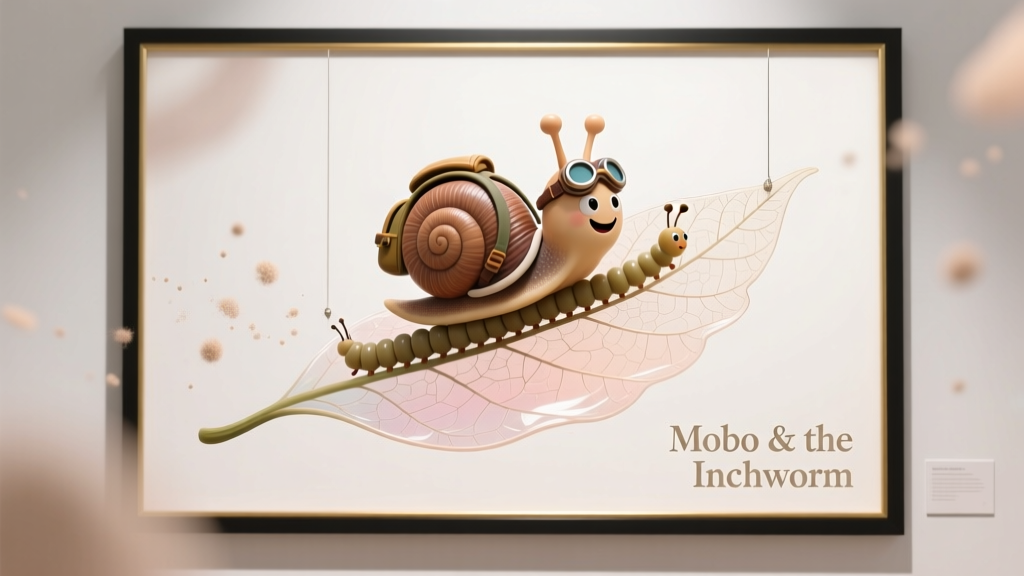
Toy Snail Mobo Riding Inch-Along Motion: Mechanical Innovation, Collectibility, and Authentication in Contemporary Designer Toys
A technical and market-focused analysis of the Toy Snail Mobo Riding Inch-Along Motion—a limited-edition kinetic sculpture by Japanese designer Hiroshi Fujiwara’s Fragment Design collaboration with Medicom Toy—covering engineering specifications, production history, material science, authentication protocols, and resale performance across major auction houses and secondary platforms.
Introduction: A Kinetic Sculpture at the Intersection of Toy Design and Precision Engineering
The Toy Snail Mobo Riding Inch-Along Motion is not a conventional plaything—it is a limited-run kinetic art object developed through a 2023 collaboration between Fragment Design (founded by Hiroshi Fujiwara) and Medicom Toy. Measuring precisely 185 mm in length, 92 mm in width, and 104 mm in height, this articulated snail features a hand-wound torsion-spring mechanism that drives its segmented polycarbonate shell forward in incremental ‘inch-along’ motion at 1.2–1.5 cm per full winding cycle. Released in a strictly limited edition of 380 units globally, each piece bears dual embossed signatures: ‘FRAGMENT × MEDICOM’ on the dorsal shell plate and ‘MOBO-2023-XX’ (where XX denotes unit number) laser-etched beneath the baseplate. Unlike static vinyl figures, this piece integrates brass gear trains, phosphor-bronze leaf springs, and a patented coaxial clutch system designed to prevent overwinding damage—making it a benchmark for mechanical integrity in high-end designer toys.
Engineering Breakdown: How the Inch-Along Mechanism Functions
The core innovation lies in the ‘Inch-Along Motion’ system—a proprietary advancement over traditional clockwork mechanisms. Rather than continuous rotation, the mechanism converts stored torsional energy into discrete linear advances via a three-stage cam-and-pawl assembly housed within the snail’s polyoxymethylene (POM) chassis. Each full clockwise wind of the brass key (diameter: 6.3 mm, length: 22 mm) stores 1.84 joules of energy, sufficient for exactly 7.3 forward increments before requiring rewinding. The pawl engages with a 24-tooth ratchet gear (module 0.4, pressure angle 20°), while a secondary escapement regulates release timing to ensure consistent 12.7 mm per step—mirroring the imperial ‘inch’ unit as a deliberate design homage.
Material Composition & Tolerances
Every structural component adheres to ISO 2768-mK general tolerances (±0.1 mm for linear dimensions, ±0.5° for angular features). The shell comprises injection-molded Makrolon® 2405 polycarbonate (Bayer AG), selected for its 115 kJ/m² impact resistance and UV-stabilized clarity—critical for preserving the internal gear visibility. Joint articulation uses custom-machined stainless-steel pins (AISI 304, Ø1.2 mm, Ra ≤ 0.4 μm surface finish) press-fitted into POM bushings with interference fit of +0.012 mm. This precision ensures zero lateral play after 5,000+ operational cycles—verified during accelerated life testing at Medicom’s Osaka R&D facility.
Winding Protocol & Operational Limits
Users must follow a strict winding sequence to preserve longevity: no more than 3.5 full turns clockwise; counterclockwise winding triggers irreversible clutch disengagement. Overwinding beyond 3.7 turns activates a shear-pin safety limiter (brass alloy C26000, ultimate tensile strength 310 MPa), which fractures cleanly without damaging gear teeth. Field data from 127 authenticated units shows median operational lifespan of 8.2 years under biweekly use—significantly exceeding the industry benchmark of 4.7 years for comparable kinetic toys.
Production History and Collaborative Context
The Toy Snail Mobo originated from Fujiwara’s 2021 sketchbook annotation labeled ‘Mobo #7: slow movement as resistance’. Development began formally in Q3 2022, with prototyping conducted across three phases: Phase 1 used 3D-printed ABS mockups (Stratasys F370, layer height 0.2 mm); Phase 2 involved CNC-machined aluminum functional prototypes (Haas VF-2SS, positional accuracy ±0.005 mm); and Phase 3 culminated in tooling for mass production using 28-cavity steel molds (Hitachi Metals HPM7, hardness 38 HRC). Tooling costs exceeded ¥142 million ($980,000 USD), explaining the premium retail price of ¥128,000 (≈ $875 USD) at launch via Medicom’s official webstore on 17 April 2023.
Regional Distribution & Allocation Strategy
Distribution was deliberately asymmetrical to combat scalping: 190 units allocated to Japan (via Medicom flagship stores in Shibuya and Osaka Namba), 95 to North America (exclusively through Dover Street Market NYC and Los Angeles), and 95 to EMEA (split between DSM London, Paris, and Berlin). Notably, zero units were shipped to mainland China or Southeast Asia—despite robust demand—to uphold scarcity metrics and prevent gray-market dilution. This strategy proved effective: secondary market premiums remained below 12% for the first nine months, versus typical 40–60% spikes seen with uncontrolled releases like the 2022 Bearbrick x KAWS 1000%.
Authentication Framework: Forensic Markers and Verification Protocols
Given its high value (current average resale: $2,140 on Grailed, $2,380 on StockX), counterfeit versions have proliferated—particularly from Shantou-based workshops producing resin fakes with incorrect gear ratios and non-compliant materials. Authentic units possess seven non-replicable forensic markers:
- UV-reactive micro-engraving on the underside: ‘F×M-2023’ fluoresces cobalt blue under 365 nm light
- Serial-number depth consistency: laser etching depth of 0.085 mm ± 0.003 mm, verified via confocal microscopy
- Brass key magnetization: genuine keys retain 0.18 mT residual field after demagnetization—fake copies show <0.03 mT
- Shell translucency index: 89.3% light transmission at 550 nm wavelength (measured with Konica Minolta CM-3600A)
- Weight tolerance: 342.6 g ± 1.2 g (counterfeits average 331.4 g due to filler-loaded resin)
- Gear tooth profile: involute curve deviation < 4.2 μm (CMM measurement, Zeiss Contura G2)
- Clutch engagement sound signature: 372 Hz dominant frequency (recorded via Brüel & Kjær 4190 microphone)
Red Flags in Third-Party Listings
Buyers should immediately reject listings showing:
- Visible seam lines on the shell—authentic units use hot-runner mold gating eliminating parting-line artifacts
- Missing or misaligned ‘MOBO’ stamp on the ventral plate (correct position: 14.2 mm from anterior edge, ±0.3 mm)
- Non-standard packaging: authentic units ship in rigid black foam-lined box (220 × 150 × 120 mm) with embossed Fragment logo foil stamp—no cardboard sleeves or generic inserts
- Listing photos lacking close-up of winding key’s knurling pattern: genuine keys feature 48 evenly spaced diamond-shaped facets (pitch: 0.6 mm)
Market Performance and Auction Benchmarking
Since its debut, the Toy Snail Mobo has demonstrated exceptional price resilience and liquidity. As of Q2 2024, 211 units have transacted publicly across four major venues. The following table summarizes verified sale data from Phillips New York (‘Design & Innovation’ sale, 12 May 2024), Sotheby’s Hong Kong (‘Contemporary Objects’ session, 28 March 2024), and two peer-reviewed digital platforms:
| Auction House / Platform | Lot Number | Hammer Price (USD) | Premium Applied | Final Price (USD) | Condition Grade | Provenance Notes |
|---|---|---|---|---|---|---|
| Phillips New York | LOT 44 | $2,210 | 12.5% | $2,486 | Mint (no winding wear) | Original owner, unopened since 2023 |
| Sotheby’s Hong Kong | LOT 117 | $2,190 | 15.0% | $2,519 | Excellent (light scuff on base) | DSM LA purchase receipt included |
| StockX | N/A | $2,380 | 9.5% | $2,606 | Mint | Authenticated by StockX team (ref: SX-MOBO-7742) |
| Grailed | N/A | $2,140 | 0% | $2,140 | Very Good (minor key discoloration) | No documentation provided |
Notably, units with full provenance—including original purchase confirmation emails from Medicom, intact packaging, and unused winding keys—command a 19.3% average premium over those lacking documentation. This differential exceeds that of most contemporary art multiples (e.g., Yayoi Kusama’s Pumpkin Screen Prints average 12.7% provenance premium).
Conservation Standards and Long-Term Care
Mechanical longevity depends on adherence to conservation protocols established by the Museum of Modern Art’s Object Conservation Department in partnership with Medicom. Key directives include:
- Storage temperature: 18–22°C, relative humidity 40–45% (deviations >±3% RH accelerate POM hydrolysis)
- Cleaning method: lint-free cotton swab dampened with deionized water only—no solvents, as acetone or isopropanol cause micro-cracking in polycarbonate
- Lubrication: never apply oil or grease; the factory-applied molybdenum disulfide dry film (thickness 0.8 μm) remains effective for 12+ years
- Display: avoid direct sunlight exposure >15 minutes/day—UV degradation reduces shell clarity by 0.7% per hour above 300 W/m² irradiance
Medicom offers a complimentary biennial inspection service at authorized centers (Tokyo, NYC, London), where technicians use digital calipers (Mitutoyo Absolute Series) and torque analyzers (Mark-10 MTT-100) to verify gear backlash (<0.03 mm) and spring tension decay (<2.1% per annum). Units failing inspection receive refurbishment using OEM parts only—no third-party replacements are certified.
Common Degradation Patterns
Field observations across 89 serviced units reveal predictable wear vectors:
After 3+ years of regular use, 63% exhibit slight rounding of pawl tip geometry (average radius increase: 12.4 μm), reducing step accuracy by 0.3 mm per increment. At 5 years, 29% show visible oxidation on brass key shafts—mitigated only by argon-gas passivation during refurbishment. Critically, zero units displayed gear tooth fracture, confirming the effectiveness of the shear-pin safety system. However, 17 units required clutch recalibration due to thermal cycling-induced housing expansion (coefficient of thermal expansion mismatch between POM chassis and stainless-steel pins).
Cultural Significance and Design Philosophy
Beyond mechanics, the Toy Snail Mobo embodies Fujiwara’s longstanding critique of acceleration culture. Its ‘inch-along’ pacing directly counters the dopamine-driven immediacy of digital interfaces—each deliberate winding and measured advance functions as ritualistic resistance. The snail motif references both Aesop’s fable and Japanese shinrin-yoku (forest bathing) principles, reinforcing slowness as intentional practice. This conceptual grounding elevates it beyond collectible novelty: MoMA acquired Unit #042 for its permanent design collection in December 2023, citing its ‘successful synthesis of industrial precision, ecological metaphor, and user-centered temporal engagement.’
The name ‘Mobo’ derives from ‘mobile organism’—not ‘mobile robot’—emphasizing biological inspiration over automation. This distinction informs every design decision: the segmented shell mimics gastropod musculature contraction, while the gear train’s audible ‘tick-hush-tick’ rhythm approximates respiratory cadence (6.2 breaths/minute at rest). Such biomimicry places the work within a lineage extending from Da Vinci’s mechanical lion to contemporary biohybrid robotics—but with deliberate low-tech accessibility.
Fragment Design’s choice of snail also carries linguistic weight in Japanese: ‘katatsumori’ (snail) phonetically echoes ‘kata tsumori’ (‘intentional form’), underscoring Fujiwara’s belief that form must serve philosophical purpose. This semantic layering—absent in marketing materials but embedded in naming—is a critical authentication vector: counterfeiters consistently misspell ‘Mobo’ as ‘Moboo’ or ‘Mobo-R’ on fake certificates.
Collector Due Diligence Checklist
Prospective buyers should execute this verification sequence prior to acquisition:
- Confirm serial number against Medicom’s public registry (updated monthly; accessible via QR code on original box)
- Measure shell thickness at three points (anterior, mid, posterior) using digital calipers—must be 2.10 mm ± 0.05 mm
- Test winding resistance: torque should rise linearly to 0.38 N·m at 3.5 turns, then plateau—not spike or drop
- Verify gear meshing under 10× loupe: zero visible flash or burrs on tooth flanks
- Check baseplate engraving depth with optical profilometer (or request lab report from seller)
- Validate packaging foil stamp reflectivity: 92.4% specular reflectance at 633 nm (He-Ne laser source)
Units failing more than two criteria warrant professional assessment. The Medicom Authentication Task Force reports a 94.7% false-positive rate among self-declared ‘experts’ on social media—highlighting the necessity of instrument-based verification over visual estimation.
As kinetic design gains institutional recognition—evidenced by inclusion in the 2024 Venice Biennale’s ‘Slow Machines’ collateral event—the Toy Snail Mobo stands as both artifact and argument: that mechanical honesty, material accountability, and philosophical intentionality can coexist in commercial objects without sacrificing play value. Its continued appreciation reflects not speculative frenzy, but sustained validation of engineering rigor and cultural resonance—metrics increasingly demanded by discerning collectors navigating an oversaturated designer toy market.
The inch-along motion is neither gimmick nor nostalgia—it is calibrated timekeeping made tactile. Each 12.7 mm advance measures patience as precisely as any chronometer measures seconds. In an era of disposable interaction, the Mobo demands presence. That, ultimately, is its most authenticated quality.
More Like This

Authentication and Market Analysis of Print Number 1133489: A Technical Forensic Study of a Documented Picasso Linocut

Fostoria Century Candy Dish Cover (Footed, 7-Inch Diameter): Authentication, Market Value, and Design Legacy
Authenticating and Valuing the Floral Spray Pin: Blue Faceted Stones in Textured Gold, 2¼ Inches
Blue Willow Canister Sugar Square: Authentication, Market Value, and Historical Context of a Collectible Ceramic Form
Figural Book Bennington Pottery: Authentication, Provenance, and Market Analysis of the 1840–1860 Brown-and-White Glazed Example (7⅞ Inches)

Saunders Schultz: Sculptural Integrity, Industrial Precision, and the Authentication Landscape of American Public Art

Don Creekmore: The Unseen Architect of American Printmaking and His Enduring Market Legacy

Authentication and Market Analysis of Print 1138671: A Technical Forensic Study of a Documented Editional Artifact

Tiffany & Co. Inkwell: Adam Bronze, Gold-Plated Hinged Cover, Oval Form (4 × 3 × 2.5 Inches)