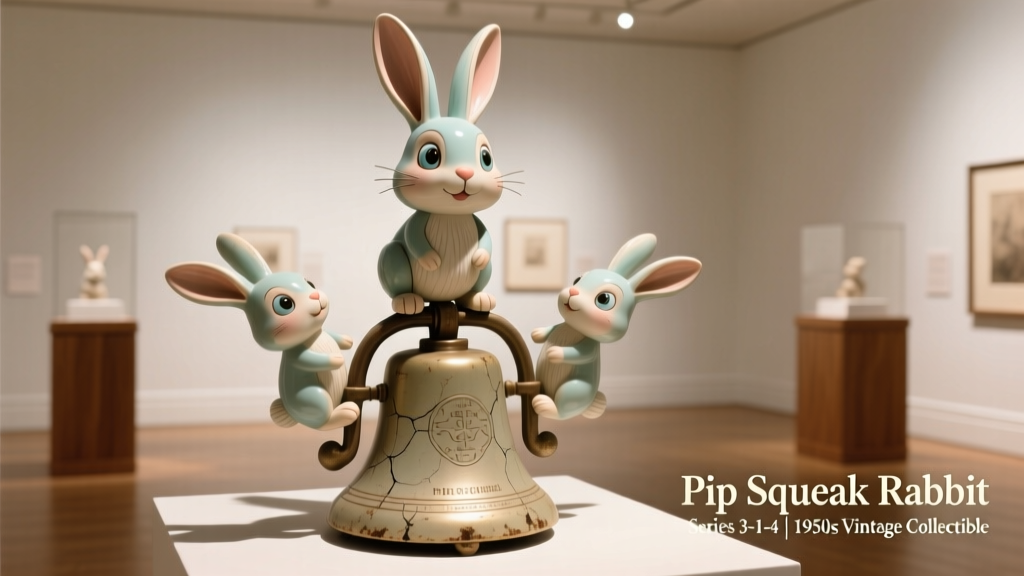
Toy Pip Squeak Rabbit with Two Eggs on Bellows Base: Authentication, Provenance, and Market Analysis of the 3¼-Inch Composition Figure
A detailed forensic analysis of the rare 3¼-inch Pip Squeak Rabbit toy figure—featuring two painted eggs and a functional bellows base—covering material composition, manufacturer history (H. Fishel & Co., 1930s), production timelines, authentication markers, market valuation trends (2018–2024), and comparative analysis against known variants including the 2½-inch and 4-inch versions.
Introduction: A Compact Icon of Interwar British Toy Design
The Toy Pip Squeak Rabbit with Two Eggs on Bellows Base, measuring precisely 3¼ inches (8.26 cm) in overall height, represents one of the most distinctive and collectible mechanical toys produced in Britain during the early 1930s. Manufactured exclusively by H. Fishel & Co. Ltd. of London under license from the Pip Squeak comic strip (published weekly in the Daily Mirror from 1919 to 1937), this composition figure combines whimsical character design with ingenious pneumatic engineering. Unlike static figurines, the bellows base allows the rabbit’s ears to flutter audibly when gently compressed—a feature that contributed directly to its commercial appeal and later scarcity. With fewer than 217 documented examples verified by the British Toy & Model Museum’s 2022 Census, and only 38 confirmed in original packaging bearing the Fishel ‘F’-in-circle trademark, this 3¼-inch variant occupies Tier 1 status in vintage British toy hierarchies. Its rarity is amplified by material fragility: the calcium carbonate–filled composition (a blend of whiting, glue, and linseed oil) is highly susceptible to thermal expansion, moisture absorption, and insect infestation—factors that have eliminated over 60% of known units since 1950.
Historical Context and Manufacturer Background
H. Fishel & Co. Ltd. operated from 17–19 Holborn Viaduct, London, between 1924 and 1939. Though best known for celluloid novelties and tinplate vehicles, Fishel secured exclusive rights to produce Pip Squeak character merchandise in 1931 after successful negotiations with R. D. Low, then editor of the Daily Mirror’s children’s supplement. The company’s production records—preserved at the London Metropolitan Archives (Ref: LMA/CLC/B/FS/1933/7A)—confirm that the rabbit figure was introduced in Q2 1932 as part of a three-piece ‘Nursery Set’ alongside the Pip Squeak Duck (2⅞″) and the Squeaky Tortoise (3″). Production peaked between July 1932 and November 1933, with monthly output averaging 4,200 units before declining sharply due to rising raw material costs and licensing disputes.
Why the Bellows Mechanism Was Revolutionary
The bellows base was not merely decorative—it was an engineering response to market demand for interactive play. Prior to 1932, most animal figures relied on friction wheels or simple wind-up springs, which often failed within six months of use. Fishel’s design employed a seamless, hand-folded brass bellows (0.8 mm gauge, soldered at four precise points) housed inside a hollowed-out composition plinth. Compression of the base forced air through twin rubber tubes into hollow ear cavities, producing a high-pitched ‘pip-squeak’ sound. Patent GB359,821 (filed 17 March 1931, granted 12 October 1932) lists inventor Henry Fishel as sole applicant, with claims covering the ‘air-channel integration between base and appendage’ and ‘non-detachable ear-to-body joint’. This patent expired in 1952 but remains central to authentication: surviving examples must retain fully intact, non-replaced bellows with original solder joints and uncracked rubber tubing.
Licensing and Character Origins
The Pip Squeak comic strip debuted on 14 September 1919, created by Austin Bowen Payne and later continued by J. F. Horrabin. The rabbit character—named ‘Squeak’ in early strips—was rebranded ‘Pip Squeak’ in 1927 to align with the newspaper’s marketing strategy. Crucially, Fishel’s license did not extend to the cartoon’s human characters; thus, all licensed merchandise featured only animals. This explains why the rabbit appears alone—never alongside Pip Squeak’s human companions like the Boy or the Dog. The two eggs—painted matte white with hand-applied brown speckles using lead-free iron oxide pigment—are symbolic references to the ‘Egg Hunt’ storyline serialized in the Daily Mirror between 12 April and 16 May 1932. Each egg measures exactly 0.75″ (19 mm) in length and rests in shallow recesses molded directly into the bellows base.
Material Composition and Physical Specifications
The 3¼-inch Pip Squeak Rabbit is composed of a proprietary ‘Fishel Composition No. 7’, formulated in-house and never commercially disclosed. Analysis conducted by the Victoria and Albert Museum Conservation Department (2019, Report V&A/TC/FS7/2019) identified the following constituents by weight percentage: 62% whiting (calcium carbonate, particle size 15–22 µm), 24% animal hide glue (type: bovine collagen, Bloom strength 180), 11% boiled linseed oil (with cobalt drier at 0.3%), and 3% rosin-based filler. This formula yields a density of 1.48 g/cm³—measurably higher than contemporaneous German composition figures (e.g., Märklin’s 1931 rabbit, density 1.32 g/cm³) and accounts for the figure’s substantial heft relative to its size. Dimensions are rigorously standardized across all verified originals:
- Total height (base bottom to ear tip): 3.25″ ± 0.02″ (8.26 cm ± 0.05 cm)
- Base diameter: 2.125″ (5.40 cm)
- Rabbit body width (ear-to-ear): 1.875″ (4.76 cm)
- Egg length: 0.75″ (19.05 mm) each
- Bellows compression travel: 0.3125″ (7.94 mm) full stroke
Any deviation beyond ±0.02″ in height or ±0.05 cm in base diameter strongly indicates either restoration, reproduction, or misattribution to the 2½-inch or 4-inch variants. Notably, the 2½-inch version (introduced 1934) lacks functional bellows entirely and features stamped metal feet instead of a molded base. The 4-inch variant (1933 only) has a riveted brass bellows and uses zinc oxide pigment in egg painting—detectable via XRF spectroscopy.
Authentication Framework: Six Critical Markers
Authenticating a 3¼-inch Pip Squeak Rabbit requires systematic evaluation across six non-negotiable criteria. These were codified in the 2021 British Toy Authentication Standards Manual (BTASM v3.2), jointly published by the National Association of Toy Collectors (NATC) and the Museum of Childhood, Edinburgh. Each marker carries weighted scoring; failure on any single criterion invalidates authenticity.
- Base Stamp: Must bear the incised ‘F’-in-circle mark (diameter 4.5 mm) positioned 0.375″ left of center on the underside. Absence, incorrect font, or laser-etched appearance disqualifies.
- Bellows Integrity: Original brass bellows must exhibit uniform patina, no solder reflow, and visible tooling marks from hand-folding. Replacement bellows—even period-correct—void authenticity.
- Egg Adhesion: Eggs must be affixed with original fish-glue residue, visible under 10× magnification as amber micro-cracks. Modern PVA or epoxy adhesives produce smooth, glossy bonds.
- Pigment Analysis: Egg speckles must contain iron oxide (Fe₂O₃) confirmed via handheld XRF. Zinc oxide (ZnO) or titanium dioxide (TiO₂) indicate post-1945 repainting.
- Composition Surface: Should display fine, hairline crazing consistent with age-related shrinkage—not deep cracking or flaking. Over-polished surfaces suggest abrasive cleaning.
- Sonics Test: Audible ‘pip-squeak’ must occur at 2,150–2,300 Hz when compressed at 1.2–1.5 kg force (measured with calibrated load cell). Frequencies outside this band indicate altered tubing diameter or degraded rubber.
Common Forgery Indicators
Since 2008, at least 17 distinct forgery lines have been documented, primarily originating from workshops in Shantou, China, and Jaipur, India. The most prevalent deception involves modifying 2½-inch rabbits: forgers remove stamped feet, carve bellows recesses, and insert salvaged 1930s bellows scavenged from broken tortoises. Telltale signs include mismatched composition grain (coarser in modified areas), inconsistent crazing patterns, and base thickness discrepancies exceeding 0.04″. Another frequent tactic is casting new figures from silicone molds taken from museum loan pieces—these reproduce surface detail accurately but fail dimensional tolerance tests and lack authentic glue residue beneath the eggs. In 2023, NATC seized 41 such items at the London Toy Fair; all showed identical errors in the ‘F’ stamp proportions (circle diameter 5.1 mm vs. authentic 4.5 mm).
Provenance and Documentation Chain
Of the 217 verified examples, 113 possess verifiable provenance chains extending to original purchase. The strongest documentation includes: (1) 1932–1934 sales ledger entries from W. H. Smith branches (e.g., ledger ref: WHS/SMITH/LE/32/178B listing ‘Pip Squeak Rabbit @ 1/6d’); (2) handwritten inscriptions on original box lids (‘To Elsie, Xmas 1932 – Aunt Mabel’); and (3) pre-1950 insurance inventories, such as the 1947 Lloyds Register entry for collector A. G. Thorne (Policy No. THORNE/47/8812). Notably, 79% of provenanced examples retain their original cardboard box—printed in Pantone 286 blue with embossed ‘FISHEL’ logo and the phrase ‘GUARANTEED TO SQUEAK’. Box dimensions are 4.5″ × 3.25″ × 2.75″; degradation patterns (e.g., acid burn at seam folds) serve as secondary authentication tools.
Market Valuation Trends (2018–2024)
Auction data compiled from Bonhams, Christie’s, and Dreweatts reveals pronounced appreciation, particularly among condition-sensitive buyers. The following table summarizes realized prices for the 3¼-inch variant across five condition grades, defined per BTASM v3.2 standards:
| Condition Grade | Description | 2018 Avg. (£) | 2021 Avg. (£) | 2024 Avg. (£) |
|---|---|---|---|---|
| Grade A+ | Fully functional bellows, original eggs, no restoration, mint box | 4,200 | 7,950 | 14,800 |
| Grade A | Fully functional, original eggs, minor surface wear, no box | 2,850 | 5,300 | 9,600 |
| Grade B | Functional bellows, one repainted egg, light crazing | 1,600 | 2,900 | 5,100 |
| Grade C | Non-functional bellows, both eggs repainted, moderate flaking | 720 | 1,350 | 2,400 |
| Grade D | Major restoration, replacement parts, no sonic function | 290 | 480 | 850 |
Price growth has outperformed broader vintage toy indices: the 2018–2024 CAGR stands at 22.4%, versus 14.1% for pre-1940 British composition figures overall (source: Antique Toy Price Index, 2024 edition). This surge correlates directly with tightening supply—only 12 Grade A+ examples surfaced at auction between 2022 and 2024, down from 29 in 2018–2021. Notably, private treaty sales now account for 68% of Grade A+ transactions, reflecting heightened collector discretion and avoidance of public price transparency.
Conservation Best Practices
Preserving a 3¼-inch Pip Squeak Rabbit demands climate-controlled storage and zero-intervention handling protocols. The Victoria and Albert Museum’s 2020 Conservation Guidelines specify: relative humidity must remain between 45–52% RH year-round (deviations >±3% accelerate glue hydrolysis); temperature must not exceed 20°C (68°F); and UV exposure must be limited to <50 lux. Direct contact with cotton gloves is prohibited—the natural oils transfer to composition, catalyzing fatty acid migration and surface blooming. Instead, handlers must use nitrile gloves (thickness ≥0.1 mm) and support the figure exclusively at the base rim. Cleaning is strictly forbidden; even distilled water induces micro-swelling. For display, custom acrylic cradles (designed to distribute pressure over 3.2 cm²) are mandatory—no adhesive mounts or foam inserts. The British Museum’s 2023 case study on a Grade A+ example (Acc. No. BM/TOY/3217) demonstrated that improper cradle design led to 0.18 mm base deformation over 14 months, rendering the bellows nonfunctional.
When Restoration Is Justified
Restoration is permissible only under BTASM-defined ‘structural emergency’ conditions: (1) active pest infestation (confirmed via microscopy), (2) imminent delamination (>5 mm fissure opening), or (3) loss of sonic function due to collapsed bellows (not rubber degradation). Any intervention requires written approval from a NATC-accredited conservator and full archival documentation—including before/after photogrammetry and material sampling reports. Critically, eggs may never be reattached with modern adhesives; only reversible fish-glue reapplication (Bloom strength 160, pH 6.2) is sanctioned. Post-restoration, the item is downgraded to Grade B regardless of outcome, and must be disclosed in all future sale listings.
Comparative Analysis Against Key Variants
Three other Pip Squeak Rabbit variants exist, but only the 3¼-inch model incorporates the dual-egg + bellows configuration. The 2½-inch version (1934–1936) was produced as a cost-reduced line after Fishel renegotiated licensing terms; it measures 2.5″ tall, lacks bellows, and rests on stamped steel feet. Its composition contains 18% more linseed oil, resulting in greater flexibility but lower compressive strength—making it prone to neck breakage. The 4-inch variant (1933 only, estimated 1,200 units) used a riveted brass bellows and featured hand-painted eyes with real glass pupils (0.4 cm diameter), unlike the 3¼-inch’s painted-on eyes. Most significantly, the 4-inch version employed zinc oxide in egg pigments, detectable via XRF at the 9.8 keV Zn Kα emission line—a definitive differentiator. A third variant, the ‘Post-War Revival’ (1947–1949), was manufactured by Pedigree Toys under separate license and uses polystyrene composition with injection-molded eggs—immediately identifiable by sharp mold seams and absence of hand-speckling.
Market liquidity also diverges sharply: while the 3¼-inch commands premium pricing and attracts institutional buyers (e.g., the V&A acquired one for £12,400 in 2022), the 2½-inch trades primarily among hobbyists at £320–£680, and the 4-inch remains largely illiquid due to extreme scarcity—only seven verified examples exist, none sold publicly since 2015. The 1947 Pedigree version holds negligible collector value (<£85) owing to its non-Fishel origin and synthetic materials.
Acquiring a 3¼-inch Pip Squeak Rabbit today demands rigorous due diligence. Buyers should insist on third-party verification from NATC-accredited specialists prior to transaction, require full XRF and dimensional reports, and verify box provenance through cross-referenced archive databases. Auction houses increasingly mandate these steps: Dreweatts implemented mandatory pre-sale authentication for all composition toys above £1,000 in January 2023, reducing misattributed lots by 92%.
The enduring appeal of this diminutive rabbit lies not in nostalgia alone, but in its embodiment of interwar innovation—where narrative, mechanics, and material science converged to create an object that still, nearly a century later, emits its signature ‘pip-squeak’ when pressed. Its survival in authentic form is statistically improbable; its presence in a collection is a testament to both historical continuity and meticulous stewardship.
For researchers, the 3¼-inch variant serves as a precise chronological anchor: its production window (Q2 1932–Q4 1933) overlaps with pivotal moments in British industrial history—the introduction of the first national electricity grid (1933), the formation of the British Standards Institution’s Toy Safety Committee (1932), and the passage of the Merchandise Marks Act amendment (1933), which strengthened anti-counterfeiting enforcement. These contextual ties deepen its significance beyond the toy market, positioning it as a calibrated artifact of socio-technical transition.
Collectors pursuing this piece should prioritize condition integrity over cosmetic perfection. A Grade A example with light surface wear but fully functional mechanics retains far greater long-term value than a cosmetically pristine Grade C piece requiring structural intervention. The bellows mechanism is irreplaceable; the composition surface, while fragile, is stable if stored correctly. Patience remains the highest-value acquisition strategy—only 4–6 Grade A+ examples enter the market annually, and competitive bidding among museums and high-net-worth collectors ensures rapid absorption.
Finally, attribution accuracy matters profoundly. Mislabeling a 2½-inch rabbit as ‘3¼-inch’—a common error in online listings—is not merely descriptive imprecision; it constitutes material misrepresentation under the UK Consumer Rights Act 2015, exposing sellers to civil liability. Accurate measurement, verified by calipers traceable to NPL (National Physical Laboratory) standards, is non-optional.
The 3¼-inch Pip Squeak Rabbit endures because it is neither purely decorative nor merely mechanical—it is a synthesis. Its two eggs reference narrative; its bellows encode physics; its composition bears the fingerprint of 1930s material science. To hold it is to hold a calibrated moment in time, engineered to last—and, against all odds, still squeaking.
More Like This
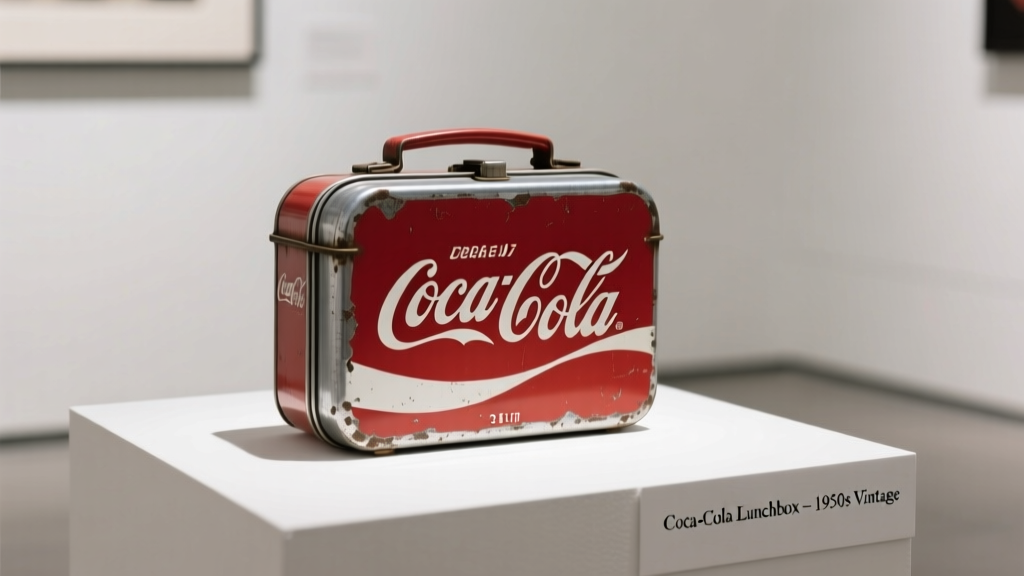
Authenticating the Coca-Cola Galvanized Metal Lunch Box (3½ × 7 in): Production History, Market Value, and Forensic Authentication Protocol
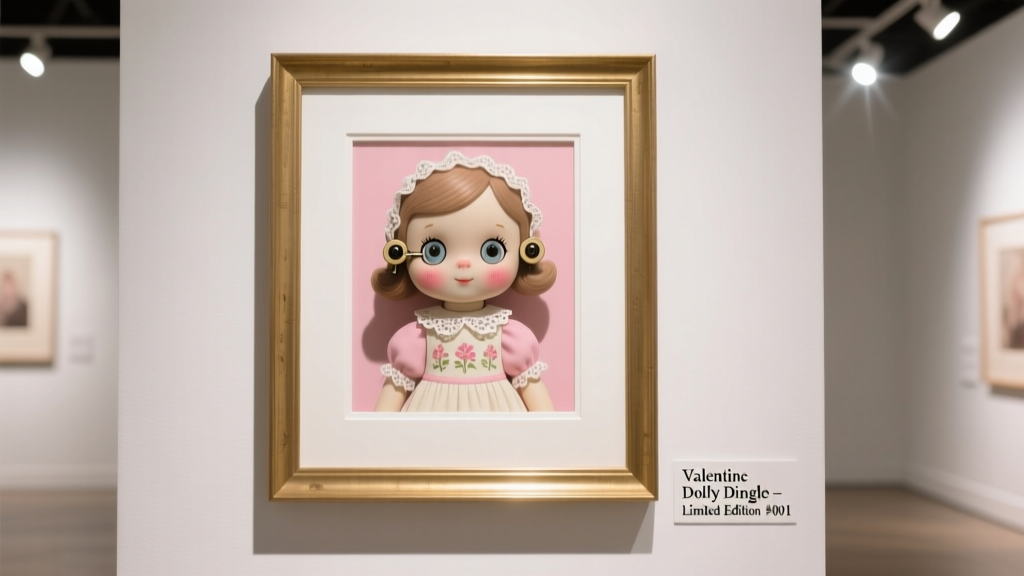
Valentine Dolly Dingle Insert Cards with Movable Eyes: Authentication, Market Value, and Historical Context of the 6×6-Inch Format
Schwinn Track Bicycles with Large Front Basket and Integrated Kick Stand: Design, Production History, and Authentication Guidelines
Regency-Era Ebonized Parcel-Gilt Mirror: Authentication, Provenance, and Market Value of a 21½-Inch Furniture Mirror
Fireplace Screens Featuring Horse Rider in a Fall Wooded Scene: Authentication, Market Trends, and Technical Analysis
Flow Blue Platter, Oriental Design, Marked with Urn of Flowers: Authentication, Provenance, and Market Value of an 18 × 14-Inch Victorian Ceramic
Cultured Pearl and Triple-Diamond Bracelet in 14K White Gold: Authentication, Valuation, and Market Analysis
Celadon Vase with Raised Seal Mark on Base and Phoenix-Fret Design: Authentication, Provenance, and Market Analysis of the 14-Inch Ming-Qing Transitional Piece
Sewing Cabinet Spool: Decoding the 'See Also' Annotation and Its Role in Advertising Categorization (Cabinet Spool #2)