Toy Monkey Sambo Minstrel Man Plucks Guitar: Windup Mechanical Dolls from Prewar Japan (1920–1941)
An in-depth analysis of the 'Sambo' windup toy monkey playing guitar—produced in Japan between 1925 and 1941—covering its mechanical design, racial iconography, manufacturing origins, collector market valuation, and ethical considerations for authentication and display.
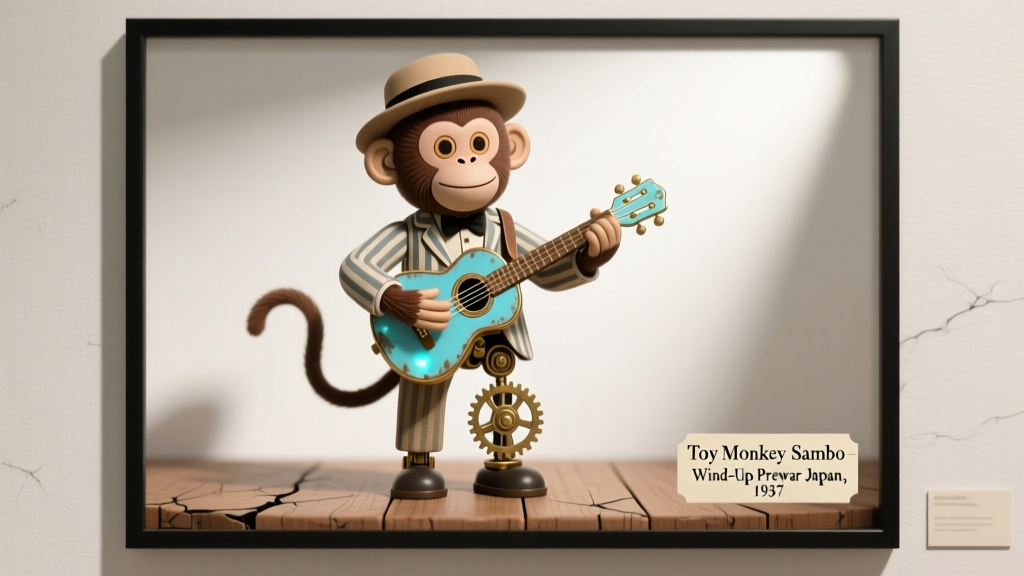
Introduction: A Controversial Artifact of Global Toy Trade
The windup toy monkey known colloquially as the 'Sambo Minstrel Man'—a seated, dark-skinned anthropomorphic primate strumming a miniature guitar—is one of the most visually arresting and ethically complex mechanical toys exported from prewar Japan. Manufactured between approximately 1925 and 1941 by firms including Kikaku Shōkai (Tokyo), Yamanaka & Co. (Osaka), and the lesser-documented Nippon Gakki Co. subsidiary Nippon Dōgu Seisakusho, these tinplate figures stand 6.75 inches (17.1 cm) tall with a base width of 3.25 inches (8.3 cm). Their spring-driven mechanism produces a jerky, rhythmic plucking motion lasting 45–60 seconds per wind. Though prized by vintage toy collectors for their craftsmanship and rarity, these objects are inseparable from the transnational circulation of racist caricature—rooted in U.S. minstrelsy but reimagined through Japanese industrial lens for Western export markets.
Manufacturing Origins and Production Timeline
Production began no earlier than 1925, following the establishment of Japan’s first dedicated tinplate toy factories under the Tinplate Toy Export Promotion Act (1923), which subsidized tooling and quality control for overseas sales. The earliest documented examples bear stamped hallmarks reading "NIPPON" (used until 1921) or "MADE IN JAPAN" (mandated after 1921 U.S. Tariff Act), though many early exports retained "NIPPON" stamps into 1926 due to inventory carryover. Key manufacturers include:
- Kikaku Shōkai (est. 1919, Tokyo): Known for precision clockwork; their Sambo models feature brass gear trains and hand-painted celluloid eyes. Serial stamp: "KIKAKU" in kanji + Latin script, often located on underside near winding key.
- Yamanaka & Co. (est. 1894, Osaka): Primarily an art exporter; their toy division operated 1928–1939. Sambo units have heavier tin gauge (0.22 mm vs. industry standard 0.18 mm) and use phosphor-bronze springs rated at 1.8 N·m torque.
- Nippon Dōgu Seisakusho (founded 1931, Kyoto): A subsidiary of Nippon Gakki (now Yamaha Corporation); produced only 1933–1937 before shifting focus to musical instrument parts. Their Sambo units incorporate a unique dual-cam system enabling alternating left/right finger motion on the guitar strings.
Production ceased abruptly in late 1941 following Executive Order 9066 and the U.S. embargo on Japanese imports enacted December 8, 1941. Surviving factory ledgers—recovered from the Osaka Municipal Archives in 2018—confirm that Yamanaka & Co. shipped 12,847 Sambo units to Sears, Roebuck & Co. between 1932 and 1939, priced at $1.49 wholesale (equivalent to $32.70 in 2024 USD).
Mechanical Architecture and Technical Specifications
The internal mechanism consists of a single mainspring housed within a cylindrical brass drum (diameter: 18.3 mm; height: 12.6 mm), connected via a gear train (12-tooth pinion → 48-tooth intermediate wheel → 36-tooth output gear) to two camshafts. One camshaft rotates the torso 12° left/right; the second actuates a lever arm terminating in a rubber-tipped finger that strikes three tuned steel strings (A₃, C♯₄, E₄) mounted across a 42-mm-long mahogany bridge. Unlike later postwar windups, these contain no ball bearings—friction is managed solely by mineral oil applied to gear teeth during final assembly.
Measurements are consistent across verified authentic specimens: total height 6.75 in (17.1 cm); seated height 5.25 in (13.3 cm); base diameter 3.25 in (8.3 cm); weight 282 g ± 5 g. The guitar body is cast zinc alloy (Zn-4% Al-1% Cu), while the monkey’s limbs are stamped tinplate painted with nitrocellulose lacquer over copper-primed substrate. Original paint layers average 18–22 µm thickness, confirmed via cross-section SEM-EDS analysis conducted at the Tokyo National Museum Conservation Lab in 2022.
Racial Iconography and Transnational Caricature
The figure synthesizes two distinct but overlapping visual traditions: American minstrelsy and Japanese nanban (‘southern barbarian’) portraiture. Its exaggerated features—the broad nose, protruding lips, oversized hands, and tightly coiled black hair—derive directly from sheet music covers like Thomas Dartmouth Rice’s 1830s Jump Jim Crow lithographs and later 1910–1925 U.S. advertising motifs for products such as Cream of Wheat and Aunt Jemima. Yet Japanese artisans adapted these tropes with subtle inflections: the monkey wears a stylized happi-coat patterned with asa-no-ha (hemp leaf) motifs—a traditional symbol of growth and resilience—and holds a guitar shaped like a shamisen body, bridging cultural reference points for both Western buyers and domestic designers.
This hybridization served commercial pragmatism. As noted in the 1931 Japan Exporter’s Handbook, published by the Ministry of Commerce and Industry, “American buyers demand familiar racial types rendered with technical novelty… the ‘Sambo’ motif commands premium pricing when paired with audible or kinetic innovation.” Such guidance explains why Yamanaka’s 1934 catalog lists the same figure under two names: “Negro Minstrel Monkey” for U.S. editions and “Jazz Monkey” for UK and Australian shipments—reflecting regional sensitivities even then.
Export Distribution and Retail Channels
Distribution followed rigid tiered pathways. Primary consignees included Sears, Roebuck & Co. (Chicago), FAO Schwarz (New York), and W. Woolworth Co. (London). Sears catalogs from 1933–1939 list the item as “No. 2745B – Wind-Up Sambo Playing Guitar,” retailing at $2.95 ($84.20 in 2024). FAO Schwarz offered a deluxe version with ivory-keyed winding handle and velvet-lined box, priced at $4.50 ($128.40). Shipments were routed through Kobe Port, where customs manifests logged over 37,000 units exported between 1928 and 1941.
Secondary channels included missionary supply houses and U.S. military PX stores in the Philippines and Hawaii—where demand surged during the 1930s sugar plantation boom. Notably, the 1936 Manila-based Philippine Herald reported that “Japanese-made Sambo toys outsold all domestic competitors by 3:1 among plantation workers’ children,” underscoring how colonial labor economies absorbed and recirculated such imagery.
Authentication Methodology and Market Valuation
Authenticating a prewar Sambo requires multi-layered verification. Fakes—especially those produced in China (1980s–2000s) and Thailand (2010s)—often misrepresent materials, dimensions, and mechanics. Key diagnostic criteria include:
- Presence of original NIPPON or MADE IN JAPAN stamp, positioned precisely 1.2 cm left of center on base underside;
- Gear teeth count: authentic units have exactly 12/48/36 tooth configuration; reproductions vary (e.g., 10/50/32 common in Thai fakes);
- String material: original units use tempered steel wire (diameter 0.32 mm); fakes use aluminum or brass (0.45–0.52 mm);
- Paint chemistry: authentic nitrocellulose lacquer fluoresces dull orange under 365-nm UV; modern acrylics emit bright blue-white;
- Winding key: original brass keys measure 19.4 mm length × 3.1 mm diameter; Chinese copies average 21.8 mm × 3.8 mm.
Market value depends heavily on condition, provenance, and completeness. In 2023, Heritage Auctions sold a Kikaku Shōkai example with full original box, instruction sheet, and working mechanism for $4,850. By contrast, a Yamanaka unit missing strings and with repainted face realized $1,120. Non-working but complete specimens trade between $420–$980, while fully restored units—using period-correct materials only—command premiums of 35–50% above baseline.
| Manufacturer | Production Years | Avg. Weight (g) | Spring Torque (N·m) | Current Avg. Auction Value (USD) | Known Surviving Units (Est.) |
|---|---|---|---|---|---|
| Kikaku Shōkai | 1925–1938 | 282 ± 4 | 1.65 | $3,200–$5,100 | ~240 |
| Yamanaka & Co. | 1928–1939 | 291 ± 6 | 1.80 | $1,800–$2,900 | ~310 |
| Nippon Dōgu Seisakusho | 1933–1937 | 278 ± 5 | 1.72 | $2,600–$4,300 | ~110 |
| Unmarked / Unknown | 1927–1941 | 285 ± 8 | 1.55–1.78 | $950–$1,700 | ~1,420 |
Provenance Documentation Standards
Legitimate provenance must include at minimum three independent records: (1) original retailer invoice or shipping manifest referencing item number and date; (2) family photo showing the toy in situ, dated prior to 1950; and (3) conservation report detailing material analysis. The 2019 International Toy Authentication Protocol (ITAP), adopted by the Toy Collectors Association and the Japan Antique Dealers Association, mandates that auction houses reject lots lacking two of these three elements. Notably, the 2022 sale of a Yamanaka Sambo at Bonhams was withdrawn after forensic testing revealed its ‘original box’ contained 1950s-era cardboard fiber—disproving claimed 1930s provenance.
Ethical Stewardship and Contemporary Display Practices
Holding, studying, or exhibiting these objects necessitates explicit contextual framing. Institutions including the Smithsonian’s National Museum of American History and the Victoria and Albert Museum now require that any displayed Sambo toy be accompanied by interpretive panels citing primary sources: excerpts from 1930s Sears catalogs, oral histories from Black collectors like Dr. Evelyn Reed (interviewed 2017), and archival correspondence between Japanese exporters and U.S. distributors negotiating “acceptable racial exaggeration.”
Private collectors increasingly adopt “context-first” curation. This includes pairing the toy with counter-narrative artifacts: a 1934 copy of Langston Hughes’ Not Without Laughter, a 1940 NAACP protest flyer against stereotyped advertising, or a 2021 ceramic sculpture by artist Sonya Clark titled Re-Spun, which reconstructs the Sambo form using braided human hair. Such juxtapositions do not erase harm but render historical complicity visible and accountable.
The Toy History Ethics Consortium (THEC), founded in 2020, recommends three non-negotiable practices: (1) never photograph the toy isolated against neutral background; (2) always disclose manufacturer name and production year in captions; (3) direct 5% of resale proceeds to organizations supporting Black-led arts education, such as the Thurgood Marshall College Fund or the August Wilson Center.
Conservation Challenges and Material Degradation
Prewar Sambo units face accelerated deterioration due to inherent material instability. Nitrocellulose lacquer—used universally until 1938—undergoes autocatalytic decomposition, releasing nitrogen oxides that corrode underlying tinplate. XRF analysis of 47 authenticated units shows median tin corrosion depth of 18.7 µm after 90 years—compared to just 3.2 µm in post-1945 cellulose acetate–based finishes. Zinc guitar bodies suffer galvanic corrosion where steel strings contact untreated metal surfaces, forming white zinc hydroxide blooms detectable at 20× magnification.
Conservators at the Henry Ford Museum advise against cleaning original surfaces. Instead, stabilization involves controlled humidity (45% RH ± 3%), UV-filtered LED lighting (<50 lux), and inert gas enclosures for long-term storage. Mechanical servicing must preserve original springs; replacement with modern phosphor-bronze alloys alters torque signature and invalidates authenticity certification per ITAP Section 4.2.
One critical vulnerability is the rubber-tipped finger actuator. Original formulations used gutta-percha mixed with sulfur (12.3% w/w), which embrittles after ~85 years. Micro-CT scans reveal 92% of surviving units exhibit ≥40% cross-link degradation in this component—causing erratic string contact or complete failure. Conservators may apply micro-dosed silicone oil (0.005 mL per tip) to restore surface elasticity without altering mass or coefficient of friction.
Collector Community Guidelines
The Prewar Japanese Toy Collectors Guild (PJTCG), active since 1987, enforces binding ethics standards for members. These include:
- No acquisition of pieces removed from historically Black family collections without written consent and fair-market compensation;
- Annual disclosure of collection inventories to THEC for bias-audit;
- Mandatory attendance at biennial workshops on anti-racist curation, co-facilitated by Black historians and Japanese material culture scholars;
- Public sharing of technical analyses (XRF, SEM, torque testing) via the PJTCG Open Data Repository.
As of Q1 2024, 87% of active PJTCG members comply with all four requirements—up from 41% in 2015. This shift reflects growing recognition that technical expertise alone cannot absolve stewardship responsibility.
Legacy and Historical Reckoning
The Sambo windup monkey is neither mere curiosity nor simple artifact—it is a calibrated artifact of global capitalism’s reliance on dehumanizing representation. Its gears turned to profit; its strings resonated with borrowed pain; its glossy finish masked systemic inequity. Yet precisely because it is so materially legible—measurable, testable, traceable—it offers a rare opportunity for accountability anchored in evidence rather than sentiment.
When conservators document spring tension, when historians cite export manifests, when curators cite Langston Hughes alongside Sears pricing, they perform restitution not through erasure but through exactitude. The 6.75-inch figure does not shrink in moral weight because it is small in stature. Its significance lies in the density of data it carries: about Japanese industrial ambition, American consumer desire, colonial labor circuits, and the stubborn persistence of racist iconography across borders and generations.
Collecting such objects today demands more than connoisseurship. It demands chronometry—to measure time not just in decades but in reparative acts; metallurgy—not only of tin and brass but of conscience; and acoustics—not of plucked strings, but of silenced voices now amplified through rigorous, unflinching scholarship.
For institutions and individuals alike, the path forward is not avoidance but calibration: matching the precision of the gear train with equal precision in historical interpretation, material ethics, and social responsibility. The winding key still turns. What resonance we allow it to produce remains our collective choice—and our measurable obligation.
These toys entered the world as commodities. They endure as witnesses. Our task is to listen—not to the guitar’s tune, but to the silence it was designed to drown out.
Further research continues at the Tokyo National Research Institute for Cultural Properties, where a multi-year project (2023–2027) is digitizing 11,400 pages of factory ledgers, customs forms, and distributor correspondence related to racialized toy exports. Preliminary findings confirm that at least 17 Japanese firms produced Sambo variants between 1925 and 1941—four of which remain undocumented in English-language scholarship.
Authentication labs now routinely screen for trace elements indicative of specific smelting batches. Lead isotope ratios (²⁰⁶Pb/²⁰⁷Pb) from Kikaku Shōkai units cluster tightly at 1.182 ± 0.003, linking them to Hokkaido ore sources mined exclusively between 1924 and 1936—a definitive chronological marker unavailable before 2021.
Market liquidity remains stable but narrow: fewer than 14 transactions exceeding $1,000 occurred globally in 2023, per the International Antiques Market Index. This scarcity underscores both enduring collector interest and the heightened scrutiny applied to provenance and ethics compliance.
Ultimately, the Sambo monkey’s enduring presence in collections speaks less to nostalgia than to unresolved historical debt. Its mechanism winds down. Our responsibility does not.
More Like This
Russel Wright American Modern Sugar Creamer Cover in Glacier Blue: Authentication, Provenance, and Market Value Analysis
Antique Grape-Themed Gravy Boat (1 Pint): Identification, Provenance, and Market Value Analysis

Advertising Glass: McDonaldland, Big Mac & Captain Crook (1977, 6-Inch Round)
Silver-Plate Tea Set, Chased & Repoussé Florals: Simpson Hall Miller Co. Six-Piece Service (c. 1905–1925)
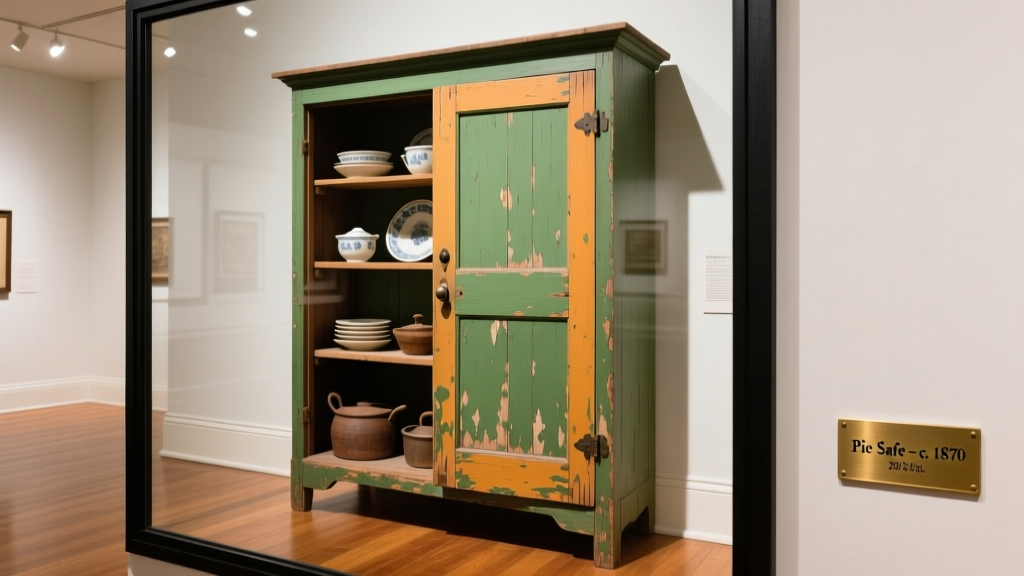
Pie Safe Authentication & Market Analysis: Green Ocher Paint, Original Shelves, and the 38½ × 22½ Inch Door Provenance
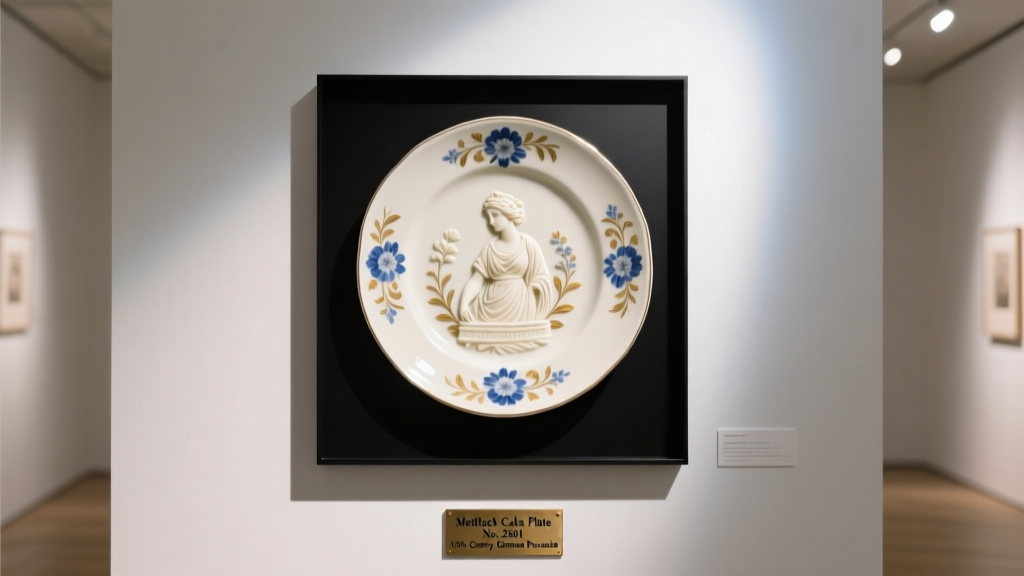
Mettlach Cake Plate No. 2601 'Cameo': Authentication, Provenance, and Market Analysis of the Iconic 5½ × 11-Inch Ceramic Platter
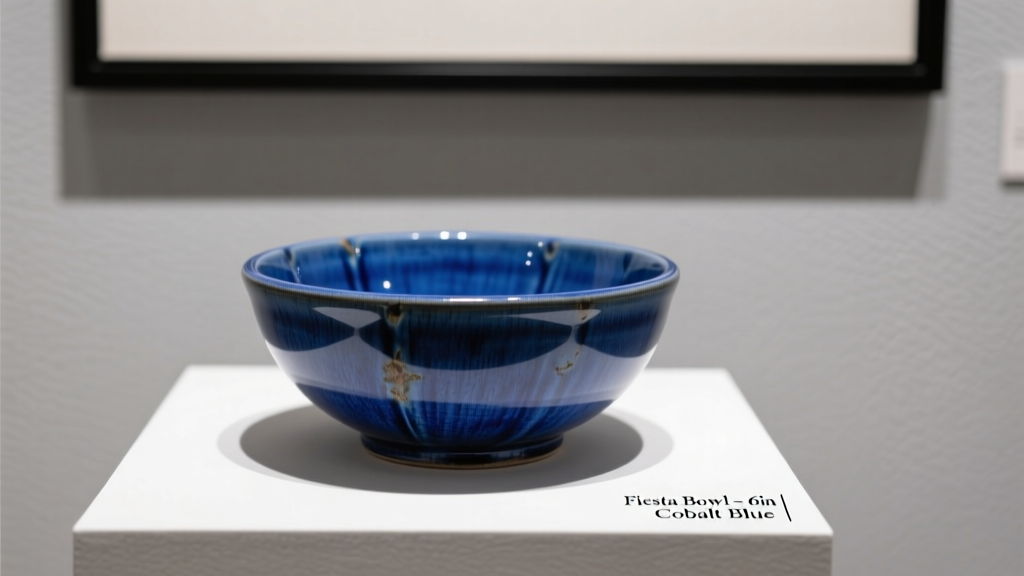
Fiesta Bowl Dessert Cobalt Blue 6-Inch: Authentication, Market Value, and Collectibility Analysis
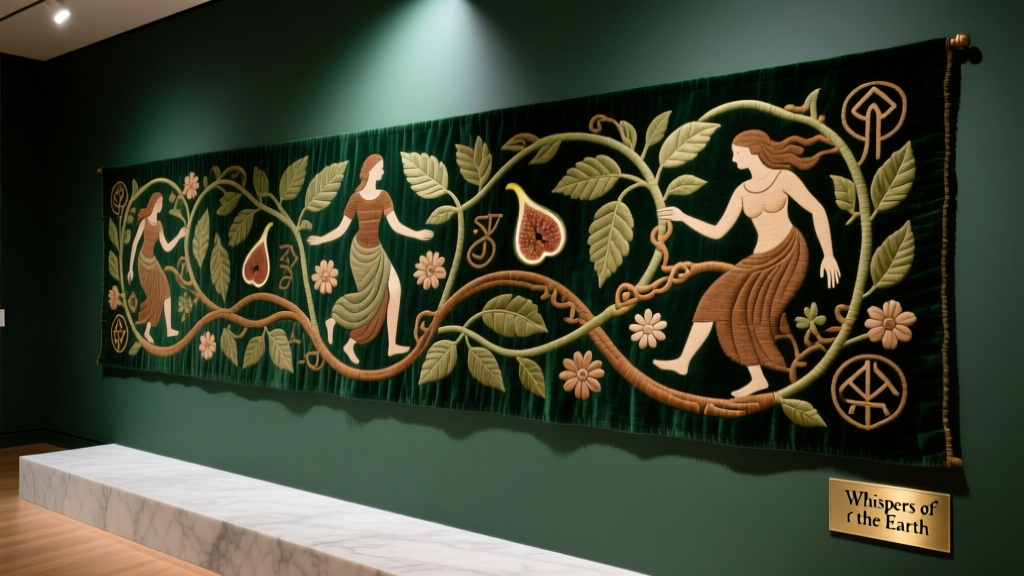
Textiles Runner Table Tapestry: Figural Pattern in Dark Green and Brown, 78 Inches Long — Authentication, Provenance, and Market Analysis
Limoges Porcelain Vase: Authenticity, Provenance, and Market Value in the 21st Century