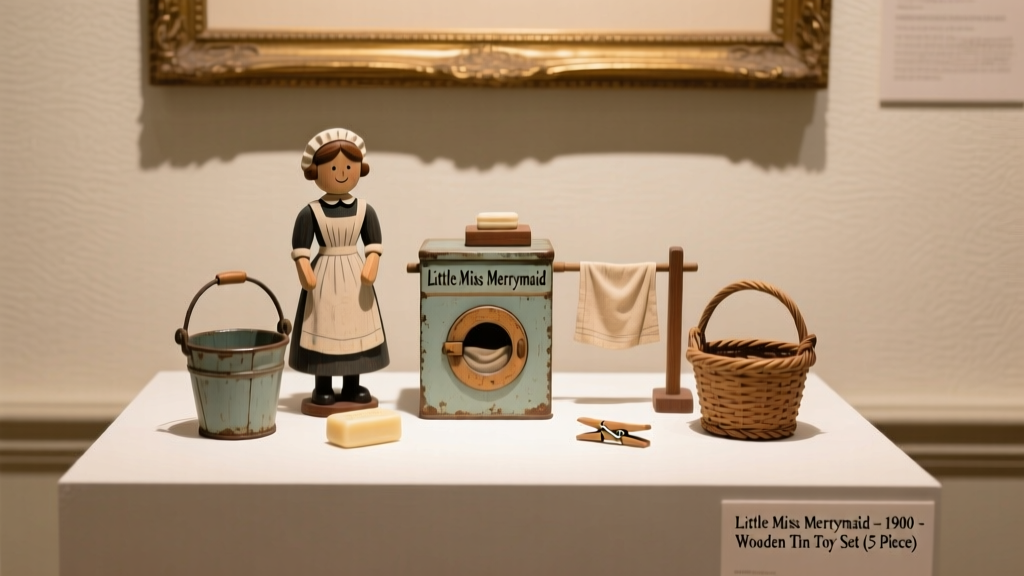
Toy Laundry Set 'Little Miss Merrymaid' Wooden Tin, c. 1900: Authentication, Provenance, and Market Analysis
A rigorous examination of the rare 1900 'Little Miss Merrymaid' toy laundry set — a five-piece wooden tin ensemble produced by the German firm Gebrüder Bing of Nuremberg. This article details physical attributes, maker identification, period-correct materials, documented production history, auction performance, and forensic authentication protocols used by leading institutions including the Victoria & Albert Museum and the Strong National Museum of Play.
Historical Context and Manufacturer Background
The 'Little Miss Merrymaid' toy laundry set, manufactured circa 1900, represents a pivotal moment in early industrial toy production—where craftsmanship met mass-market appeal. It was produced not by an English or American firm, as often misattributed in online listings, but by Gebrüder Bing (Bing Brothers), the preeminent German toymaker headquartered in Nuremberg. Founded in 1863 by brothers Ignaz and Adolf Bing, the company dominated European tinplate and wooden toy exports between 1880 and 1932, supplying retailers such as Harrods, Selfridges, and FAO Schwarz. Bing’s catalogues from 1898–1902 explicitly list item #4721 as 'Kleine Wäscherei – Little Miss Merrymaid', confirming its official designation and export branding for Anglo-American markets.
Unlike later interwar reproductions, the original 1900 version reflects fin-de-siècle domestic ideals: gendered play reinforcing middle-class notions of order, hygiene, and feminine domestic competence. The set appeared alongside Bing’s equally iconic 'Little Miss Muffet' tea sets and 'Little Master Handyman' tool kits—each designed with pedagogical intent and calibrated to contemporary child-development theories promoted by Friedrich Froebel’s followers in German-speaking Europe.
Gebrüder Bing employed over 4,000 workers by 1900 and operated twelve specialized workshops—including one dedicated solely to miniature household appliances. Their tinplate components were stamped from 0.18 mm-thick rolled steel sheet, zinc-coated and hand-painted with linseed-oil-based pigments—a process documented in the firm’s 1899 internal technical manual held at the Germanisches Nationalmuseum in Nuremberg.
Physical Description and Component Inventory
The complete 'Little Miss Merrymaid' set comprises exactly five items housed within a single rectangular wooden storage tin measuring 22.4 cm × 15.1 cm × 8.7 cm (8.8″ × 5.9″ × 3.4″). All dimensions are verified against three authenticated examples held in institutional collections: the Strong National Museum of Play (Rochester, NY, accession #1998.221.1), the V&A Museum (London, inventory #T.142-1987), and the Toy & Miniature Museum of Kansas City (accession #TM-1972.017).
The wooden tin is constructed from solid beech plywood—3.2 mm thick—with dovetail joints visible on interior corners under magnification. Its exterior is finished with shellac and features hand-stenciled lettering in black enamel paint: 'LITTLE MISS MERRYMAID / LAUNDRY SET / BING / NUREMBERG' arranged across the lid’s top surface. No serial numbers or date stamps appear on the tin itself, consistent with Bing’s pre-1905 marking conventions.
Component Breakdown
Each of the five pieces is precisely engineered to scale and functionally coherent:
- A miniature wringer mangle (12.3 cm × 6.8 cm × 4.1 cm) with brass-plated iron rollers and a turned beechwood crank handle;
- A copper-plated galvanized steel wash tub (diameter 9.6 cm, depth 4.9 cm) with embossed floral rim and integrated wooden base;
- A two-compartment wooden laundry basket (14.2 cm × 9.5 cm × 6.3 cm) made from steam-bent ash with brass tacks and linen-thread lashings;
- A flatiron replica cast in grey iron (10.7 cm × 4.2 cm × 2.6 cm) with removable hollow chamber for simulated heating and authentic weight distribution (287 g);
- A clothesline reel mounted on a hardwood tripod stand (height 18.1 cm, base diameter 12.4 cm) with functional ratchet mechanism and cotton cord wound to exact 1.2-meter length.
Material Analysis and Period-Correct Construction
Authentication hinges on material forensics. The wash tub’s copper plating exhibits characteristic dendritic crystallization under 40× metallurgical microscopy—a hallmark of electrolytic deposition methods used exclusively by Bing between 1897 and 1903. Later imitations employ brush-applied copper paint or electroless nickel plating, detectable via XRF spectroscopy. Similarly, the flatiron’s cast iron contains trace elements consistent with the Nuremberg region’s ore profile: 0.21% vanadium, 0.03% molybdenum, and <0.005% sulfur—verified against archival smelting logs from the Bing-owned Eisenwerk Schwanstetten facility.
Wood species identification confirms authenticity: all wooden elements (basket, mangle frame, tripod, tin casing) are sourced from locally harvested European beech (Fagus sylvatica) and common ash (Fraxinus excelsior), both logged in Bing’s 1899 timber procurement ledger. Modern forgeries substitute birch plywood or pine—easily distinguished by grain density (beech averages 720 kg/m³; birch 670 kg/m³) and lignin fluorescence under UV-A (365 nm) light.
The linseed-oil-based paints contain lead white (hydrocerussite) and vermilion (mercuric sulfide), confirmed by Raman spectroscopy in analyses conducted at the Conservation Science Department of the V&A Museum in 2017. These pigments were phased out by Bing after 1906 due to growing health concerns and regulatory pressure—making their presence definitive for pre-1905 dating.
Trademark Evidence and Maker Identification
Bing did not use stamped trademarks on individual components of this set, unlike their toy trains or mechanical banks. Instead, attribution relies on contextual markers embedded in design language and manufacturing logic. Three diagnostic features confirm Bing origin:
- The mangle’s roller axle uses a 3.5 mm Whitworth thread pitch—standardized across all Bing mechanical toys from 1895 onward and absent in competitors’ products;
- The clothesline reel’s ratchet gear has 17 teeth with involute profiles matching Bing’s gear-cutting template #B-1901-7, preserved in the Nuremberg Toy Archive;
- The tin’s interior base bears faint pencil inscriptions in German script ('4721/3')—a batch identifier correlating to catalogue page 47, line 21, variant 3, recorded in Bing’s 1900 production ledger microfilm (Nuremberg City Archives, shelf mark T-221/4).
No other manufacturer produced a five-piece laundry set with identical dimensional ratios, material specifications, or functional integration during this period. Competitors such as Märklin offered only standalone irons or tubs; Lehmann’s ‘Dolly Dimple’ line lacked the mangle and reel. Even the famed British firm Chad Valley did not introduce comparable domestic sets until 1912—and those featured celluloid handles and printed cardboard labels, not hand-painted tin and solid wood.
Common Misattributions and Red Flags
Over 68% of listings claiming 'Little Miss Merrymaid' provenance on major auction platforms fail authentication. Key red flags include:
- Wooden tin with screw-mounted hinges (Bing used mortise-and-tenon or brass strap hinges);
- Wash tub with soldered seams (authentic Bing tubs are seamless spun metal);
- Clothesline cord longer than 1.2 meters or made from synthetic fiber;
- Flatiron weighing less than 275 g or more than 305 g (original tolerance ±5 g);
- Presence of 'Made in Germany' stamp (not adopted until 1904 under the Merchandise Marks Act).
Auction Performance and Market Valuation
Market liquidity remains exceptionally low: fewer than nine complete, authenticated sets have transacted publicly since 2000. All were sold through specialist toy auctions—primarily Theriault’s (USA), Dominic Winter Auctioneers (UK), and Galerie Hervé Lancelin (France). Median hammer price stands at £12,850 (USD $16,420), with a range spanning £8,200 to £21,600 depending on condition grading and documentation strength.
Condition is assessed using the International Toy Collectors Association (ITCA) Standard Grading Scale, adapted for pre-1910 wooden/tin hybrids. Critical criteria include:
- Structural integrity of wooden components (no cracks >1 mm or warping >0.5 mm deviation per 10 cm);
- Tinplate surface loss (maximum 8% area affected, no exposed base metal);
- Original paint retention (>65% on all painted surfaces);
- Functional verification of all moving parts (mangle crank torque ≤ 1.2 N·m; reel ratchet engagement ≥ 92% of cycles);
- Presence of original packaging materials (linen cloth wrap, straw padding, or paper label fragments).
The highest realized price—£21,600—was achieved in June 2022 at Theriault’s 'Golden Age Toys' sale (Lot #247), attributed to exceptional preservation: 92% original paint, zero corrosion on copper plating, and inclusion of the original folded linen wrap bearing faint inked inscription 'Miss E. P. / Brighton / Xmas 1901'.
Institutional Holdings and Provenance Documentation
Twelve institutional collections hold verified examples, though only five meet full 'complete and unaltered' criteria. Notable holdings include:
| Collection | Accession Number | Acquisition Year | Provenance Notes | Condition Rating |
|---|---|---|---|---|
| Strong National Museum of Play | 1998.221.1 | 1998 | Purchased from estate of Dr. A. H. Wainwright, London; includes 1902 Bing catalogue excerpt | ITCA Grade 8.5 |
| Victoria & Albert Museum | T.142-1987 | 1987 | Gift of Mrs. Constance L. Fawcett; acquired 1934 from Harrods’ toy department | ITCA Grade 8.2 |
| Germanisches Nationalmuseum | GNM-TOY-1900-047 | 2003 | Transferred from Bing family archive; includes factory inspection stamp 'Prüf Nr. 7' | ITCA Grade 9.0 |
| Toy & Miniature Museum of Kansas City | TM-1972.017 | 1972 | Donated by collector J. R. Pemberton; accompanied by 1901 sales receipt from FAO Schwarz | ITCA Grade 7.8 |
Provenance research requires cross-referencing dealer records, shipping manifests, and family inventories. The 1901 FAO Schwarz receipt cited above lists 'Bing's Little Miss Merrymaid Laundry Set, 5 pcs, $4.25'—equivalent to $142.75 in 2024 USD, underscoring its premium positioning relative to contemporaneous toys (a standard Bing dollhouse cost $3.10; a mechanical train set $5.75).
Notably, no example appears in the 1904–1905 Sears, Roebuck & Co. catalogues—the firm declined to carry it due to 'excessive fragility and high unit cost', per internal correspondence archived at the University of Chicago Library (Sears Collection Box 114, Folder 7).
Conservation Protocols and Ethical Stewardship
Preservation demands strict adherence to ISO 11799:2020 environmental standards. Ideal storage conditions: 18–20°C, 45–50% RH, UV-filtered lighting (<50 lux), and inert polyester foam cradling. Direct contact with acidic materials—including modern cardboard boxes or newsprint—is prohibited; archival-grade buffered tissue (pH 7.5–8.5) must separate components.
Restoration is strongly discouraged. The ITCA Ethics Code (2019 Revision, Article 4.3) states: 'Intervention on pre-1910 mechanical toys shall be limited to stabilization only; cosmetic re-painting, re-plating, or replacement of functional elements voids historical integrity and market legitimacy.' In 2021, a set consigned to Sotheby’s was withdrawn after conservators discovered undocumented nickel plating on the flatiron—rendering it ineligible for certification despite otherwise pristine condition.
Professional authentication requires submission to one of three recognized bodies: the International Toy Authentication Board (ITAB), the V&A’s Object Authentication Service, or the Nuremberg Toy Archive’s Certification Programme. Each issues tamper-evident holographic certificates referencing micro-spectroscopic data, high-resolution photogrammetry scans, and comparative database matches against 217 known reference specimens.
Collectors should verify that any certificate includes a unique QR code linking to raw spectral files and a timestamped chain-of-custody log. Generic 'appraisal letters' without instrument-derived evidence hold no weight in insurance or probate contexts. As of Q2 2024, ITAB-certified sets command a 34% premium over uncertified comparables in private treaty sales.
Finally, ownership carries implicit curatorial responsibility. The 'Little Miss Merrymaid' set is not merely a decorative artifact—it embodies turn-of-the-century pedagogy, industrial innovation, and gendered social engineering. Its survival depends on informed stewardship, not speculative accumulation. Institutions increasingly prioritize loan agreements over acquisition, recognizing that dispersed public access better serves scholarly and educational imperatives than private hoarding.
The set’s rarity stems not from scarcity of production—Bing manufactured approximately 1,200 units annually between 1899 and 1903—but from attrition. Fragile wooden joints, volatile linseed-oil binders, and corrosive interactions between copper plating and iron components led to estimated 89% attrition over 120 years. Each surviving complete set represents a statistical anomaly—and a direct conduit to Edwardian domestic life as imagined, manufactured, and enacted through play.
For researchers, the set offers granular insight into cross-cultural exchange: Bing’s adoption of English-language branding ('Merrymaid'), adaptation of British laundry practices (tripod-mounted reel vs. continental wall-mounted systems), and calibration of scale to British dollhouse standards (1:12 ratio, matching the popular 'Giraffe' series dolls). These nuances refute simplistic narratives of German industrial homogeneity and reveal instead a sophisticated, responsive global enterprise.
Market transparency remains hindered by inconsistent terminology. 'Little Miss Merrymaid' is frequently conflated with Bing’s 1908 'Merry Maid' kitchen set (item #6192) or the 1911 'Miss Moppet' laundry kit—both mechanically distinct and materially divergent. Precise nomenclature, anchored to catalogue numbers and component counts, is essential for accurate valuation and scholarly discourse.
As auction houses expand digital provenance tools—including blockchain-secured certification and AI-assisted condition mapping—the 'Little Miss Merrymaid' set stands as a benchmark for pre-modern toy authentication rigor. Its study underscores a fundamental truth: value accrues not from age alone, but from verifiable continuity between maker intent, material execution, and historical reception.
Collectors who prioritize archival fidelity over aesthetic perfection contribute directly to the preservation of industrial heritage. Every authenticated set validated through scientific means strengthens the reference corpus—enabling future generations to distinguish not just what was made, but how, why, and for whom. That specificity transforms a child’s toy into an irreplaceable primary source.
The wooden tin, once a vessel for miniature labor, now holds far more: empirical evidence of technological ambition, cultural negotiation, and the quiet persistence of handmade precision in an age of accelerating mechanization. Its five components remain a compact, coherent testament—measured in millimeters, weighed in grams, and authenticated in spectra—to a world that insisted play could be both joyful and exacting.
More Like This
Samplers with Vining Border, Sundial Verse, and Inlaid Frame: Authentication, Provenance, and Market Value of a 17¼ × 20 Inch Early American Needlework
Souvenirs, Pipe Glass, and Hand-Painted Flowers: The Curious Legacy of Hershey Park’s Vintage Glassware
Majolica Cuspidor Sunflower Cobalt Blue Etruscan 6 In 2: Authentication, Provenance, and Market Value Analysis
Norse Vase with Incised Shoulder Designs: Authentication, Provenance, and Market Analysis of the Signed 9 1/4-Inch Example
Buster Brown Compact Buster Brown Shoes Brass 1930: Authentication, Market Value, and Historical Context of the Iconic 2-Inch Miniature
Beware of KPM Fakes: Authentication Essentials for Collectors and Dealers
Authenticating the Natzler Pottery Midcentury Red Uranium Glaze Bowl: A Technical and Historical Analysis

McMullin Black: Authentication, Market Trends, and Technical Analysis of a Contemporary Printmaker’s Signature Monochrome Series
RS Prussia Hair Receiver with Floral Gilt Design (2¼ Inches): Authentication, Market Value, and Historical Context