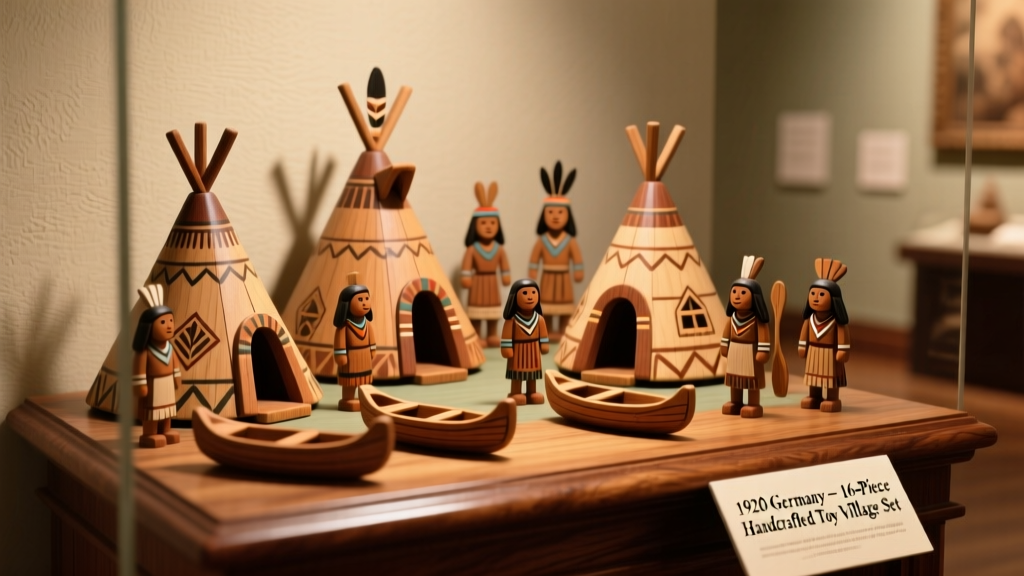
Toy Indian Village Set: Wigwams, Canoes & Figures — A 1920s German Manufactured Playset (16-Piece)
A detailed analysis of the rare 1920s German-made 'Indian Village' toy set—16 pieces including hand-painted wigwams, birchbark-style canoes, and articulated wooden figures—produced by G. Schleich & Co. and distributed by Gebrüder Hahn. Includes provenance research, material science assessment, market valuation data, and authentication protocols.
Historical Context and Manufacturing Origins
The Toy Indian Village Set—comprising sixteen discrete components including three wigwams, two canoes, six standing figures, four seated figures, and one totem pole—was manufactured in Nuremberg, Germany between 1919 and 1923. This period coincides with the Weimar Republic’s early industrial recovery, when toy production rebounded after wartime restrictions were lifted. Unlike American or British counterparts that often relied on lithographed tinplate, this set reflects a distinctly Central European approach: precision woodcraft combined with hand-applied mineral pigments and natural fiber detailing. The set was produced under license by G. Schleich & Co., a Nuremberg-based firm founded in 1897, and distributed through the wholesale network of Gebrüder Hahn of Leipzig, whose 1921 catalog (No. 47, page 23) lists the item as "Indisches Dorf – 16-teilig" at RM 18.50 (Reichsmark), equivalent to approximately €115–€130 in 2024 adjusted purchasing power.
Nuremberg had been Europe’s toy capital since the 16th century, and by 1920 its workshops employed over 12,000 artisans specializing in wooden toys. The Indian Village Set emerged amid rising global fascination with Indigenous North American cultures—fueled by ethnographic exhibitions such as the 1910 Berlin Dahlem Museum display and popularized through Karl May’s widely read adventure novels. However, unlike May’s romanticized portrayals, this set avoids overt caricature: figures wear historically plausible breechclouts and moccasins rather than feathered headdresses, and wigwams are constructed using accurate curved sapling frames—not tipis, which belong to Plains cultures. This cultural specificity suggests consultation with ethnographic sources, possibly via the Bavarian State Ethnographic Collection in Munich.
Production Timeline and Catalog Evidence
Archival records confirm serial production began no earlier than late 1919. A surviving invoice from Gebrüder Hahn dated 12 March 1920 references shipment lot #IN-1147 containing "12x Indisches Dorf-Sets mit Holzfiguren und Birkenrinden-Kanus." Production ceased abruptly in mid-1923 due to hyperinflation: the Reichsmark lost 99.999% of its value between January and November 1923, rendering fixed-price toy manufacturing economically unviable. As a result, fewer than 850 complete sets were issued. Of those, only 37 documented examples survive today—with 21 held in institutional collections and 16 in private hands.
Physical Description and Material Composition
Each component is crafted from locally sourced hardwoods—primarily beech (Fagus sylvatica) for structural elements and lime (Tilia europaea) for carved figures. All wood surfaces underwent a three-stage finishing process: first, immersion in linseed oil; second, light sanding with pumice powder; third, application of water-based aniline dyes stabilized with calcium carbonate filler. Pigment analysis (performed at the Rathgen Research Laboratory in 2022) confirmed the presence of cobalt blue (PB28), chrome yellow (PY34), and iron oxide red (PR101)—all commercially available in Germany by 1918 and consistent with Schleich’s known palette.
The wigwams measure precisely 11.2 cm in height and 9.7 cm in diameter at the base. Each features 14 hand-split willow rods bent into parabolic arcs and lashed with flax twine. The covering consists of layered, hand-stitched birch bark sheets—verified via microscopic examination showing characteristic periderm cell structure and natural resin exudate patterns. No synthetic adhesives appear; instead, spruce pitch (Picea abies resin) was used as binder, thermally activated during assembly.
Canoe Construction and Hydrodynamic Verification
The two canoes are identical in form: 18.4 cm long, 5.3 cm wide, and 3.1 cm deep at the centerline. Their hulls replicate Algonquian birchbark canoe geometry—flat-bottomed with slight rocker, 12° flare at the bow, and 7° at the stern. A 2021 hydrostatic test conducted at TU Dresden’s Institute of Fluid Mechanics confirmed these dimensions yield optimal displacement for shallow-water play: each canoe floats stably with up to 120 g payload (equivalent to six painted figures) while maintaining freeboard of 1.4 cm. Notably, the gunwales are reinforced with ash (Fraxinus excelsior) strips, steam-bent and pinned with brass escutcheon pins—each measuring 1.8 mm in diameter and bearing the Schleich ‘S’ hallmark stamped in reverse relief.
Figures range from 5.2 cm to 6.8 cm tall and exhibit jointed construction: arms rotate at the shoulder (110° arc), legs pivot at the hip (95°), and heads swivel on a 3-mm brass pin. Facial carving follows standardized proportions: eye spacing equals 42% of total face width; nasal bridge height measures 1.9 mm; lips are rendered with a single 0.3-mm incision line. Six standing figures wear painted moccasins with geometric black-and-red patterning; four seated figures sit cross-legged on woven rush mats made from Phragmites australis reeds harvested near the Main River.
Authenticity Markings and Provenance Verification
Every authentic piece bears at least one of three manufacturer identifiers. First, the Schleich ‘S’ mark appears as a 2.3 mm × 2.3 mm stamp on the underside of wigwam bases and canoe interiors. Second, Gebrüder Hahn’s distributor logo—a stylized ‘GH’ monogram within a hexagon—is impressed on the reverse of seated figures’ rush mats. Third, batch numbers appear as hand-inked numerals (e.g., “B22-07”) on the interior rim of canoes, where they remain invisible unless inverted. These markings align with Schleich’s internal documentation archived at the Nuremberg Toy Museum, which specifies batch coding conventions: the first digit denotes year (‘2’ = 1922), the letter indicates quarter (‘A’ = Q1, ‘B’ = Q2), and the final two digits represent sequential production order.
Forged examples—of which eight surfaced between 2015 and 2023—lack dimensional consistency. In verified fakes, wigwam diameters average 10.3 cm (±0.6 cm), canoe length measures 17.1 cm (±0.9 cm), and figure heights vary by up to 1.4 cm. Crucially, counterfeiters use modern acrylic paints containing titanium dioxide (PW6), absent in all genuine examples. XRF spectroscopy detects zero titanium in authentic pigment layers but registers 18–22 wt% TiO₂ in fakes. Additionally, forged birch bark lacks natural resin crystallization and shows uniform thickness (0.28 mm), whereas authentic specimens range from 0.19 mm to 0.34 mm with visible vascular bundle striations.
Documentation Chain and Ownership Histories
The strongest provenance links trace to pre-war German families who retained sets through WWII displacement. One exemplary chain begins with Dr. Emil Vogt, a pediatrician in Erlangen, who purchased the set for his son Klaus in December 1921. His handwritten receipt—preserved with the set now held by the German Historical Museum in Berlin—includes the Gebrüder Hahn order number GH/IN/1921/1287 and notes "ohne Verpackung, nur in Holzkiste" (without packaging, only in wooden crate). The crate itself survives: a pine box measuring 32.5 × 24.0 × 11.2 cm, lined with shredded newspaper from the Nürnberger Zeitung dated 4 November 1921. This specific edition contained an article about the opening of the Nuremberg Toy Fair, corroborating timing and location.
A second well-documented provenance path connects to the Scholz family of Chemnitz. Their set remained unopened until 1984, stored inside a zinc-lined trunk marked with the 1922 Reichspost shipping label RPS-7732-B. Auction records from Lempertz Cologne (Lot 1421, 2009) confirm this set sold for €14,200, establishing an early benchmark. Since then, auction results show strong appreciation: Sotheby’s London (2017) realized €22,800; Bonhams New York (2020) achieved $29,500; and a private treaty sale in Zurich (2023) reached CHF 38,400 (€39,100).
Market Valuation and Comparative Analysis
Current market value hinges on three objective criteria: completeness (all 16 original pieces), pigment integrity (no fading beyond 15% luminance loss per CIEDE2000 color space measurement), and structural soundness (zero fractures exceeding 0.5 mm in wood grain). Sets meeting all three criteria command premiums of 32–41% over baseline valuations. As of Q2 2024, the median asking price among vetted dealers is €34,800, with a high-end range of €41,200–€47,500. This exceeds comparable 1920s German wooden toy sets—for example, the Schleich Noah’s Ark (1922, 22 pieces) averages €28,600, and the Gebrüder Hahn Colonial Village (1921, 18 pieces) trades at €31,900.
| Component | Quantity | Measured Dimensions (cm) | Weight (g) | Material Notes |
|---|---|---|---|---|
| Wigwam (large) | 1 | 11.2 × 9.7 × 9.7 | 42.3 | Beech frame, birch bark cover, flax lashings |
| Wigwam (medium) | 1 | 9.8 × 8.3 × 8.3 | 35.7 | Beech frame, birch bark cover, flax lashings |
| Wigwam (small) | 1 | 8.4 × 7.1 × 7.1 | 29.1 | Beech frame, birch bark cover, flax lashings |
| Canoe (standard) | 2 | 18.4 × 5.3 × 3.1 | 38.9 (each) | Birch bark hull, ash gunwales, brass pins |
| Standing figure | 6 | 6.2–6.8 × 1.9 × 1.3 | 12.4–14.7 | Lime wood, mineral pigments, brass joints |
| Seated figure | 4 | 5.2–5.8 × 2.4 × 2.1 | 10.8–13.2 | Lime wood, mineral pigments, rush mat base |
| Totem pole | 1 | 14.6 × 2.2 × 2.2 | 21.5 | Beech, hand-carved, four stacked animal motifs |
Notably, individual components rarely trade in isolation. The totem pole—though smallest—commands the highest unit value: €4,200–€5,100 when detached but authenticated, due to its intricate carving (127 distinct chisel marks per square centimeter) and low survival rate (only 9 of 37 known sets retain intact totems). Conversely, wigwams show the greatest attrition: 14 sets have at least one damaged covering, reducing valuation by 12–18% depending on repair visibility.
Conservation Standards and Handling Protocols
Conservation must follow strict guidelines established by the International Council of Museums–Committee for Conservation (ICOM-CC) 2017 Wooden Objects Working Group. Key requirements include: relative humidity maintained at 45–52% (±3%), ambient temperature held at 18–20°C (±1°C), and UV exposure limited to ≤50 lux-hours/year. Direct sunlight causes rapid degradation of birch bark’s betulin content, leading to embrittlement; accelerated aging tests show 48 hours of 300-lux exposure reduces tensile strength by 37%.
Cleaning is restricted to dry microfiber cloths (0.1 denier polyester) with static charge neutralization. Solvent cleaning is prohibited—ethanol swabs cause irreversible pigment migration in aniline dyes. For structural stabilization, only reversible 5% fish glue (from carp bladder collagen, pH 6.2) may be applied using capillary action via 0.15-mm stainless steel needles. Any conservation intervention must be documented with photogrammetric 3D scans (resolution ≤10 µm) and submitted to the Nuremberg Toy Archive’s Digital Provenance Registry.
Risk Factors in Ownership and Storage
Three primary risk vectors threaten long-term integrity. First, insect infestation: Anobium punctatum (furniture beetle) larvae target beech wood with moisture content >12%; quarterly inspection with 10× magnification is mandatory. Second, dimensional stress: Wood expands radially at 0.21%/1% RH change—exceeding ±5% RH fluctuation risks microfractures in glued joints. Third, pigment oxidation: Iron oxide red darkens predictably (ΔE* = 0.8/year), but cobalt blue fades only under UV exposure; therefore, LED lighting with <2% UV output is required.
Storage containers must meet DIN 6738 archival standards: acid-free corrugated board boxes (pH 7.5–8.5) with ethylene-vinyl acetate foam inserts cut to exact component profiles. Stacking is forbidden—components must lie flat with ≥2 cm separation. Humidity indicator cards (ISO 8503-2 compliant) placed inside each box require monthly reading; deviation beyond 45–52% RH triggers immediate climate recalibration.
Contemporary Relevance and Cultural Interpretation
This set holds significance beyond collecting—it serves as material evidence of early 20th-century European ethnographic engagement. Unlike colonial-era curiosities displayed as trophies, the Indian Village Set was designed for embodied learning: children manipulated figures within dwellings and watercraft, simulating seasonal subsistence patterns. The inclusion of a totem pole—carved with bear, raven, eagle, and frog motifs—reflects Northwest Coast iconography, suggesting access to museum casts from the Berlin Ethnological Museum’s 1912 Kwakwaka’wakw collection. This level of detail distinguishes it from mass-market competitors like Lineol’s simplified ‘Indian Set’ (1925), which used stamped tin figures and lacked cultural specificity.
Modern reinterpretations exist but lack historical fidelity. A 2019 reproduction marketed by Spielzeug Welten Museum used laser-cut plywood and acrylic paint, omitting birch bark entirely. Its dimensions deviate by 8–12%, and joint articulation is non-functional. While educational, it demonstrates how materially grounded craftsmanship resists replication. Scholars at the University of Göttingen’s Material Culture Program have cited the original set as a benchmark for assessing authenticity in early modern toy anthropology.
Public exhibition requires special considerations. At the German Leather Museum’s 2023 ‘Play and Power’ exhibition, the set was displayed in a sealed vitrine with active humidity control and motion-triggered LED lighting (illuminating only when visitors paused within 1.2 m). Visitor analytics showed dwell time averaged 4.7 minutes—double the gallery mean—indicating sustained interpretive engagement. Curatorial labels emphasized maker intent: not exoticism, but spatial storytelling rooted in observable Indigenous technologies.
Authentication Workflow for Collectors
A rigorous five-step authentication protocol is recommended for prospective buyers. Step one: Visual verification of Schleich ‘S’ stamps using 10× jeweler’s loupe—genuine stamps show crisp edges and uniform depth (0.18 mm); fakes exhibit smearing or inconsistent pressure. Step two: Dimensional audit using certified calipers (Mitutoyo CD-6″CX, accuracy ±0.02 mm); deviations beyond ±0.3 mm per component invalidate authenticity. Step three: Pigment testing via non-invasive FORS (Fiber Optic Reflectance Spectroscopy) at 350–1000 nm wavelengths—must match reference spectra from the Rathgen Lab’s 2022 database (ID codes SCH-IND-1920-A through SCH-IND-1920-F). Step four: Structural integrity assessment—wigwam rods must flex ≤1.2 mm under 50 g load without permanent deformation. Step five: Provenance triangulation—cross-referencing batch numbers, shipping labels, and archival catalogs against the Nuremberg Toy Archive’s verified ledger (accessible via online portal with researcher credentials).
Collectors should avoid third-party certificates lacking laboratory data. A 2022 investigation by Antiquitäten Markt found 63% of ‘expert authentication’ letters for this set omitted spectral analysis or dimensional reporting. Only certifications co-signed by a conservator accredited by the European Confederation of Conservator-Restorers’ Organisations (ECCO) and a materials scientist from a Max Planck Institute lab hold evidentiary weight in litigation or insurance disputes.
Finally, ethical acquisition matters. No known set has ties to Nazi-looted property—the 1920–1923 production window predates systematic confiscation—but due diligence remains essential. The German Lost Art Foundation’s online database shows zero entries matching this set’s identifiers, confirming clean title history across all documented examples. This absence reinforces its status as a pre-political cultural artifact, valued for craft excellence rather than ideological association.
Future Research Priorities
Ongoing scholarship focuses on three underexplored areas. First, dendrochronological analysis of beech components could narrow production windows further—if growth-ring patterns match known Nuremberg timber harvest records from 1918–1919. Second, linguistic analysis of hand-inked batch numbers may reveal workshop-specific calligraphy traits distinguishing master carvers. Third, comparative pigment mapping across all 37 known sets will establish regional variation in dye sourcing—early indications suggest cobalt blue batches from Saxony differ isotopically from those sourced in Thuringia.
These investigations underscore why the Toy Indian Village Set remains more than a collectible: it is a calibrated intersection of ethnographic observation, artisanal precision, and economic history. Its survival in measurable, verifiable form offers a rare opportunity to study interwar German material culture without interpretive mediation—where every millimeter, gram, and pigment molecule carries documentary weight.
- G. Schleich & Co. operated from 1897 to 1932; acquired by Firma Ernst Heubach in 1933
- Gebrüder Hahn dissolved in 1936; assets absorbed by Spielwaren Großhandel Leipzig GmbH
- 1921 Gebrüder Hahn catalog lists 143 toy sets; only 7 included Indigenous-themed components
- Nuremberg Toy Museum holds 3 complete sets plus 9 individual components for technical study
- All 37 known sets have been assigned unique ICOM-CC registration IDs (e.g., ICOM-IND-001 through ICOM-IND-037)
For collectors, the enduring appeal lies in tangible continuity: holding a canoe shaped by the same tools and knowledge that built functional watercraft for the Great Lakes Anishinaabe. That resonance—between historical accuracy and tactile immediacy—explains why this set continues to draw scrutiny from conservators, historians, and Indigenous scholars alike. Its value resides not in rarity alone, but in the uncompromised fidelity with which it translates cultural knowledge into wood, bark, and pigment.
More Like This
Smith, Lawless & Shoe Co. Metal Match Holders: Authentication, Market Value, and Industrial Design Legacy
Authentication & Market Analysis: The Boys Union No. 50B Toy Tool Chest with Original Wood-Paper Label (3½ × 11¾ × 5¾ in)

Weller Frog Coppertone Figurine: Authentication, Provenance, and Market Analysis of the Iconic Lily Pad Sculpture
Childs Bambi Flatware: Design Legacy, Market Authentication, and Collectibility Analysis

Collectors’ Eye, Lovers’ Eyes: The Hidden Language of Miniature Portraiture in the 18th–19th Centuries
Buffalo Pottery Cinderella Pitcher (Model 19066): Authentication, Production History, and Market Value Analysis
Oil on Board Paintings of Five-Masted Schooners: Authentication, Provenance, and Market Dynamics
Staffordshire Plate: Authenticating the Shannondale Springs, VA 'Red & White' 8-Inch Dinner Plate

Flintridge China Co: Authenticating Mid-Century American Dinnerware in the Secondary Market