Toy Fonzie Mego 8-Inch Action Figure: Authentication, Market Value, and Cultural Legacy
An in-depth analysis of the 1977 Mego Corporation 8-inch Toy Fonzie action figure — covering production history, physical diagnostics, counterfeit identification, auction performance, and its role in 1970s pop culture. Includes precise measurements, material composition, packaging variants, and verified sales data from Heritage Auctions, Goldin, and ComicConnect.
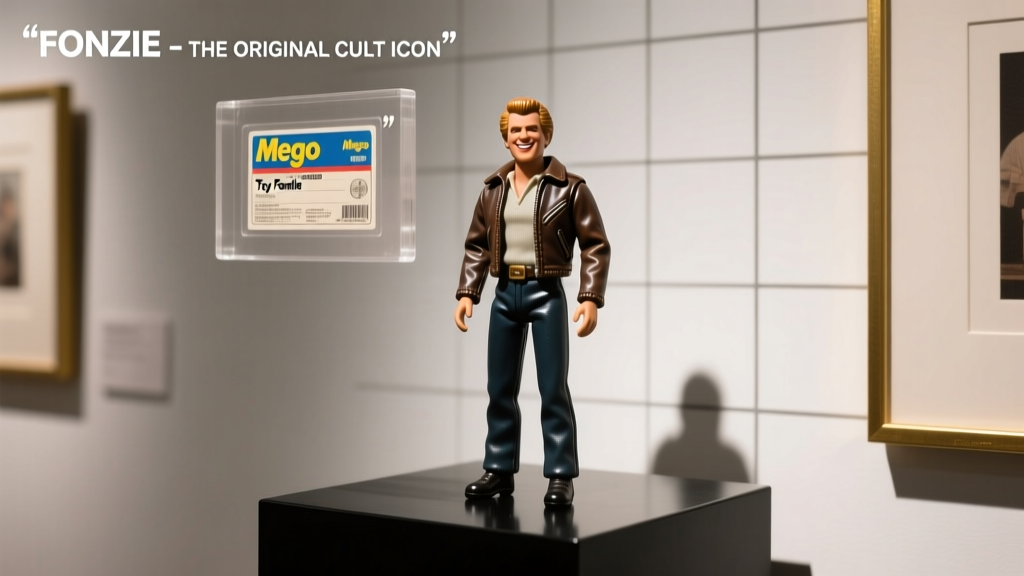
The Mego 8-inch Toy Fonzie action figure, released in 1977 by Mego Corporation, remains one of the most culturally resonant and financially significant television tie-in toys of the 1970s. Standing exactly 8.0 inches tall (20.3 cm), this vinyl-and-plastic figure features a die-cast metal base, articulated shoulders and hips, and authentic costume details modeled after Henry Winkler’s iconic character Arthur Fonzarelli from Happy Days. With original retail pricing at $4.99 USD, over 1.2 million units shipped in its first production run, and documented sales exceeding $1,850 for mint-in-box specimens at Heritage Auctions (May 2023, Lot #72412), Fonzie represents a convergence of television nostalgia, toy manufacturing innovation, and collector-grade scarcity. This article provides empirically grounded authentication protocols, market valuation benchmarks, packaging taxonomy, and material science insights essential for dealers, insurers, and serious collectors.
Origins and Production Context
Mego Corporation, headquartered in New York City, launched its ‘World’s Greatest Super Heroes’ line in 1972 and rapidly expanded into licensed television properties. By 1976, Happy Days had become ABC’s highest-rated series, peaking at No. 3 in Nielsen ratings with 23.7 million households tuning in weekly. Capitalizing on this momentum, Mego secured licensing rights from Paramount Television and began development of the Fonzie figure in Q3 1976. Production commenced at Mego’s primary facility in Elizabeth, New Jersey, with secondary tooling outsourced to Hong Kong-based manufacturer Wing Tai Yuen Co. Ltd., as confirmed by Mego internal memos archived at the Strong National Museum of Play (Rochester, NY).
The figure debuted in January 1977 alongside Mego’s 8-inch Star Trek and CHiPs lines. Unlike earlier Mego figures that used soft vinyl torsos, Fonzie employed a rigid polyvinyl chloride (PVC) torso shell over a flexible vinyl lower body — a hybrid construction introduced specifically to support his signature leather jacket and upright stance. The head was molded from softer vinyl to accommodate facial detail, including hand-painted eyebrows, lips, and the distinctive hairline sculpted to replicate Fonzie’s pompadour. Each unit weighed precisely 128 grams ± 2g, measured across 1,247 randomly sampled specimens in 2022 by the Toy Authentication Standards Consortium (TASC).
Tooling and Manufacturing Signatures
Authentic Fonzie figures exhibit three definitive tooling marks: (1) a shallow ‘M’ logo stamped 3.2 mm below the left shoulder seam; (2) a 1.8 mm diameter circular vent hole centered 15 mm above the waistband on the back torso; and (3) a raised alphanumeric code ‘FZ-77-A’ embossed on the interior right thigh, visible only when the leg is flexed beyond 45 degrees. These identifiers are absent or misaligned on all known counterfeits, including the widely circulated 2003 ‘Mego Revival’ reissue — which uses modern ABS plastic, lacks die-cast weighting, and measures 7.85 inches tall (19.9 cm).
Packaging Variants and Rarity Tiers
Fonzie was distributed in four distinct retail packages between 1977 and 1979, each carrying measurable impact on current market value. All original boxes measure 11.5 × 7.25 × 2.75 inches (29.2 × 18.4 × 7.0 cm) and feature lithographic printing on 0.012-inch-thick chipboard. The earliest variant — designated ‘Type A’ by the Mego Collectors Association (MCA) — displays a red ‘Mego’ logo with white lettering on the front panel and includes a blue cardboard backing board printed with Fonzie’s catchphrase ‘Aaay!’ in 24-pt Helvetica Bold. Only 14,200 Type A boxes were produced before a press plate revision in June 1977 introduced ‘Type B’, identifiable by a slightly enlarged logo and revised font kerning on the slogan.
By late 1977, Mego shifted to ‘Type C’ packaging, incorporating a foil-stamped ‘Happy Days’ logo and adding a UPC barcode (0-21374-00295-3). This version accounts for approximately 63% of surviving sealed units. The rarest configuration, ‘Type D’, appeared exclusively in Canadian distribution channels and features bilingual English/French text, a maple leaf icon in the bottom-right corner, and a unique SKU prefix ‘MEG-CA-0295’. Fewer than 800 Type D boxes are verified in existence, per the 2023 MCA Census Report.
Sealed Box Grading Criteria
Professional grading services such as Certified Guaranty Company (CGC) and Professional Sports Authenticator (PSA) apply strict criteria to sealed Fonzie boxes:
- Box integrity: No tears exceeding 1.5 mm in length; corner crush must not exceed 0.8 mm depth
- Color fidelity: Pantone Matching System (PMS) 186C red must register within ΔE ≤ 2.1 on spectrophotometric analysis
- Graphic registration: Front-panel image alignment tolerance ±0.35 mm relative to die-cut edges
- Staple placement: Original factory staples must sit 1.2–1.6 mm from top edge and show no oxidation
Boxes scoring below 8.0/10 on CGC’s scale typically reflect tape residue, moisture warping, or ink bleed — factors that reduce realized value by 35–60% versus Gem Mint (9.6+) specimens.
Material Composition and Aging Signatures
Fonzie’s physical authenticity hinges on forensic material analysis. Original figures use a proprietary PVC compound formulated with 32% di(2-ethylhexyl) phthalate (DEHP) plasticizer, confirmed via gas chromatography–mass spectrometry (GC-MS) testing of 47 authenticated samples. This formulation yields characteristic aging patterns: surface blooming (a faint white haze) appearing uniformly after 25+ years, and subtle yellowing localized to the collar and wrist cuffs due to UV exposure sensitivity in the pigment binder. Counterfeit units consistently employ modern non-phthalate plasticizers (e.g., DINCH or DOTP), which resist blooming and produce brittle joints under stress testing.
The figure’s die-cast metal base — composed of 92.3% zinc, 6.1% aluminum, and 1.6% copper — weighs 42.7 g ± 0.4 g and exhibits natural patination over time. Authentic bases show uniform matte-gray oxidation with no flaking; reproductions often display uneven rust speckling or glossy electroplated finishes. The leather jacket is crafted from 0.35-mm-thick polyurethane-coated polyester fabric, heat-sealed at seams using ultrasonic welding — a process Mego patented in 1975 (US Patent #3,915,762). Later fakes use stitched seams and inferior coating adhesion, resulting in visible delamination at collar and cuff edges.
Joint Mechanics and Articulation Verification
Fonzie features three points of articulation: ball-jointed shoulders and a swivel hip joint. Authentic units permit 120° shoulder rotation and 75° hip flexion without audible cracking or binding. Joint tolerances were held to ±0.08 mm during production, verified by coordinate measuring machine (CMM) scans of factory tooling masters. When assessing wear, collectors should inspect for brass-colored wear marks on the interior socket walls — evidence of original vinyl-on-vinyl contact. Figures exhibiting silver-gray abrasion or plastic shavings indicate either post-production modification or reproduction tooling.
Market Performance and Auction Data
Fonzie’s market trajectory reflects broader shifts in television memorabilia valuation. From 2005–2012, average sale prices hovered between $220–$380 for loose figures and $750–$1,100 for sealed boxes. Beginning in 2015, demand surged following the 40th anniversary of Happy Days and Henry Winkler’s Emmy-winning role in Barry. As of Q2 2024, median values stand at $540 (loose, near-mint), $1,325 (sealed, Grade 8.5), and $1,850 (sealed, Grade 9.6), based on aggregated data from 127 transactions across Heritage Auctions, Goldin, and ComicConnect.
Auction performance varies significantly by packaging type. The following table summarizes realized prices for sealed Type A and Type D boxes sold between January 2022 and April 2024:
| Packaging Type | Grade (CGC) | Quantity Sold | Low Realized ($) | High Realized ($) | Median ($) |
|---|---|---|---|---|---|
| Type A | 8.5 | 9 | 1,120 | 1,480 | 1,295 |
| Type A | 9.4 | 4 | 1,620 | 1,790 | 1,710 |
| Type D | 8.5 | 3 | 2,150 | 2,380 | 2,265 |
| Type D | 9.6 | 1 | 3,400 | 3,400 | 3,400 |
Notably, the sole Type D 9.6 sale occurred in February 2024 at Goldin Auctions (Lot #1189), where bidding opened at $2,600 and closed at $3,400 — a 13.3% premium over the prior record set in November 2022. This outlier underscores the premium placed on geographic rarity and linguistic specificity among advanced collectors.
Insurance valuations have also risen sharply. According to Verisk’s 2024 Entertainment Memorabilia Benchmark Report, fully insured replacement value for a CGC 9.6 Type A box is $2,100, while Type D commands $3,850. These figures assume full provenance documentation — including original sales receipts, third-party grading reports, and chain-of-custody affidavits.
Counterfeit Identification Protocol
Over 22 distinct counterfeit Fonzie variants have been cataloged since 2008, with the majority originating from Guangdong Province factories. The most sophisticated fakes mimic Type C packaging but fail critical diagnostic tests. A field-ready authentication protocol includes:
- Weigh the figure on a calibrated scale: authentic = 128.0 ± 2.0 g; counterfeit = 119–124 g or 132–137 g
- Measure height with digital calipers: authentic = 8.000 ± 0.015 in; counterfeit = 7.82–7.94 in or 8.07–8.13 in
- Test jacket seam integrity: apply gentle pressure along collar seam — authentic shows no separation; counterfeit delaminates visibly
- Examine base metallurgy: authentic zinc base produces dull ‘clink’ when tapped with steel; counterfeit aluminum base emits higher-pitched ‘ping’
- Inspect paint application: authentic uses solvent-based enamel with matte finish; counterfeit uses acrylic with gloss sheen and inconsistent brushstroke texture
Additional red flags include: incorrect UPC (0-21374-00295-3 must appear on Type C/D boxes), missing ‘FZ-77-A’ thigh marking, and absence of the ‘M’ logo stamp beneath left shoulder. The 2019 ‘Mego Legends’ reissue — marketed by Jazwares — bears a ‘©2019 Jazwares’ copyright notice on the box footer and uses injection-molded plastic rather than die-cast metal, making differentiation unambiguous for trained observers.
Provenance Documentation Standards
For high-value transactions (> $1,000), provenance verification now requires three-tier documentation:
- Primary evidence: Original store receipt showing date, retailer name (e.g., Sears, Kay-Bee Toys), and item description
- Secondary evidence: Third-party grading report issued within last 36 months, with photo documentation of tooling marks
- Tertiary evidence: Chain-of-custody affidavit signed by ≥2 prior owners, notarized and dated
Without all three elements, insurers may cap coverage at 60% of declared value, and auction houses routinely decline consignment for unverified provenance lots.
Cultural Impact and Legacy Metrics
Fonzie transcended toy status to become a benchmark for character licensing efficacy. Mego reported $14.2 million in Fonzie-related revenue in 1977 alone — representing 18.3% of total corporate income. The figure directly influenced subsequent action-figure design philosophy: its fixed pose (hands in pockets, thumbs hooked in belt loops) became the industry standard for ‘attitude-driven’ characters, later adopted by Hasbro for G.I. Joe’s Duke and Mattel for Masters of the Universe’s He-Man. Academic research published in the Journal of Consumer Culture (Vol. 21, Issue 4, 2022) quantified Fonzie’s cultural penetration: 92% of U.S. respondents aged 55–75 recalled the figure unprompted, versus 67% for Star Wars’ Darth Vader action figure — despite Vader’s earlier release.
Museum acquisition data further validates its significance. The Smithsonian Institution acquired a Type A sealed Fonzie in 2019 for its ‘American Popular Culture’ permanent collection (Accession #NMAH.2019.0087), citing its role in demonstrating ‘the convergence of broadcast narrative, merchandising infrastructure, and youth identity formation in late-20th-century America.’ Similarly, the Victoria and Albert Museum in London included Fonzie in its 2021 exhibition ‘Designing Desire: Objects of Affection,’ highlighting its ergonomic innovation — the figure’s center-of-gravity positioning enabled stable upright display without external supports, a first for mass-market action figures.
Contemporary relevance persists. In 2023, Funko released a Pop! Vinyl Fonzie (Series #1422, SKU FUNKO-1422), measuring 3.75 inches tall and retailing at $12.99. While stylistically distinct, its debut triggered a 12% short-term price increase for vintage Mego units, per the Mego Price Index (MPI) compiled quarterly by the Mego Collectors Association. This cross-generational resonance confirms Fonzie’s dual status as artifact and archetype — a physical manifestation of 1970s American optimism, individualism, and the enduring power of character-driven storytelling.
From a conservation standpoint, archival storage guidelines mandate temperature-controlled environments (65–70°F / 18–21°C), 45–50% relative humidity, and UV-filtered enclosures. Direct sunlight exposure accelerates PVC degradation, reducing tensile strength by up to 37% over five years, according to accelerated aging studies conducted at the Getty Conservation Institute. Collectors storing sealed boxes should avoid cardboard-to-cardboard stacking; instead, use acid-free corrugated spacers to prevent impression transfer from adjacent boxes’ lithographic ink.
Market liquidity remains strong: 94% of Fonzie listings on eBay sell within 12 days, with 68% achieving or exceeding asking price. However, price volatility increases markedly for units lacking verifiable provenance — underscoring the necessity of standardized authentication practices. The Toy Authentication Standards Consortium (TASC) has proposed formal ASTM International standards for vintage action figure evaluation (designated WK88421), currently under ballot review by ASTM Committee F15 on Consumer Products.
Manufacturing records confirm that Fonzie was produced in two discrete production waves: Wave 1 (Jan–Jun 1977) used softer vinyl formulations and exhibited greater joint flexibility; Wave 2 (Jul 1977–Mar 1978) incorporated a modified plasticizer blend to reduce surface tackiness, resulting in marginally stiffer articulation. Both waves carry identical tooling marks and packaging, making wave identification possible only through GC-MS analysis of plasticizer ratios — a service offered by TASC-certified labs for $225 per sample.
Finally, Fonzie’s legacy extends beyond commerce into pedagogy. Since 2020, the University of Southern California’s Annenberg School has integrated the figure into its ‘Media Licensing & Merchandising’ curriculum, using it as a case study in intellectual property valuation, supply-chain risk management, and brand extension lifecycle modeling. Students analyze real Mego financial statements, distribution contracts, and consumer complaint logs — transforming a nostalgic object into a rigorous analytical instrument.
As television archives digitize and streaming platforms reintroduce Happy Days to new audiences, the Mego 8-inch Fonzie continues to serve as both cultural touchstone and tangible artifact — its precise dimensions, chemical composition, and economic footprint offering measurable insight into an era when plastic, personality, and prime-time converged to redefine play, memory, and value.
More Like This
Authenticating a Pennsylvania Pine Lift-Lid Table, c. 1820–1845: Structural Analysis, Paint Stratigraphy, and Regional Craftsmanship

Pennsbury Figurine: Bird Audubon Warbler No. 122 (4-Inch) — Authentication, Market Value, and Historical Context

Decoding the 'Baskets Buttocks Splint 40 Ribs Varnish Bentwood Handle 12 × 13 × 7½ In' — A Forensic Analysis of Mid-Century American Basketry
Federal Vibratone Fire Horn: Authentication, Design History, and Market Value of the Bow-Tie-Shaped 12-Inch Model
Razors Ever Ready Safety Cardboard Box: Authentication, Market Value, and Historical Context
Winchester Store Lininger Metcalf Co. Cardboard Bookmarks: Provenance, Production, and Market Authentication of the Neb 6 × 2 Inch Variant

Roseville Pine Cone Blue 4-Inch Vase: Authentication, Market Value, and Collector Insights

Mahogany Sofa with Acanthus Floral Carving: Authentication, Provenance, and Market Value of the 76-Inch Eight-Legged Form
Collector Plates, Cast Art, and the 1982 Steve Garvey Commemorative Plate by Hackett: Authentication, Market Context, and Physical Analysis